How to Preserve Egg White: Expert Storage Methods You Need
This post contains affiliate links. As an Amazon Associate, we earn from qualifying purchases.
To preserve egg white, store it in a clean, airtight glass container in the refrigerator at 4°C (39°F) or colder for a maximum of 8 days. For long-term storage, freeze it in measured portions or dehydrate it into a powder. The container material matters, glass outperforms plastic by up to three days in shelf life.
That 8-day window comes from a specific food-science study on packaging. Glass isn’t just inert; it doesn’t leach chemicals or allow oxygen permeation the way plastic does, which directly slows the growth of spoilage bacteria. The wrong container cuts your safe storage time in half.
What follows: the exact temperatures and timelines from regulatory bodies, the step-by-step freeze-and-thaw method that preserves texture, and the one preservation trick that gives you an almost infinite shelf life at room temperature.
Key Takeaways
- Refrigerated liquid egg white lasts 5–8 days, with glass containers offering the longest safe window.
- Freezing is the most practical long-term method; use an ice cube tray for portion control.
- Dried egg white solids, stored dry, have an almost indefinite shelf life.
- Australian food safety rules require discarding raw egg products after 24 hours in a commercial setting.
- Total bacterial counts exceed safe limits after 6–9 days depending on packaging, this isn’t a guess, it’s a measured threshold.
The 8-Day Refrigerated Window
Forget the generic “a few days” advice. The shelf life of liquid egg white is a function of temperature and packaging, and both have hard numbers attached. The goal is to keep the total bacterial count below 1×10^6 CFU/mL, the recognized limit for pathogenic bacteria in food.
Industry guidance from USAPEEC states that unopened, refrigerated liquid egg whites should be held at or below 45°F (7.2°C). Once opened, or if you’re storing separated whites, you need to get colder and more careful.
A 2022 study published in Applied Sciences compared glass, plastic, and tinplate packaging for liquid egg white stored at 4°C. Glass-packaged samples (LEW-PG) maintained acceptable sensory quality and bacterial counts for 8 days. Plastic-packaged samples (LEW-PP) crossed the bacterial threshold by day 6.
That’s a 25% shorter shelf life based solely on your container choice. The study also noted that storage at 10°C accelerated spoilage dramatically, cutting the safe window by nearly half. Your fridge’s actual temperature isn’t a suggestion.
The mechanism is straightforward. Bacteria like Escherichia and Pseudomonas are present even in cleanly separated egg whites. Cold temperatures at or below 4°C (39°F) slow their reproduction to a crawl. Glass, being non-porous and chemically inert, provides no extra surface for biofilms to form and doesn’t allow oxygen transfer, which further stifles microbial growth. Plastic breathes.
| Packaging Material | Preliminary Shelf Life at 4°C | Day Bacterial Counts Exceed 1×10^6 CFU/mL |
|---|---|---|
| Glass (LEW-PG) | 8 days | Day 9 |
| Plastic (LEW-PP) | 5 days | Day 6 |
| Tinplate (LEW-PT) | 7 days | Day 8 |
Where this goes sideways: Using a plastic takeout container with a faint grease film. The residual oils harbor bacteria that inoculate the egg white, and the safe window collapses to three days. You’ll smell a faint sulfur note before you see any visual change.
For home use, transfer separated egg whites to a impeccably clean glass jar, like a Mason jar, and press a piece of plastic wrap directly onto the surface before sealing the lid. This minimizes air contact. Write the date on the lid with a marker. Day eight is the absolute hard stop, discard it regardless of how it looks.
Freezing Egg Whites: The Portion-Control Method
Freezing stops biological activity completely. It’s the most reliable way to preserve egg whites for months without any meaningful quality loss for cooking and baking, though it does murder their ability to form a stable meringue. The texture change from ice crystal formation disrupts the protein matrix too severely.
The YouTube method of using an ice cube tray is correct, but the details matter. A standard large egg white is about 30 grams, or two tablespoons. Most ice cube tray compartments hold roughly one tablespoon. So two cubes equals one egg white. Don’t just guess.
- Separate meticulously. Ensure not a speck of yolk contaminates the whites. Fat from the yolk will prevent the whites from whipping properly later, even after thawing. Use a clean slotted spoon or your clean hands, not the shell-to-shell method.
- Gently combine and strain. Lightly stir the whites together, then pour them through a fine-mesh sieve into a pouring jug. This catches any stray chalazae or shell fragments.
- Portion into the tray. Pour the strained whites into a clean ice cube tray. Cover the tray tightly with cling film to prevent freezer odor absorption.
- Flash-freeze, then bag. Once solid (after about 4 hours), pop the cubes out and immediately transfer them to a heavy-duty, labeled freezer bag. Squeeze out all the air and seal.
- Thaw in the fridge. When needed, place the desired number of cubes in a covered container in the refrigerator overnight. Never thaw at room temperature or in warm water, that’s how you grow bacteria in the outer thawed layer while the core is still frozen.
I tried freezing whites in a single plastic container once. Needing just one white for a recipe meant thawing the whole block under running water, which created a watery exterior. The rest refroze poorly. The ice-cube method fixed that waste.
Thawed egg whites will appear slightly more watery than fresh. That’s normal. They work perfectly as a binder in cookies, muffins, or coating for breading. For angel food cake or macarons, you must use fresh whites.
Drying and Powder: The Infinite Shelf Life
Most home guides skip because it sounds industrial. Spray-dried egg white solids with the glucose removed are shelf-stable for years, even at room temperature. This isn’t a hack; it’s the commercial standard for a reason.
The USAPEEC notes that spray-dried egg white, when kept dry, has an “almost infinite shelf life.” The key is glucose removal. Egg white naturally contains glucose, which participates in the Maillard reaction during storage, this causes browning and off-flavors in the powder. Commercially, the glucose is removed via a bacterial fermentation or enzyme treatment before drying.
For the home cook, this means purchasing a quality dried egg white product is a legitimate preservation strategy. Look for terms like “glucose-free” or “low-glucose” on the label. Once opened, store the powder in an airtight container with an oxygen absorber packet in a cool, dark cupboard. It reconstitutes with water at a 1:7 ratio (powder to water by weight) for use in recipes where whipping isn’t critical.
Common mistake: Storing dried egg white in a humid environment like above the stove. The powder clumps, absorbs moisture, and becomes a breeding ground for mold within weeks. Keep it dry, and it keeps indefinitely.
Why does this work? Without water, microbial life cannot exist. The dehydration process also pasteurizes the egg white. The official USDA pasteurization standard for this product is a heat treatment at 130°F (54.4°C) for seven days, which destroys all viable Salmonella microorganisms. When you add water back, you’re essentially creating a pasteurized liquid egg white.
Food Safety Rules You Haven’t Seen
Most discussions focus on home storage. The professional kitchen rules are stricter and based on outbreak data. They highlight the risks we’re managing.
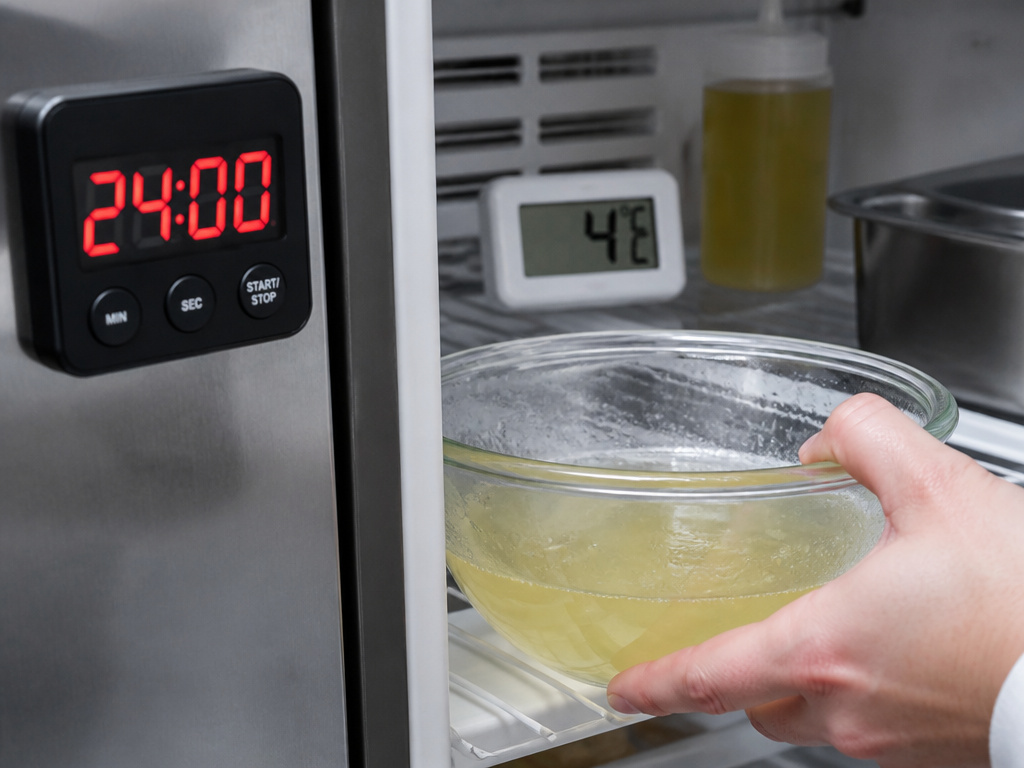
The Australian government’s National Raw Egg Guidelines are unequivocal: raw egg products in a food-service setting must be stored at or below 5°C and discarded within 24 hours. This includes pooled egg whites. The rationale is the amplified risk of Salmonella contamination when eggs are pooled, one contaminated egg taints the entire batch.
From the official guidelines: “The raw egg product should be stored at or below 5˚C for no longer than 24 hours i.e., should be discarded at the end of the day.”
This 24-hour rule is a regulatory bright line for businesses. At home, your risk is lower because you’re not pooling dozens of eggs, but the principle stands. The clock starts ticking the moment the egg is cracked.
The U.S. Code of Federal Regulations (21 CFR § 160.140) defines liquid egg whites as a food that must be “pasteurized or otherwise treated to destroy all viable Salmonella microorganisms.” This is the legal standard for commercial products. Your home-separated whites are not pasteurized. This is why temperature control is non-negotiable, you are the sole barrier against pathogen growth.
If you’re ever preserving whites for a recipe served to vulnerable individuals (the elderly, pregnant, immunocompromised), treat them like a professional kitchen would. Use them immediately or freeze them. Do not let them linger in the fridge for “a few days.”
Frequently Asked Questions
Can you refreeze thawed egg whites?
No. Do not refreeze thawed egg whites. The freeze-thaw cycle further damages the protein structure, making them useless for cooking, and the partial thawing allows bacterial growth. Portion before freezing so you only thaw what you need.
Why did my frozen egg whites turn yellow?
This is usually a sign of yolk contamination. Even a tiny amount of yolk fat will tint the whites and prevent them from whipping. It can also indicate the whites were stored in the freezer too long, over a year, where they can develop off-colors and flavors from oxidation.
How do I know if refrigerated egg whites have gone bad?
Trust your senses. Spoiled egg whites develop a cloudy appearance, a distinctly sour or sulfurous smell, and may show visible mucoid strands. When in doubt, throw it out. The risk of foodborne illness isn’t worth a few cents worth of eggs.
Can I freeze egg whites in their shells?
Absolutely not. Egg shells are porous and will crack during freezing, allowing bacteria in and making a mess. Always separate and store in a dedicated container.
Is it safe to preserve raw egg whites?
Yes, if you follow strict hygiene and temperature controls. The raw egg white itself is not inherently unsafe, but it is a potential vector for Salmonella. Proper preservation (immediate refrigeration, prompt freezing, or using dried pasteurized product) mitigates this risk effectively.
Before You Go
Preserving egg white isn’t about a single trick. It’s a chain of correct decisions: separate cleanly, choose glass, chill below 4°C, and respect the 8-day limit. For long-term storage, freeze in pre-portioned cubes. For absolute shelf stability, invest in a quality dried egg white powder.
The data from food science gives you clear edges, glass over plastic, freezing over risky refrigeration, drying over everything else. Use those edges. Now you can separate a dozen eggs for a custard and know the whites won’t go to waste. That’s the whole point.
