The Right Way to Store Sourdough Bread Once It Has Been Cut
This post contains affiliate links. As an Amazon Associate, we earn from qualifying purchases.
Store cut sourdough bread by placing it cut-side down on a clean cutting board for the first 1-2 days. This protects the moist crumb while letting the crust breathe. After day two, slice the remaining loaf, wrap portions tightly in plastic wrap and foil, and freeze them. Never refrigerate a cut sourdough loaf, cold temperatures accelerate starch retrogradation, turning it stale and tough within hours.
That cut-side-down position is the whole game for the first 48 hours. It uses the loaf’s own crust as a shield. Once you break that seal with a knife, the clock starts on moisture loss from the exposed crumb. A batard, with its higher surface area, will dry out faster than a boule. The goal isn’t to prevent staling forever, that’s impossible, but to manage the rate so you eat most of it fresh and freeze the rest before the decline hits.
What follows is the physics of why your bread goes stale, the one storage method that works for the first two days, and the only real long-term solution. We’ll also cover what to do when you get it wrong and how commercial bakeries push shelf life far beyond what your kitchen can achieve.
Key Takeaways
- Place a cut loaf cut-side down on a board for 1-2 days maximum; this lets the crust breathe while protecting the crumb.
- Never refrigerate cut sourdough. The cold accelerates starch retrogradation, making it stale and chewy in a single day.
- For storage beyond 2 days, slice and freeze immediately. Tight plastic wrap followed by foil or a freezer bag prevents freezer burn for 2-3 months.
- The loaf’s shape determines drying speed: a long batard stales faster than a round boule due to higher surface area.
- If the bread is stale but not moldy, refresh it with a 5-minute bake after a quick rinse under the tap, it won’t be like new, but it’ll be edible.
Why Cut Sourdough Goes Stale (It’s Not Just Drying Out)
Staling isn’t simply your bread drying into a rock. It’s a molecular reorganization called starch retrogradation. When bread cools, the gelatinized starch molecules in the crumb start to recrystallize. This process pushes water out from between the starch chains, making the crumb firm and gritty. Refrigeration speeds this recrystallization dramatically.
Starch retrogradation is the recrystallization of amylose and amylopectin molecules after baking, which forces moisture out of the crumb’s structure and results in a firm, dry texture. Cold temperatures between 32°F and 50°F (0°C and 10°C) maximize the rate of this reaction.
Your sourdough’s natural acidity from lactic acid bacteria does fight mold better than commercial yeast bread. But it doesn’t stop starch crystals from forming. That’s why a loaf can be perfectly safe from mold but still taste stale and tough. The battle is against physics, not just spoilage.
How Long Does Cut Sourdough Last at Room Temperature?
A cut sourdough loaf stored properly will stay at its best for about 2 days. It remains edible for up to 5 days, but the quality, crumb texture, crust crispness, declines noticeably after day 3.
The exact timeline hinges on two things: how you store it and the loaf’s shape. A round boule, with its low surface area relative to volume, holds moisture longer. A long, thin batard has more exposed crust and will dry out faster.
| Storage Method | Peak Freshness | Edible Until | Key Risk |
|---|---|---|---|
| Cut-Side Down on Board | 24-48 hours | 4-5 days | Crust softens, crumb dries from exposed cut face |
| In a Paper Bag | 2-3 days | 5-7 days | Entire loaf dries out uniformly; mold risk rises after day 5 |
| In a Plastic Bag | 3-4 days | 5-7 days | Crust turns rubbery; trapped moisture can cause spot mold by day 7 |
| In a Bread Box | 3-4 days | 5-7 days | Similar to paper bag; depends on ambient humidity |
The published University of Illinois Extension sourdough guide notes that for best quality, frozen bread should be used within two months, aligning with the rapid decline in room-temperature quality after the first few days. Once sliced, the internal clock speeds up.
The Cut-Side-Down Method (Day 1-2)
This is the professional baker’s move for the first day or two after cutting. You need a clean cutting board and a relatively stable spot on your counter, away from direct sun or heat.
- Let the loaf cool completely after baking. Slicing into a warm loaf releases steam that condenses inside any bag, creating a damp environment where mold spores thrive.
- Make your first cut. Use a sharp serrated bread knife and slice only what you’ll eat immediately.
- Place the remaining loaf cut-side down directly on the board. The crust acts as a natural plate, sealing the moist crumb from air exposure.
The method works because it balances moisture loss. The crust can still breathe and stay crisp, while the dense crumb is protected. Just don’t leave it like this for more than two days, the exposed cut face will still slowly dehydrate.
Where this goes sideways: Storing the cut side up. The crumb’s open cells lose moisture directly to the air, and the bottom crust traps condensation against the board, turning soggy. You get a dry top and a wet bottom within 24 hours.
When to Bag It (And Which Bag to Choose)
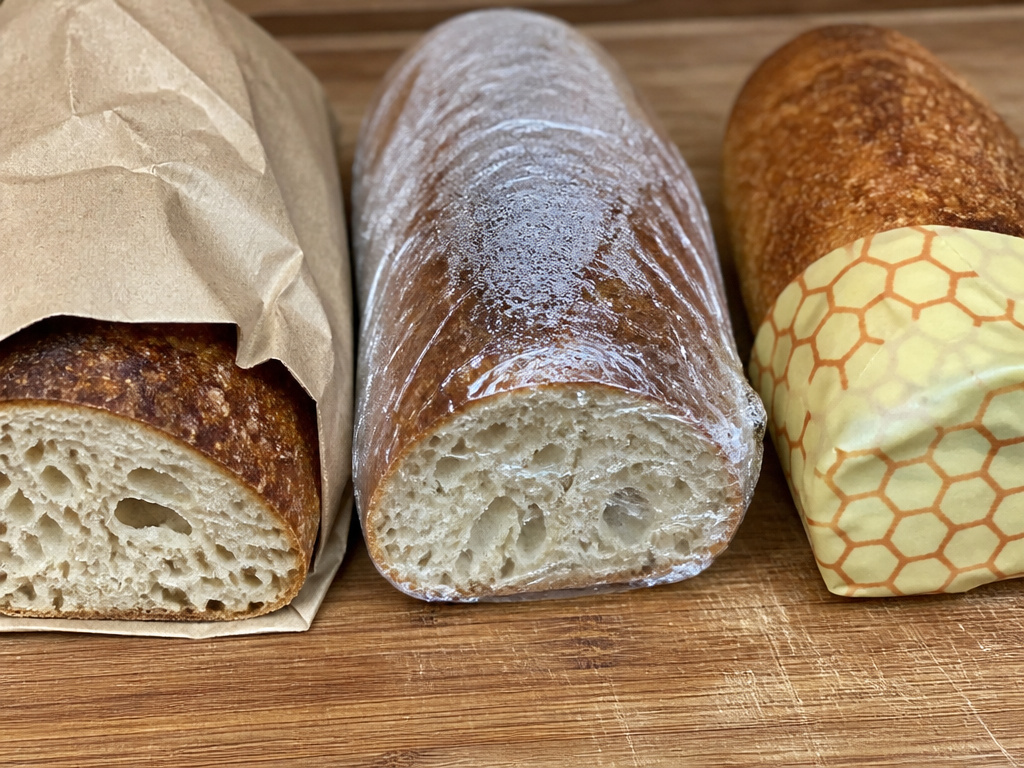
After day two, or if your kitchen is very humid or dusty, you need a barrier. Your choice of bag changes what happens to the crust and crumb.
A paper bag is breathable. It slows drying more than the open-air method but still allows some moisture exchange. The crust stays firmer longer, but the entire loaf will stale uniformly. Use this if you prefer a chewier crust and will finish the loaf within 3 days.
A plastic bag is a sealed environment. It keeps the crumb soft by trapping humidity, but that same moisture softens the crust to a rubbery texture. It also raises the risk of spot mold if any spores were on the loaf when bagged. This is a last-resort method for a day or two when you have no better option.
A reusable beeswax wrap or linen bag strikes a middle ground. These materials are slightly breathable but hold in more moisture than paper. I prefer a linen bag for a whole, uncut loaf, but for a cut one, the beeswax wrap molded over the cut face works well.
For most home bakers, the sequence is: cut-side down for two days, then slice and freeze the remainder. Bags are a temporary bridge.
Freezing: The Only Long-Term Fix
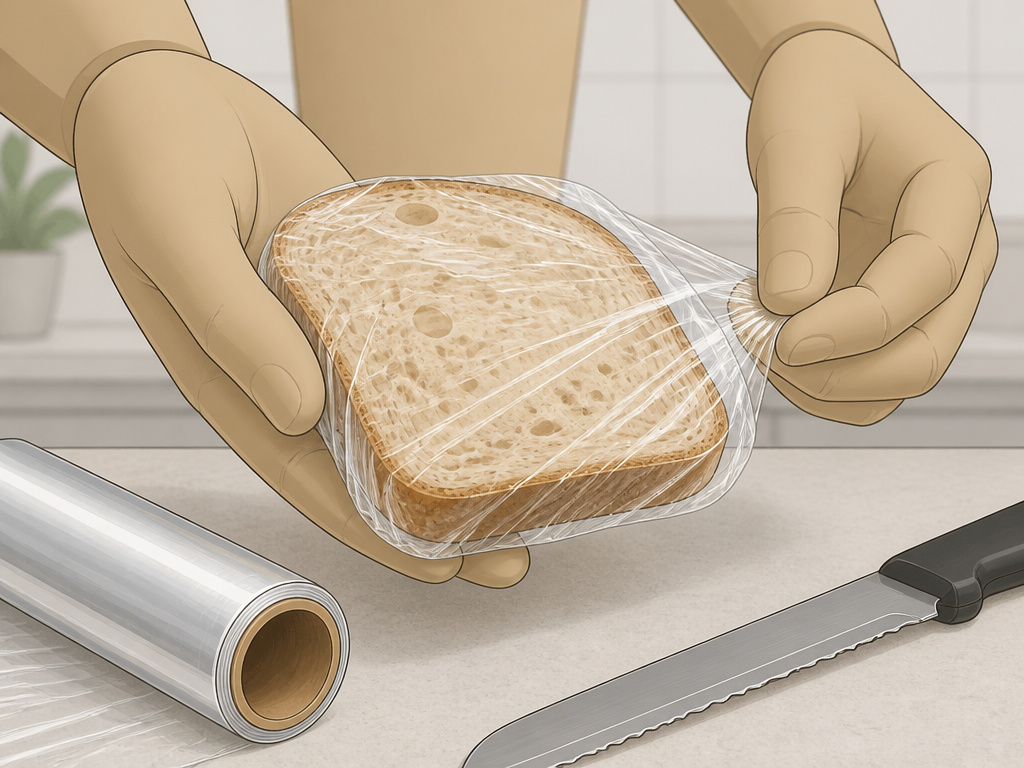
Freezing is the only reliable way to pause staling for more than a week. At 0°F (-18°C), starch retrogradation essentially stops. The goal is to get the bread frozen quickly with minimal air contact to prevent freezer burn.
You need a sharp serrated knife, plastic wrap, and aluminum foil or heavy-duty freezer bags.
- Slice the remaining loaf into portions you’d typically eat (one or two slices).
- Wrap each portion tightly in plastic wrap. Press out as much air as possible. The plastic creates a vapor barrier.
- Wrap again in aluminum foil or place the plastic-wrapped portions in a freezer bag, squeezing out excess air before sealing. The foil or bag protects against odor transfer and physical damage.
- Label with the date and place flat in the freezer.
I won’t freeze an entire half-loaf. The thermal mass is too large, it takes hours to freeze solid, during which time ice crystals grow and damage the crumb structure. Individual slices freeze solid in under an hour and can be toasted straight from frozen.
Thaw slices directly in a toaster or toaster oven. For a larger portion, let it thaw, still wrapped, on the counter for an hour, then refresh in a 300°F (150°C) oven for 5-10 minutes.
Why Your Fridge is the Worst Place for Bread
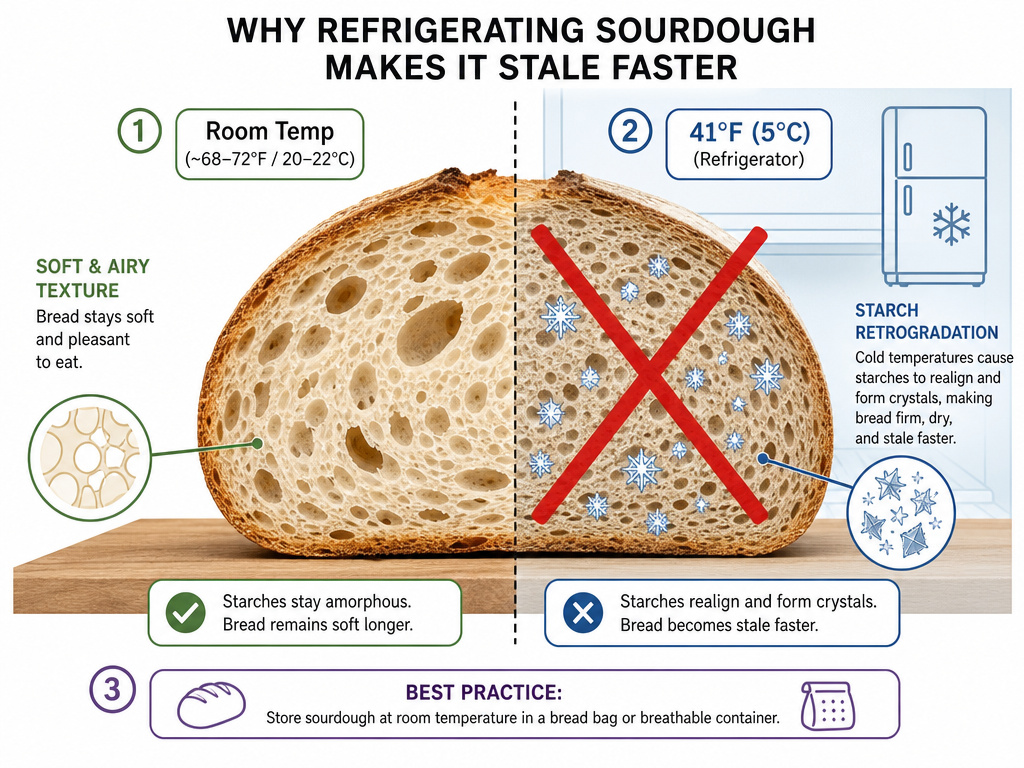
This is the one rule with no exception: do not put sourdough bread in the refrigerator. The common thought is that cold equals preservation, but for bread, it’s the opposite.
The starch recrystallization of retrogradation happens fastest at temperatures just above freezing. A study on bread staling kinetics shows the rate peaks around 41°F (5°C). Your fridge is perfectly calibrated to turn your bread stale. A loaf that would stay acceptably soft on the counter for three days will become firm and chewy in the fridge in less than one.
The only reason to refrigerate is if your bread contains perishable mix-ins like cheese or cooked meat. In that case, you’re trading accelerated staling for food safety. Accept the trade-off and plan to eat it quickly.
What If It’s Already Stale or Hard?
Stale bread is dry and firm but has no mold. It’s a texture problem, not a safety one. You can often revive it enough for toast or recipes.
The oven-refresh method: Heat your oven to 300°F (150°C). Run the stale loaf quickly under cold tap water, just enough to dampen the crust, avoid soaking the cut face. Place it directly on the oven rack for 5-15 minutes until the crust crisps and the interior softens. This works because the heat temporarily melts the starch crystals that formed during staling.
It doesn’t turn back time. The bread will be edible, often quite good, but it will re-stale as it cools. Use refreshed bread within a few hours.
For bread that’s beyond refreshing, rock-hard or showing early mold, don’t risk it. Repurpose it into breadcrumbs or croutons.
How Commercial Bakeries Do It (And Why You Can’t)
Bakeries that ship sourdough use a technique you can’t replicate at home: modified atmosphere packaging (MAP). They seal the bread in bags filled with inert gases like argon or carbon dioxide, which dramatically slow mold growth and oxidation.
A 2022 study on PDO Tuscan bread tested different gas mixtures. Slices packed in 100% argon showed the slowest quality decay. Mixtures of 70% CO2/30% N2 doubled shelf-life compared to air. The control group, bread stored in regular air, was stopped at day 8 due to mold development.
Your kitchen doesn’t have an industrial gas-packing machine. This is why a bakery loaf in a sealed bag stays soft for a week, while your homemade version in the same bag might get spotty. They’re not using magic; they’re replacing the air.
Frequently Asked Questions
Can I store sourdough in a Dutch oven?
Yes, a completely cool, empty Dutch oven with the lid on is an excellent, breathable container for a whole, uncut loaf. It protects the crust from getting knocked and maintains a stable microclimate. For a cut loaf, the cut-side-down method is better, as the Dutch oven’s enclosed space can trap too much moisture from the exposed crumb.
Does sourdough bread last longer than regular bread?
Yes, typically by 1-2 days. The natural acidity produced by the lactic acid bacteria during fermentation creates a less hospitable environment for mold compared to breads made with commercial yeast alone. However, the staling process (starch retrogradation) happens at the same rate, so it will still become dry and firm on a similar timeline.
How can I tell if sourdough bread has gone bad?
Look for visible mold, which can be blue, green, white, or black fuzzy spots. Smell it, off odors like strong ammonia, sour milk, or anything distinctly unpleasant are bad signs. If it’s just very hard and dry but smells like bread, it’s stale, not spoiled, and can often be revived or used in cooking.
Is it better to store sourdough whole or sliced?
Store it whole for as long as possible. Every cut exposes more surface area to air, accelerating moisture loss. Pre-slicing is only advisable if you are immediately freezing the slices, as it allows you to take out only what you need without thawing the entire loaf.
What’s the best way to store half a sourdough loaf?
Use the cut-side-down method on a board for the first day. If you won’t finish it the next day, slice the remaining half, wrap the slices for the freezer as described above, and freeze them. Do not leave a half-loaf wrapped at room temperature for more than three days; the large exposed surface almost guarantees rapid staling.
The Bottom Line
Forget the bread box for a cut loaf. The sequence is simple: cut-side down for two days, then slice and freeze. The freezer is your friend, the fridge is your enemy, and any bag is a short-term compromise. Your goal is to eat most of the loaf in the first 48 hours when it’s best, and have a plan for the rest that doesn’t involve the cold middle shelf of your refrigerator.
