
Are Thermos Dishwasher Safe | The Lid Gasket That Melts
This post contains affiliate links. As an Amazon Associate, we earn from qualifying purchases.
Most Thermos brand bottles and mugs are not fully dishwasher safe. The stainless steel body can survive the lower rack, but the plastic or silicone lid components, especially the sealing gasket, will warp, crack, or lose their seal after repeated cycles. The high heat and harsh detergents degrade these parts faster than hand-washing.
That’s the short, direct answer. It’s not about the steel; it’s about everything attached to it.
The confusion comes from the word “dishwasher safe” meaning different things to different people. For a steel bottle, it means the exterior won’t rust. For the company, it means the entire product, lid, gasket, valve, will function normally after a cycle. Those two definitions rarely meet. The manuals are clear, but we skip reading them. The result is a lid that no longer clicks shut or a gasket that lets your coffee go cold in twenty minutes.
What follows is the breakdown: which parts of a Thermos actually tolerate the dishwasher, the exact temperature that warps a silicone seal, and the one cleaning method that preserves a bottle for a decade instead of a year.
Key Takeaways
- The stainless steel body of a Thermos can go on the dishwasher’s lower rack, but the intense heat and detergent spray can dull its finish over time.
- Plastic lids and silicone sealing gaskets are the weak points. Dishwasher heat softens silicone, causing it to deform and lose its airtight seal, often permanently after just one cycle.
- Dishwasher detergent enzymes are formulated for baked-on food, not for the oils in coffee or tea. They can leave a chemical residue inside the bottle that affects taste.
- Manufacturer warranties for appliances like dishwashers often void coverage if damage occurs from cleaning items not rated for dishwasher use, creating a potential double loss.
- For longevity, hand-wash the lid and gasket with warm, soapy water and use a bottle brush for the interior. It takes three minutes and avoids all the failure modes.
The “Dishwasher Safe” Label Is a Trap
You see the words on a product page or a store tag and assume it’s a green light. For a Thermos, that assumption costs you the lid.
The problem isn’t dishonesty. It’s ambiguity. When Thermos says a product is “top-rack dishwasher safe,” they are telling you the materials can withstand the cycle without melting. They are not promising the intricate mechanics of a push-button lid or the precise compression of a silicone gasket will survive unchanged. The heat threshold for safety is different from the heat threshold for functional integrity.
Where this goes sideways: Assuming “dishwasher safe” means “completely maintenance-free.” The gasket softens at the dishwasher’s sanitize cycle temperature (usually around 155°F/68°C), deforms under the pressure of other items, and cools into a new, imperfect shape. Your thermos might not leak immediately, but it will lose its 12-hour temperature retention guarantee.
The real standard at play is the dishwasher’s own certification. NSF/ANSI 184 certifies residential dishwashers to sanitize dishes. That certification assumes you are washing plates and cups, not complex sealed containers with internal gaskets. The machine is doing its job, but its job isn’t designed for your thermos lid.
What Happens to a Thermos in the Dishwasher?
Let’s track the journey of a typical stainless steel Thermos with a push-button lid through a standard cycle.
| Component | Dishwasher Effect | Timeline to Failure |
|---|---|---|
| Stainless Steel Body | Heat and alkaline detergents can cause clouding or slight discoloration; physical impact from racks may cause dents. | Gradual; aesthetic damage appears over 20-50 cycles. |
| Plastic Lid (BPA-Free Tritan, etc.) | High heat can cause stress, making plastic brittle over time; hinge mechanisms for flip lids can warp. | 5-15 cycles before lid doesn’t seat correctly or feels loose. |
| Silicone Sealing Gasket | Heat softens silicone beyond its glass transition temperature; it deforms under its own weight or pressure from other items. | Often one cycle is enough to compromise the seal; failure is immediate and permanent. |
| Stainless Steel Interior | Detergent residues can bind to the surface, creating a film that holds flavors; jet spray is ineffective at scridding corners. | Taste transfer issues can arise after 2-3 cycles without thorough rinsing. |
The silicone gasket is the critical failure. Silicone’s sealing ability depends on its exact molded shape pressing evenly against the bottle’s rim. When it softens in the heat, it relaxes. It might develop a flat spot or a slight bulge. Once it cools in that new shape, it will never seal as well again. You’ll notice your drinks don’t stay hot as long, or condensation forms on the outside, a sure sign the vacuum insulation’s effectiveness is compromised because moist air is getting in.
I won’t put any sealed-container lid in the dishwasher anymore. I learned with a coffee travel mug that had a similar silicone ring. After one cycle, the lid never quite locked down with that satisfying click. A week later, my coffee was lukewarm by 10 a.m. The ring looked fine, but it had flattened just enough.
Hand-Washing vs. Dishwasher: The Performance Trade-Off
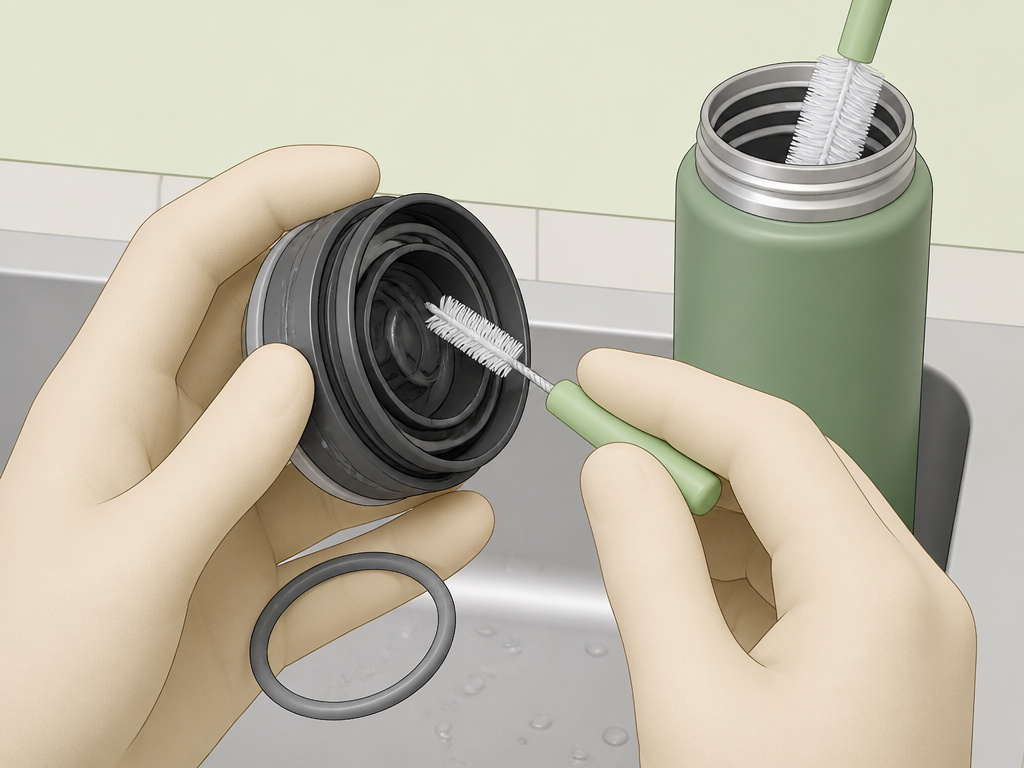 You can dishwasher the bottle. You should hand-wash the lid. The difference isn’t just about avoiding damage; it’s about preserving the thing you bought the Thermos for in the first place: temperature retention.
Hand-washing with a mild dish soap and warm water accomplishes the goal, removing oils and residues, without the collateral damage. The process is simple, but skipping steps leads to smells.
The 4‑Step Hand-Wash Method That Actually Works:
- Disassemble completely. Unscrew the lid, remove the silicone gasket, and take out any interior stoppers or drinking spouts. Every part that touches liquid needs air circulation to dry.
- Wash the bottle with a dedicated brush. Use a long-handled bottle brush with soft bristles. Pour in a drop of dish soap, add warm water, and scrub the interior, focusing on the bottom where sediment pools. Rinse until the water runs clear with no soapy film.
- Wash lid components separately. Use a small brush or your fingers to clean the gasket and the grooves in the lid where it sits. This is where old coffee oils hide and create stale smells.
- Air-dry upside down. Place all parts on a clean dish towel or a drying rack, ensuring the bottle is inverted so internal water droplets can drain. Do not reassemble until every piece is bone-dry.
Common mistake: Reassembling the thermos while the gasket or lid threads are still damp. Trapped moisture between the silicone and plastic becomes a mildew incubator. That’s the source of the “funky” smell people try to fix with vinegar soaks later.
The dishwasher, by contrast, is a blunt instrument. Its 30-minute heated dry cycle does ensure parts are dry, but the trade-off is the thermal stress on plastics and the abrasive spray on the bottle’s exterior. For a product built around a vacuum-insulated double wall, introducing repeated extreme thermal cycling around that seal is asking for trouble.
When the Dishwasher Manual Says “No” (And Why It Matters)
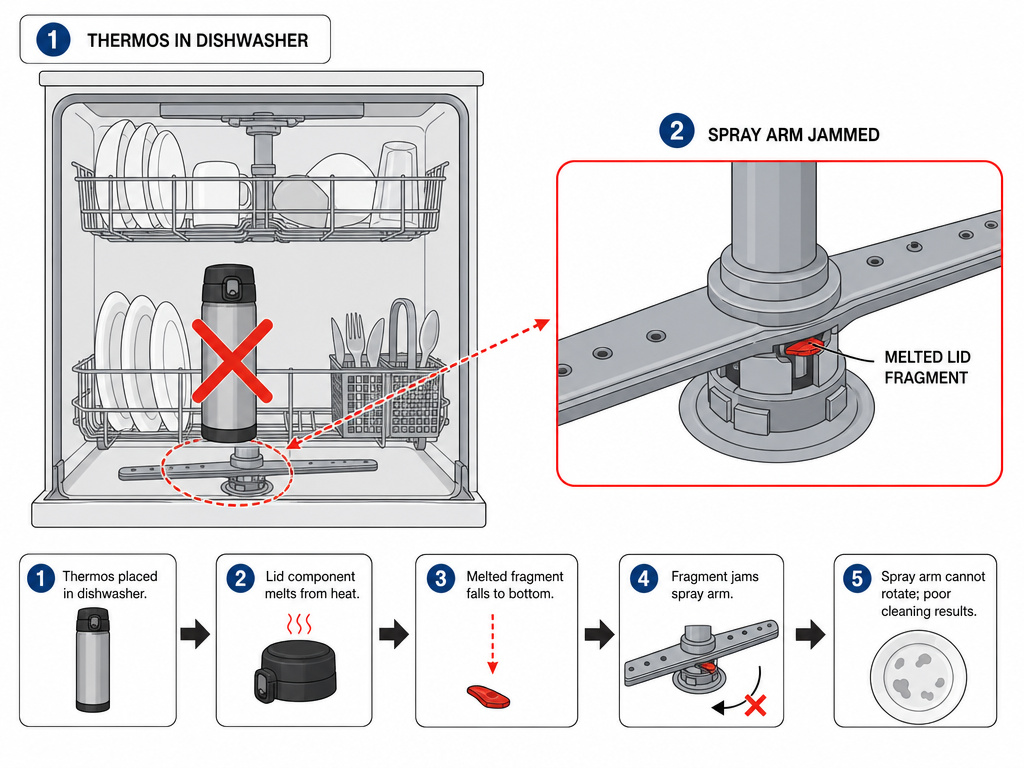 This is where the issue expands beyond your Thermos to your appliance. Dishwasher manufacturers explicitly warn against what they call “improper use.”
The Bosch Dishwasher Use and Care Manual for model SHX4AEF5N states not to use “steam cleaners or high-pressure cleaners” on the appliance and specifies it is only for use “in enclosed residential spaces.” While not directly about loading a thermos, this establishes a principle: the machine is designed for a specific set of items under specific conditions.
More critically, the warranty terms for brands like Bosch and Thermador list exclusions. The Bosch Statement of Limited Product Warranty (source 3) excludes damage from “use of the product in anything other than its normal, customary and intended manner.” If a melted plastic lid component jams a spray arm or disrupts the filter, causing a leak or motor failure, that repair might not be covered.
Think of it as a chain of liability: 1. You put a non-dishwasher-safe item (by functional standards) in the machine. 2. That item fails and causes a secondary failure in the dishwasher. 3. The technician finds the foreign object and cites the “improper use” clause. 4. You now have a broken thermos and a dishwasher repair bill.
It’s a low-probability, high-consequence event. But it’s the reason the manuals are written with such broad, protective language.
The Right Tools for Cleaning a Thermos
If you’re committing to hand-washing, a few specific tools turn a chore into a quick routine. These are the items that target the problem areas without guesswork.
- Long-Handled Bottle Brush: The OXO Good Grips Bottle Brush is the standard for a reason. Its silicone bristles reach the bottom curve of a tall bottle and won’t scratch stainless steel.
- Small Nylon Detail Brush: For scrubbing the tight grooves in a threaded lid or around a flip-top hinge. Any cheap set from a kitchen store works.
- Mild Dish Soap: Avoid heavy degreasers or soaps with lotions. Dawn Platinum or Seventh Generation Free & Clear are effective without leaving a perfumed residue.
- Drying Rack with Pegs: Something like the SimpleHouseware Over-the-Sink rack lets you invert bottles and separate all small parts for full air circulation.
You don’t need special tablets or powders marketed for water bottles. Baking soda pastes can be abrasive. White vinegar soaks work for mineral deposits from hard water, but for daily food oils, soap, water, and mechanical scrubbing is the complete solution.
Frequently Asked Questions
Can I put the stainless steel part of my Thermos in the dishwasher?
Yes, the stainless steel body can generally be placed on the lower rack of a dishwasher. However, the high heat and harsh detergents may eventually dull the exterior finish. For longevity and to prevent dents from rack impacts, hand-washing is still recommended.
Why did my Thermos lid crack after going in the dishwasher?
The plastic used in lids, even BPA-free varieties like Tritan, is subject to thermal stress. Repeated exposure to the dishwasher’s high-temperature wash and dry cycles can make the plastic brittle. Sudden temperature changes (from a hot wash to a cool room) can cause micro-fractures that turn into visible cracks, especially around thin or stressed areas like hinge points.
Is the smell from my Thermos after dishwashing safe?
The smell is likely a combination of two things: chemical residue from dishwasher detergent clinging to the stainless steel interior, and trapped moisture in lid components that didn’t fully dry. While not necessarily “unsafe,” it will affect taste. To remove it, hand-wash thoroughly with baking soda or a diluted vinegar solution, then ensure all parts are completely dry before storage.
How do I clean a Thermos that smells like old coffee?
Fill the bottle with hot water and a tablespoon of baking soda. Let it sit overnight. In the morning, use a bottle brush to scrub, then rinse thoroughly. For the lid and gasket, soak them in a mixture of equal parts white vinegar and warm water for 30 minutes, then scrub with a small brush. Always air-dry completely.
Are all insulated bottles unsafe for the dishwasher?
Most share the same vulnerability: the seal. Any bottle claiming vacuum insulation or temperature retention relies on a perfect seal, usually achieved with a silicone gasket. Dishwasher heat compromises that seal. While some brands design lids with more heat-resistant materials, the rule of thumb holds: if keeping things hot or cold is the main feature, hand-wash the lid.
Before You Go
The question isn’t really “can it survive?” It’s “for how long, and at what cost to the thing it’s supposed to do?” A Thermos is an engineered system, stainless steel walls, a vacuum between them, and a seal that locks it all in. The dishwasher attacks the weakest link in that system, which is always the soft, pliable part that makes the seal work.
Hand-washing is a minor habit change. It takes the three minutes you’d spend loading and unloading the dishwasher anyway and applies it directly to the object. You keep the gasket pliable, the lid clicking shut, and the interior tasting clean. You also avoid a vague but real warranty risk to an appliance that costs twenty times what the bottle does.
So wash the steel bottle in the dishwasher if you must. But take the lid apart and wash it by hand. Your coffee will stay hot, your ice will stay solid, and the bottle will work the same way in five years as it did on day one. That’s the whole point.
