
Can You Keep Dry Ice in the Freezer? Safety Risks & Rules
This post contains affiliate links. As an Amazon Associate, we earn from qualifying purchases.
You cannot keep dry ice in a standard home freezer. It will sublimate far too quickly, and the massive volume of carbon dioxide gas it releases can build up to dangerous levels, creating a suffocation hazard or even causing an airtight container to rupture. The only safe storage method is in an insulated, vented container like a cooler, placed in a well-ventilated area.
That answer hinges on a physical fact: dry ice is solid carbon dioxide at -78.5°C (-109.3°F), which is extremely cold and constantly turns directly into gas.This process, called sublimation, expands the solid’s volume by 600 to 800 times. A standard freezer is designed to contain cold air, not to safely vent a continuous, heavy gas that displaces oxygen.
What follows is a breakdown of the three hazards you’re actually managing, the one exception for specialized equipment, and the exact quantities to use if your freezer loses power. By the end, you’ll know how to handle dry ice not as a curiosity, but as the regulated cryogenic material it is.
Key Takeaways
- A standard kitchen freezer is a hard “no” for storage. Its operating fan accelerates sublimation, and the sealed space traps CO2 gas, creating a serious asphyxiation risk.
- Dry ice expands 600-800 times in volume as it turns to gas. This is why airtight containers, including unvented freezers, can explode.
- Safe storage requires an insulated, vented container in a ventilated room. A Styrofoam cooler with a loose lid or drilled holes in a plastic cooler works.
- During a power outage, dry ice is a temporary rescue tool, not a storage method. Use it only with the freezer unplugged and the door kept closed, following weight guidelines by freezer type.
- The only “freezer” that can store dry ice is an ultra-low temperature unit rated below -80°C. These are laboratory or biomedical-grade appliances, not kitchen equipment.
The Short, Simple Answer: A Standard Freezer is a “No”
The guidance from university environmental health and safety departments is unanimous. The Florida International University safety document states directly: “Do not store dry ice in a standard refrigerator, cooler, or freezer designed for food storage.This is a rule built around two failure modes that happen on predictable timelines.
First, the freezer’s own mechanics work against you. If the appliance has power, its internal fan runs to circulate air. That constant airflow dramatically accelerates the sublimation rate, turning your expensive dry ice into gas in hours instead of days. You’re paying for a fan to destroy your coolant. Second, and more critically, a standard freezer is a relatively sealed environment. As the dry ice sublimates, the CO2 gas has nowhere to go. It builds up, displacing the breathable air.
Where this goes sideways: Storing a 5-pound block of dry ice in a sealed, powered-on freezer. The CO2 concentration can reach the dangerous threshold of 0.5% (5,000 ppm) within an hour in a small space, leading to headache, dizziness, and suffocation if the door is opened without ventilation.
The correct vessel is an insulated container that allows gas to escape. A Styrofoam cooler is the default because its insulation slows sublimation and its lid doesn’t seal airtight. For a plastic cooler, you must drill a few small holes (¼ inch) in the lid or body to act as vents. This setup, placed in a garage, shed, or well-ventilated basement, is the standard for a reason. It manages the gas.
Why the Rules Are So Absolute: The Physics of CO2 Expansion
Dry ice isn’t like water ice. You can’t just swap them. The sublimation process—skipping the liquid phase entirely—releases a volume of gas that is almost incomprehensible in a confined space. That 600 to 800 times expansion figure is the calculated conversion from solid to gas at room temperature and pressure.
Think of a one-liter soda bottle full of solid dry ice. If you sealed the cap, the gas produced would need 600 to 800 liters of space. The bottle fails instantly. This is the same principle that makes a standard freezer a risk. While not as perfectly sealed as a soda bottle, it is still designed to contain its environment. The pressure from the expanding CO2 has to go somewhere, which can stress door seals, pop hinges, or in a truly airtight scenario, rupture the liner.
The gas itself is heavier than air. It doesn’t just mix and drift away. It sinks and pools in low areas. This is why storage advice always specifies a “well-ventilated area.” A closed closet or a small, sealed room is a confinement hazard. The University of Rochester dry ice safety guide emphasises this, noting that CO2 can accumulate in walk-in coolers or basements, creating an oxygen-deficient atmosphere that is dangerous to enter without checking first.
The One Real Exception: Ultra-Low Temperature Freezers
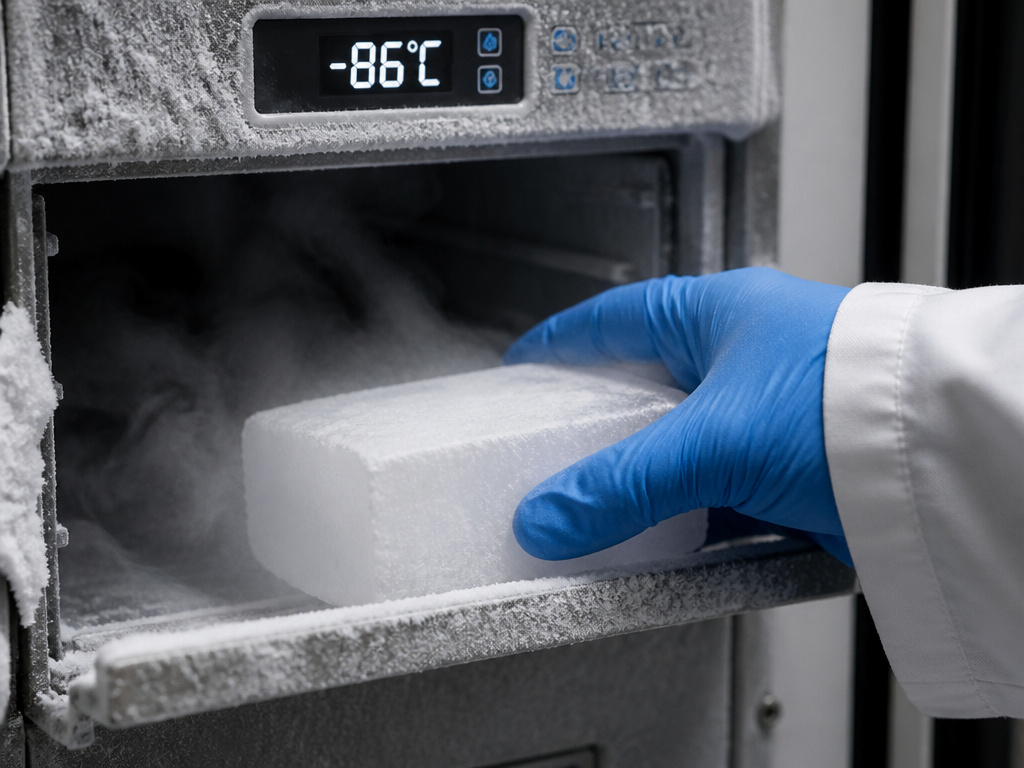
The blanket statement “never put dry ice in a freezer” has a legitimate, scientific exception. It just doesn’t apply to your kitchen. Specialized ultra-low temperature (ULT) freezers, used in laboratories, hospitals, and biomedical storage, operate at -80°C or lower.
At those temperatures, the thermal drive for sublimation is nearly eliminated. The dry ice stays closer to its own -78.5°C state, so it sublimates extremely slowly. A manufacturer like Meling Biomedical specifies that their -86°C units are suitable for long-term dry ice storage, precisely because the freezer is colder than the dry ice itself. Units that operate between -60°C and -40°C can only be used for short-term storage of 5-10 days, and even then with some loss.
| Freezer Type | Typical Temperature Range | Suitable for Dry Ice Storage? | Reason |
|---|---|---|---|
| Standard Kitchen Freezer | -18°C to -23°C (0°F to -10°F) | No | Much warmer than dry ice; fan accelerates sublimation; sealed space traps CO2. |
| Ultra-Low Temp (ULT) Freezer | -60°C to -40°C (-76°F to -40°F) | Short-term only (5-10 days) | Temperature is closer to dry ice’s point, slowing sublimation, but volatilization still occurs. |
| Ultra-Low Temp (ULT) Freezer | -80°C to -86°C (-112°F to -123°F) | Yes, for long-term storage | Freezer is colder than dry ice, dramatically reducing the sublimation rate. |
This exception proves the rule. Your home freezer isn’t just different in degree; it’s different in kind. Treating them the same is how accidents happen.
Safe Handling and Storage: The Non-Negotiables
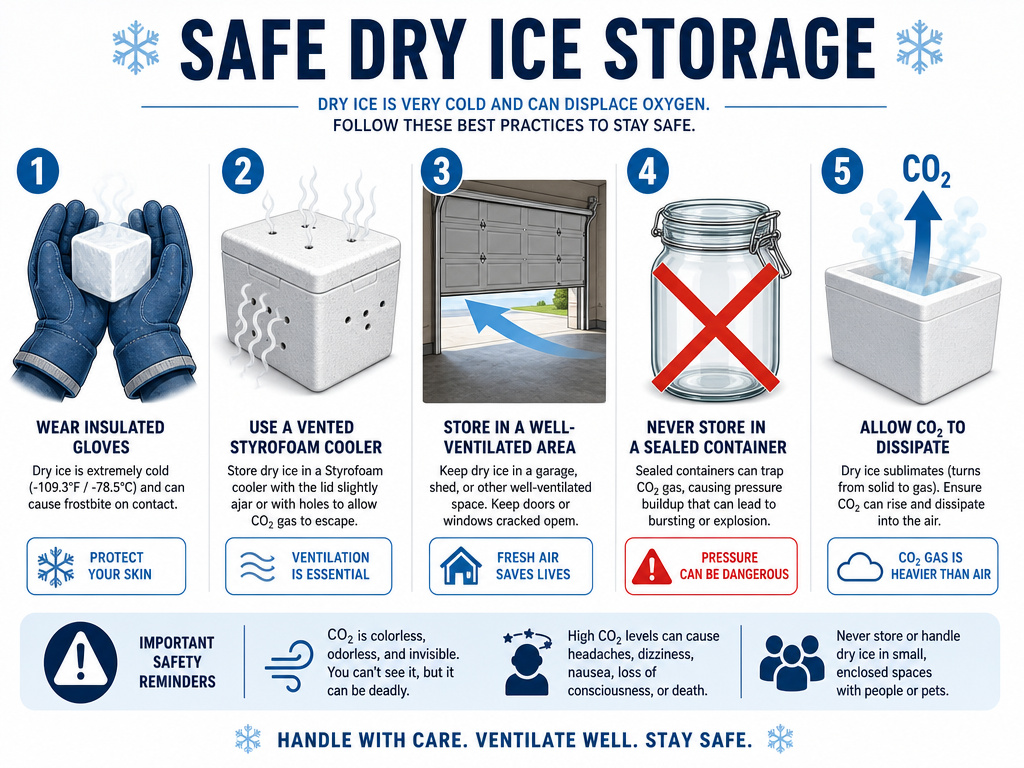
If you can’t use a freezer, what does correct handling look like? It’s a short list of non-negotiable rules, each with a concrete “why” behind it. Ignoring any one of them shifts the risk from manageable to serious.
1. Use Proper Protection. Always.
Dry ice causes frostbite on contact within seconds. You need insulated cryogenic gloves or dry ice tongs. A kitchen towel or oven mitt is a bare minimum, but they aren’t designed for -78.5°C and can become saturated with cold, transferring it to your skin. Never handle it with bare hands.
2. Store in a Vented, Insulated Container.
The container’s job is twofold: slow sublimation (insulation) and vent gas (venting). A Styrofoam cooler with a loosely placed lid is the classic solution. For a hard-sided plastic cooler, you must create vents. Drill two or three ¼-inch holes in the lid. This prevents pressure buildup and allows the heavier-than-air CO2 to flow out and dissipate.
3. Choose a Well-Ventilated Storage Location.
Place your cooler in a room with air movement—a garage with the door cracked, a shed, a ventilated basement. Never in a closed closet, car, or small bathroom. The FIU laboratory safety guidelines PDF explicitly warns against confined spaces due to the rapid CO2 buildup that can lead to suffocation.
4. Never Store in an Airtight Container.
This includes sealed plastic bins, glass jars, or metal tins. The 600-800x expansion rule makes this an explosion hazard. The gas must have a permanent escape route.
5. Understand Disposal.
Don’t throw it in the trash or sink. Leave unused dry ice in its vented cooler at room temperature in a ventilated area and let it sublimate away. It will leave no residue.
The part nobody mentions: Dry ice will “carbonate” anything nearby. If you’re storing it in a cooler to keep food cold (not frozen), wrap open beverage containers or moist food. Otherwise, you’ll get fizzy milk and soda-flavored chicken.
The Emergency Scenario: Using Dry Ice When the Freezer Fails
This is the only time dry ice should ever go into a food freezer, and the rules change completely. During a power outage, your freezer becomes a insulated box. The goal is to keep food frozen for 24-48 hours until power returns. You are using the dry ice inside the freezer, not storing the dry ice in the freezer as an appliance.
First, unplug the freezer. This stops the fan that would waste the dry ice. Keep the door closed as much as possible. The dry ice goes on top of the frozen food. Cold air sinks, so placing it above creates a blanket of cold CO2 that falls through the contents. Wear gloves, place cardboard or a towel on top of the food, and set the dry ice block on it to prevent direct contact that could freeze-burn food packages.
The amount you need isn’t a guess. The dry ice usage and storage procedures from FIU provide specific weight guidelines for a 24-hour period, based on freezer design and insulation.
| Freezer Type | Dry Ice Needed per 24 Hours | Placement Instructions |
|---|---|---|
| Freezer-on-Bottom (Refrigerator) | 15 to 25 pounds | Place slab on top shelf of freezer compartment. |
| Freezer-on-Top (Refrigerator) | 20 to 30 pounds | Place slab directly on top of frozen food. |
| Side-by-Side Freezer | 30 to 40 pounds | Place slabs starting on the top shelf. |
| Chest Freezer | 40 to 50 pounds | Place slab on top of food. Lift carefully with gloves to access items below. |
These quantities assume a reasonably full freezer. A half-full freezer has more air space to cool and will consume dry ice faster. This is a stopgap. It turns a potential 1-day food loss into a 2-day window. It is not a long-term storage solution.
Frequently Asked Questions
Can dry ice save my food if the power is out for a week?
No. Dry ice sublimates at about 5-10 pounds per 24 hours, even in an unplugged freezer. The quantities needed for a week in a standard chest freezer (280-350 lbs) are impractical, expensive, and hazardous to manage. It’s an emergency bridge for 1-2 days, not a week-long solution.
Is it safe to put dry ice in a cooler to keep food cold on a trip?
Yes, this is a common and correct use. The key is ventilation. Never lock a cooler full of dry ice in a car’s airtight trunk or passenger cabin. Crack a window and keep the cooler in the main cabin. Remember, dry ice goes at the bottom of the cooler for cooling (with a cardboard layer above it), but on top of the food if you need to keep items frozen.
What’s the difference between dry ice and regular ice in a freezer?
Regular ice melts into water, which stays inside the freezer (until it overflows). Dry ice turns into an odorless, colorless gas that expands to fill the space. Water is a containment problem. CO2 gas is an inhalation hazard. Your freezer is designed to handle the first, not the second.
Are there any containers I can use besides a cooler?
Specialized dry ice shipping containers exist, but for home use, a cooler is the standard. The industrial gas association safety guidelines (like the AIGA 103_19 dry ice standard) mandate containers that are insulated, robust, and vented for commercial transport. A cooler is the consumer-grade equivalent.
I touched dry ice for a second. What should I do?
Treat it like a frostbite or burn. Run the affected skin under lukewarm (not hot) water. Do not rub it. If the skin blisters, turns white or waxy, or feels numb, seek medical attention. A brief touch might only cause redness, which will heal.
Before You Go
Store dry ice in a vented cooler, never in a sealed freezer. That’s the rule that prevents the two real dangers: explosive pressure from gas expansion and suffocation from CO2 buildup. The physics are non-negotiable—600 times volume expansion and a gas heavier than air.
For a power outage, it’s a rescue tool, not a storage method. Unplug the appliance, follow the weight chart for your freezer type, and place the block on top. That buys you a critical day or two.
The entire framework is built on managing a phase-change material that doesn’t behave like anything else in your kitchen. Handle it with gloves, respect its ventilation needs, and you can use its incredible cooling power safely. Forget those needs, and the risks are physical, immediate, and well-documented in every safety manual on the subject.
