What Is a Freezer | The 0°F Standard and How It Works
This post contains affiliate links. As an Amazon Associate, we earn from qualifying purchases.
A freezer is a refrigerated cabinet designed to freeze and store food at 0°F (-17.8°C) or below, using a sealed system of refrigerant, a compressor, and an evaporator to remove heat. This temperature halts bacterial growth and enzymatic activity, preserving food for months. The core freezer mechanics rely on phase-change cooling, where a liquid refrigerant absorbs heat as it evaporates inside the cabinet.
That 0°F target isn’t arbitrary. It’s the line where water in food cells turns completely to ice, dramatically slowing down the chemical reactions that cause spoilage. Go warmer, and those processes inch forward. Your ice cream gets icy, your vegetables lose texture, and your meat’s shelf life shrinks.
What follows: the exact science behind that cold, the difference between your kitchen freezer and a commercial unit, the three main types you can buy, and the handful of specs that actually matter for your groceries.
Key Takeaways
- The official 0°F (-17.8°C) standard for residential freezers is defined by ENERGY STAR and is critical for long-term food safety.
- Commercial freezers for ice cream operate at a much colder -15°F, as defined by the AHRI 1200-2023 industry standard.
- A freezer’s performance is heavily influenced by its climate class (SN, N, ST, T), which specifies the ambient temperature range it’s designed for.
- The EN 62552 standard requires a freezer to freeze at least 4.5 kg of food per 100 liters of volume in 24 hours at 77°F (25°C) room temperature.
- Frequent door opening or high humidity can cause rapid frost buildup, forcing even a frost-free system into a manual defrost cycle.
The Core Definition: Temperature and Function
According to the ENERGY STAR Version 5.0 requirements, a residential freezer is “a cabinet designed as a unit for the freezing and storage of food at temperatures of 0 °F (-17.8 °C) or below.”
That’s the legal, technical definition. Every modern home freezer is engineered to hit and hold that mark. The ideal freezer temperature isn’t a suggestion; it’s the threshold for safe, long-term storage. At 0°F, microbial activity is effectively paused. Enzymes that break down food are immobilized. It’s a state of suspended animation.
But not all freezers are created for the same job. Your kitchen unit and the one at the ice cream shop live in different worlds.
| Freezer Type | Target Temperature | Governed By | Primary Use Case |
|---|---|---|---|
| Residential Freezer | 0°F (-17.8°C) or below | ENERGY STAR Specification | Long-term home food storage |
| Commercial Freezer (Low-Temp) | 0°F ± 2°F | AHRI 1200-2023 Standard | Storing frozen goods, meat, vegetables |
| Commercial Freezer (Ice Cream) | -15°F ± 2°F | AHRI 1200-2023 Standard | Storing ice cream and frozen desserts |
The commercial standard exists because ice cream is a fussy product. Its fat and sugar content requires a colder temperature to maintain a solid, scoopable state. A home freezer set to 0°F will eventually cause ice cream to become unpleasantly hard and develop large ice crystals. That -15°F target is a professional-grade requirement.
Your freezer’s ability to maintain its temperature depends on its “climate class.” This is a spec buried in the manual that most people never see, but it dictates where the appliance will work reliably.
- SN (Sub-Normal): 50°F to 90°F (10°C to 32°C)
- N (Normal): 61°F to 90°F (16°C to 32°C)
- ST (Sub-Tropical): 61°F to 100°F (16°C to 38°C)
- T (Tropical): 61°F to 109°F (16°C to 43°C)
Install a Class N freezer in an uninsulated garage in Arizona summer (Class T territory), and it will struggle. The compressor will run constantly, frost will build rapidly, and it may fail to reach 0°F on the hottest days. That’s not a defect. It’s being used outside its designed environment.
How a Freezer Actually Works
The magic isn’t in making cold. It’s in moving heat. A freezer is a heat-pump system that grabs warmth from inside the cabinet and dumps it into your kitchen.
The process runs on a closed loop of refrigerant. Here’s the cycle:
- Compression: A motor-driven compressor squeezes the cool, low-pressure refrigerant gas into a hot, high-pressure gas.
- Condensation: This hot gas travels through condenser coils (usually on the back or bottom of the unit), where it releases its heat to the surrounding air and condenses into a high-pressure liquid.
- Expansion: The liquid refrigerant passes through an expansion valve, which rapidly drops its pressure. This causes it to cool drastically.
- Evaporation: The cold, low-pressure liquid now flows through the evaporator coils inside the freezer cabinet. As it absorbs heat from the air and your food, it evaporates back into a gas.
- Return: The cool gas returns to the compressor to start the cycle again.
A thermistor (a temperature-sensitive resistor) monitors the air inside the cabinet. When it senses the temperature rising above the set point, it signals the compressor to kick on and restart the heat-removal cycle.
Where this goes sideways: If you unplug the freezer and plug it back in immediately after a move, the system’s gas pressure isn’t balanced. A built-in thermic safeguard will trip, and the compressor won’t start for about six minutes. That’s normal. Wait it out.
This system works tirelessly, but it’s not impervious. The evaporator coils are where the cold happens, and where moisture in the air freezes into frost. In a manual defrost freezer, this frost builds up over weeks until it acts as an insulator, forcing the compressor to work harder. You have to unplug it and melt the ice.
Modern frost-free or NoFrost models add a heater and a fan to this equation. Periodically, the heater turns on to melt frost off the evaporator coils. The water drains into a pan, and the fan evaporates it. If you leave the door open too long in a humid room, however, the system can’t keep up. The evaporator ices over completely, and you’re back to a manual defrost.
Types of Freezers: More Than Just a Cold Box
You have three fundamental choices, each with trade-offs. The right one depends on your space, your budget, and what you’re storing.
Upright Freezers
These look like a refrigerator, with front-opening doors and shelves or baskets inside. They’re the default for most kitchens, especially as part of a fridge-freezer combo.
- Pros: Space-efficient footprint, easy organization, often frost-free, easier to find specific items.
- Cons: More expensive per cubic foot of storage, less energy-efficient (cold air spills out every time you open the door), can’t store unusually large items.
Common mistake: Packing an upright freezer too tightly. You need air circulation around the evaporator coils, usually at the back. Blocking it with food causes temperature swings and frost buildup.
Chest Freezers
These are horizontal units with a top-opening lid. They are the workhorses of bulk storage.
- Pros: Most energy-efficient design (cold air, being heavier, stays inside when you open it), lowest cost per cubic foot, can store very large items like a side of beef or a whole turkey.
- Cons: Requires floor space, organization is challenging (items get buried), almost always manual defrost, bending over to dig for food.
For dedicated, high-volume freezing—whether for a large family, a hunter, or a gardener—a deep freezer is almost always a chest model. Its simplicity and efficiency are unmatched for long-term holds.
Refrigerator-Freezer Combos
This is the most common appliance in homes. It’s a single unit with separate, insulated compartments for fresh and frozen food.
- Pros: Convenient, single appliance, often includes advanced features like water/ice dispensers.
- The catch: The freezer compartment is smaller and shares a single compressor with the fridge. If the fridge door is opened frequently, it can slightly warm the freezer side. These units are also subject to a specific government freezer energy criteria that rates their efficiency as a whole.
There are also niche types, like a convertible freezer that can switch between fridge and freezer modes, useful for fluctuating needs. And don’t forget the classic standalone freezer—a single-purpose unit that does one job very well.
Key Specifications That Matter (Beyond Size)
When you’re comparing models, these are the numbers to look for.
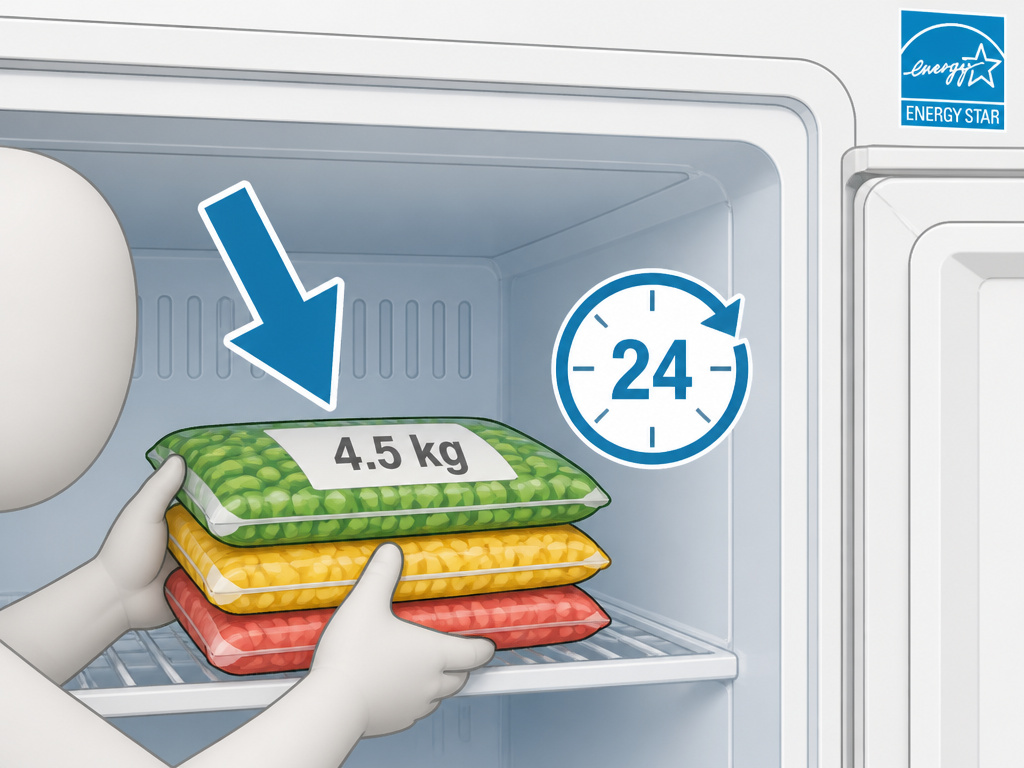
Freezing Capacity: This is the star of the show. The EN 62552 standard mandates a minimum performance: a freezer must be able to freeze 4.5 kg (about 10 lbs) of food per 100 liters of volume within 24 hours in a 77°F (25°C) room. A 200-liter freezer should freeze 9 kg (20 lbs) in a day. This number tells you how quickly it can bring fresh food down to 0°F without warming your already-frozen stock.
Energy Efficiency: Look for the ENERGY STAR label. A qualified freezer uses about 10% less energy than a standard model. Over a 12-year lifespan, that can save a significant amount. The label also shows estimated yearly kilowatt-hour (kWh) usage and estimated annual operating cost.
Defrost Type:
- Frost-Free (Auto Defrost): Convenient, no manual defrosting needed. Uses slightly more energy due to the periodic heater cycle.
- Manual Defrost: More energy-efficient, but requires you to unplug and empty the unit 1-2 times a year to melt ice buildup. Common in chest freezers and budget models.
Here’s a quick diagnostic table for when things don’t feel right:
| Symptom | Likely Cause | Immediate Action |
|---|---|---|
| Freezer not cold enough | Dirty condenser coils, faulty door seal, overfilled cabinet blocking airflow. | Unplug, vacuum coils, check seal with dollar bill test, rearrange food. |
| Excessive frost buildup | Faulty auto-defrost heater/timer, damaged door seal, high humidity environment. | Manual defrost. If frost returns quickly, check seal. May need service. |
| Compressor runs constantly | Room too hot (wrong climate class), low refrigerant, failing compressor. | Ensure room temp is within climate class. If problem persists, call a technician. |
| Loud knocking or buzzing | Evaporator fan hitting ice, faulty compressor mounts, normal start-up surge. | If linked to frost, manual defrost. If noise is new and persistent, investigate. |
Freezer Use and Food Safety
A perfect freezer temperature is wasted if you use the appliance wrong. The goal is to freeze food fast and keep it stable.
To Freeze Food Properly:
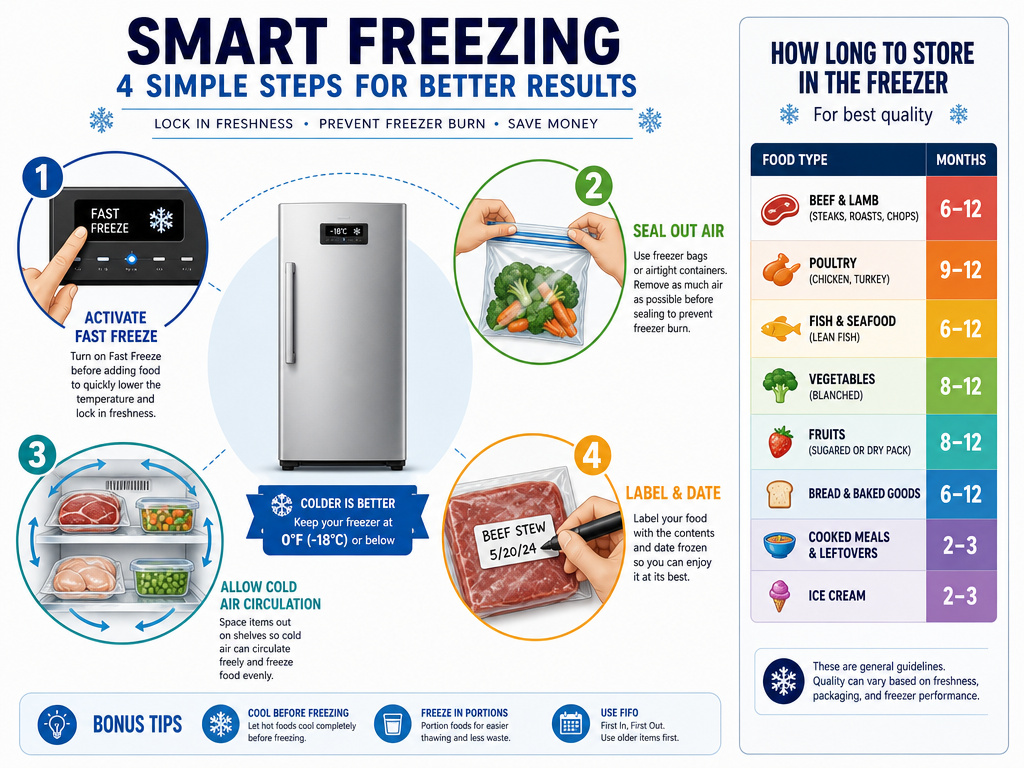
- Use the “Fast Freeze” or “Super Freeze” function. This bypasses the thermostat and runs the compressor continuously for 24-48 hours, dropping the temperature to its lowest point. Activate it before you add fresh food.
- Package for the long haul. Use airtight, moisture-proof containers or heavy-duty freezer bags. Remove as much air as possible to prevent freezer burn on food—those dry, grayish patches caused by dehydration and oxidation.
- Spread it out. Don’t dump 20 pounds of warm meat in the center. Spread packages out, preferably on the coldest shelf (often the top or bottom, depending on design), so cold air can circulate around them.
- Label everything. Use a marker and masking tape. Write the contents and the date. Your future self will thank you.
How Long Does Frozen Food Last?
At a steady 0°F, food is safe indefinitely from a bacterial standpoint. Quality, however, degrades over time due to chemical changes. * Fruits & Vegetables: 8-12 months * Raw Poultry & Meat: 6-12 months * Fish: 3-6 months * Prepared Meals & Soups: 2-3 months
The one non-negotiable rule: never refreeze thawed food unless you have cooked it first. Thawing allows bacteria to multiply. Refreezing locks in that higher bacterial load. Cooking to a safe internal temperature (165°F for poultry, for example) resets the clock, allowing you to freeze it again.
Organizing isn’t just for neat freaks. A well-organized freezer saves energy and food. Group like items together. Keep a running inventory on the door. Use clear bins to create zones—one for meats, one for vegetables, one for prepared meals. This minimizes door-open time and prevents those mystery packages from becoming permanent fixtures.
Frequently Asked Questions
What’s the difference between a freezer and a refrigerator?
Refrigerator keeps food cool, typically between 35°F and 40°F (2°C and 4°C), to slow bacterial growth. A freezer brings food to 0°F (-18°C) or below, which stops bacterial growth and chemical reactions almost completely, allowing for preservation over many months.
Can a freezer be too cold?
Yes. Most home freezers have an adjustable range, often from -5°F to 5°F. Setting it significantly below 0°F wastes energy and offers no food safety benefit. Extremely cold settings can also make some foods, like lettuce or dairy-based dishes, deteriorate in texture more quickly.
Why does my freezer have ice buildup even though it’s frost-free?
Frost-free systems have limits. Frequent door opening, storing hot food, or a faulty door seal introduces more moisture than the defrost cycle can handle. Placing the unit in a very humid room (like a damp basement) is a common culprit. The system ices over, requiring a manual thaw.
Is it okay to put hot food directly in the freezer?
No. Hot food raises the temperature inside the cabinet, potentially thawing surrounding items and forcing the compressor to overwork. It also creates steam, which condenses and freezes as frost. Always cool food to room temperature first, then transfer it to the freezer.
What should I do if my freezer stops working?
First, check if it’s plugged in and the circuit breaker hasn’t tripped. If power is fine, listen for the compressor. If it’s silent, the unit may have failed. A full freezer will keep food frozen for about 48 hours if the door stays shut; a half-full freezer for about 24 hours. Transfer food to another freezer or a cooler with ice blocks as soon as possible.
The Bottom Line
A freezer is a preservation engine, defined by its 0°F target. That number is backed by residential freezer performance standards and is non-negotiable for long-term storage. Whether you choose an upright for convenience or a chest for efficiency, understand its climate class and freezing capacity. Use the fast-freeze function, pack food airtight to avoid freezer burn, and keep it organized. It’s a simple appliance with one job, but doing that job right protects your groceries, your budget, and your dinner plans for months to come.
