
Can a Chest Freezer Go in a Shed? Key Factors and Limits
This post contains affiliate links. As an Amazon Associate, we earn from qualifying purchases.
Yes, you can put a chest freezer in a shed if the shed’s temperature stays between 55°F and 90°F (13°C and 32°C) year-round. Most standard freezers are not built for unheated spaces. If your shed drops below freezing, the compressor will shut off, thinking its job is done, and your food will thaw.
That 55–90°F range isn’t a suggestion. It’s printed in the manual for models like the Lowes ICM050LC. Go outside it, and the warranty may not cover a failed compressor. The real question isn’t about space; it’s about whether your shed acts like a conditioned room or an outdoor shed.
What follows: the specific temperature specs that matter, how to decode a freezer’s “climate class,” and the setup steps that keep a shed freezer running for years, not months. If your winters hit 20°F or your summers bake past 100°, you need a different plan.
Key Takeaways
- Standard freezers require a minimum ambient temperature of 55°F (13°C). Below this, the thermostat stops calling for cooling.
- Look for the “Climate Class” (SN, N, ST, T) on the nameplate. An “N” class (16–32°C) is for a heated room, not a shed.
- Garage-ready models have hidden condensers and extended temperature ranges, but test results vary, some work, some don’t.
- Always maintain 2–4 inches of clearance on all sides for airflow, or the compressor overheats and fails early.
- Defrost manually when frost reaches 1/4 inch thick. Ice buildup makes the unit work harder, spiking your energy bill.
The Temperature Rule You Can’t Ignore
Head design changes the entire process. Look at the business end of your trimmer.
A freezer doesn’t create cold. It moves heat from inside the box to the outside air. If the outside air is already freezing, the system has nothing to do. If it’s scorching, the system struggles.
Manufacturers define this with a hard operating range. For a standard chest freezer like the Lowes ICM050LC, that’s 55°F to 90°F. GE Appliances states a wider but still critical range: 0°F to 110°F for their current models. These aren’t ideals. They’re limits.
Common mistake: Assuming “garage-ready” means shed-ready. Consumer Reports tests show some marketed models still struggle with temperature uniformity in variable conditions. The label is a start, not a guarantee.
The lower limit is the real shed-killer. As a GE Appliances director explained, in very cold temperatures the freezer “gets confused.” The thermostat senses the cold ambient air and assumes the interior is already at 0°F. It shuts the compressor off. Your ice cream turns to soup, and you won’t know until you open the lid.
What “Climate Class” Really Means
This rating, found on the appliance nameplate, tells you the room temperature the unit is engineered for.
| Climate Class | Optimum Room Temperature Range | Suitable For |
|---|---|---|
| SN (Subnormal) | 10°C to 32°C (50°F to 90°F) | Cool basements, some insulated sheds |
| N (Normal) | 16°C to 32°C (61°F to 90°F) | Heated indoor rooms only |
| ST (Subtropical) | 16°C to 38°C (61°F to 100°F) | Hot garages, sheds in warm climates |
| T (Tropical) | 16°C to 43°C (61°F to 109°F) | Very hot, uninsulated spaces |
An “N” class freezer, common in big-box stores, has a minimum of 61°F. Put it in a 40°F shed and it’s operating outside spec. The compressor will short-cycle or not run at all. This is why some retailers guarantee shed use while the nameplate says otherwise, a discrepancy that voids warranties.
Garage-Ready vs. Standard: The $200 Difference
A garage-ready chest freezer isn’t magic. It usually has two engineered tweaks. First, a concealed condenser coil is protected from dust and moisture. Second, the thermostat and compressor are rated for a broader ambient range, often from -15°F to 110°F.
But “garage-ready” is a marketing term, not a certified standard. Performance isn’t uniform.
In its garage freezer suitability report, Consumer Reports notes that some tested models excelled at maintaining temperature, while others did not. The takeaway? You can’t trust the badge alone. You must check the specific model’s manual for its published ambient temperature range.
For a shed, you need a model that explicitly handles low temperatures. A standard unit might survive one mild winter. The second winter, when a cold snap hits, is when the compressor gives up.
Where this goes sideways: Buying a standard 7-cu-ft freezer on sale for the shed. It runs fine from April to October. Come December, the interior temperature drifts up to 25°F. You lose a holiday turkey and a year’s worth of garden vegetables.
How to Set Up a Shed Freezer Correctly
If your shed’s climate fits the freezer’s specs, placement is everything. A freezer suffocated in a corner dies young.
Clearance is non-negotiable. The compressor and coils need airflow to shed heat. The Lowes manual mandates 4 inches on all sides and back. GE says 2 inches for its larger chest freezers. Err on the side of more space.
Your shed floor must be solid, level, and dry. Moisture rots the cabinet and poses an electrical risk. If the floor is concrete, consider a wooden pallet or pressure-treated planks to elevate the unit slightly and improve under-body airflow.
I won’t recommend a standard freezer for a damp, unheated shed. The constant thermal stress on the seals and the risk of condensation inside the control panel aren’t worth the storage space. I’ve seen units where the internal thermostat corroded after two seasons.
Power matters. Use a dedicated outlet. Extension cords are banned for a reason, voltage drop over distance makes the compressor labor, causing premature failure. If your shed isn’t wired, that’s the first project, before you even buy the freezer.
Maintenance That Prevents a Meltdown
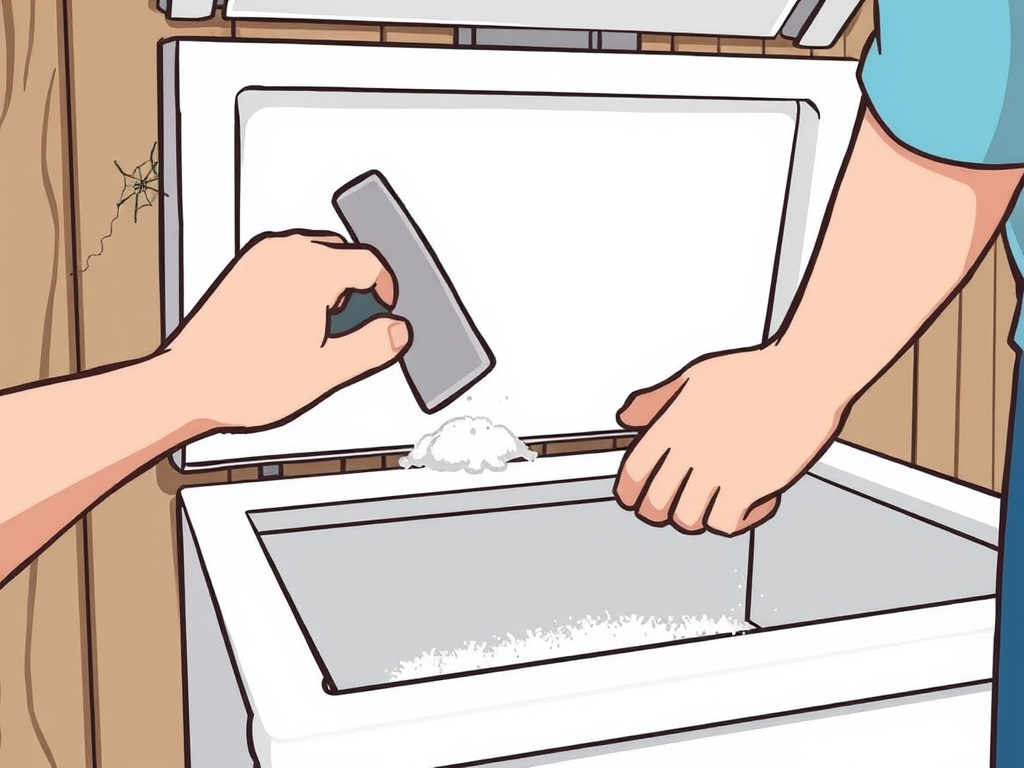 A shed freezer works harder. It needs more attention than your kitchen fridge.
Defrost is your first defense. The manual says 1/4 inch of frost. Wait longer, and the ice acts as an insulator. The compressor runs longer cycles to achieve the same cooling, which can spike energy use by 20% or more. Follow the manual’s steps: unplug, remove food, use a plastic scraper, never metal, and let it melt fully. Our guide on defrost a freezer walks through the safest method.
Clean the coils and vents twice a year. In a shed, dust, pollen, and spider webs accumulate faster. A vacuum with a brush attachment does the job. Blocked vents lead to the same outcome as poor clearance: overheating.
Monitor the temperature with an independent freezer alarm or a simple thermometer. Don’t trust the unit’s built-in dial alone. If the shed temperature plummets, you’ll see the interior temperature rise on your monitor before the food spoils.
For long-term storage, a deep clean is wise. Our article on how to clean a deep freezer covers sanitizing after a defrost to prevent odors.
Frequently Asked Questions
Will a chest freezer work in an unheated shed in winter?
Only if the shed temperature never drops below the freezer’s minimum ambient rating, typically 55°F for standard models or -15°F for true garage-ready units. Most unheated sheds in temperate climates will drop below this threshold, causing the compressor to shut off and food to thaw.
What is the coldest temperature a chest freezer can be in?
According to GE Appliances, the surrounding air should not fall below 0°F (-18°C). However, many standard units have a higher minimum around 55°F (13°C). The colder limit is for specialized “garage-ready” components. Always check your specific model’s owner’s manual.
How do I know if my freezer is garage-ready?
Check the owner’s manual or product specifications sheet for an “extended ambient temperature range” or explicit “garage-ready” designation. Look for a published operating range that includes temperatures below freezing (e.g., -15°F to 110°F). The badge on the box is not sufficient proof.
Can I modify a regular freezer for shed use?
No. You cannot reliably modify the thermostat or compressor to operate safely outside its designed range. Attempting to do so voids the warranty and creates a fire risk. The correct solution is to purchase a freezer engineered for the conditions or to climate-control your shed.
Do I need a special outlet for a shed freezer?
Yes. You must plug the freezer directly into a grounded, dedicated outlet rated for 15 amps. Using an extension cord, even a heavy-duty one, causes voltage drop that strains the compressor and can lead to overheating or failure.
The Bottom Line
Putting a chest freezer in a shed is a game of matching specs to reality. Your shed isn’t just storage; it’s an environment with its own climate. Ignore the nameplate’s “Climate Class” and you buy a compressor failure.
For most people with a typical unheated shed, the only safe path is a genuinely garage-ready model with a published low-temperature rating. For everyone else, the better investment is in insulating the shed or finding indoor space. A freezer is a long-term appliance. Don’t let a short-term space solution cost you hundreds in spoiled food and a broken machine.
