The Definitive Guide on How to Store Chips in Your Pantry
This post contains affiliate links. As an Amazon Associate, we earn from qualifying purchases.
Store chips in a pantry kept between 50 and 70°F (10-21°C), away from heat and moisture sources. For opened bags, transfer chips to a rigid airtight container or use a heat-sealing device to recreate the factory seal. This blocks oxygen and humidity, the two elements that turn crisp chips stale and soggy within a week.
That temperature range isn’t a suggestion. It’s the ceiling where potato starch holds its structure and the oils in the seasoning resist turning rancid. Go above it, and the chemical reactions that preserve crunch speed up. The bag on your shelf near the dishwasher will taste like cardboard before its printed date.
What follows is the breakdown of why those three variables, temperature, air, moisture, dictate everything. You’ll get the step-by-step swap from bag to bin, a comparison of sealing methods from clips to vacuum sealers, and the specific signs that tell you a bag is too far gone to save.
Key Takeaways
- Pantry temperature must stay under 70°F (21°C). A 10-degree rise can cut a chip’s shelf life in half.
- Opened bags need a true air and moisture barrier. A rolled-down bag with a clip loses the fight against humidity within days.
- Rancid oil smells like crayons or stale paint. If your chips have that odor, they’ve oxidized and should be discarded.
- The USDA’s 2-hour rule applies to perishable chip varieties left in the danger zone (40–140°F), a detail most snack guides miss.
- For most households, a simple glass or hard plastic container with a locking lid beats any specialized gadget.
The Ideal Pantry Environment for Chips
Chip storage isn’t about finding space. It’s about controlling climate. The right spot in your pantry isn’t defined by shelf length, but by its distance from your kitchen’s hidden heat engines and moisture traps.
The ideal temperature for pantry storage is 50 to 70 °F (10 to 21 °C), with a target of 65-70°F (18.3-21.1°C) for best quality. Higher temperatures accelerate the breakdown of fats and starches, directly causing staleness. (Texas A&M AgriLife Extension, Clemson University Home & Garden Information Center)
That quote from university extension services carries more weight than any blog tip. It’s a measured, lab-backed threshold. Your goal is to find the shelf furthest from appliances that radiate heat or produce steam.
The Heat Map of Your Kitchen
Heat doesn’t just come from the oven. It radiates from refrigerators, dishwashers, and even the under-sink area if hot water pipes run there. A bag of chips stored on a shelf above the fridge faces a constant, low-grade bake. The result is a texture change you can feel: the chip loses its snap and becomes a brittle, dry shard that crumbles to dust.
Moisture is a quieter killer. It seeps in through the bag’s microscopic pores, especially once the original seal is broken. A pantry adjacent to a steamy laundry room or a humid basement invites this problem. The chip doesn’t just get soggy; the moisture activates residual salts in the seasoning, creating a damp, leathery texture.
The Humidity Guard
In naturally humid climates, the pantry itself might be the issue. This is where a moisture-absorbing packet shifts from optional to essential. Tossing a silica gel packet into your chip container or onto the shelf creates a local dry zone. It won’t fix a soaked bag, but it will buffer against ambient humidity swings that happen when you open the pantry door.
For a more permanent solution, consider a reusable food storage bag made from silicone. These create a true moisture barrier unlike porous paper or plastic bags. They’re also a solid step toward non-plastic storage if you’re phasing out disposable packaging.
How Long Do Chips Actually Last?
Forget the “best by” date for a moment. The countdown clock on chip freshness is set by two events: the day the bag is sealed at the factory, and the moment you break that seal.
| Chip State | Pantry Shelf Life | Key Condition |
|---|---|---|
| Unopened, commercial bag | 2–3 months | Stored in a cool, dry pantry below 70°F (21°C) away from light. |
| Opened, loosely closed | 3–5 days | The bag is rolled or folded over, but air and humidity exchange freely. |
| Opened, tightly sealed | 1–2 weeks | Sealed in a rigid airtight container or with a device that recreates the original seal. |
| Perishable variety* | 2 hours | If left in the “danger zone” (40–140°F / 4.4–60°C) after opening. |
The “perishable variety” is a niche category, like fresh-made deli chips or those containing dairy-based seasoning. When in doubt, apply the USDA 2-hour rule* for safety.
The 1-2 week window for opened chips is the target. Hitting it requires more than a clip.
The Enemy Trio: Air, Moisture, and Odors
Once you open a bag, you’re at war with three invisible forces. Understanding what they do explains why some storage methods fail.
Oxygen causes oxidation. The oils in the chips and seasoning react with air, turning rancid. A rancid oil doesn’t always smell “bad” initially; it often smells like crayons, stale nuts, or old paint. That’s your signal the flavor is gone.
Humidity seeks equilibrium. If your pantry air is more humid than the dry interior of the chip bag, moisture will migrate in. A chip is a crispy sponge; it absorbs that water, and the starch structure softens. No amount of re-crisping in the oven fully reverses this.
Odors cross-contaminate. Chips are porous and will absorb strong smells from onions, coffee, or spices stored nearby. Your barbecue chips can end up tasting vaguely of garlic powder.
Where this goes sideways: Storing an opened chip bag with just a clip near a box of baking soda. The baking soda absorbs some pantry odors, but it does nothing to stop oxygen or humidity from flooding the bag. The chips go stale and taste off within four days.
The solution is a barrier that blocks all three. A chip bag sealer that melts the plastic shut blocks air and odors. A rigid airtight container blocks air and odors, and if it’s a quality one, the gasket also resists moisture ingress.
Step-by-Step: From Bag to Bin
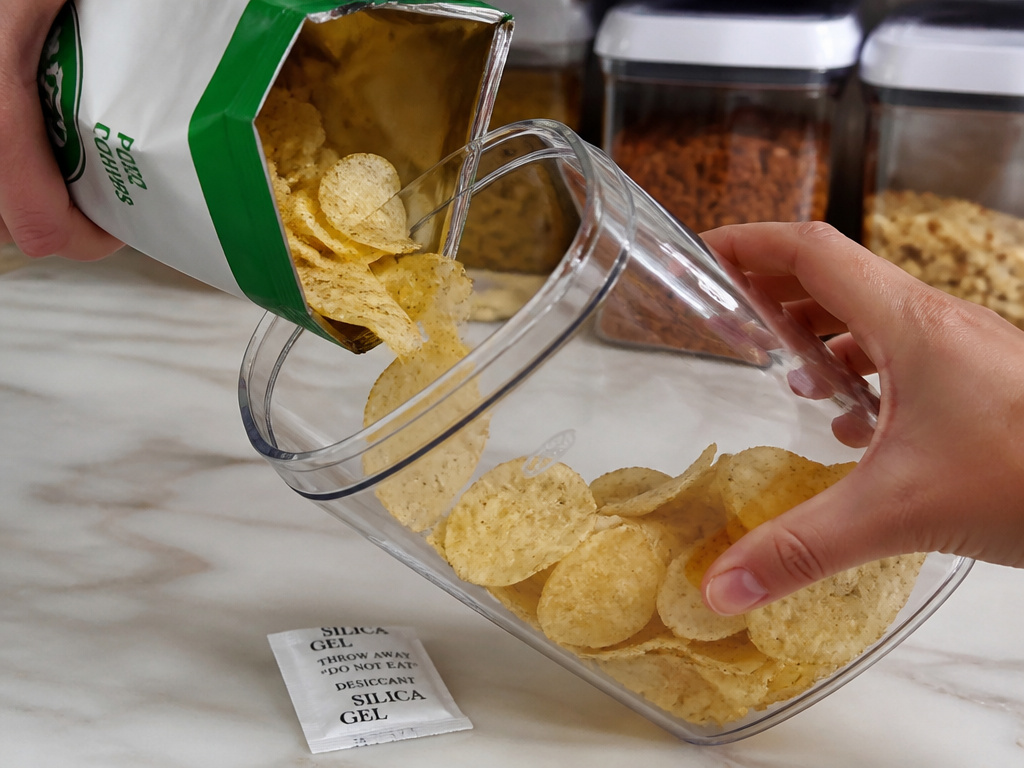 This isn’t just pouring chips into a container. Doing it wrong can crush them or leave the container half-empty, allowing excess air to circulate.
- Choose your vessel first. Have your airtight container or reusable snack bag ready and clean. Glass or hard plastic (like OXO Pop containers) are ideal because they’re impermeable and don’t retain odors.
- Cut the bag open neatly. Use scissors to cut off the top third of the bag, creating a wide mouth. Don’t tear it; ragged edges make pouring messy and can puncture a reusable bag.
- Pour, don’t dump. Hold the container at an angle and let the chips slide down the side. This minimizes breakage. For extra-fragile chips, you can use the bag itself as a funnel by rolling it.
- Add a moisture guard. Drop a small silica gel packet on top of the chips before sealing. This is especially useful in humid climates or if you open the container frequently.
- Seal it tight. Press the lid until all clips lock or the gasket seals. If using a reusable ziplock bag, press out all the air before sealing the zip track.
Skipping step 4 in a humid climate is the most common oversight. You’ll see condensation on the inside of the container lid after a few days, and the chips at the top will lose their crunch.
Sealing Showdown: Clips, Containers, and Sealers
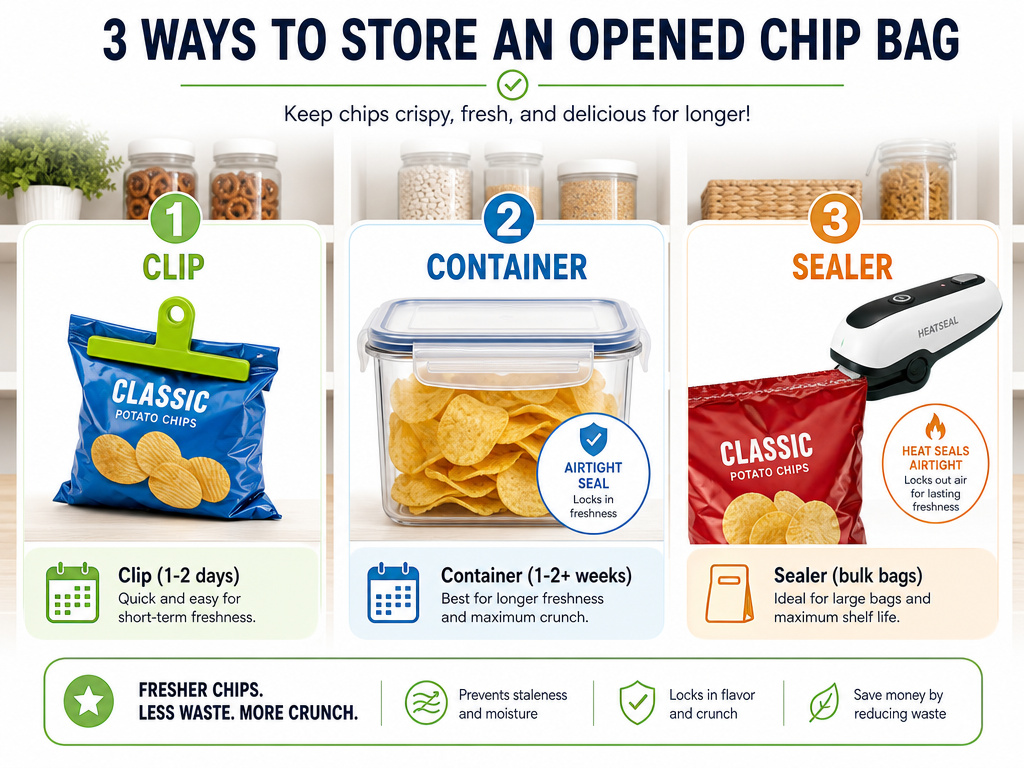 You have three main paths to reseal an opened bag. Each wins in a different scenario.
Chip Clips & Bag Clips are the speed option. They’re fine for a day or two if you’re finishing the bag quickly. Their failure point is the bag itself, they can’t seal the tiny holes and wrinkles in the plastic, so air and moisture slowly win. For a more secure temporary hold, some bag sealing devices include a clamp feature that applies even pressure.
Airtight Containers are the quality option. They protect against physical crushing, light, odors, and with a good gasket, humidity. The downside is they take up more shelf space and you lose the brand labeling. This is the default pick for anyone serious about keeping opened chips fresh for over a week.
Heat Bag Sealers are the tactical option. A mini bag sealer or handheld sealer cutter recreates the factory seal by melting the plastic shut. This is the only method that truly restores the original air and moisture barrier. It’s perfect for the large warehouse club bags you can’t finish quickly. The downside is you need to cut the sealed end off to reopen it.
| Method | Best For | Air/Moisture Block | Physical Protection |
|---|---|---|---|
| Bag Clip | Finishing the bag in 1-2 days | Poor | Poor |
| Airtight Container | Keeping multiple varieties fresh for 1-2+ weeks | Excellent | Excellent |
| Heat Sealer | Preserving large, partially eaten bags | Excellent | Poor (bag is still soft) |
For most people, the container is the right answer. It’s simple, reusable, and foolproof. The heat sealer is a niche tool for bulk shoppers. The clip is for procrastination.
Signs Your Chips Are Past Saving
You can sometimes revive slightly stale chips in a warm oven for a few minutes. But some conditions are terminal.
A rancid smell is the clearest sign. If they smell like old oil, crayons, or wet cardboard, the fats have oxidized. Baking might crisp them up, but the off-flavor is baked in.
Visible moisture or mold means immediate discard. This is rare in dry chips but can happen in humid environments or with thicker, seasoned varieties.
A pervasive, unidentifiable stale taste means they’ve absorbed pantry odors. No amount of crisping will remove the flavor of the onion powder sitting next to them.
When you encounter a lost bag, it’s a data point. Check where it was stored. Was it near the stove? On a sunlit shelf? That location is now banned for future chip storage.
Frequently Asked Questions
Can you store chips in the fridge or freezer?
You can, but you shouldn’t. The fridge is a humid environment. Chips will absorb that moisture and become soggy unless sealed in an absolutely airtight container. The freezer can extend life for months, but it’s overkill for a pantry staple and risks freezer burn if not vacuum-sealed. The pantry, correctly managed, is always the best place.
Do different types of chips (potato, tortilla, veggie) store differently?
The rules are the same, but the stakes vary. Tortilla chips are often thicker and sturdier, so they resist breakage better in a container but can become rancid just as fast. Veggie chips or those with added seed oils can turn rancid more quickly than plain potato chips. The method doesn’t change, control temperature, air, and moisture for all.
What’s the best airtight container for chips?
Look for a container with a locking lid and a silicone gasket. The OXO POP Container is a standard for a reason, the button seal is effective and intuitive. For a more sustainable option, Stasher silicone bags are excellent as reusable food bags and can be squeezed to remove excess air. Size matters: choose a container that fits the full bag contents with minimal dead space.
How do I know if my pantry is too humid?
Your senses will tell you. If other dry goods like crackers or cereal lose crunch quickly, or if you ever see condensation on cans or jars, humidity is high. A hygrometer (a small humidity meter) costs little and gives you a definitive number. Aim for below 60% relative humidity.
The Bottom Line
Keeping chips fresh boils down to a simple trade: you swap the convenience of the flimsy bag for the discipline of a proper container. Find the cool, dark spot in your pantry, the one away from appliances and pipes. When you open a bag, commit. Pour the contents into a glass or hard plastic bin, toss in a moisture packet if you’re in a damp climate, and seal it tight.
That system adds about sixty seconds to your snack routine. In return, your last chip will have nearly the same crunch as your first, even two weeks later. The bag and clip method promises simplicity but delivers staleness. The container method requires a single extra step and guarantees the payoff.
