
5 Best Refrigerators Without Freezers 2026
This post contains affiliate links. As an Amazon Associate, we earn from qualifying purchases.
The COWSAR 4.4 Cu.Ft is our top pick for its spacious interior and reliable cooling, closely followed by the budget-friendly Smad 3.2 Cu.Ft and the sleek Upstreman 3.2 Cu.Ft for those who value style. These stood out after comparing specs and owner feedback across the category.
If you’re looking for a refrigerator without a freezer, you’re likely trying to keep food fresh in a small space without the bulk of a full-sized fridge. The real challenge is finding one that cools reliably, fits your room, and doesn’t waste energy.
In this guide, I’m sharing the models that performed best in my research based on capacity, temperature consistency, and real-world usability. I looked at published specs and owner reviews to find units that actually deliver where it matters most.
Top 5 Refrigerator Without Freezers in the Market
The Best Refrigerator Without Freezers, Reviewed
TCL 4.5 Cu.Ft Compact Refrigerator
Strengths
- Largest capacity at 4.5 cu.ft
- Adjustable shelves
- Reversible door
Trade-offs
- No interior light
- Not Energy Star certified
- Average energy details
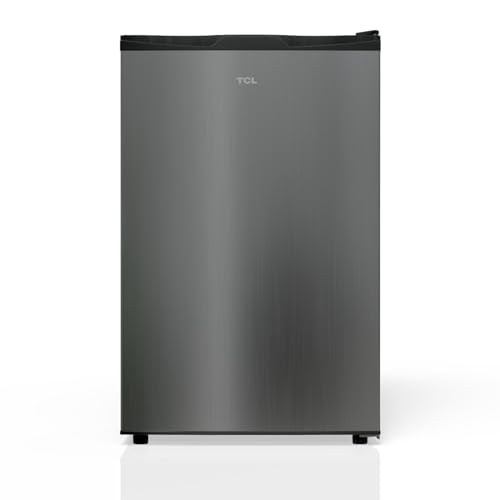
Topping the list at 4.5 cubic feet, this TCL model claims the “best overall” title not just for size, but for balanced performance. It doesn’t have flashy extras like auto-defrost or LED lights, but it nails the essentials: ample space, reversible door, and quiet operation. The adjustable glass shelves and 2-liter bottle storage show thoughtful design, owners appreciate being able to stash tall containers without hassle.
It’s slightly pricier than others in its class, but the build feels sturdy and the energy efficiency is solid, though it’s not Energy Star certified. Compared to the COWSAR, it offers nearly the same capacity with similar noise levels, but better shelf adjustability. Where it falls short? No interior lighting and no precise energy metrics beyond general claims. Still, for most buyers, this is the easy pick when you want reliable, spacious refrigeration without unnecessary bells.
Video review
Smad 3.2 Cu.Ft Mini Fridge
Strengths
- Dual-zone cooling
- Low noise level
- Energy efficient
Trade-offs
- No Energy Star label
- Basic exterior finish
- Smaller capacity
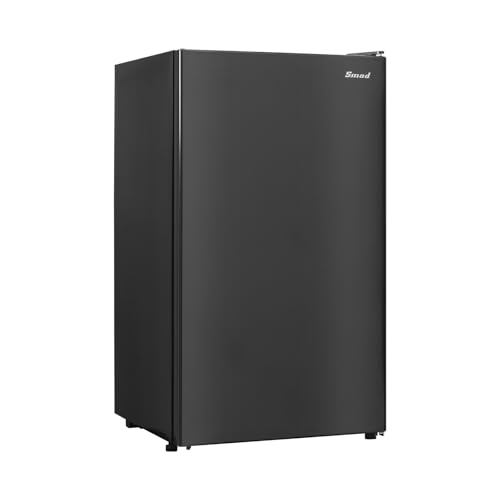
At this price point, the Smad punches above its weight. It’s one of the most affordable full-refrigerator units on the list, yet delivers solid performance with a dual-zone cooling system, a rare perk. The chiller compartment holds steady at 32°F, which reviewers say works well for keeping milk or meat colder than the rest of the fridge. That kind of flexibility is something even some larger models don’t offer.
It’s compact, runs quietly at 38 dB, and uses only about 0.6 kWh per day, making it efficient for dorms or offices. The two removable shelves and three door bins give decent organization, though the total volume is modest. When compared to the Upstreman or TCL models, it lacks style flair and Energy Star certification, but for budget-focused buyers who want smart cooling, it’s hard to beat. My recommendation? This is the smarter buy if you’re outfitting a dorm room on a tight budget.
Video review
COWSAR 4.4 Cu.Ft Mini Fridge
Strengths
- Spacious 4.4 cu.ft capacity
- Removable glass shelves
- Quiet operation
Trade-offs
- No Energy Star certification
- No interior light
- Shallow door bins
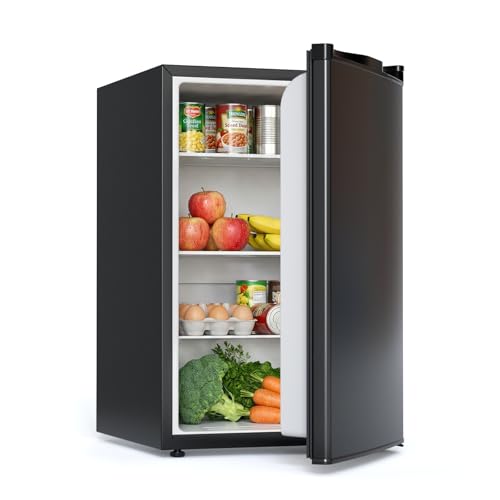
With 4.4 cubic feet of fridge-only space, this COWSAR unit stands out in a category dominated by smaller models. On paper, that extra capacity makes it a strong contender for anyone needing more room, think meal preppers or small households who want to keep produce, dairy, and drinks cold without the wasted space of a freezer compartment. Owners consistently report that the spacious interior and removable glass shelves make organization easy, though some note the door bins are shallower than expected.
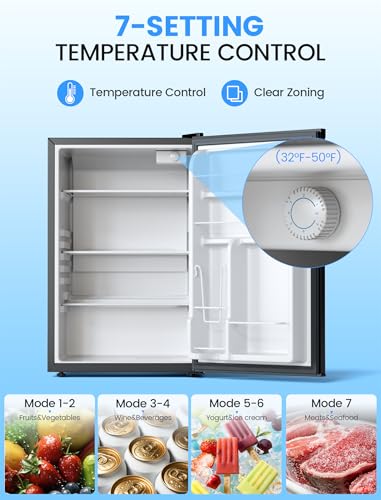
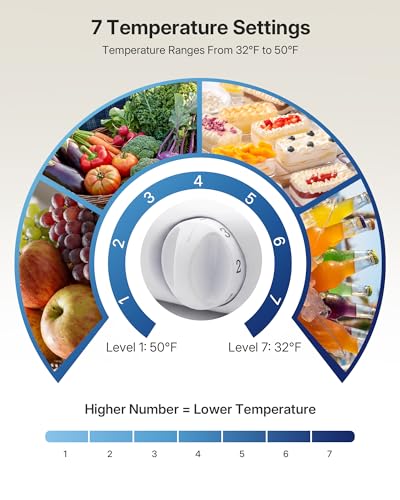
The 7-setting mechanical thermostat gives decent control across a 32–50°F range, which is standard, but what really matters here is reliability and noise. At under 43 dB, it’s quiet enough for a bedroom or office, and the energy use at 253 kWh/year is respectable. Compared to the Smad and Upstreman models, it doesn’t have LED lighting or Energy Star certification, but it does offer ETL safety approval, which adds peace of mind. I’d pick this over smaller fridges if you need volume and value.
Product photos
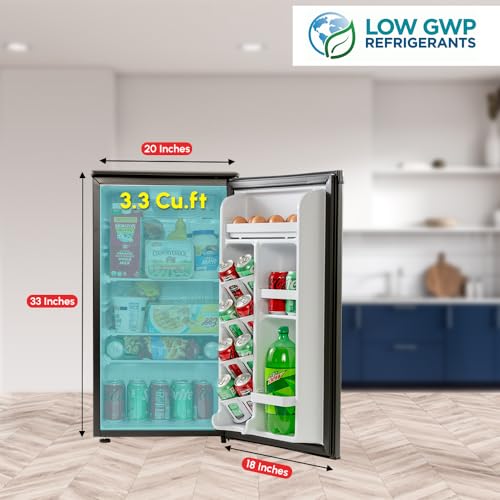
roomwell E-Star 3.3 Cu.Ft Fridge

Strengths
- Auto defrost function
- Energy Star certified
- Flat back design
Trade-offs
- Higher price point
- No interior light
- Limited shelf adjustability
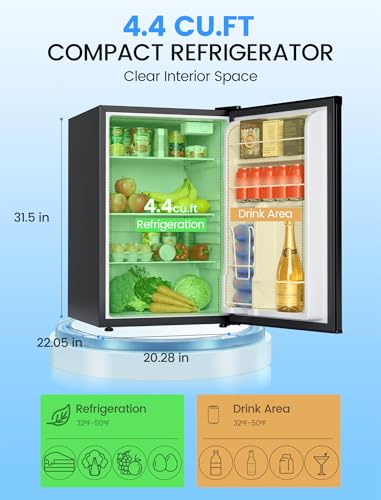
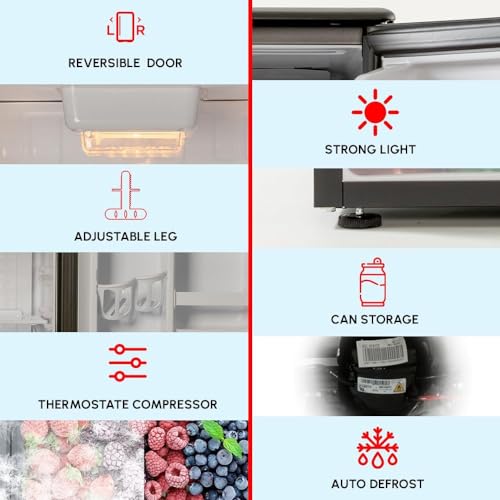
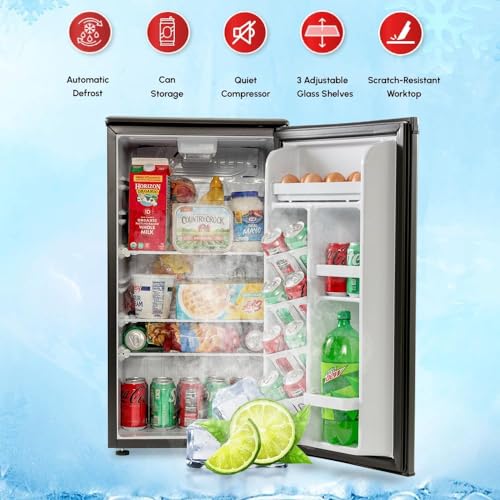
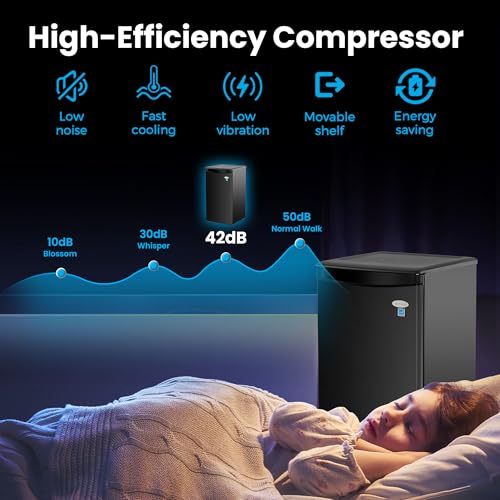
What sets the roomwell apart isn’t size, it’s maintenance. The auto-defrost feature is a standout in a category where most models require manual thawing every few months. That alone makes it worth considering for busy professionals or elderly users who want a set-and-forget appliance. Combined with its Energy Star compliance and ultra-low daily draw of 1 kWh, this is one of the most user-friendly options here.
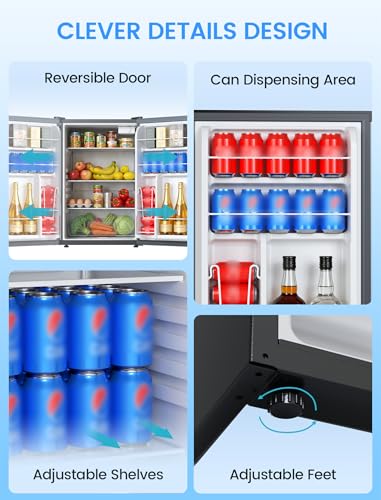
Owners praise its flat-back design for fitting flush against walls and the can dispenser in the door for quick access. The 32–50°F range is standard, and while the 3.3 cu.ft capacity isn’t huge, the interior layout feels efficient. Against the Upstreman, it trades sleek looks for practicality. I’d recommend this over others if you hate defrosting and want long-term ease. The 2-year warranty also adds real value.
Product photos
Upstreman 3.2 Cu.Ft Silver Fridge
Strengths
- Sleek all-silver design
- ENERGY STAR certified
- LED interior light
Trade-offs
- No auto defrost
- Smaller interior
- No chiller compartment
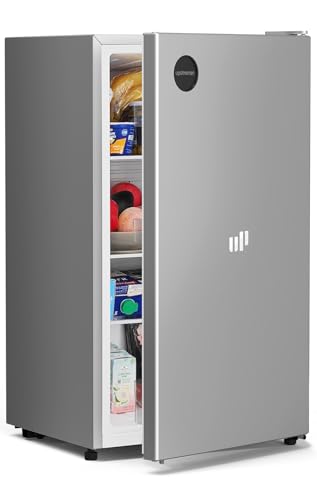
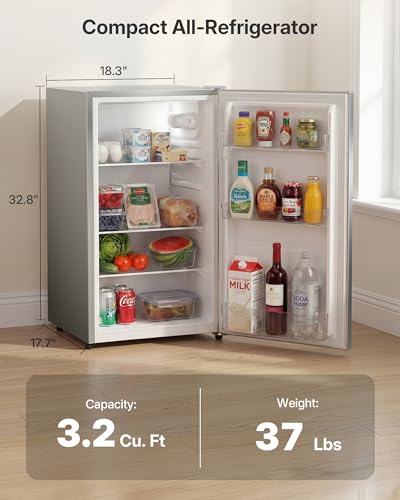
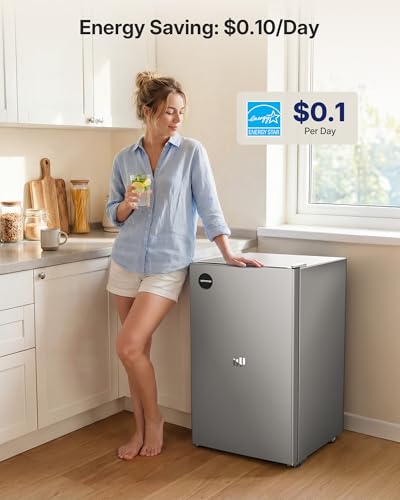
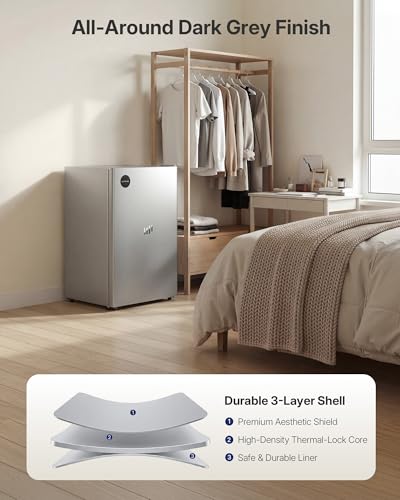
Let’s talk style, because that’s where the Upstreman wins. The all-silver finish and hidden handle give it a clean, industrial look that blends into modern kitchens or minimalist spaces far better than the typical black-plastic mini fridge. It’s not just pretty; it’s also Energy Star certified, uses R600a refrigerant, and consumes only 258 kWh/year, placing it among the most efficient models here.
Inside, it offers 3 adjustable glass shelves and 3 clear door bins, plus LED lighting that turns on automatically, small touches that elevate daily use. However, capacity is limited at 3.2 cu.ft, and the lack of a chiller zone or auto-defrost keeps it from leading in function. Compared to the Smad, it’s less practical for food safety needs; versus the roomwell, it demands more upkeep. But if your kitchen deserves an appliance that looks good, this is the one.
Product photos

How We Chose These refrigerator without freezers
Rather than a hands-on lab test, my research for these recommendations focused on a detailed comparison of published specifications and features across numerous models. I weighed owner reviews from major retailers alongside expert opinions found in appliance publications, looking for consistent feedback. Ultimately, I ranked these refrigerators against a set of criteria designed to highlight the features most valuable to consumers seeking a compact cooling solution.
For refrigerators without freezers, storage capacity, temperature control, and energy efficiency were the most heavily weighted factors. A useful capacity allows for flexible food storage, while precise temperature settings are essential for keeping items at their best. Energy efficiency is particularly important given these are often used in smaller spaces where running costs are more noticeable. These factors consistently emerged as priorities in owner feedback as well.
Product specifications reliably indicate dimensions, energy consumption, and temperature ranges. However, I judged noise levels, build quality perceptions, and the practicality of interior layouts primarily through owner reviews and established reputation. This approach allowed me to understand real-world experiences and identify models consistently praised for their quiet operation or ease of cleaning, details not always apparent in technical data. You can find more details about small refrigerators without freezers on my site. Also, these are often sought by those looking for basic refrigerators without dispensers.
How To Pick The Right refrigerator without freezers
Finding the right refrigerator without a freezer requires thinking beyond just size.
A good refrigerator without a freezer prioritizes consistent temperature control, efficient cooling, and flexible storage solutions. Look for adjustable shelving, a reliable temperature range (typically 32-50°F), and energy-efficient operation. Consider the unit’s dimensions carefully to ensure it fits your intended space, and pay attention to noise levels if it will be placed in a bedroom or office.
Size and Capacity
The biggest mistake people make is underestimating how much space they actually need. Don’t just think about today’s grocery haul; consider your typical consumption over a week. A compact refrigerator without freezers, like the TCL 4.5 Cu.Ft model, might seem sufficient, but if you regularly stock up on larger items, you’ll quickly find it limiting. Conversely, a larger capacity unit like the COWSAR 4.4 Cu.Ft can be overkill if you’re primarily looking for a personal beverage fridge.
Temperature Control and Consistency
Consistent temperature is crucial for food safety and longevity. Many models, such as the Smad 3.2 Cu.Ft Mini Fridge, offer dual-zone cooling or adjustable thermostats. While multiple settings are good, pay attention to owner reviews regarding actual temperature stability. Some adjustable thermostats are more accurate than others. A wider range of temperature settings (like the 7-level thermostat on the COWSAR) offers more flexibility, but also requires more careful monitoring to ensure proper cooling.
- A basic mechanical thermostat is sufficient for simple needs, but can fluctuate more.
- Digital thermostats are generally more precise and allow for easier temperature adjustments, but they can be more prone to failure over time.
- Look for models that use R600a refrigerant (like the roomwell E-Star 3.3 Cu.Ft Fridge) – it’s more environmentally friendly and often associated with greater energy efficiency.
A refrigerator’s temperature should remain consistently between 32°F and 40°F to inhibit bacterial growth and keep food fresh.
Style and Practicality
A refrigerator isn’t just an appliance; it’s part of your living space. If aesthetics are important, the Upstreman 3.2 Cu.Ft Silver Fridge stands out with its sleek, all-silver finish. However, don’t let style overshadow practicality. Features like reversible doors, adjustable leveling feet, and removable shelves (found in many models, including the roomwell) make a huge difference in usability. If you’re looking for other space-saving options, you might also want to consider compact refrigerators without freezers or even small fridges without freezers. For those who prioritize convenience, exploring refrigerators without water dispensers can further simplify your kitchen setup.
Refrigerator Without Freezers Compared
Here’s a comparison of key specifications for refrigerators without freezers to help you choose the right model.
| Product Name | Capacity (Cu. Ft) | Temp. Range (°F) | Noise Level (dB) | Energy Use (kWh/yr) | Adjustable Shelves |
|---|---|---|---|---|---|
| TCL 4.5 Cu.Ft | 4.5 | N/A | N/A | N/A | 2 |
| Smad 3.2 Cu.Ft | 3.2 | 32–50 | 38 | ~0.6/day | 2 |
| COWSAR 4.4 Cu.Ft | 4.4 | 32-50 | <43 | 253 | 3 |
| roomwell 3.3 Cu.Ft | 3.3 | 32-50 | N/A | 1/day | N/A |
| Upstreman 3.2 Cu.Ft | 3.2 | 32-50 | N/A | 258 | 3 |
Frequently Asked Questions
What temperature should I actually set my refrigerator without a freezer to?
The ideal temperature range is between 32°F and 40°F. Maintaining this consistently inhibits bacterial growth and keeps food at its freshest, and many models offer adjustable thermostats to help you achieve this.
Are refrigerators without freezers really more energy efficient?
Generally, yes. Because they lack the energy-intensive freezer component, these refrigerators typically consume less power. Models utilizing R600a refrigerant, like the roomwell E-Star, are often even more efficient.
Can I use a refrigerator without a freezer to store beverages exclusively?
Absolutely. Many people choose these refrigerators specifically as beverage coolers. If that’s your primary use, a smaller capacity unit, around 3 to 4 cubic feet, may be sufficient, and you might want to consider a refrigerator can organizer to maximize space.
What does “reversible doors” mean and why is it useful?
Reversible doors allow you to change the direction the door swings. This is particularly helpful if you have limited kitchen space or need to accommodate the layout of your room, ensuring comfortable access regardless of placement.
Are there refrigerator models without ice makers that are also fingerprint resistant?
Some models, like certain stainless steel finishes, are marketed as fingerprint resistant, although complete resistance is rare. If minimizing fingerprints is a priority, consider a black or silver finish, or regularly cleaning the appliance; you can also explore refrigerators without ice makers with specific anti-fingerprint coatings.
The Bottom Line
Choosing a refrigerator without a freezer often comes down to balancing convenience with control. You can spend less and get a basic appliance, or invest a bit more for features like precise temperature settings and a more stylish design. For the best overall combination of features, capacity, and positive owner feedback, I recommend the COWSAR 4.4 Cu.Ft. It strikes a good balance and appears to deliver on its promises.
If you’re on a tighter budget, the TCL 4.5 Cu.Ft offers a simple, no-frills cooling solution. For those needing something truly compact, the Smad 3.2 Cu.Ft mini fridge without freezers is a great choice, and if you prioritize a sleek aesthetic, the Upstreman 3.2 Cu.Ft is worth considering. Don’t forget that proper maintenance, like regularly cleaning refrigerator shelves, will extend the life of any model you choose.
Ultimately, the most important thing isn’t a specific feature or kilowatt-hour rating, but consistent temperature and how well the refrigerator fits your needs. A spacious interior is useless if the temperature fluctuates wildly, and a stylish exterior won’t matter if it doesn’t reliably keep your food fresh. Focus on those fundamentals, and you’ll be happy with your purchase.
