Safe Storage for Clean Cutting Boards: Where & The 6-Inch Rule
This post contains affiliate links. As an Amazon Associate, we earn from qualifying purchases.
Store clean cutting boards at least six inches above the floor in a clean, dry, self-draining position, vertically on a rack is best. This is the legal minimum in state food codes like Ohio’s and Virginia’s. Never store them in a closed cabinet, under a sink, or flat on a counter where moisture pools. The goal is air circulation, not just being out of the way.
That six-inch floor clearance is a codified barrier against splash, dust, and pests that gets missed in home kitchens focused on countertop clutter. The real failure point is the 24 hours after washing when a board stays damp.
What follows: the specific regulations most guides omit, the three storage tools that actually work, and the material-specific mistakes that warp wood and crack plastic within a season.
Key Takeaways
- State food codes mandate clean equipment be stored at least six inches (15 cm) above the floor, a rule that applies to home cutting boards.
- Vertical, self-draining storage on a dedicated rack is non-negotiable for air circulation; laying boards flat traps moisture and bacteria.
- Never use a cloth to dry a board after sanitizing; air-drying is required, and cloths can re-introduce pathogens.
- Wood and plastic have opposite dishwasher rules: plastic boards benefit from the sanitizing heat, but dishwashers will warp and split solid wood.
- Replace any board with deep grooves, cracks, or warping; these defects harbor bacteria that cleaning cannot reach.
The Core Rule: Six Inches Up and Self-Draining
Forget “a clean, dry place.” The actionable standard is precise. Food service regulations from states like Ohio and Virginia specify that cleaned equipment and utensils must be stored at least six inches (fifteen centimeters) above the floor. This is the minimum height to avoid contamination from floor splash, dust, and pests.
The second part of the rule is just as critical: storage must be in a self-draining position. This means the board’s surface shouldn’t hold water. A board laid flat on a counter or in a bottom cabinet will puddle in its own grooves. That residual moisture is an invitation for microbial regrowth, undoing the work of cleaning and sanitizing.
Clean equipment and utensils shall be stored… at least six inches (15 centimeters) above the floor… in a self-draining position., Virginia Administrative Code, 2VAC5-585-2045
This code exists for commercial kitchens, but the physics of bacteria don’t change at your home sink. The six-inch rule translates directly to your kitchen. It means don’t lean a board against the cabinet toe-kick. Don’t stash it on the floor of a pantry. Elevate it.
How do you actually comply? A dedicated, wall-mounted or countertop drying rack made of stainless steel or coated wire. These racks hold boards vertically, spaced apart for air flow. The board drips dry quickly, and the rack itself can be placed on a clean counter or mounted well above the floor line. This single tool solves both the height and the drainage requirement.
Why “Air-Dry Only” Isn’t Just About Speed
You wash a board, grab a dish towel, and give it a wipe. It feels efficient. It’s also the step where you can re-contaminate a clean surface. Official guidance is blunt: after sanitizing, equipment may not be cloth dried.
The logic is simple. Unless that towel is fresh from a sanitizing wash and hasn’t been used for anything else, it carries bacteria from hands, countertops, or other dishes. Rubbing a board with it smears those microbes across the surface. The only exception in codes like Virginia’s is for polishing utensils that have already been completely air-dried.
Common mistake: Drying a cutting board with a kitchen towel. The cloth re-deposits bacteria from previous use, and moisture trapped under the board warps wood within weeks.
Air-drying isn’t a passive wait; it’s the final sanitizing step. Proper drying removes the water that bacteria need to multiply. This is why the self-draining position from the previous rule is coupled with air-drying. A board standing vertically in a rack dries in under an hour. A board left flat on a granite counter can stay damp for six hours in a humid kitchen, plenty of time for colonies to begin forming.
The takeaway is mechanical: don’t touch it. Wash it, rinse it, sanitize it, and let the air do the rest. If you need it dry faster, point a fan at your drying rack.
The Wrong Places: Where to Never Put a Clean Board
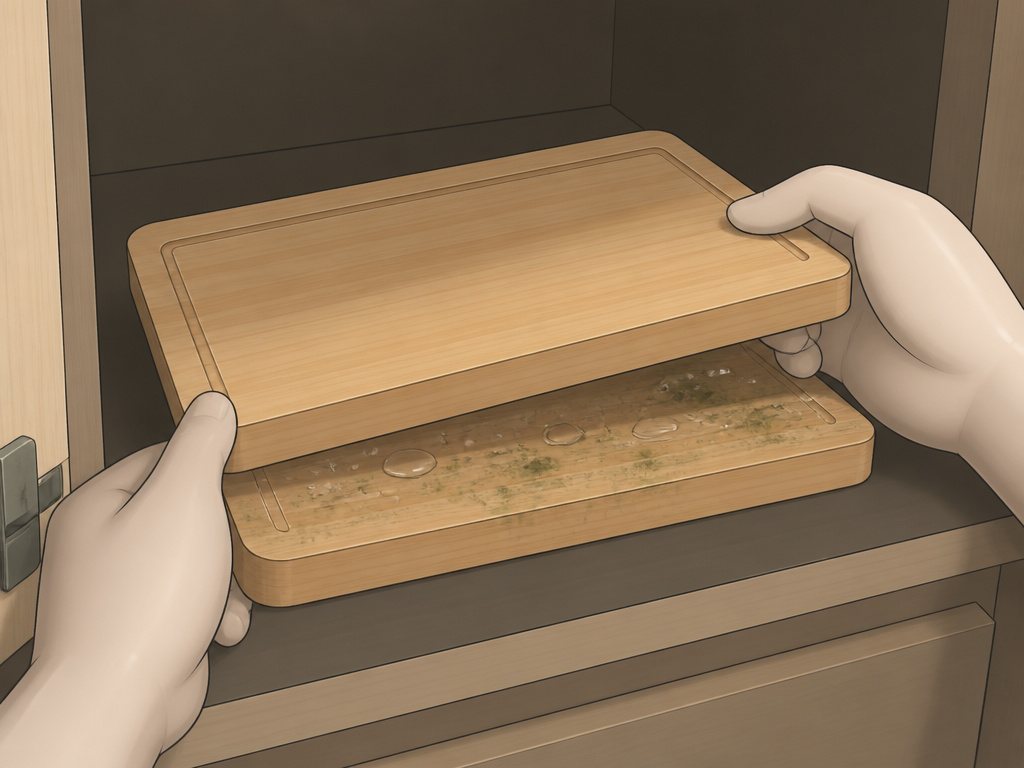 Knowing where to store a board is half the battle. Knowing where not to store it prevents silent failures. These locations violate the core principles of elevation, dryness, and cleanliness.
| Storage Spot | Why It Fails | Consequence Timeline |
|---|---|---|
| Laying flat on counter | Pools moisture in grooves; exposes surface to airborne contaminants from food prep. | Bacterial regrowth can begin within 2–3 hours of storage. |
| Inside a closed cabinet | Zero air circulation creates a humid, dark environment ideal for mold and bacteria. | Musty odor develops within 1–2 weeks; warping in wooden boards follows. |
| Under the sink | Proximity to plumbing leaks, cleaning chemicals, and potential pests; often below 6-inch height. | Chemical contamination risk is immediate; physical damage from humidity is likely within months. |
| Dishwasher (left inside) | Remains damp in a dark, enclosed space; plastic may retain heat and warp. | Becomes a breeding ground if not removed promptly after cycle ends. |
| Stacked with other boards | Traps moisture between surfaces, preventing any air drying. | The contacting surfaces stay wet indefinitely, leading to cross-contamination and mold. |
The cabinet is a particular trap. It feels tidy and protected. In reality, you’re sealing a damp, organic surface (wood or plastic with food residues) in a dark box. It’s the perfect incubator. The University of Maine Extension bulletin explicitly advises against stacking and recommends upright storage in a dedicated space with air circulation.
Any location where you wouldn’t store a clean drinking glass is a bad place for a cutting board. The standards are that high.
Material Matters: Wood vs. Plastic Storage Secrets
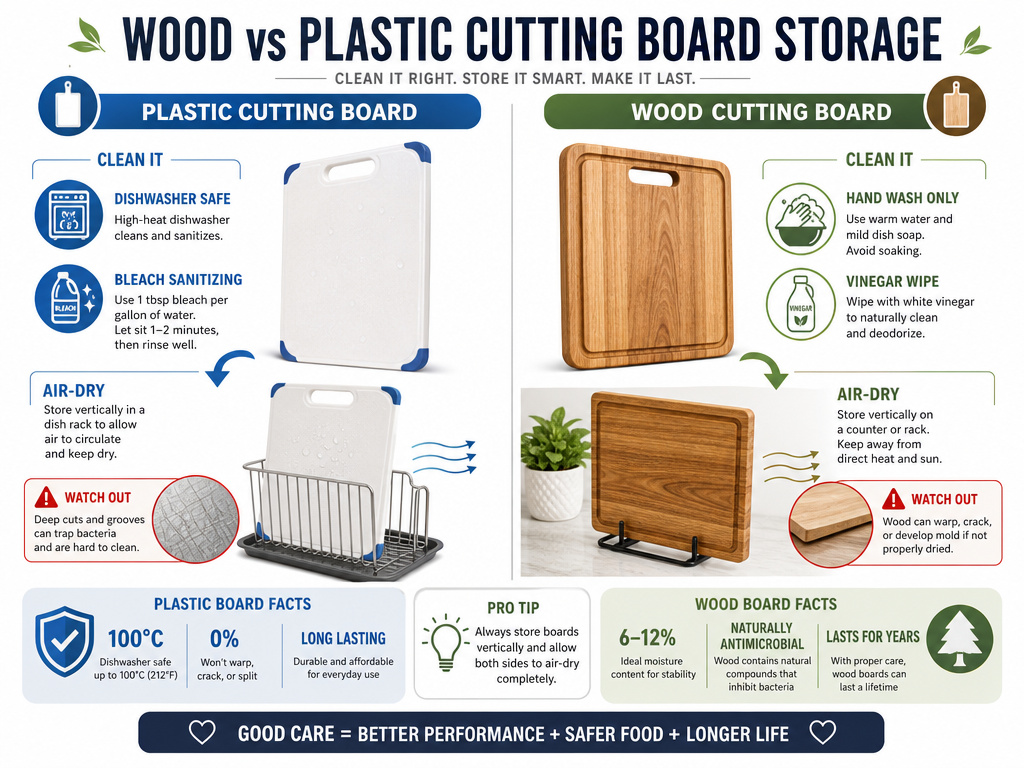 Wood and plastic boards end up in the same rack, but they get there through different paths. Ignoring their material-specific needs leads to premature damage and hidden safety risks.
Plastic (Polyethylene) Boards:
- Dishwasher Safe: Yes, generally. The high-temperature rinse of a dishwasher provides excellent sanitization. The key is to let them air-dry in the rack immediately after the cycle ends. Don’t leave them sitting in the dishwasher tub.
- Sanitizing: Can withstand bleach solutions. After washing, a spray with a diluted bleach solution (1 tablespoon unscented bleach per gallon of water) followed by air-drying is a professional standard.
- Failure Sign: Deep, cloudy scratches that feel rough to a fingernail. These grooves harbor bacteria. Once a plastic board is heavily scarred, it’s time to replace it.
Solid Wood Boards:
- Dishwasher Safe: Never. The heat and moisture cause wood to warp and split. As Hygiene Food Safety notes, these cracks become “massive reservoirs for bacterial growth.” Hand-wash only.
- Sanitizing: Avoid harsh chemicals like bleach, which can break down wood fibers. Use a mild detergent and warm water. For periodic sanitizing, use a vinegar solution (undiluted 5% white vinegar), though note it is not a registered sanitizer for commercial use.
- Drying: Critical. Wood must be dried immediately and thoroughly after washing. Standing it vertically is the only way to prevent water from seeping into the end grain, which causes cracking.
- Maintenance: Season with food-grade mineral oil or beeswax every few months when the board looks dry. This seals the surface, making it more resistant to moisture and stains.
- Failure Sign: Warping, deep cracks, or a sour smell that won’t wash away. These boards cannot be cleaned effectively and must be discarded.
Where this goes sideways: Putting a beautiful end-grain maple board in the dishwasher. The glue joints between the wood blocks will soften, and the board will literally come apart at the seams after 3-5 cycles. I’ve seen it.
Tools & Setups That Actually Work
You need a system, not just a spot. Here are the specific tools that make safe storage automatic.
- Vertical Drying Rack: This is the cornerstone. Look for a stainless-steel or coated-wire rack that holds at least 2-3 boards upright. The Victorinox Fibrox Board Rack is a classic, simple design. Place it on an empty counter section or mount it to a wall or inside a cabinet door.
- Over-the-Sink Rack: If counter space is tight, a rack that spans your sink utilizes unused air space and provides excellent drainage. Ensure it’s sturdy enough to hold heavy boards.
- Designated Cabinet with Rack: If you must use a cabinet, install a vertical rack inside it and leave the door ajar after storing a damp board to allow humidity to escape. This is a compromise, but better than flat storage.
- Color-Coded System: For ultimate food safety, use multiple boards. A color-coded set (e.g., red for raw meat, green for vegetables, blue for fish) prevents cross-contamination at the source. Store them all in the same rack, but the colors tell you their use history.
Integrating board storage into your kitchen’s drying routine is key. The rack should live next to your dish rack, not in a distant corner. The easier it is to put the board away correctly, the more consistently you’ll do it.
Frequently Asked Questions
Can I store my cutting board in the oven to save space?
No. This is a dangerous practice. You will forget it’s there and preheat the oven, melting plastic boards or causing a fire with wooden ones. Even if off, ovens are dark, enclosed, and often humid, which defeats the purpose of air-drying.
Is it okay to store boards on their side leaning against a wall?
Leaning is better than laying flat, but it’s unstable and the board’s face is still pressed against the wall, limiting air circulation to one side. A vertical rack where the board is suspended and air can flow around all sides is vastly superior.
How often should I replace my cutting board?
Replace it when it has deep grooves that catch your fingernail, significant warping, or cracks. The Academy of Nutrition and Dietetics states all boards eventually wear out and deep grooves trap bacteria that cleaning cannot remove. For a frequently used board, inspect it every 6 months.
Does the “six-inch rule” apply to boards stored inside a closed cupboard?
The rule is about elevation from floor contamination. While a closed cupboard provides some barrier, the primary issue inside a cupboard is lack of air circulation. If you use a cupboard, ensure the board is stored vertically on a rack and that the cupboard is clean, dry, and you allow humidity to dissipate.
Can I use a paper towel to dry my board after washing?
It’s better than a cloth towel, but it’s still unnecessary contact. The goal is to eliminate manual drying altogether. If you must remove droplets before racking, use a fresh, clean paper towel and discard it immediately. Do not polish or scrub.
The Bottom Line
Safe cutting board storage is a matter of physics and following the clear rules already written for professionals: six inches up, vertical for drainage, and never touched by a cloth after washing. Invest in a simple vertical rack, it pays for itself by extending the life of your boards and protecting your kitchen from preventable contamination.Your board is clean when it’s washed, but it’s only safe when it’s stored bone-dry and ready for its next use.
