Can I Storing Onions in Basement? 4 Must-Have Conditions
This post contains affiliate links. As an Amazon Associate, we earn from qualifying purchases.
Yes, you can store onions in a basement, but only if your basement meets four exact conditions: a stable temperature between 32°F and 55°F, relative humidity between 50% and inflates, good air circulation, and complete darkness. Miss one, and your onions will either sprout, rot, or turn translucent within weeks.
That gap between 32°F and 55°F is where the whole decision lives. Most basements sit at the warmer, damper end of that range, which is why so many batches fail. What follows are the four non-negotiable specs, the tools to measure them, and the fixes for when your space falls short.
Key Takeaways
- Your basement needs a stable 32–55°F to work. Temperatures above 55°F trigger sprouting; below 27°F causes freezing damage.
- Humidity must stay between 50–70%. Lower dries them out, higher invites mold and bacterial rot.
- Airflow is non-negotiable. Store onions in mesh bags or open crates at least a foot from walls.
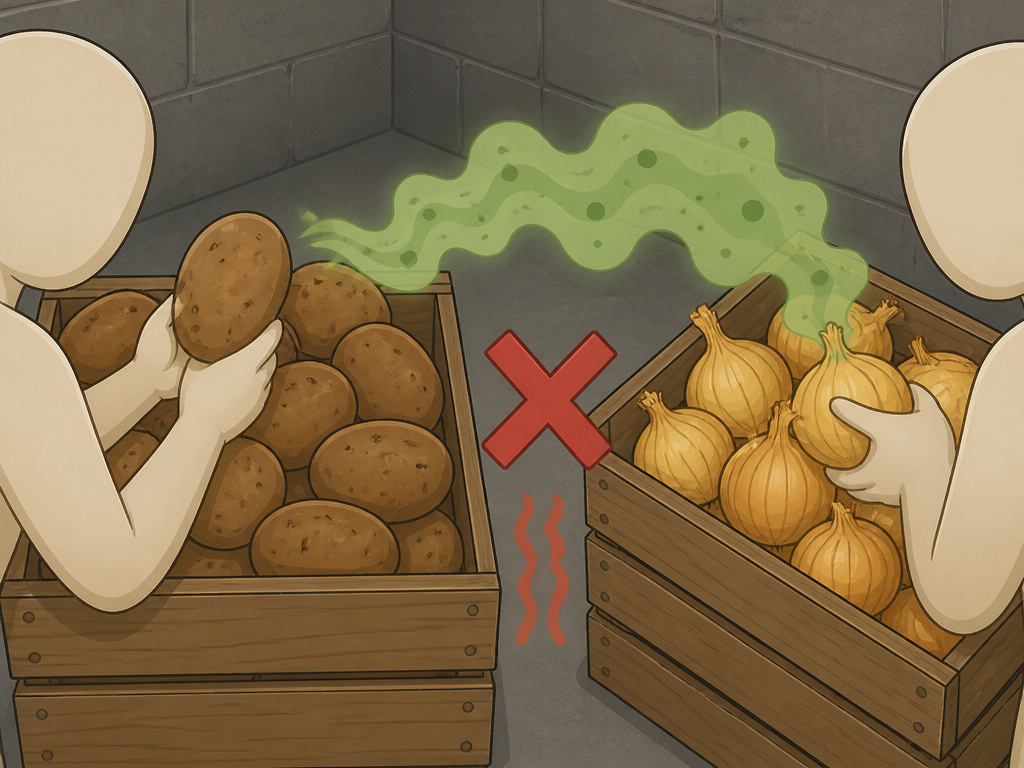
- Never store onions with potatoes. Potatoes release moisture and ethylene gas, which accelerates onion spoilage.
The Science of Onion Storage: Why Basements Are a Gamble
Onions are dormant bulbs. The goal is to keep them that way, dry, firm, and not thinking about spring. A basement can mimic the ideal root cellar environment, but most modern basements are built for furnaces and laundry, not produce. They trap humidity, lack consistent cooling, and often have zero planned airflow.
The storage life of an onion is dictated by its pungency. A mild, sweet onion like a Vidalia has more moisture and sugar. It might last a month in perfect conditions. A pungent yellow storage onion, properly cured, can go six to nine months. Your basement’s job is to halt the processes that shorten that timeline: respiration, which is temperature-driven, and microbial growth, which thrives on moisture.
Technical Snippet: According to the University of Wisconsin-Madison Extension, the optimal holding conditions for storage onions are 32°F with 65-70% relative humidity. At this temperature, respiration nearly stops, extending shelf life to 6-9 months. In the absence of refrigeration, the University of Maine Cooperative Extension notes that an unheated garage or basement may suffice, but only if temperatures can be maintained “cool,” defined as between 35°F and 55°F.
If your basement naturally sits at 50°F with 60% humidity, you’ve won the lottery. You have a passive root cellar. The rest of us need to engineer it.
The Four Basement Storage Conditions (and Where It Goes Wrong)
Your onions will tell you quickly if a condition is off. Here’s what to measure and what you’ll see if you don’t.
1. Temperature: The 23-Degree Window
Aim for 32°F to 55°F. This is not a suggestion; it’s the physiological range where onions stay dormant.
- Above 55°F: Enzymes activate. The onion thinks it’s growing season. A sprout pushes from the center within two to three weeks, and the bulb turns soft and mealy as its sugars feed the new growth.
- Below 32°F: The onion’s cells can freeze. Water expands, rupturing cell walls. You’ll see water-soaked scales, translucent, mushy layers, immediately after thawing. The Oregon State onion storage guidelines note that freezing damage is immediate and irreversible.
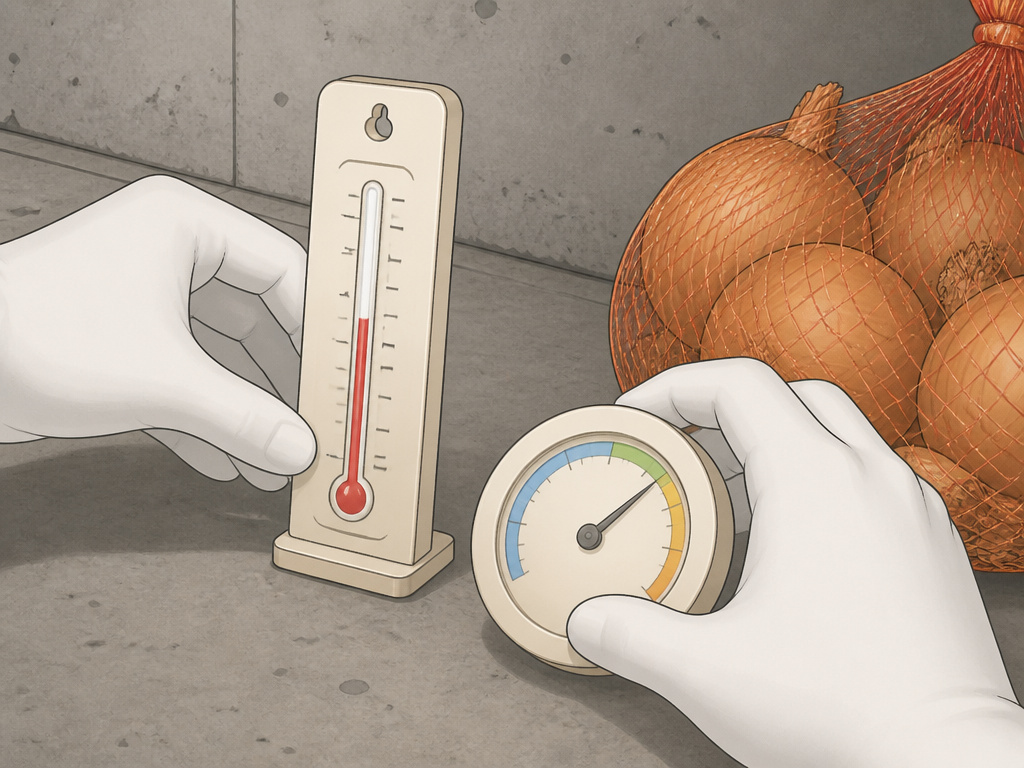
How to check it: Use a simple digital thermometer. Place it on the shelf where the onions will sit, not on the wall. Check it morning and evening for a week to gauge stability. Fluctuations matter more than the average.
2. Humidity: The 50–70% Sweet Spot
Relative humidity (RH) keeps the outer papery scales intact without letting moisture reach the bulb itself.
- Below 50% RH: The outer scales crackle and split, exposing the inner bulb to air and pathogens. The onion shrivels as it loses moisture.
- Above 70% RH: Mold spores germinate. You’ll see grey or black fuzzy patches, usually starting at the neck or a bruise. Bacterial soft rot follows, turning the onion into a foul-smelling, liquefied mess.
How to check it: A hygrometer is essential. They’re cheap. If your RH is too high, improve airflow (see condition #3). If it’s too low, which is rare in basements, you can place a shallow pan of water nearby to gently raise it.
3. Air Circulation: The Forgotten Factor
Stagnant air is a death sentence. It allows humidity to pool around the onions and lets ethylene gas, which onions themselves produce, build up and accelerate their own decay.
The University of Wisconsin storage publication emphasizes the need for dry, well-ventilated storage. This means using containers that breathe.
| Storage Method | Airflow Rating | Best For | Risk If Used Wrong |
|---|---|---|---|
| Plastic grocery bag | None | Never. | Traps humidity and ethylene; onions rot in 1-2 weeks. |
| Cardboard box | Low | Short-term (weeks), very dry basements. | If basement humidity spikes, the box absorbs moisture and molds. |
| Mesh bag | Excellent | Long-term basement storage. | None if hung freely; if piled on floor, airflow is blocked. |
| Wooden crate / milk crate | Very Good | Large quantities, stacked. | Must be kept at least 1 foot from walls for air to move around all sides. |
Common mistake: Dumping onions into a bin or box and shoving it into a corner. The onions in the center suffocate, heat up from their own respiration, and rot. That rot then spreads via spores in the still air.
4. Darkness: No Compromise
Light, especially sunlight, signals the onion to grow. It also warms the immediate area, pushing it out of the safe temperature window. Store your onions in total darkness. A cloth cover over a crate or a dark corner of the basement is fine.
How to Prep Onions for Basement Storage
The onions you store are as important as where you store them. Start with onions meant for storage, pungent yellow, white, or red varieties. Sweet onions are a losing battle.
- Cure them first. If you grew them or bought them with tops on, they need curing. Spread them out in a single layer in a warm (75-85°F), dry, shaded place with good airflow for 1-2 weeks. The necks will tighten and the outer skins will become papery.
- Inspect and sort. Feel each onion. It should be rock-hard. Any with soft spots, thick necks, or visible damage should be set aside for immediate use. One rotten onion will spoil the bunch.
- Don’t wash them. Brush off loose dirt only. The protective dry skin is your best ally.
- Trim with care. If curing, cut the dried tops to about an inch above the bulb. Don’t cut too close, as it opens a pathway for rot.
Step-by-Step: Setting Up Your Basement Storage Area
 Follow this sequence. Skipping a step compromises the whole system.
Step 1: Measure the environment. Before you bring a single onion down, place your thermometer and hygrometer in the proposed spot for 48 hours. You must confirm the conditions are in range.
Step 2: Choose your container. For most households, mesh bags are the winner. They provide maximum airflow, can be hung from hooks or beams, and let you see the contents. If you have a large harvest, use wooden crates or stackable milk crates.
Step 3: Position for airflow. Wherever you place the container, ensure air can move around it. This means not against a concrete wall, not on a dusty floor, and not crammed behind boxes. The National Onion Association recommends keeping stored onions at least one foot away from walls and other obstructions.
Step 4: Monitor and rotate. Every two weeks, feel your stored onions. Remove any that are softening or sprouting immediately. This isn’t just about saving the bad one; it’s about protecting the rest from the ethylene and mold it releases.
What Not to Store With Your Onions
 This is non-negotiable. Some common basement companions will ruin your onions.
Where this goes sideways: Storing onions and potatoes together. Potatoes release moisture and ethylene gas as they age. That humid, ethylene-rich microclimate makes onions sprout and rot twice as fast. Keep them on opposite sides of the basement.
Also, avoid storing onions near apples, which also emit significant ethylene. The Ohio State University onion fact sheet includes general storage advice that emphasizes keeping onions separate from other produce.
When Your Basement Fails: Alternative Storage Options
If your basement is too warm, too damp, or you simply don’t have one, here are your next-best choices.
The Unheated Garage: This is often better than a basement. It’s usually drier and cooler in fall and winter. The same rules apply, monitor temperature closely and bring onions inside before a deep freeze. The University of Maine onion storage guide lists an unheated garage as a primary option “until the really cold weather sets in.”
A Cool Pantry or Cupboard: If the space stays below 60°F and is dark, it can work for medium-term storage of a few months. Use a mesh bag hung on the back of the pantry door.
Refrigeration (For Sweet Onions Only): For sweet onions like Vidalias, the fridge is the recommended place. Wrap each onion individually in a dry paper towel to absorb excess moisture, then place them in the crisper drawer set to low humidity. They’ll last about a month.
Freezing or Dehydrating: If you have a surplus, preserving onions by chopping and freezing them is a reliable way to avoid waste. Dehydrating into onion flakes is another long-term solution.
Frequently Asked Questions
Can I store onions in the basement in plastic bins?
No. Plastic bins seal in humidity and ethylene gas. This creates a perfect environment for rot and mold. Always use breathable containers like mesh bags, burlap sacks, or wooden crates for proper onion storage.
How long will onions last in a basement?
It depends entirely on your conditions and the onion type. In a perfect 32-40°F, 65% RH basement, pungent storage onions can last 6 to 9 months. In a 50-55°F basement, expect 3 to 5 months. Sweet onions might only last 3 to 4 weeks even in good conditions.
Why are my stored onions turning translucent?
Translucent, water-soaked scales are a classic sign of freezing injury. Your basement likely dipped below 27°F at night. Check your thermometer’s min/max function. Once frozen, they are not salvageable for fresh use but can still be cooked immediately.
Can I store garlic and onions together in the basement?
You can, but it’s not ideal. Garlic prefers slightly cooler and drier conditions than onions (32-38°F). If your basement is in the lower end of the onion range, they can coexist if kept in separate, well-ventilated containers. For best results, follow dedicated guides on how to store garlic.
What’s the best container for basement onion storage?
The mesh produce bag is the undisputed champion for home storage. It’s designed for breathability, is easy to hang, and costs nothing if you reuse one from the grocery store. For larger scale storage, an open wooden crate is the professional choice.
Before You Go
Storing onions in a basement isn’t a yes-or-no question. It’s a checklist. Hit the four targets, cool, dry, breezy, dark, and you’ll have firm onions for months. Miss one, and you’ll have a bag of compost.
Your first move is to get a thermometer and hygrometer. Data beats guesswork every time. If the numbers are off, don’t force it. Use the garage, the fridge for sweets, or preserve your surplus. The goal is to eat the onion, not just store it.
