How to Store Onions | The 3 Specs That Keep Them 9 Months
This post contains affiliate links. As an Amazon Associate, we earn from qualifying purchases.
To store onions for months, match three things: a temperature at or near 0°C (32°F), a relative humidity between 65-75%, and constant air movement. Pungent varieties like ‘Copra’ hold at these specs for 6-9 months; sweet onions like ‘Walla Walla‘ last only a few weeks regardless of conditions.
The numbers aren’t suggestions. They’re physical limits. Onions respire, losing weight and quality faster at room temperature. The right combination of cold, dry air, and flow slows that respiration to a crawl.
What follows: the exact specs from university extensions, the step-by-step home method that mirrors commercial practice, and the two mistakes that ruin a crop within a month.
Key Takeaways
- Store pungent, long-day onions at 0°C (32°F) with 65-70% humidity for maximum shelf life. Sweet, short-day onions are short-term storage only.
- Cure onions thoroughly until the necks are tight and the outer skins rustle. Skipping this step invites neck rot within two weeks.
- Provide constant, gentle air movement. Stagnant air lets moisture settle and fungal spores germinate.
- Never store onions with potatoes or other high-moisture produce. The onions will absorb that ambient moisture and soften.
- Check stored onions monthly. Remove any that show softening or sprouting immediately to prevent spread.
The Exact Temperature and Humidity Numbers You Need
Forget “cool, dry place.” That phrase hides a ten-degree range that decides whether your onions last six months or six weeks.
Commercial storage runs on published specs. The FAO postharvest compendium on onions consolidates global research, but regional extensions nail it down further. The Oregon State onion storage guidelines specify 0.6°C (33°F) at 60-70% RH for refrigerated holding in the Columbia Basin. East of the Cascades, non-refrigerated storage targets 2°C (35°F).
Refrigerated storage at 0°C (32°F) with 70-75% relative humidity is the globally recommended condition for long-term onion preservation, per the FAO. At this setting, respiration slows to 3-4 ml of CO₂ per kg of onions per hour.
Why does a few degrees matter? Onion respiration isn’t linear. The UC Davis produce facts sheet notes the rate jumps from ~4 ml/kg·hr at 0-5°C to over 27 ml/kg·hr at 25°C. That’s nearly a seven-fold increase in metabolic activity. The onions consume their own sugars, lose mass, and soften.
| Onion Type | Optimal Temp | Optimal RH | Expected Storage Life |
|---|---|---|---|
| Pungent / Storage | 0°C (32°F) | 65-70% | 6-9 months |
| Sweet / Short-Day | 0°C (32°F) | 65-70% | 3-6 weeks |
| Do NOT Store At | 5-25°C (41-77°F) | Any humidity | Promotes rapid sprouting |
Home storage rarely hits a perfect 0°C. A basement or cellar hovering between 4-10°C (40-50°F) can work for a few months if the humidity is controlled. The Iowa State extension onion FAQ suggests 32-40°F with 65-70% RH as a practical home target.
The takeaway is precision. “Cool” means as close to freezing as you can get without actually freezing the bulbs. “Dry” means 65-70% relative humidity, not bone-dry desert air.
Why Your Onion Variety Decides Everything
You can’t store a ‘Walla Walla’ like a ‘Copra’. The cultivar’s genetics dictate its storage potential before you even pull it from the ground.
Long-day, pungent onions have higher dry matter content and more phenolic compounds. These act as natural fungicides and sprouting inhibitors. Short-day, sweet onions have higher water content and sugar levels. They’re bred for immediate mild flavor, not shelf stability.
The Iowa State extension onion FAQ names names: ‘Copra’ and ‘Stuttgarter’ are good keepers for several months. ‘Walla Walla’ and ‘Candy’ are poor keepers, lasting only a few weeks. If you’re planning a long-term storage strategy, start with the right seed.
Common mistake: Buying sweet onion varieties in bulk expecting them to last. Their biochemistry guarantees a short shelf life. Use them first.
This is the first filter. Know your onion. If you grew or bought a sweet variety, your best storage plan is to eat it within a month. For true keeping onions, the next step is non-negotiable.
Step-by-Step: From Harvest to Storage Bin
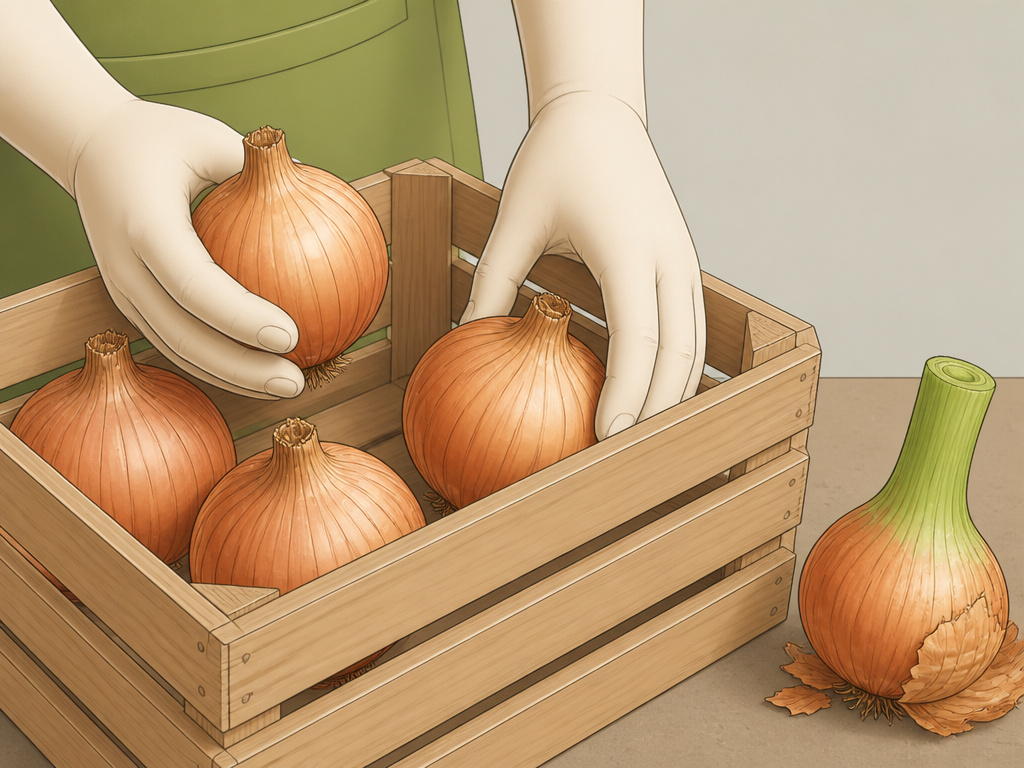
Storage starts at harvest. A bruised bulb or a damp neck is a future rot pocket. The process is simple, but each step has a physical consequence if skipped.
1. Harvest at the right sign. Wait until most tops have fallen over naturally. Don’t bend them over yourself. The plant is reallocating resources from the leaves to the bulb, sealing the neck from the inside out.
2. Cure completely. This is the most critical phase. Lay bulbs in a single layer in a warm, dry, well-ventilated spot, a shed, garage, or covered porch. Leave the tops on. They need 2-3 weeks. The goal is to dry the outer scales and, most importantly, the neck until it’s tight and papery. The outer skin should rustle when rubbed.
3. Trim and sort. After curing, cut tops 1-2 inches above the bulb. Now inspect. Discard any with thick, green necks, they won’t store. Feel for soft spots. Even one compromised onion can spoil a crate. This is the time for ruthless sorting.
4. Choose a breathable container. Mesh bags, woven baskets, milk crates, or slatted wooden boxes. The container must allow air to circulate on all sides. Plastic bins or sealed bags trap ethylene and moisture. A pantry organization system using stackable crates works well.
5. Place in your cold zone. This is your basement corner, unheated garage (monitored so it doesn’t freeze), or spare refrigerator set to the high 30s°F. Never use the same fridge as ripe fruit; onions absorb odors.
Follow these five steps and your methods for storing onions long-term will work. Skip curing, and neck rot sets in by week two. Use a non-breathable container, and you’ll smell the problem before you see it.
The Two Failure Modes That Sneak Up On You
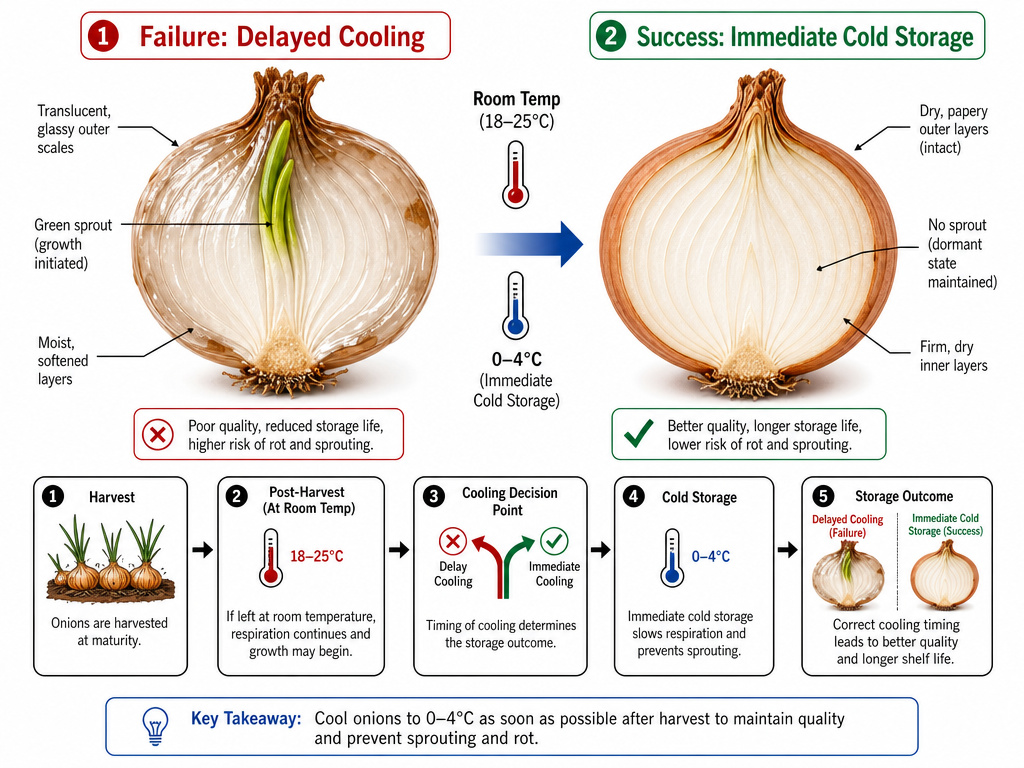
Two specific problems don’t show up until it’s too late: translucent scales and sprouting induced by delayed cooling.
Translucent scales look like freezing injury, glassy, water-soaked outer layers. According to postharvest research, a 3-4 week delay in moving cured onions into cold storage significantly increases the risk. The mechanism isn’t fully understood, but it’s linked to water redistribution within the bulb at non-optimal temperatures. The fix is simple: move onions from curing directly into cold storage. Don’t let them sit at room temperature for a month.
Sprouting is triggered by temperatures between 5-25°C (41-77°F). This range mimics spring conditions, telling the bulb it’s time to grow. Once the green shoot emerges from the center, the onion’s flavor turns sharp and its texture softens. The only prevention is immediate, consistent cold. This is why the ISO onion storage standard emphasizes rapid temperature stabilization after curing.
Where this goes sideways: Letting onions “rest” in the garage for a month after curing. That rest period is the sprouting trigger. Get them cold within days of finishing the cure.
Commercial operations use Controlled Atmosphere (CA) storage, low oxygen, high carbon dioxide, to further suppress sprouting. At home, your best tool is a consistent 0-4°C environment.
How Commercial Storage Works (And What to Copy)

A YouTube walkthrough of a Pacific Northwest storage facility shows the scale: one bay holds seven million pounds. The technology isn’t magic; it’s optimized airflow and precise temperature control.
The core principle is 1 m³ of air movement per minute for every m³ of onions. Massive fans pull air through refrigeration coils to drop temperature and wring out humidity, then force it through pressurized tunnels under the pile. The air flows up through the onions, removing field heat, respiration heat, and moisture.
You can’t replicate that volume, but you can copy the intent. – Air movement: Use a small, low-speed fan in your storage area if it’s enclosed. A ceiling fan on low in a basement corner helps. – Moisture control: If your storage feels damp, add a desiccant like silica gel or a bucket of unscented clay cat litter. This is especially important for basement storage. – Stack for airflow: Don’t dump onions into a deep bin. Use shallow crates and stack them with gaps between. The optimal storage conditions require air contact on all sides.
This approach also works for other alliums. The principles for storing garlic are nearly identical, cool, dry, ventilated, though garlic prefers slightly warmer temperatures (around 15°C/60°F).
Onions vs. Potatoes: Why They’re Storage Enemies
Every old-time recipe says to store them together. Every modern extension says it’s a mistake.
Potatoes release moisture and ethylene gas as they respire. Onions are hygroscopic; they absorb that ambient moisture. A damp onion skin is a breeding ground for Aspergillus and Botrytis molds. The potato, meanwhile, prefers a higher humidity (85-90%) than the onion’s ideal 65-70%.
The result: both spoil faster. The potato shrivels, the onion rots.
Keep them separate. A dedicated root cellar might have separate chambers. At home, use different crates on opposite sides of the basement. This same logic applies to other pairings. Learn the specific rules for storing potatoes and storing sweet potatoes to avoid cross-contamination.
What to Do With Cut or Partial Onions
A whole, cured onion is a sealed system. The moment you cut it, you breach that seal. The best way to store cut onions is to treat them as a perishable.
For a half or quarter, wrap tightly in plastic wrap, pressing the wrap directly onto the cut surface to minimize air exposure. Refrigerate and use within 3-4 days. Diced onions go in an airtight container in the fridge for 2-3 days. For longer storage, spread diced onions on a tray, freeze solid, then transfer to a freezer bag. They’ll last months but will only be suitable for cooked dishes, the texture turns soft.
This is a different skill set from whole onion storage. It’s part of a broader home preservation strategy that includes pickling, dehydrating, and freezing.
Frequently Asked Questions
Can I store onions in the refrigerator?
You can, but it’s often overkill and wastes space. The humidity in a standard fridge crisper (90%+) is too high for onions, promoting mold. If you must fridge-store them, use the main compartment (less humid) and keep them away from ethylene-producing fruits like apples. A dedicated garage fridge set to 4°C (40°F) is a better option.
How do I know if a stored onion is going bad?
Feel it. A good storage onion is rock-hard. The first sign of trouble is a slight softening at the neck or on one side. Next, look for dark, powdery spots under the skin (black mold) or a grey, fuzzy growth (neck rot). Smell it. A healthy onion has almost no odor until cut. A sour or musty smell means internal decay.
Should I wash onions before storing them?
Never. Washing removes the protective dry outer scales and introduces moisture. Brush off loose dirt after curing, but leave the papery skins intact. They are part of the onion’s natural packaging.
Can I store green onions the same way?
No. Green onions (scallions) are a leafy green, not a storage bulb. For storing green onions, trim the roots, stand them upright in a jar with an inch of water, cover loosely with a plastic bag, and refrigerate. They’ll last about a week.
Why are my stored onions sprouting?
They’re too warm. Temperatures between 10-20°C (50-68°F) are the sprouting range. Once a sprout appears, the onion is done for long-term storage. Use it immediately, as the center will be tough and the flavor more intense.
Before You Go
Store onions like the commercial growers do: start with a keeping variety, cure until the neck is tight, then hold them at a steady, cold temperature with moving, dry air. The numbers, 0°C, 65-70% RH, aren’t just goals. They’re the physical parameters that slow respiration to a near halt.
For most home gardeners, that means a mesh bag in the coldest corner of a dry basement, checked monthly for soft spots. Forget the pantry. Forget the cupboard. Think like a warehouse manager. Control the climate, and the onions will keep until spring.
