
What Is a Deep Freezer? Essential Facts on Sub-Zero Storage
This post contains affiliate links. As an Amazon Associate, we earn from qualifying purchases.
A deep freezer is a specialized refrigeration appliance engineered to reach and maintain temperatures far below a standard home freezer, typically between -40°C and -86°C (-40°F and -122°F). This extreme cold is not for extra ice cream; it’s the minimum standard for preserving biological integrity in vaccines, research samples, and high-value food like wagyu beef, where even a few degrees of fluctuation can mean total loss.
That temperature gap isn’t just a number on a dial. It demands a different mechanical heart, a cascade refrigeration system, and far thicker insulation. While a standard freezer slows microbial growth, a deep freezer halts enzymatic and cellular activity almost completely. The trade-off is cost, energy use, and a complete intolerance for the garage or laundry room environments a regular freezer might handle.
What follows is a breakdown of the three specs that actually matter, the two mechanical systems that make the cold, and the one installation mistake that voids the warranty on day one.
Key Takeaways
- Deep freezers operate between -40°C and -86°C, a range necessary for preserving biological samples, vaccines, and premium meats.
- They use a cascade refrigeration system (two compressors stacked) to achieve ultra-low temps, unlike a standard freezer’s single compressor.
- The EN 62552 standard requires a deep freezer to freeze at least 4.5 kg of food per 100 liters of capacity within 24 hours at 25°C room temperature.
- Humidity and high ambient temperature are the top installation killers; placing a unit in a garage or damp basement risks compressor failure and safety shorts.
- For long-term home food storage, a garage-ready upright freezer set to -18°C is usually sufficient and costs a fraction of a true deep freezer.
The Core Specs: Temperature, Capacity, and Climate Class
Forget marketing fluff. Three printed specifications tell you if a unit is a true deep freezer or just a cold box with ambitions.
The temperature setting range is the first filter. A home freezer might go down to -24°C. A commercial deep freezer like the Hoshizaki HDF series has a factory setting of -60°C with an adjustable range down to -50°C. If the spec sheet doesn’t show a minimum temperature of at least -40°C, you’re looking at a standard freezer.
The EN 62552 standard requires that a freezer be able to freeze at least 4.5 kg of food per 100 liters of freezer compartment volume within 24 hours at a room temperature of 25°C. This is the freezing capacity, a measure of raw cooling power, not just storage space.
Capacity is listed in liters or cubic feet, but the usable space is always less. Look at the interior dimensions, not the nominal volume. A Maxx Cold Select MXSF48U undercounter unit lists 11.1 cubic feet (314 L), but the interior measures 43″ W x 23.4″ D x 26.6″ H. That’s the space you actually get.
The climate class is the most ignored spec with the fastest consequences. It’s a letter code. SN, N, ST, or T, that tells you the ambient temperature range the compressor is rated for. | Climate Class | Ambient Temperature Range | Typical Environment | |——————-|——————————–|————————–| | SN (Subnormal) | 10°C to 32°C | Cool basement | | N (Normal) | 16°C to 32°C | Indoor, climate-controlled| | ST (Subtropical) | 16°C to 38°C | Garage in mild climates | | T (Tropical) | 16°C to 43°C | Garage in hot climates |
Installing an N-class unit in an uninsulated garage that hits 38°C in summer means the compressor runs non-stop. It dies within 18 months.
How Is a Deep Freezer Different from a Regular Freezer?
The difference is mechanical, not just colder air. A standard freezer uses a single-compressor vapor compression cycle. It’s efficient for hitting -18°C. To plunge to -60°C, you need a cascade system.
Think of it as two complete refrigeration circuits stacked. The first circuit cools the interior to an intermediate range, say -20°C. The second circuit uses a different refrigerant to cool the first circuit’s condenser, pulling temperatures down another 40 degrees. This dual-stage process is why true deep freezers are louder, more expensive, and draw more power.
The insulation is different, too. Thicker walls with higher-density foam keep that intense cold in. A regular freezer might have 3 inches of insulation; a deep freezer has 5 or 6. That extra mass is why the exterior feels only cool, not frozen, even at -60°C.
Where this goes sideways: Using a standard freezer for deep-freeze tasks. Vaccines stored at -18°C instead of -50°C can lose potency in weeks. Premium meat crystals form differently, damaging cell structure and turning a $200 cut into stringy, flavorless protein.
For most home food preservation, understanding the basic function of a freezer is enough. The jump to a deep freezer is for when the stakes are irreplaceable.
What Is a Deep Freezer Used For? (It’s Not Just Leftovers)
This isn’t appliance overkill. Each use case depends on a specific temperature threshold.
Medical and Laboratory: This is the primary domain. Vaccines, blood plasma, and many biological reagents require storage at -50°C to -80°C. At -18°C, their proteins denature and they become useless. Research samples follow the same rule, genetic material, enzymes, and cell cultures need the deep freeze to remain viable for years.
Commercial Food and Hospitality: High-end restaurants and butchers use deep freezers for aging premium cuts. Ultra-low temperatures allow for very slow, controlled aging without bacterial spoilage. It’s also for bulk storage of ingredients with high fat content, which oxidizes and turns rancid faster at higher freezing temperatures.
Home Use (The Niche Case): For a household, a true deep freezer is rarely justified. The exception is a hunter or fisherman processing hundreds of pounds of meat or fish at once, where rapid freezing at -40°C preserves texture far better than a home freezer’s slower freeze. For everyone else, a garage-ready freezer set to -18°C is the practical choice.
The mechanical principles of refrigeration are the same, but the performance envelope is what separates a kitchen appliance from a laboratory instrument.
The Two Types of Deep Freezers: Chest vs. Upright
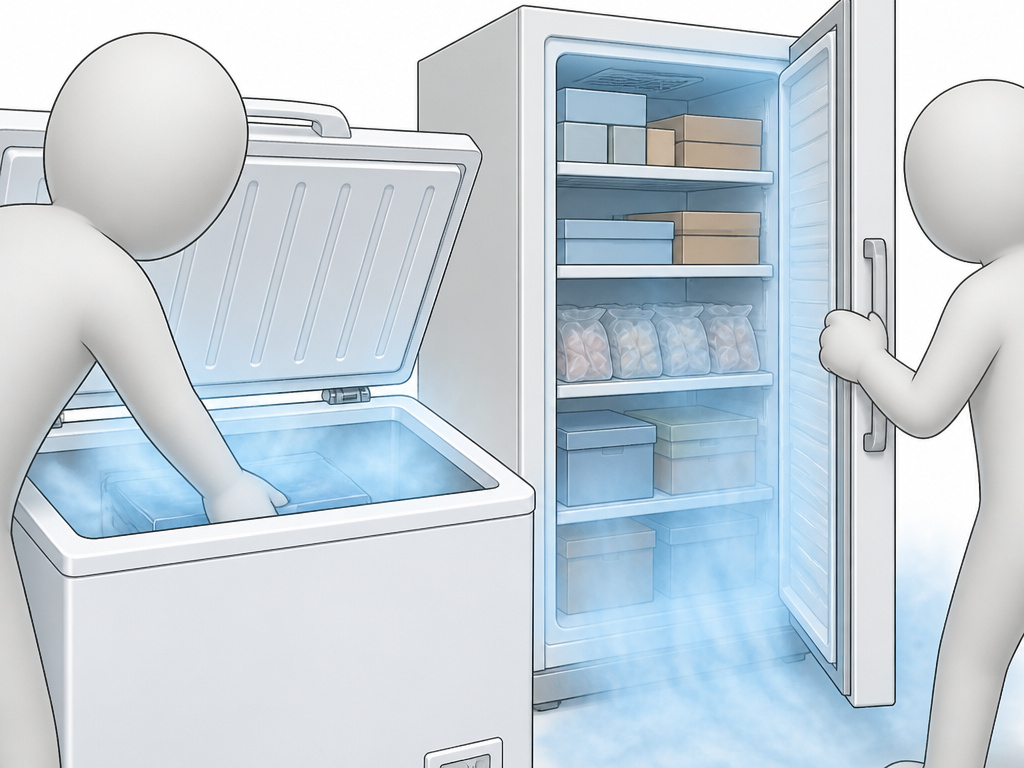 You have two physical forms, and the choice dictates what you can store and how much energy you’ll use.
Chest Freezers are the classic deep freeze shape. They offer more usable cubic footage for the exterior footprint and have better cold-air retention (cold air sinks, so it doesn’t rush out when you open the lid). They are generally more energy-efficient. The trade-off is organization, digging through a chest for a specific package is a chore. Models like the Amana Deepfreeze are built for sheer volume and efficiency.
Upright Freezers look like a refrigerator. They use shelves and drawers, so organization is straightforward. The major drawback is that every time you open the door, all the cold air falls out, making the compressor work harder. They also have less actual storage space than a chest freezer of the same exterior size due to the internal shelving framework. For upright deep freezers used in labs, the shelving is often specialized for racking boxes or vials.
| Feature | Chest Freezer | Upright Freezer |
|---|---|---|
| Cold Retention | Excellent (cold air stays in) | Poor (cold air spills out) |
| Floor Space | Large footprint | Smaller footprint, taller |
| Organization | Difficult, requires bins | Easy, with shelves and drawers |
| Energy Efficiency | Typically higher | Typically lower |
| Best For | Bulk storage, maximum efficiency, garages | Frequent access, lab samples, organized inventory |
If you need maximum efficiency and don’t mind digging, a chest is the answer. If you need to access specific items daily without unloading the whole unit, an upright wins.
Critical Installation and Safety Rules
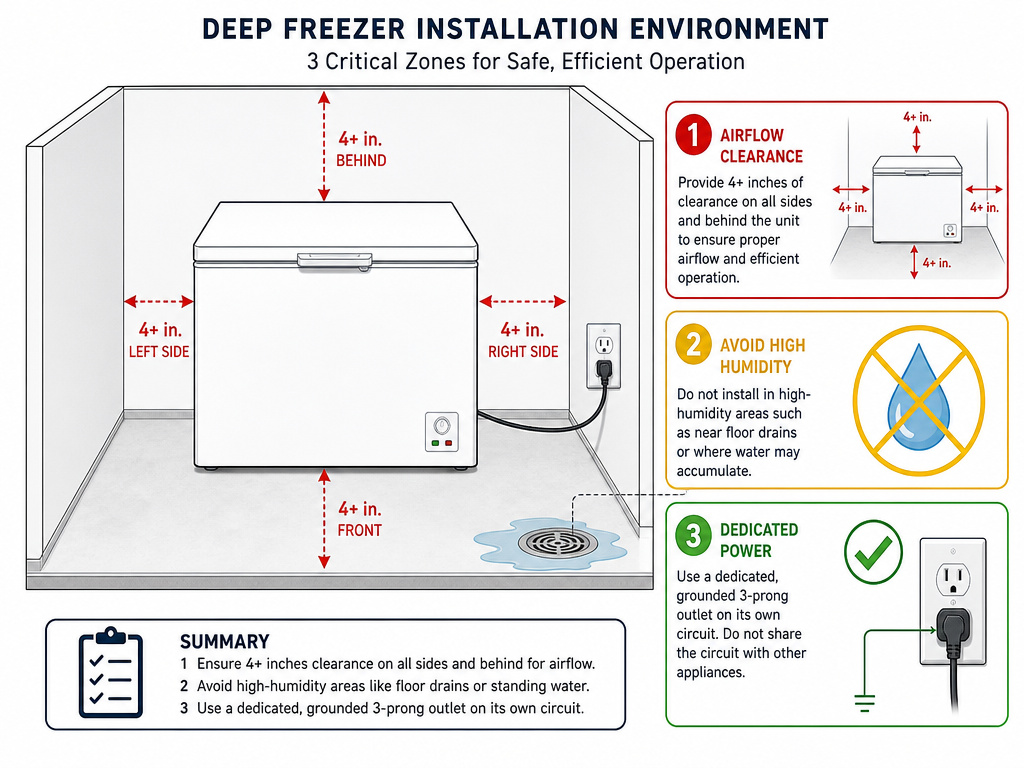 The manual’s installation section isn’t suggestions. It’s a checklist to avoid a $3,000 paperweight.
Location is Everything. The unit needs clearance, at least 4 inches on all sides and especially at the back for condenser airflow. More critical is the environment. Never install it in a room with high humidity, like a laundry room or basement with a floor drain. Condensation forms inside the electrical compartment, leading to short circuits. Garages are risky unless the unit is explicitly rated for the climate class (ST or T).
Power is Non-Negotiable. These are not appliances you plug into an extension cord or a shared outlet. A Hoshizaki HDF-140A draws 3.8A; larger models pull more. They require a dedicated, grounded 3-prong outlet on their own circuit. The power cord has a third prong for a reason, bypassing it risks electrocution.
Before you start: The compressor and lines carry high voltage even when unplugged. Never attempt to service the sealed refrigeration system yourself. A puncture releases refrigerant under high pressure and can cause severe frostbite. Leave repairs to a certified technician.
Leveling is Not Optional. Use the adjustable feet to make the unit perfectly level in both directions. An unlevel freezer strains the compressor, causes uneven wear on the door seals, and can lead to early failure. This is the first thing installers check on commercial units like the Maxx Cold Select series.
Operating and Maintaining a Deep Freezer
Operation is simple, but the penalties for getting it wrong are steep.
The First Freeze. When you plug it in, set the temperature and walk away for 24 hours. Let the cabinet come down to temperature empty. Loading it with warm food immediately forces the compressor into a marathon it can’t win, risking a thermal overload shutdown.
Loading for Efficiency. Don’t just fill it. Stack items tightly to create thermal mass, which helps maintain temperature during door openings. But leave some space for air to circulate around the cooling vents, usually on the back wall. Refer to the manual, the top shelf often has the highest freezing capacity for a reason.
Defrosting. Most modern units, especially uprights, use a NoFrost system that automatically defrosts the evaporator coil. You’ll never see ice buildup. Older chest freezers or manual defrost freezer models require you to power down and melt accumulated ice once or twice a year. Letting frost build beyond half an inch makes the compressor run constantly.
The One Cleaning Rule. Unplug it first. Use a mild detergent and warm water. Never use abrasive cleaners or solvents on the interior liner, they can crack it. For the exterior, especially stainless steel, use a cleaner meant for appliances to avoid streaks.
Troubleshooting Common Deep Freezer Problems
The symptoms are simple; the causes are specific.
Not Cold Enough. Check the ambient temperature first. If the room is above 32°C (90°F), even a healthy compressor can’t keep up. Next, feel the condenser coils on the back, if they’re hot, the compressor is running. If they’re cool, the compressor might not be kicking on due to a failed start relay or a blown fuse (the Hoshizaki manual specifies a 10A fuse).
Excessive Frost or Ice. This almost always points to a bad door seal. Close the door on a dollar bill; if you can pull it out easily, the seal needs replacing. In a humid environment, frequent door opening introduces moisture that turns to frost.
Strange Noises. A loud hum that comes and goes is usually the compressor cycling, which is normal. A constant, loud buzzing or rattling is not. It could be a failing fan motor or the compressor mounting bolts working loose. For undercounter models like the Maxx Cold, ensure nothing is touching the exterior panels, as they can amplify vibration.
Water on the Floor. This is either a blocked defrost drain (in auto-defrost models) or, more seriously, condensation from high humidity collecting inside the cabinet and dripping out. If the room is humid, a dehumidifier nearby is cheaper than a new compressor.
The goal is to prevent freezer burn and system failure. Most issues trace back to installation environment or user habit, not a faulty unit.
Frequently Asked Questions
How cold is a deep freezer?
True deep freezer reaches temperatures between -40°C and -86°C (-40°F and -122°F). Commercial lab models like the Hoshizaki HDF series are factory set to -60°C. This is fundamentally colder than a standard home freezer, which typically maxes out between -18°C and -24°C.
Can I use a deep freezer as a regular freezer?
You can, but you shouldn’t. It’s overkill. A deep freezer costs 3-5 times more upfront and uses significantly more electricity to maintain ultra-low temperatures. For storing frozen vegetables, ice cream, and meats for a few months, a standard freezer is far more economical. The deep freezer’s purpose is for items that degrade at anything warmer than -40°C.
What is the difference between a freezer and a deep freezer?
The difference is in capability and construction. A standard freezer holds food at -18°C using a single compressor. A deep freezer reaches -40°C to -86°C using a two-stage cascade refrigeration system and has much thicker insulation. One is for preservation; the other is for near-perfect stasis.
Is a deep freezer better for long-term food storage?
For very long-term storage (over a year), the deep freezer’s colder temperatures better preserve texture and flavor by forming smaller ice crystals. However, for most households, the energy cost outweighs the benefit. Proper packaging for freezing in a standard freezer is more important than a few extra degrees of cold.
How much does a deep freezer cost to run?
It varies widely by model, size, and ambient temperature, but expect a true deep freezer to use 2-3 times the electricity of a similarly sized standard freezer. A unit in a hot garage will cost even more. Always check the Energy Guide label, and remember that a garage-ready freezer rated for wider temperature swings will be more efficient in non-climate-controlled spaces.
Before You Go
A deep freezer is a tool for a specific job. If you’re not storing vaccines, biological samples, or aging wagyu, you don’t need one. The investment and operating cost are too high.
For 95% of homes, the right move is a well-built upright or chest freezer set to -18°C, placed in a cool, dry space, and packed using techniques that prevent freezer burn. Focus on the specs that matter for your reality: capacity, climate class, and energy rating. Let the labs and pharmaceutical companies handle the -60°C world. Your leftovers will be just fine.
