
What Is a Convertible Freezer? A Complete Dual-Mode Guide
This post contains affiliate links. As an Amazon Associate, we earn from qualifying purchases.
A convertible freezer is a single appliance that can operate as either a standard refrigerator or a standalone freezer at the push of a button, with internal temperatures typically adjustable from about -11°F (-24°C) for freezing to 46°F (8°C) for refrigeration. It’s a dual-mode unit designed for flexible food storage, often marketed as garage-ready for use in spaces with wider temperature swings.
That flexibility is the whole point. But the switch isn’t magic, it’s a mechanical and electronic process with hard limits on how fast it can change and what environments it can handle. Getting those limits wrong is how you end up with a unit that runs constantly, trips error codes, or voids its warranty in under a month.
What follows: the mechanical truth behind the mode switch, the exact specs that matter (drawn from service manuals), a head-to-head on who builds what, and where these units actually make sense over buying two separate appliances.
Key Takeaways
- Mode switching takes hours, not minutes. Converting from fridge to freezer can take a full day to reach target temperatures; adding warm food resets the clock.
- “Garage-ready” is a specific spec. It means the unit is tested to operate in ambient temperatures from 38°F to 110°F (3°C to 43°C). Using it outside that range can cause failure.
- Special functions have firm time limits. Features like Cold Boost or Fast Freeze auto-shut off after 24-50 hours to prevent overcooling and compressor strain.
- Warranties often have critical carve-outs. For example, Danby warranties plastic parts on its DUF140A1WDB model for only 30 days from purchase.
- They solve a space problem, not a capacity one. A convertible is ideal where you need occasional extra freezer or fridge space but lack room for a second full appliance.
How Does a Convertible Freezer Actually Work?
The core mechanism is a single compressor and cooling system paired with an electronic control board. When you press the mode button, the board changes the thermostat’s target temperature and, on many models, adjusts the fan speed. It doesn’t have two separate cooling circuits. This is why the conversion isn’t instantaneous.
The compressor and evaporator coil work identically in both modes. The system simply pursues a different set-point: around 0°F to -11°F (-18°C to -24°C) for freezing, and 35°F to 46°F (2°C to 8°C) for refrigeration. The physical process of removing heat remains the same.
Switching from refrigerator to freezer mode is the more demanding transition. The unit must now extract enough heat to drop the interior air and all the thermal mass inside, including any food, shelves, and liners, by 50 degrees Fahrenheit or more. This is why manuals warn against adding warm food during the changeover; it adds more heat for the system to remove, prolonging the stabilization period and potentially triggering a high-temperature alarm.
The reverse switch, from freezer to refrigerator, is mechanically simpler but requires you to remove all frozen food first. If you don’t, the system will slowly warm the contents, causing them to thaw. Most manuals are explicit: you must have another appliance to hold the food during the transition.
Key Specs and Features You Must Check
Looking at a convertible freezer’s spec sheet tells you what it can actually do. The marketing says “flexible,” but the numbers say where that flexibility ends.
Temperature Ranges and Timers
Every model has a published operating range. These are not suggestions.
| Specification | Typical Range | Why It Matters |
|---|---|---|
| Freezer Mode Temp | -11°F to 10°F (-24°C to -12°C) | Sets how cold it can get. Not all reach a true deep-freeze -0°F. |
| Fridge Mode Temp | 35°F to 46°F (2°C to 8°C) | Must stay within safe food refrigeration bounds. |
| Ambient Operating Temp | 38°F to 110°F (3°C to 43°C) for garage-ready models | Using it in a colder garage or hot porch outside this range causes failure. |
| Fast Freeze/Cold Boost Duration | 24 to 50 hours (auto-shutoff) | Prevents compressor damage from continuous max-cool operation. |
The ambient temperature specification is the most overlooked. A garage-ready freezer like the Frigidaire FFUE1536A is explicitly designed for a garage where temperatures might swing seasonally. A non-garage-rated model, even if convertible, should stay in your climate-controlled kitchen. Putting a standard unit in an uninsulated space is asking for a breakdown.
Special Functions: Cold Boost, Fast Freeze, and Alarms
These features exist for specific jobs, and they all have built-in timers.
- Cold Boost (Frigidaire) / Fast Freeze (Danby): This function maxes out the compressor, setting the temperature to its lowest point, like -11°F (-24°C) on a Frigidaire. It’s for rapidly freezing a new batch of food. It will turn itself off after a set period, often 24 to 40 hours, to protect the compressor from burnout.
- High-Temperature Alarm: This triggers if the interior stays too warm for too long. For example, the Frigidaire manual states the alarm sounds if the freezer interior stays above 18°F (-8°C) for 36 hours. It’s a warning that the mode switch isn’t complete, the door is ajar, or the ambient temperature is too extreme.
- Sabbath Mode: A niche but important feature for some users. It disables most control panel functions and interior lights while keeping the cooling system running, allowing use during religious observances without breaking custom.
Where this goes sideways: Assuming “garage-ready” means “anywhere ready.” The Danby DUF140A1WDB manual states its units are tested for ambients between 0°F and 110°F (-17°C to 43°C). If your garage dips below 0°F in winter, the unit’s components can freeze and fail. Always match the spec to your actual space.
Common Models and How They Compare
The market isn’t vast. A few brands dominate with slightly different takes on the convertible concept.
Danby DUF140A1WDB: This is a workhorse upright model. Its Fast Freeze function drops the temperature to -18°F (-28°C) for 26 hours before reverting. It’s clear about its garage use limits and has a blunt warranty clause: plastic parts are covered for only 30 days. This is a unit for someone who needs basic, no-frills switching.
Frigidaire FFUE1536A: Marketed as a convertible freezer-refrigerator, this model is explicitly garage-ready. Its Cold Boost function sets the freezer to -11°F (-24°C). Its manual provides clear thresholds for its high-temperature alarms in both modes, which is a useful diagnostic tool. It represents the more user-friendly, feature-aware end of the spectrum.
Samsung Convertible Refrigerators: Samsung’s approach often integrates convertible compartments into larger French-door fridges. Their Power Freeze function boosts fan speed for up to 50 hours. These are more about flexible space inside a primary kitchen refrigerator than being a standalone garage unit.
The choice often comes down to placement. For a garage or basement, the Frigidaire or Danby garage-ready models are purpose-built. For a kitchen where you want an extra freezer for holidays and an extra fridge for summer parties, a Samsung compartment model might integrate better.
The Step-by-Step Reality of Switching Modes
Here’s the actual process, with the consequences of skipping steps called out.
- Plan for Food Migration. You must have another freezer or refrigerator ready to accept all the food from the current mode. There is no pause state.
- Skip this and you’ll lose your food. The unit will either thaw frozen items or partially freeze fresh ones during the transition.
- Initiate the Mode Switch. Press and hold the mode button (often for 3 seconds) on the control panel until the indicator changes. The display will show the new target temperature.
- Getting impatient and pressing it multiple times can confuse the control board, sometimes locking the panel or requiring a power cycle to reset.
- Allow Stabilization Time. Do not add any new food for at least 12-24 hours. Use a standalone thermometer to verify the interior has reached the new set point.
- Adding a warm gallon of soup during this phase forces the compressor to work overtime, extending stabilization by hours and increasing wear.
- Reset Special Functions. If you use Cold Boost or Fast Freeze, remember it will turn off automatically. The unit will then maintain its standard set temperature.
Ideal Use Cases: When a Convertible Freezer Makes Sense
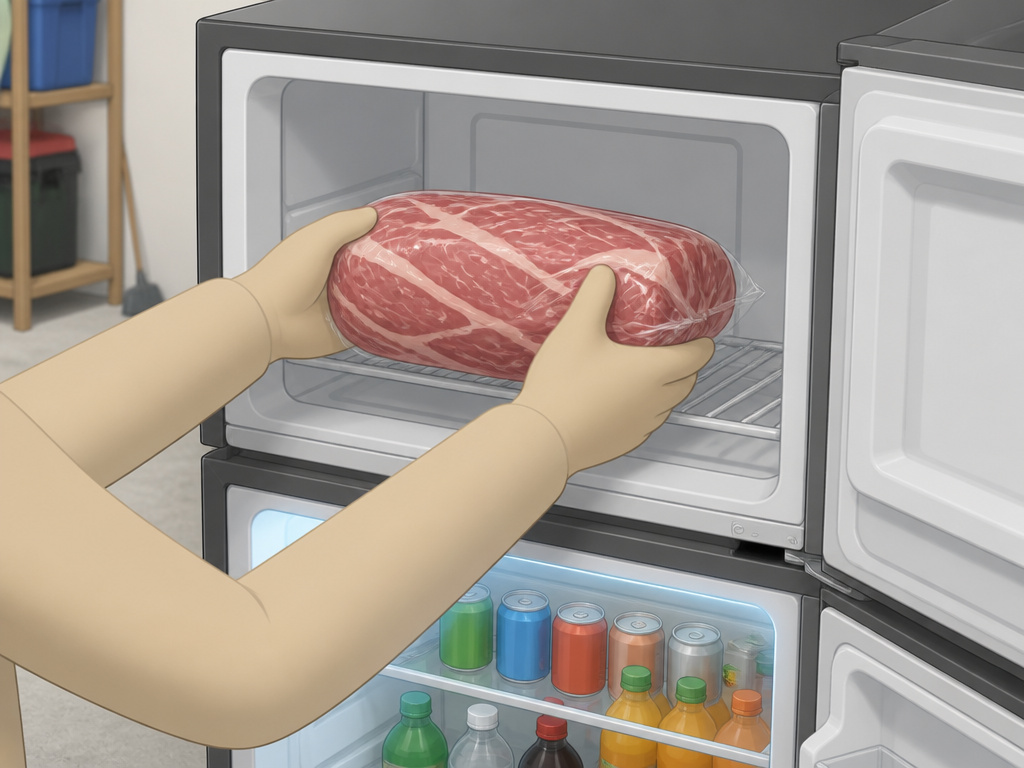 This appliance is a specialist, not a universal replacement.
- The Garage or Basement Overflow Solution: When you need extra freezer space for hunting season or bulk buys, but also want fridge space for beverage overflow during summer gatherings. A garage-ready model here is perfect.
- The Small Household with Fluctuating Needs: A couple that occasionally needs to freeze a quarter of a cow or store extra meals for elderly parents, but doesn’t want a permanent second appliance taking up space.
- The Supplemental Holiday Appliance: It can serve as a dedicated drinks fridge for a party weekend and then be switched to freeze cookie dough and leftovers in the weeks after.
It does not make sense as a home’s primary food preservation system. The switching process is too cumbersome, and the compartment is generally smaller than a dedicated unit. For bulk meat storage, a dedicated deep freezer is more efficient. For constant, high-volume refrigeration, a standard fridge is simpler.
Frequently Asked Questions
Can I switch modes back and forth frequently?
Technically yes, but it’s mechanically stressful. Each full conversion is a long, high-work cycle for the compressor. Doing it weekly will shorten the appliance’s lifespan compared to leaving it in one mode for seasons at a time.
How much does it cost to run a convertible freezer?
Operating cost depends heavily on the mode and ambient temperature. A unit in freezer mode in a hot garage will run more often and cost more than the same unit in fridge mode in a cool basement. Check the yellow EnergyGuide label for the specific model’s estimated yearly cost in its designed primary mode.
What does the E1 error code mean on my Danby?
According to the Danby DUF140A1WDB manual, an E1 code indicates a temperature sensor failure. This is a fault that typically requires a service technician, as the sensor is part of the sealed cooling system.
Is a convertible freezer the same as a dual-zone wine cooler?
No. A dual-zone cooler maintains two different, constant temperatures in separate compartments simultaneously. A convertible freezer changes the entire single compartment’s temperature. They achieve different goals.
Can I put a convertible freezer on an extension cord?
Most manuals, like Danby’s, explicitly say no. The high startup current (amp draw) of the compressor can overload a typical extension cord, creating a fire hazard. Plug it directly into a properly grounded wall outlet.
Before You Go
A convertible freezer solves a specific problem: variable storage needs in limited space. Its value is in its flexibility, not its raw performance. Success hinges on respecting its mechanical limits, the long stabilization times, the ambient temperature bounds, and the auto-shutoff timers on its special features.
Choose based on where it will live. For a variable-temperature garage, the Frigidaire FFUE1536A or a similar garage-ready model is the only safe choice. For a stable kitchen nook, a Danby offers straightforward switching. And always, without exception, read the manual first. The 30-day warranty on plastic parts is a real thing, and finding out after your control panel cracks is a bad way to learn.
