
Should You Store Coffee in the Freezer? A Data-Driven Guide
This post contains affiliate links. As an Amazon Associate, we earn from qualifying purchases.
You can store coffee in the freezer to drastically slow oxidation and extend its shelf life, but only if you vacuum-seal it in single-use portions first. For mundane, everyday coffee, this is a viable preservation method. For expensive, complex single-origin beans, freezing often mutes the vibrant top notes you paid for, as documented in peer-reviewed studies where washed Ethiopian coffee lost its acidity and fruitiness after a freeze-thaw cycle.
That shelf-life extension comes with a documented flavor trade-off. The chemistry is clear: freezing halts the staling reactions driven by oxygen and heat, but the process of freezing and thawing itself can damage cellular structure and alter moisture, stripping delicate volatiles.
What follows is a breakdown of the three storage temperatures, room temperature, refrigeration, and freezing, with the peer-reviewed numbers on what degrades and how fast. We’ll cover the single method that makes freezing work, the beans you should never freeze, and how to decide based on what’s actually in your bag.
Key Takeaways
- Freezing whole bean coffee can extend its shelf life by months, but ground coffee should never be frozen due to rapid oxidation and moisture absorption.
- Peer-reviewed research shows a clear “vibrant bean penalty”: the more complex and high-quality the coffee, the more flavor it stands to lose from freezing and thawing.
- The critical threshold is a water activity level of 0.45; beans stored above 20°C (68°F) can fall below this in 6 months, accelerating quality loss.
- Successful freezing requires an airtight, moisture-proof barrier, standard coffee bags with one-way valves are insufficient. You need vacuum sealing or airtight canisters like the Fellow Atmos.
- Refrigeration is the worst option for coffee, combining harmful moisture, light, and frequent temperature swings that promote staleness and odor absorption.
The Science of Freezing vs. Room Temperature
The debate isn’t about opinion; it’s about measurable chemical reactions. Two key processes dictate coffee’s decline: oxidation (reaction with oxygen) and the Maillard reaction (ongoing chemical changes post-roast). Temperature controls the speed of these reactions.
Storing green coffee beans at 10°C (50°F) instead of 20°C (68°F) allowed them to maintain “very good” cupping scores for up to 9 months in a peer-reviewed study. At 20°C, scores dropped significantly after just 3 months, with two samples failing to maintain the critical water activity level of 0.45 after 6 months.
Room temperature storage, typically around 20-25°C (68-77°F), keeps these reactions moving at full speed. Your coffee stales predictably. Freezing, at -18°C (0°F) or below, slams the brakes on nearly all of them. The trade-off is the thaw.
When you freeze coffee, the remaining water inside the bean’s cellular structure expands. This can fracture cell walls. Upon thawing, those broken cells release their contents differently during grinding and brewing, which can mute bright acidity and flatten complex flavor notes. A 2018 case study on freezing green coffee to treat infestation found that a washed Ethiopian coffee showed marked sensory decline after freezing, lower acidity, papery flavors, and muted fruit notes compared to the vibrant untreated sample.
| Storage Condition | Primary Effect on Coffee | Best Use Case |
|---|---|---|
| Room Temperature (20-25°C / 68-77°F) | Steady oxidation & staling; preserves full flavor profile for 2-4 weeks post-roast. | Daily-driver coffee you’ll finish within a month. |
| Freezing (-18°C / 0°F or below) | Near-complete pause on staling; risk of flavor degradation from moisture & thawing. | Long-term storage (>1 month) of bulk beans or preserving a special lot. |
| Refrigeration (4°C / 40°F) | Accelerated staling from moisture, odors, and constant temperature cycling. | None. Do not store coffee in the refrigerator. |
For your standard best coffee storage, a cool, dark cupboard in an airtight containers is sufficient. Freezing is a tool for a specific job, not a default.
Why Refrigeration is the Worst Choice for Coffee Beans
It seems logical, cooler than the cupboard, less extreme than the freezer. In practice, it’s the perfect storm for ruining coffee. Refrigerators are humid environments. Coffee beans are hygroscopic; they actively pull moisture from the air.
This moisture accelerates staling and can lead to mold if beans are stored long-term. Furthermore, every time you open the refrigerator door, the coffee is hit with a wave of warm, moist air, causing condensation to form on the cold beans inside their bag. This repeated thermal cycling degrades quality faster than steady room-temperature storage.
Common mistake: Refrigerating coffee in its original bag. The constant 40°F environment doesn’t stop staling; it introduces moisture and foreign odors from other foods, which the porous beans will absorb.
The data backs this up. A study in the Journal of the Japan Society for Design Engineering found that ground coffee stored in a glass bottle in the refrigerator saw its total acid content begin to increase at day 14, the same timeline as room-temperature storage. Refrigeration provided no protective benefit against this key indicator of quality loss. For a deeper look at the pitfalls, see our analysis on storing coffee in the refrigerator.
How to Freeze Coffee Correctly (The Only Way It Works)
Freezing fails because of two enemies: air and moisture. The standard bag with a one-way valve won’t cut it. Air trapped inside will still oxidize the beans, and the porous bag material allows freezer moisture and odors in. The goal is to create a stable, sealed microenvironment.
Step 1: Portion Immediately. Divide your whole bean coffee into doses you will use in one sitting, typically the amount for one pot or a day’s espresso. This is non-negotiable. You must avoid repeatedly thawing and refreezing the main stash, which introduces destructive moisture each time.
Step 2: Seal Airtight. Place each portion into a vacuum sealing bag. Remove as much air as possible and seal it. If you don’t have a vacuum sealer, use a high-quality freezer bags designed for long-term storage. Press out all excess air before sealing. As an alternative, a canister like the Fellow Atmos, which creates a manual vacuum, can work for smaller quantities.
Step 3: Label and Freeze Fast. Write the roast date and coffee details on the bag with a permanent marker. Place the bags flat in the coldest part of your freezer, away from the door. The goal is to freeze the beans as quickly as possible to minimize ice crystal formation.
Step 4: Thaw Without Opening. When ready to use, take one portion out and let it sit, still sealed, on your counter until it reaches room temperature. This prevents condensation from forming on the cold beans. Only open the bag once the beans are no longer cold to the touch. Grind immediately.
This method mirrors the step-by-step guide to freezing soup in its focus on portion control and air removal. The container matters, too, ensure you’re using freezer-safe containers or bags rated for the task.
Which Coffees Should You Freeze (And Which Should You Never Touch)
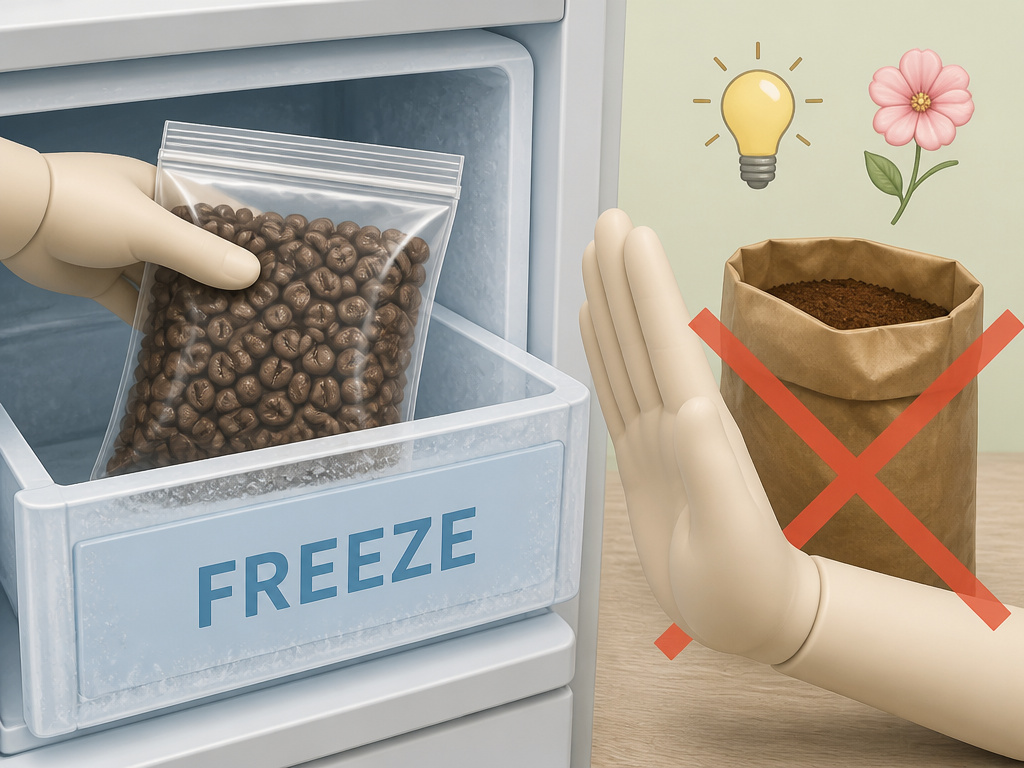 Not all coffee responds to freezing equally. The processing method, density, and flavor profile determine the risk.
Freeze These:
- Bulk Blends or “Daily Drivers”: If you buy a 5-pound bag of a consistent, darker roast blend you drink every day, freezing most of it in portions is smart. The flavor sacrifice on a hearty, chocolatey blend is minimal, and the shelf-life extension is valuable.
- Coffee You Won’t Drink Soon: Received a bag as a gift but have a backlog? Freezing it immediately upon receipt is better than letting it stale for two months in the cupboard.
Never Freeze These:
- Ground Coffee: The increased surface area means it will oxidize in seconds upon removal from the freezer, absorbing moisture and tasting flat. The PMC chemical compounds in coffee study highlights how volatile compounds are especially vulnerable in ground form.
- Exceptionally Vibrant, Light Roasts: Washed Ethiopians, bright Kenyans, or any complex single-origin where you cherish the delicate floral, tea-like, or fruity notes. These are the beans that showed the most decline in the freezing case study.
- Coffee in Paper Bags or Non-Airtight Packaging: If it’s not already sealed against the elements, freezing will only make things worse.
The rule of thumb is inverse: the more you paid for the coffee and the more unique its flavor, the less you should consider the freezer. Enjoy it fresh. Your goal for keep coffee beans fresh is to buy in quantities you can consume within a few weeks.
The Real-World Timeline: What Degrades and When
 Understanding the stakes requires a timeline. Here’s what happens to coffee left at room temperature versus frozen, based on published research.
| Time Since Roast | At Room Temperature (20°C/68°F) | In the Freezer (-18°C/0°F) |
|---|---|---|
| Day 7 | Ground coffee in an aluminum pouch shows an increase in total acid content. Color luminosity begins to decrease. | All chemical changes are effectively paused. Beans remain in a state of suspended animation. |
| Month 1 | Peak freshness has passed. Many volatile aromatic compounds have dissipated. The coffee is still drinkable but simpler. | Beans retain nearly all volatile aromatics. Taste is close to day-one freshness if vacuum-sealed. |
| Month 3 | A significant drop in cupping scores is documented. Stale, cardboard, or woody notes become noticeable. | Minimal change. The Scientific Reports coffee storage study shows samples at -10°C maintained “very good” scores at this point. |
| Month 6 | Green coffee beans can drop below a water activity of 0.45, accelerating quality loss. Flavor is largely stale. | Vacuum-sealed beans remain protected. Without a vapor-proof barrier, freezer burn and off-flavors are likely. |
This table reveals the core argument for freezing: it buys you time. But that time is only useful if you need it. Most household coffee storage doesn’t require a six-month shelf life.
Frequently Asked Questions
Does freezing coffee prevent it from going stale?
Freezing dramatically slows the staling process by reducing the kinetic energy that drives oxidation and other chemical reactions. It does not prevent staleness indefinitely, and improper freezing (exposure to air, moisture) can cause other flavor defects like freezer burn.
Can you freeze coffee in its original bag?
No. Original coffee bags, even those with one-way valves, are not vapor-proof. They will allow moisture from the freezer environment to permeate the bag, and they contain too much residual air. This leads to frost on the beans and rapid oxidation upon thawing.
How long does frozen coffee last?
Vacuum-sealed whole bean coffee can maintain good quality in a standard home freezer for 3-6 months. After that, while it may not be “bad,” it will very slowly begin to develop stale flavors. This is far longer than the K-State safe freezer storage guide recommends for most foods, highlighting coffee’s low-moisture advantage.
Does freezing kill mold on coffee?
No. Freezing temperatures render mold in the freezer dormant but do not kill the spores. If your coffee has mold before freezing, it will still have mold after thawing. Freezing is a storage method, not a sanitation step.
Is it safe to put a glass container of coffee in the freezer?
It can be, but you must follow rules for freezing in glass. Use only wide-mouth, freezer-safe glass jars and leave ample headspace (at least an inch) for liquid expansion if there’s any residual moisture. Ensure the lid seals tightly. A vacuum-sealed bag is generally safer and more space-efficient.
Before You Go
Freezing coffee is a powerful tool with a strict manual. It extends shelf life at the potential cost of peak flavor, especially for the most exciting beans in your collection. The science shows the trade-off is real: a mundane blend might survive unscathed, but a prized Ethiopian often won’t.
If you choose to freeze, commit to the process. Portion, vacuum-seal, and never re-freeze. For everything else, a dark, airtight canister in a cool cupboard is still the champion for preserving coffee freshness. Your best move is to buy what you’ll drink within a month and grind it fresh. That beats any freezer trick every time.
