
What Makes a Freezer Garage Ready | The 4 Essential Specs
This post contains affiliate links. As an Amazon Associate, we earn from qualifying purchases.
A garage-ready freezer is built to operate in a non-climate-controlled environment, meeting specific engineering standards for extreme ambient temperatures, high humidity, and freeze-rate performance. The four essential specs are a verified climate class rating (like ST or T), a freeze-rate that meets the IEC 62552 standard, humidity-resistant components, and a thermostat designed to avoid “confusion” in extreme cold.
The IEC 62552 standard, for example, demands a freezer cool 4.5 kg of food per 100 litres of volume to -18°C within 24 hours at 32°C ambient. That’s a measurable engineering benchmark, not just marketing. A freezer that passes this test in a hot lab can handle your garage in July.
What follows: the four technical specs that define “garage-ready,” why humidity kills more compressors than heat, the one feature that prevents food thawing in a cold snap, and how to read a manual to spot a unit that’s genuinely built for the job.
Key Takeaways
- Climate class is the first spec to check. Look for ST (up to 38°C) or T (up to 43°C) ratings; a standard N-class (up to 32°C) freezer will fail in a hot garage.
- Humidity protection is non-negotiable. Many manuals explicitly warn against garage installation due to short-circuit risk from condensation on live parts.
- The compressor can “get confused” below 0°F. In extreme cold, a standard thermostat may shut the system off, thinking it’s done its job, while your food thaws.
- Garage-ready doesn’t mean indestructible. Even rated units have limits, often between 0°F and 110°F. Insulating your garage or choosing a shaded spot extends the unit’s life.
- Extension cords are a hard no. They cause voltage drop, overheat, and are a leading cause of appliance failure in outbuilding installations.
The 4 Essential Garage-Ready Specs
Forget marketing claims. A freezer earns its garage stripes by meeting four verifiable engineering benchmarks. These specs are buried in the technical data sheet or installation manual, not the sales brochure.
The first and most critical is the climate class. This is a standardized rating (SN, N, ST, T) that defines the ambient temperature range the compressor and sealed system are designed for. A standard kitchen freezer is typically class N, rated for rooms between 16°C and 32°C (61°F to 90°F). Put that in a garage that hits 100°F, and the compressor runs non-stop until it burns out.
A freezer from the SN climate range can operate without difficulties down to +5°C. (Miele FNS 7794 E manual, p. 10)
A true garage-ready model will carry an ST (16°C to 38°C / 61°F to 100°F) or T (16°C to 43°C / 61°F to 110°F) rating. This isn’t a suggestion; it’s a certification of component stress-testing.
Second is freeze-rate performance, defined by the IEC 62552 standard. It states the product must freeze 4.5 kg of food to -18°C or lower within 24 hours for every 100 litres of freezer volume, at an ambient of 32°C. This quantifies recovery speed after a warm grocery load. A slow freezer in a hot garage will let ice cream melt before it re-solidifies.
Third is humidity resistance. Garages are damp. Basements are worse. Condensation on electrical components leads to corrosion and short circuits. Look for explicit language in the manual about approved environments. Many, like the one sourced for this article, warn: “Do not install the product in places such as garages or laundry rooms where humidity is high or water may splash.”
Fourth is thermostat logic for cold extremes. As noted in the Consumer Reports garage freezer placement article, Wendy Treinen of GE Appliances explains that in very cold temperatures, a regular freezer “gets confused and shuts off, failing to keep a freezing temperature because it ‘thinks’ it is already maintaining 0°F.” Garage-ready models use different sensor calibrations or a “garage mode” to override this.
| Specification | Standard Freezer | Garage-Ready Freezer | Consequence If Missing |
|---|---|---|---|
| Climate Class | N (16°C to 32°C) | ST (to 38°C) or T (to 43°C) | Compressor burnout in summer heat |
| Freeze Rate (IEC 62552) | May not be tested/verified | Meets 4.5kg/100L/24h @32°C standard | Warm spots, food thawing after loading |
| Humidity Protection | Often warned against damp locations | Sealed components, explicit garage allowance | Short-circuit, corrosion, premature failure |
| Cold Ambient Logic | Thermostat may shut off below 0°F | “Garage mode” or cold-climate calibration | Compressor cycles off, internal temps rise above freezing |
Why Humidity Matters More Than Temperature
You might obsess over summer highs, but moisture is the stealth killer. It works slowly, often without a dramatic failure until it’s too late.
High humidity causes condensation on the freezer’s external panels and, more dangerously, inside the electrical compartment. This can lead to corrosion on control boards and terminal connections. The real threat is a short circuit across live parts, which can fry the main control board, a repair that often costs more than a new unit.
Where this goes sideways: Using an unrated freezer in a damp garage. The condensation builds inside the panel over weeks, and the first major humidity spike causes a short. The repair call starts at the price of a garage-ready model.
This is why some commercial-grade units, like the Zero Zone SMZP26, specify an operating environment of 75°F or lower with a relative humidity not exceeding 55%. Residential garage-ready models might not state a hard humidity percentage, but their components use conformal coatings on circuit boards and sealed connectors.
The fix is part placement, part product choice. If your garage feels damp, a dehumidifier is a smarter investment than a cheaper freezer. Or, choose a model like the Follett FZR series, which states an optimum maximum relative humidity of 60%, a clue it’s built for less-than-ideal conditions.
Garage Mode vs. Built-In Toughness
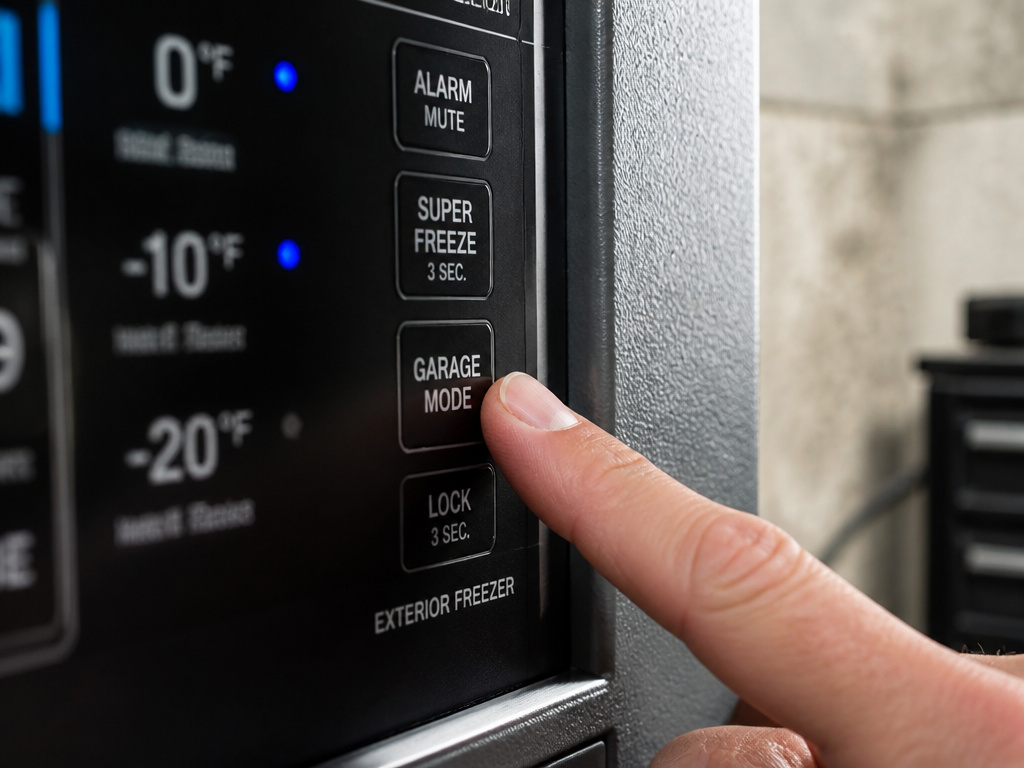
Some brands offer a “garage mode” switch, often on the temperature control panel. This isn’t a magic button. It typically does one or two things: it adjusts the thermostat’s cut-in/cut-out points to prevent the “confusion” shutdown in the cold, and it may trigger more frequent defrost cycles in high humidity to prevent ice buildup on the evaporator coil.
Other models, like many from LG and GE, bake this logic into the main controller without a separate switch. Their testing ensures the unit automatically adapts across its rated range (e.g., 38°F to 110°F for some GE models). This “set it and forget it” approach is simpler but means you’re trusting the black box.
Which is better? A manual switch gives you control and confirms the unit is in the right operating state. An automatic system is less fuss. The underlying hardware, the compressor, fan motor, insulation, must be robust in either case. A switch on a weak compressor is just a placebo.
For true set-and-forget performance, look for a combination of a high climate class and an automatic system. Your best bet is often a dedicated garage chest freezer from a line known for outdoor durability, where the engineering from the ground up assumes a harsh environment.
The Real-World Limits: What “Garage-Ready” Actually Covers
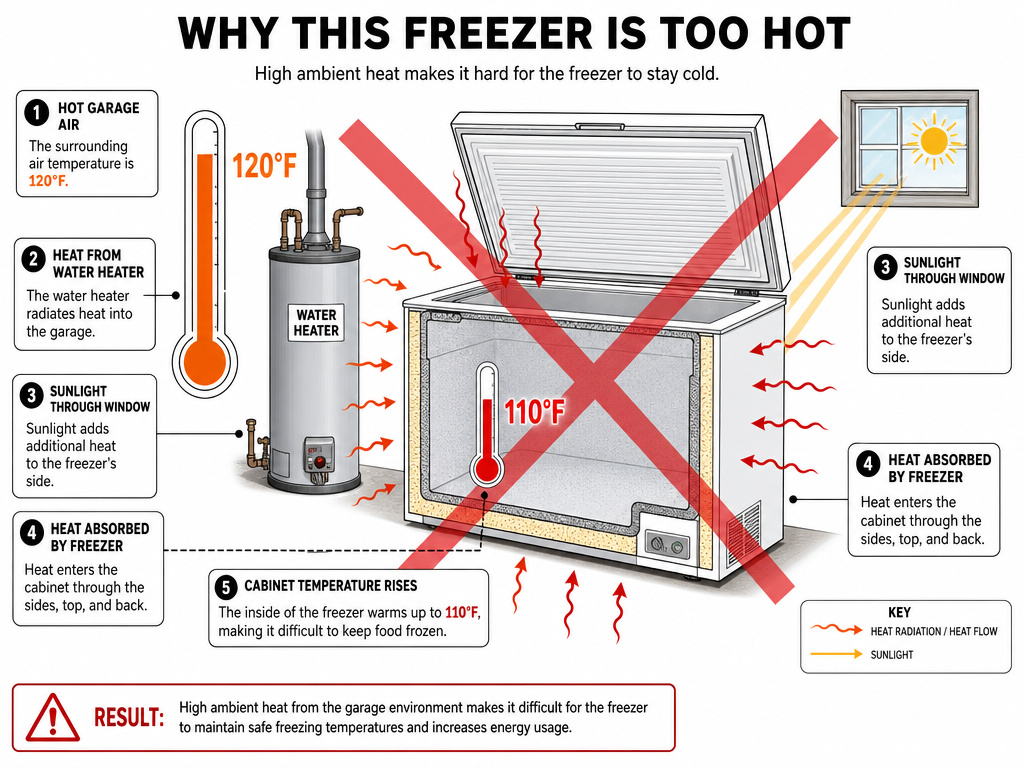
Even the toughest residential freezer has boundaries. The most common certified operating range is 0°F (-18°C) to 110°F (43°C). This covers most attached garages in continental climates, but not all.
In Phoenix, a west-facing garage can exceed 120°F. In International Falls, MN, winter garage temps can plunge below -20°F. In both cases, a unit rated for 0°F to 110°F will fail. The compressor will either overwork and trip on thermal overload, or the thermostat will lock it out.
Your garage’s microclimate matters more than the manual’s range. Direct sunlight through a window can add 15-20°F to the ambient air around the freezer. Always place the unit on an interior wall, away from windows and away from heat sources like water heaters or furnaces. The manual for a generic model warns: “Product must not be subjected to direct sunlight.”
The Follett FZR1 and FZR2 manuals specify an optimum maximum air temperature of 80°F (27°C), with an absolute maximum of 100°F (38°C). This is a more conservative, commercial-grade rating that highlights how much variance exists behind the “garage-ready” label. It also underscores why proper garage installation planning is critical, even with a rated unit.
Choosing the Right Type: Chest vs. Upright
The garage-ready specs apply to both chest and upright designs, but the form factor changes the practical experience.
Chest freezers are inherently more efficient. The cold air sinks and stays put when you open the lid, and they typically have thicker insulation. This makes them naturally more resilient to ambient temperature swings. Many of the highest-rated garage-ready chest freezers are simple, robust boxes with few electronics to fail.
Upright freezers offer convenience, shelves and door bins, but lose cold air every time you open the door. In a hot garage, the compressor must work harder to recover. Look for models with fast-cooling technology and excellent door seals. The best garage-ready upright freezers compensate with powerful compressors and extra insulation in the door.
For a garage that sees wide swings, the inherent efficiency of a chest freezer often makes it the safer bet. For frequently accessed storage, a well-built upright with a high climate class can work.
Installation Non-Negotiables
A garage-ready freezer can still fail if installed wrong. Three rules are absolute.
- Dedicated Circuit: Plug the unit directly into a grounded outlet on its own 15- or 20-amp circuit. No power strips. No extension cords. The manual for the Follett FZR states: “Connect to dedicated circuit.” Extension cords cause voltage drop, which makes the compressor draw more amperage, overheat, and fail prematurely.
- Adequate Clearance: Allow at least 3 inches of space on all sides, especially the back where the condenser coil lives, for airflow. Some models, like the Follett, note no clearance is needed at the back, but most residential units require it. Blocked airflow turns your freezer into an oven for its own components.
- Level Floor: Use the adjustable feet to level the unit front-to-back and side-to-side. An unlevel freezer stresses the compressor and can prevent doors from sealing properly. A poorly sealed door in a humid garage invites frost buildup and overwork.
Following these best practices for garage freezers ensures the engineered specs have a fighting chance.
Frequently Asked Questions
Is a “garage-ready” freezer more expensive?
Usually, yes. The added cost covers the higher-grade compressor, enhanced insulation, humidity-resistant components, and the engineering validation for extreme temperatures. Think of it as an insurance premium against losing hundreds of dollars in food and a costly repair.
Can I convert my regular freezer to be garage-ready?
No. The differences are in fundamental hardware, compressor type, insulation thickness, control board coatings, thermostat programming. You cannot retrofit these features. Using a standard freezer in a garage voids the warranty and dramatically shortens its life.
How do I know if my garage is too hot or cold for a given model?
Check the manual’s climate class or stated operating range (e.g., 0°F to 110°F). Then, monitor your garage’s temperature with a simple thermometer over a full year, noting the highest summer and lowest winter readings. If your extremes fall outside the unit’s range, you need a different model or must climate-control your garage.
Do all brands make garage-ready models?
No. It’s a specialized line. Major brands like GE, Frigidaire, and LG offer specific “garage-ready” series. Other brands may not. Always verify the climate class in the technical specs, don’t just trust a marketing bullet point.
What’s the difference between “garage-ready” and “outdoor-rated”?
Outdoor-rated typically means the unit has a weatherproof casing and can withstand precipitation and direct sun exposure. Garage-ready assumes a sheltered, dry(ish) garage but with no temperature control. An outdoor-rated unit is overkill for a garage; a garage-ready unit will fail outdoors.
The Bottom Line
A garage-ready freezer is defined by hard engineering, not clever marketing. The four pillars are a verified climate class (ST or T), a freeze-rate meeting the IEC 62552 standard, humidity-protected internals, and intelligent cold-weather operation. Your garage is a harsh environment, choose a freezer built with the specs to match it. Start with the manual’s fine print, not the sales tag.
