
Can You Put a Freezer in a Garage? The 3 Deal-Breakers
This post contains affiliate links. As an Amazon Associate, we earn from qualifying purchases.
Yes, you can put a freezer in a garage if three conditions are met: a dedicated 115-volt, 15-amp circuit on a non-GFCI outlet, an enclosed space protected from wind and rain, and an ambient temperature that stays between the freezer’s rated operating range, typically 40°F to 90°F. Fail any one of these, and the compressor burns out or the food thaws within days.
The electrical clause is where most garage installations fail first. Garage outlets are often shared circuits with outdoor lights and tools, and they’re frequently GFCI-protected. A freezer’s compressor startup surge can trip a GFCI or overload a shared line, cutting power silently. The food spoils before you notice.
What follows is the wiring diagram the manuals assume you have, the temperature specs they print in the back, and the physical protections a garage demands that a kitchen does not. By the end, you’ll know whether your garage is a viable location or a one-way trip to an appliance repair shop.
Key Takeaways
- A freezer needs a dedicated 115V, 15-amp circuit on a standard outlet, not a GFCI. Shared garage circuits trip under the compressor load.
- Ambient temperature is non-negotiable. Most freezers fail below 40°F and above 90°F. A Midwestern garage that hits 10°F in winter will shut the unit down.
- “Garage-ready” is a marketing term, not a universal standard. It usually means better insulation, but it doesn’t override the electrical and temperature requirements.
- Physical protection from moisture, dust, and direct sunlight is mandatory. An uninsulated shed with a dirt floor is not an enclosed garage.
- Leveling and clearance are not optional. Tilt the unit more than 45 degrees during move-in and you can oil-lock the compressor, a repair that costs more than the freezer.
The Electrical Circuit Is the First Hurdle
Your freezer’s manual doesn’t ask for a special circuit. It demands one. The Whirlpool manual states a “115 Volt, 60 Hz., AC only, 15- or 20-amp fused, grounded electrical supply is required” and explicitly recommends “a separate circuit serving only your freezer.” The Liebherr installation guide echoes this, calling for a “15 Amp (20 Amp for side-by-side installation) fused electrical supply” and a dedicated circuit to prevent overload.
A 115 Volt, 60 Hz., AC only, 15- or 20-amp fused, grounded electrical supply is required. It is recommended that a separate circuit serving only your freezer be provided. Use an outlet that cannot be turned off by a switch. Do not use an extension cord. — Whirlpool Freezer Installation Manual
This isn’t cautious advice. It’s the specification for the appliance’s motor. The compressor draws a significant surge on startup. Plug it into a garage outlet that’s already feeding outdoor floodlights, a battery tender, and a shop vacuum, and you’re asking for a tripped breaker. The power cuts, the freezer warms up, and you might not discover it for days.
GFCI outlets are a deal-breaker. Ground Fault Circuit Interrupters are code for garage and outdoor outlets because they shut off power if they detect a current leak to ground—like from a wet cord. A freezer compressor’s inductive load can mimic a ground fault, causing nuisance trips. When that GFCI trips, everything on that circuit dies. If your outdoor outlets are on the same circuit, a rainstorm could trip it and kill your freezer remotely.
The fix is an electrician. They run a new, dedicated line from your main panel to a standard, non-GFCI outlet for the freezer. It’s the only way to be sure.
Where this goes sideways: Assuming the existing garage outlet is sufficient. Most are 15-amp circuits shared with half the garage. The compressor starts, the voltage sags, the motor strains, and it either trips the breaker or burns itself out over months. The repair bill starts at the cost of a new freezer.
| Electrical Mistake | Immediate Consequence | Long-Term Damage |
|---|---|---|
| Using an extension cord | Voltage drop at the plug | Overheating motor windings, compressor failure |
| Plugging into a GFCI outlet | Nuisance trip during compressor cycle | Spoiled food after an unnoticed power loss |
| Sharing a circuit with other loads | Breaker trips under combined load | Repeated power cycling wears out the compressor |
| Ignoring the “no switch” rule | Someone turns off the freezer accidentally | Complete thaw, potential bacterial growth in meat |
Ambient Temperature: The Silent Freezer Killer
Freezers are not space heaters. They move heat from inside the box to the outside air. If the outside air—your garage—is too cold, the system has nowhere to dump that heat. If the garage is too hot, the system can’t shed the heat fast enough. The manuals are blunt about this. One upright freezer manual states: “Do not install the freezer where the temperature will go below 50°F or above 90°F, because it will not maintain proper temperatures.” Another Whirlpool guide warns against locations “where the temperature will fall below 40°F (5°C).”
That’s your operating window: 40°F to 90°F. Stray outside it, and the freezer stops working.
In a cold garage, the refrigerant pressure in the system drops too low. The compressor is designed to pump against a certain pressure; without it, the oil doesn’t circulate properly. The compressor runs dry, seizes, and dies. You’ll hear it click on, run for a few seconds, and click off in a short cycle. That’s the sound of a freezer giving up.
In a hot garage, the opposite happens. The high ambient temperature makes the condenser coil inefficient. The compressor runs non-stop trying to achieve set temperature, overheating itself and racking up a huge energy bill. It will likely burn out before the season is over.
Common mistake: Putting a freezer in an uninsulated detached garage in a cold climate. When winter hits and the garage dips to 20°F, the freezer’s thermostat won’t even call for cooling. Your frozen food is safe from thawing, but the compressor is oil-locked and done.
The garage-ready label is not a magic shield. A garage-ready freezer often has a more robust compressor and better cabinet insulation to handle a wider temperature range. But even those models have limits, usually printed in their spec sheets. They’re for enclosed garages that still experience seasonal swings, not for porches or unheated sheds.
If your garage routine sees summer peaks above 95°F or winter lows below 35°F, you need to consider climate control. A simple insulated box around the freezer, or a small space heater with a thermostat set to 45°F for the winter months, can keep it in its happy zone. It’s cheaper than a new appliance.
Garage vs. “Outside”: Understanding the Enclosure
Manufacturers make a critical distinction between a garage and the great outdoors. The Frigidaire manual lists approved locations: “Kitchen / kitchenette, Pantry room, Basement, Enclosed garage, Other interior residential type environments.” An enclosed garage has walls, a roof, and a door. It’s protected from the elements.
An “outdoor setting” is explicitly forbidden. The upright freezer manual is clear: “This unit MUST be installed in an area protected from the elements, e.g., wind, rain, water spray or drips. Do NOT use the upright freezer in an outdoor setting.”
Why? Moisture and dust. A compressor’s condenser coils need airflow, but that air should be relatively clean and dry. A porch or carport exposes the unit to rain, leaf litter, and high humidity, which can corrode electrical components, clog the coils, and promote mold growth inside the cabinet. Direct sunlight on the exterior raises the surface temperature, making the compressor’s job even harder.
So, can you put a deep freezer outside on a covered patio? Technically, no. A fully enclosed shed with a solid floor and a door is the bare minimum for considering it a “garage-like” space. Even then, you must verify the shed’s temperature range. Many people successfully use a chest freezer in a shed, but they often add insulation and ventilation to stabilize the climate.
The physical setup matters just as much as the location:
- Leveling: The compressor is lubricated by oil that sits in a sump. If the freezer isn’t level, the oil can flow away from the pump intake. Use a spirit level and adjust the feet. The Liebherr guide warns that floors must be level to ensure “air vents are not obstructed.”
- Clearance: Leave space for heat to escape. The Koolatron manual calls for 4 inches at the sides and back. Whirlpool says 3 inches at top and sides, 1 inch at the back. Block these vents, and you’re baking the compressor in its own waste heat.
- Floor Strength: A fully loaded 20-cu-ft freezer can weigh over 600 pounds. Make sure your garage floor or shed platform can support it. The Liebherr manual says to verify floors “can support refrigerator’s weight plus approximately 1200 pounds (544 kg) of food weight.”
Choosing a Freezer for Garage Duty
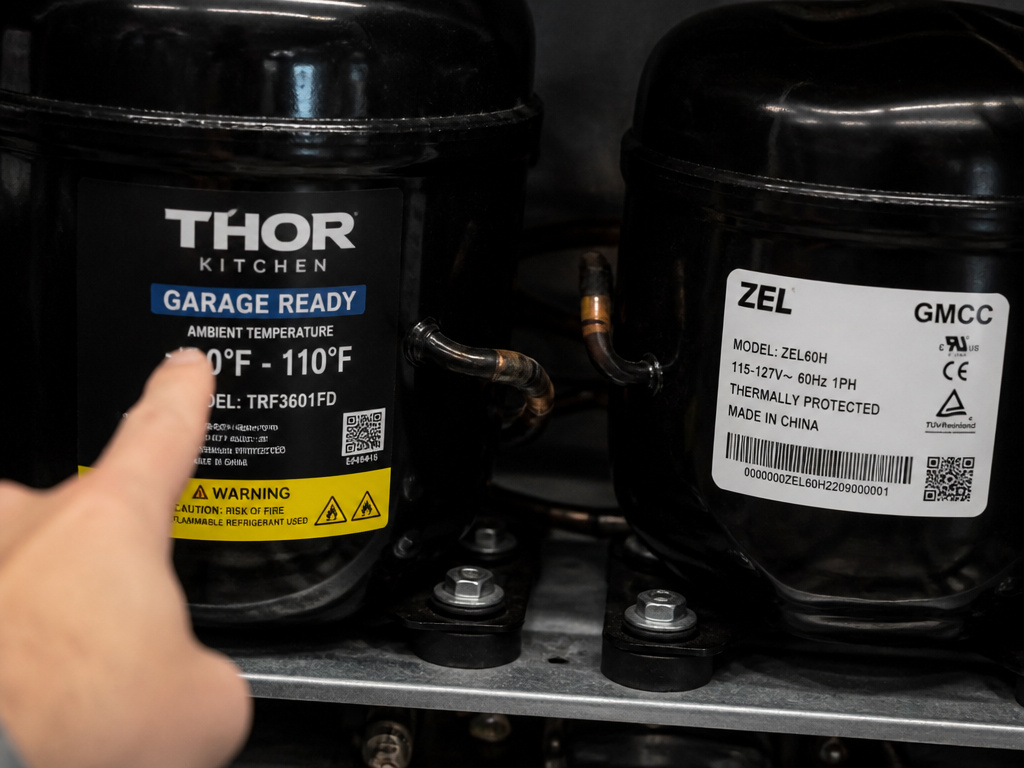
If your garage passes the electrical and temperature tests, your next decision is which freezer to buy. The market splits into “garage-ready” models and standard units. The difference is usually in the compressor technology and insulation thickness.
A true garage-ready freezer uses a compressor designed to operate in a wider ambient range, often from 0°F to 110°F. Brands like Frigidaire, Whirlpool, and GE offer specific “garage ready” lines. They are the safest bet, but you pay a premium for that engineered tolerance.
A standard freezer can work if your garage is mild and stable. Many best chest freezers for garage lists include reliable standard models from brands like Midea and Arctic King that owners use in garages without issue. The risk is entirely on you if the temperature spikes or drops.
Chest vs. Upright for the garage?
Chest freezers are generally more efficient because cold air doesn’t spill out when you open them. They also tend to have simpler mechanics. For a garage where you might access it less frequently, a chest freezer is a smart, efficient choice. For easier organization and access, an upright is better. There are excellent garage-ready upright freezers and garage-ready chest freezers available.
Size dictates the electrical load. A compact 7 cu ft chest freezer for overflow storage draws less current than a 25-cu-ft bulk freezer. Match the size to your actual needs and your circuit’s capacity. Bigger isn’t better if it strains your wiring.
I prefer a manual-defrost chest freezer for garage duty. The auto-defrost function in many uprights uses a heating element to melt frost, which adds heat to the cabinet and makes the compressor work harder in an already challenging environment. Manual defrost is one less thing to break, and in a dry garage, you might only need to do it once a year.
Installation Checklist: Get It Right the First Time
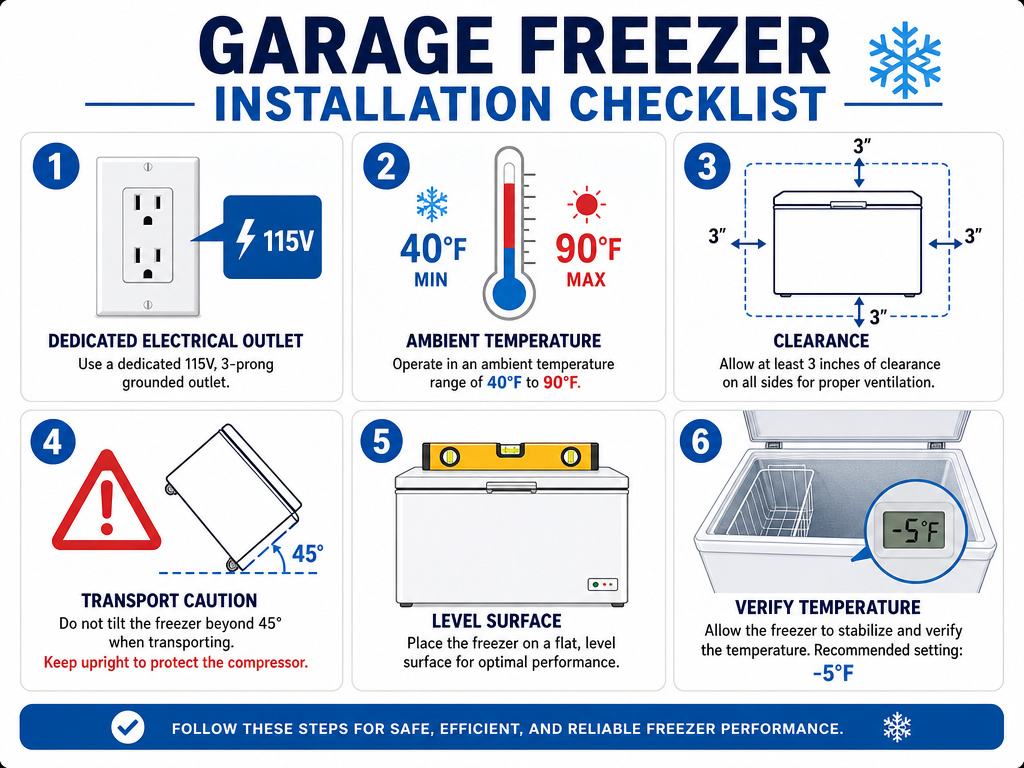
Don’t wing this. Follow this sequence, and you avoid 90% of garage freezer failures.
- Verify Circuit & Outlet. Hire an electrician to install a dedicated 115V, 15-amp circuit ending in a standard, non-GFCI outlet where the freezer will sit. This is the single most important step.
- Monitor Garage Temperature. Use a simple min/max thermometer for a full year. Record the highest summer and lowest winter temperatures in the exact spot the freezer will occupy. If it stays within 40–90°F, proceed.
- Prepare the Space. Clear an area with proper clearances (at least 3 inches on all sides, 1 inch from the wall). Ensure the floor is level, solid, and clean.
- Move with Care. Never tilt the freezer beyond 45 degrees. The Koolatron manual warns tilting “could damage the compressor and the sealed system.” If you must lay it down, let it stand upright for 24 hours before plugging it in so the compressor oil settles.
- Level and Plug. Adjust the feet until the cabinet is perfectly level in both directions. Plug directly into the wall outlet—no extension cords, no power strips.
- Set and Wait. Turn the thermostat to the manufacturer’s recommended starting setting (often “4” or “Mid”). Let it run empty for 24 hours to ensure it reaches and holds a stable temperature below 0°F before loading it with food.
Skip step one, and you’re building on sand. Everything else is detail work.
Frequently Asked Questions
Will a freezer work in a cold garage?
It depends on how cold. Most standard freezers are designed to operate in ambient temperatures down to about 40°F. Below that, the refrigerant pressure drops too low for the compressor to operate correctly, leading to short cycling and eventual failure. If your garage regularly drops below freezing, you need a specifically designed freezer in cold garage model or you must add supplemental heat to the space.
What does “garage-ready” mean for a freezer?
“Garage-ready” typically indicates the freezer’s compressor and cooling system are engineered to perform across a broader ambient temperature range than a standard kitchen model, often from 0°F to 110°F. It may also include better insulation. It is not a certified standard, so always check the specific temperature operating range in the product’s manual before assuming it will work in your garage.
Can I use an extension cord for my garage freezer?
No. Every manufacturer’s manual explicitly prohibits extension cords. They cause voltage drop, which makes the compressor work harder, overheat, and fail prematurely. The freezer must be plugged directly into a properly grounded wall outlet.
How much does it cost to run a freezer in a garage?
It varies widely based on the freezer’s efficiency, size, and your garage’s ambient temperature. A freezer in a hot garage (above 80°F) will run almost constantly, potentially doubling or tripling its energy consumption compared to a climate-controlled kitchen. The cost isn’t just in watts; it’s in the shortened lifespan of a compressor fighting extreme temperatures.
The Bottom Line
You can put a freezer in a garage, but the garage must meet the freezer’s needs, not the other way around. The appliance is not adaptable. It requires a specific electrical feed, a narrow temperature band, and a clean, level, enclosed space.
Start with the circuit. If you can’t install a dedicated line, stop. Move on to a year of temperature logs. If your garage swings outside 40–90°F, stop. Only after passing those two tests should you shop for a freezer, leaning towards a purpose-built best garage freezer model.
The alternative is a cycle of frustration: spoiled food, repair bills, and the realization that the manual was right all along. Follow its specs, and the freezer will hum along for years, turning your garage into valuable, reliable cold storage.
