
Can You Keep a Refrigerator in a Garage? Temperature Guide
This post contains affiliate links. As an Amazon Associate, we earn from qualifying purchases.
You can keep a refrigerator in a garage if it is specifically designed and certified as “garage-ready,” with an ambient temperature operating range that typically spans from 38°F to 110°F. Standard kitchen refrigerators are engineered for stable, indoor climates and will fail, sometimes within a single season, when subjected to garage temperature swings.
The difference isn’t a marketing label. It’s a set of engineering tolerances printed in the installation manual. A standard unit placed in a 45°F garage won’t know it needs to cool the freezer, so your ice cream turns to soup. That same unit in a 95°F summer will run its compressor non-stop until it overheats and shuts down. Garage-ready models have components rated for that abuse and often include a “Garage Mode” to trick the thermostat into working correctly in the cold.
What follows: the exact temperature specs from major brands, what physically breaks in a standard fridge, how to read your own manual’s fine print, and a direct comparison of your options if your garage isn’t climate-controlled.
Key Takeaways
- Garage-ready refrigerators are engineered for 38°F to 110°F ambient temperatures; standard units are for indoor use only.
- In cold garages below 50°F, a standard freezer stops cycling, allowing food to thaw. In heat above 110°F, the compressor overheats and fails.
- Built-in or panel-ready models (like IKEA’s SUPERKALL) are almost never garage-ready, their manuals explicitly forbid garage installation.
- Warranties often void coverage if an appliance is used outside its specified ambient range. Check your manual’s “where to install” section.
- You need 2 inches of rear clearance for airflow and must ensure the garage floor is level to prevent door seal failure.
The 38°F to 110°F Rule That Decides Everything
The single most important spec is the ambient temperature operating range. This isn’t about where you live; it’s about the actual temperature inside your garage on the coldest winter night and the hottest summer afternoon.
A garage-ready refrigerator is tested to maintain safe internal food temperatures when the surrounding air is between 38°F (3°C) and 110°F (43°C). This engineering tolerance is what separates a garage-safe appliance from a standard kitchen model.
Manufacturers print this range in the installation section of the owner’s manual. For the Samsung RT18DG6700SR, it’s 38°F to 110°F. For the LG LSC27960ST, it’s 41°F to 110°F. KitchenAid and Whirlpool garage-ready models typically preset to a similar 55°F to 110°F range. If your manual doesn’t list a range, or says “for indoor use only,” your refrigerator is not garage-ready.
Why these numbers matter. Below the lower limit, around 50°F, two things happen. First, the oil in the compressor thickens, making startup difficult and causing wear. Second, and more critical for your food, the thermostat believes the fridge is already cold enough. It stops calling for cooling cycles. Your freezer can rise above 32°F while the fridge section feels fine. You won’t know until you grab a frost-free, thawed bag of peas.
Above 110°F, the compressor and condenser coils fight to reject heat into an already-hot environment. They run constantly. This spikes your energy bill and pushes electrical components past their design limits. The compressor overheats, the thermal overload trips, and the unit shuts down. Repeated cycles lead to a burnt-out compressor, a repair that often costs more than a new, proper garage refrigerator.
What Actually Breaks in a Standard Kitchen Fridge
Putting a standard refrigerator in a garage doesn’t just make it inefficient. It actively dismantles it from the inside out. The failure modes are predictable and tied directly to the temperature extremes.
In the cold: The compressor is the first victim. Modern compressors use a synthetic lubricant that circulates with the refrigerant. In cold temperatures, this oil thickens to a honey-like consistency. On startup, the compressor piston has to fight through viscous oil, straining the motor and windings. This is called “hard starting,” and it shortens the compressor’s life. Meanwhile, as the unit stops cycling, the freezer warms up. Humidity from the air and food inside condenses and freezes into thick frost blankets on the evaporator coils, which the next defrost cycle may not fully melt.
In the heat: The condenser coils, usually at the back, need cooler air to dissipate heat. In a 100°F garage, their cooling capacity plummets. The high-pressure side of the refrigeration system skyrockets. The compressor labors against this pressure, drawing more amperage and generating intense heat. The overload protector on the compressor will eventually open to prevent a burnout. If it doesn’t reset, the compressor is dead. If it does reset, the cycle repeats every few hours. Each cycle is a step closer to total failure.
Common mistake: Assuming an unused second fridge is “tough enough” for the garage. Age makes it worse. Older seals are brittle, letting in more humid air. Older compressors are less efficient and more susceptible to thermal stress. A 10-year-old kitchen fridge might not survive one summer in an unconditioned garage.
The ice maker is a special point of failure. The LG manual specifically warns that ambient temperatures outside the 41°F–110°F range may cause the water tube between the dispenser and ice maker to freeze, blocking water flow and rendering the feature useless. This is a repair that requires disassembling the door.
Garage-Ready vs. Standard: A Side-by-Side Breakdown
Not sure what you have? This table spells out the differences. If your fridge lacks the features in the left column, treat it as a standard model.
| Feature | Garage-Ready Refrigerator | Standard Kitchen Refrigerator |
|---|---|---|
| Ambient Range | 38°F – 110°F (clearly stated in manual) | Not specified or “for indoor use only” |
| Compressor & Components | Heavy-duty, higher temperature tolerance | Rated for stable room-temperature operation |
| “Garage Mode” | Often present; warms thermostat sensor in cold weather | Never present |
| Condenser Fan | May have a higher CFM fan for hot-weather heat rejection | Standard fan |
| Warranty Coverage | Valid when used within specified garage range | Voided if installed outside conditioned space |
| Built-in Models | Extremely rare; most are forbidden for garage use | Standard design; not for garages |
The “Garage Mode” deserves explanation. It’s not a magic button. On models that have it, engaging this mode applies a small amount of heat to the thermostat sensor or alters its algorithm. This tricks the system into thinking the interior is warmer than it is, prompting normal cooling cycles even when the garage is cold. It’s a clever workaround for the main problem.
If you’re considering a new unit, focus on the garage-ready refrigerators from brands like Samsung and LG that advertise the feature. Our guide on the best garage-ready refrigerators breaks down the latest models with these specs.
Your Installation Checklist: Clearance, Leveling, and Power
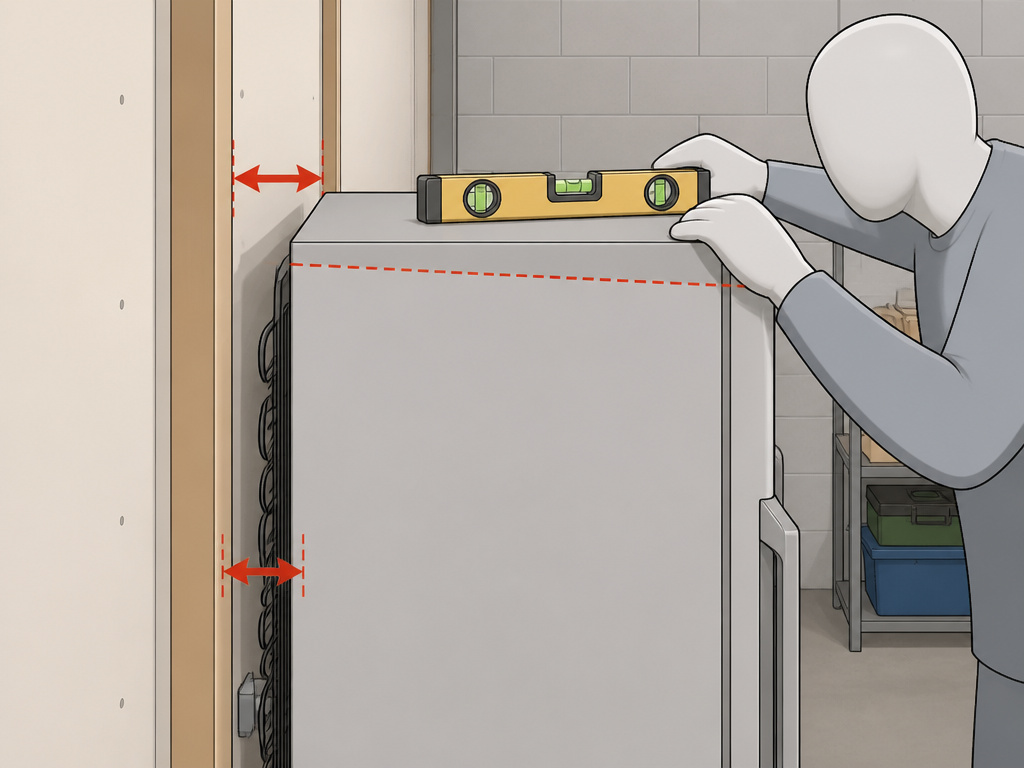
A garage-ready fridge won’t save you if you install it wrong. Garages present unique challenges that kitchens don’t.
Clearance is non-negotiable. You need air to move. The Samsung specs mandate a 2-inch minimum clearance at the rear for airflow and electrical connections. The sides and top need at least 3/8 inch for the unit to fit and the doors to open fully. Cramming it into a tight space guarantees early failure. This is similar to the care needed for garage freezer installation, both appliances live and die by airflow.
Leveling is everything. Garage floors are often sloped for drainage. A refrigerator must be perfectly level side-to-side and tilted slightly forward (about 1/4 inch) so the doors close automatically. An unlevel fridge strains the compressor, causes noisy vibration, and, most critically, breaks the door seal. A broken seal lets in humid air, which ices up the interior and makes the compressor run 24/7. Use the adjustable front wheels or leveling legs; don’t just shim the back with wood scraps.
Power matters. Ensure the outlet is grounded and on a dedicated 15- or 20-amp circuit. Garages often have shared circuits with garage door openers or lights. A refrigerator compressor starting up can cause a voltage drop, dimming lights and stressing the fridge’s electronics. If your lights dim when the fridge kicks on, you need an electrician.
Before you start: Unplug the old unit. Get a helper to move the heavy fridge to avoid back strain or dropping it. Check that the water supply line (if you have an ice maker) is rated for in-wall use and protected from freezing if your garage gets cold. A burst line is a flood waiting to happen.
The Built-In and IKEA Problem
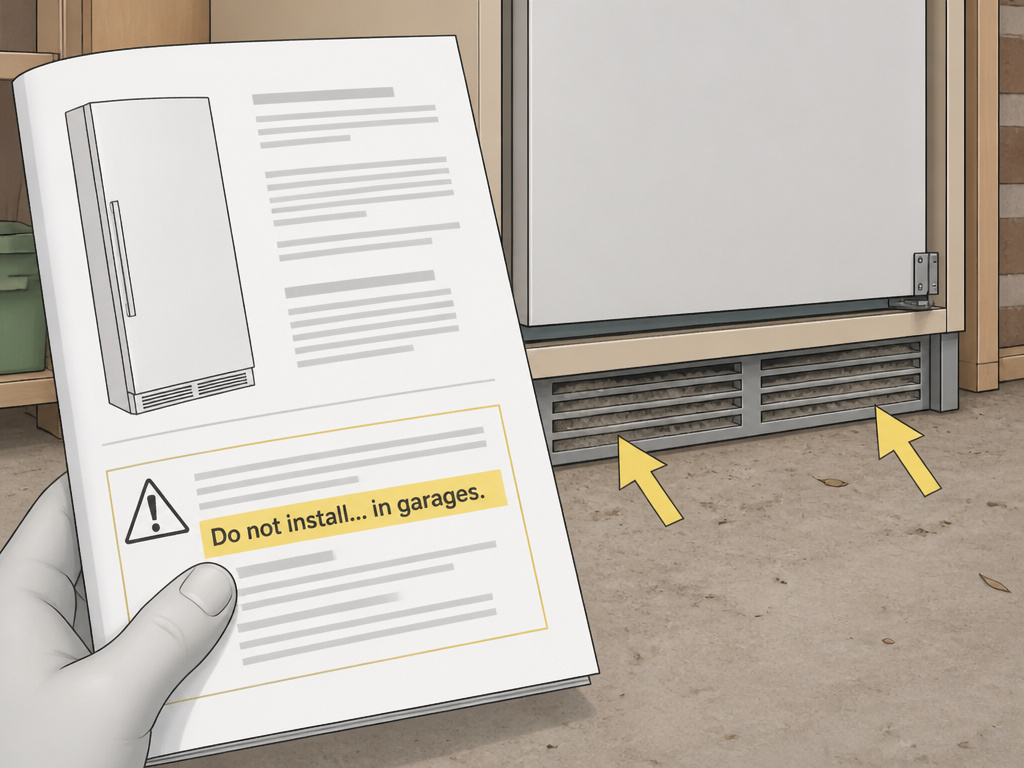
This is the biggest trap for DIYers. Built-in or panel-ready refrigerators, designed to blend with cabinetry, are almost universally not garage-ready.
Take the IKEA SUPERKALL. Its manual is explicit: “Do not install this appliance in areas that are too humid or too cold, such as the construction appendices, garages or wine cellars.” The reason is their design. Built-ins rely on the surrounding cabinet for structural support and often have integrated ventilation fronts that require kitchen-grade airflow. A garage’s temperature swings and dust will choke them.
If you want a seamless look in a garage bar or kitchenette, you must find a garage-ready refrigerator-freezer that is also designed as a built-in, a category so niche it barely exists. The safe bet is to use a freestanding garage-ready model and build cabinetry around it with ample ventilation space, following the same clearance rules.
Warranty and Long-Term Costs
Using a refrigerator outside its specified environment voids the warranty. It’s that simple.
Manufacturers can tell. A compressor failure in a unit with ambient temperature sensors (common in modern fridges) will log error codes showing it was operating in 40°F or 115°F conditions. Your claim will be denied. The Samsung RT18DG6700SR offers a 5-year warranty on the sealed system and a 10-year warranty on the digital inverter compressor, but only if used within that 38°F–110°F garage-ready range. The LG LSC27960ST provides only a 1-year labor warranty, putting the repair cost burden on you much sooner.
The long-term cost equation is straightforward. A standard $800 fridge that dies in two years in the garage costs you $400 per year. A $1,200 garage-ready refrigerator that lasts ten years costs $120 per year. The garage-ready option is cheaper over time, not even counting spoiled food and repair headaches.
Frequently Asked Questions
Will a refrigerator work in an unheated garage?
It depends entirely on the model’s rated ambient temperature range. A true garage-ready refrigerator will work down to its stated minimum, often 38°F. A standard refrigerator will begin to fail as the garage dips below 50°F, with the freezer losing its ability to stay cold. For dedicated freezing in a cold garage, a standalone garage freezer is a more robust choice.
What temperature is too cold for a refrigerator?
For standard refrigerators, sustained ambient temperatures below 50°F (10°C) are problematic. Below this point, the unit may stop cycling, causing the freezer to rise above freezing. Garage-ready models have a published lower limit, like 38°F, below which they are not designed to operate safely.
Can I use a refrigerator in the garage in the summer?
Yes, if it is a garage-ready model rated for the high end of your garage’s summer heat. Standard refrigerators risk compressor overheating and failure when ambient temperatures consistently exceed 110°F. Ensure the unit has the proper rear clearance for airflow to help it shed heat.
How do I stop my garage fridge from freezing food in winter?
If you have a garage-ready model with a “Garage Mode,” turn it on. This setting adjusts the thermostat to maintain proper cooling cycles in cold weather. If your model lacks this feature and food is freezing, the ambient temperature is likely below your fridge’s operating range. You may need to add a small, thermostatically controlled space heater near the compressor area to keep the environment within spec, a technique discussed in our article on how to keep a garage fridge from freezing in winter.
The Bottom Line
Stop wondering if your old kitchen fridge will survive the garage. It won’t. Check your manual for an ambient temperature range. If it doesn’t say 38°F–110°F or similar, it’s not built for the job.
The correct path is to buy a refrigerator engineered for the environment. Look for “garage-ready” in the product title and confirm the temperature specs in the installation manual. Brands like Samsung, LG, and Whirlpool build these models for a reason. The investment protects your appliance, your food, and your wallet from the predictable chaos of garage climate swings. Get the right tool, install it with clearance and level care, and your garage fridge will be the reliable workhorse you need for years.
