Can You Eat Freezer Burned Meat? A Guide to Safety and Quality
This post contains affiliate links. As an Amazon Associate, we earn from qualifying purchases.
You can eat freezer-burned meat if your freezer has stayed at 0°F (-18°C) and the meat was fresh when frozen. Safety isn’t the issue, quality is. The grayish, leathery patches are dried-out spots where moisture escaped, leaving the texture tough and flavor bland or off. For mild cases, trim the burned areas before or after cooking. For severe freezer burn, the quality loss is so great that discarding the meat is the better choice.
That 0°F threshold is the line. Below it, bacterial growth stops, which is why the food remains technically safe almost indefinitely. The problem isn’t pathogens; it’s the slow, steady escape of water molecules from the frozen meat through a process called sublimation.
What follows is a breakdown of that process, the official storage times for quality, and the specific packaging that actually works. You’ll also get the one university extension’s stance that goes further than “just trim it.”
Key Takeaways
- Freezer-burned meat is safe to eat if continuously stored at 0°F (-18°C), but its texture and flavor will be poor.
- The damage is caused by sublimation, ice crystals turning directly to vapor, which dries out the meat’s surface.
- For quality, follow the USDA Frozen Meat Storage Chart: steaks last 4-12 months, ground meat 3-4 months.
- Trim minor burns; discard meat that’s extensively leathery or has a strong off-odor.
- Prevent it with airtight packaging: vacuum sealing, double-wrapping with freezer paper and bags, or using dedicated freezer-safe containers.
The 0°F Rule and Meat Safety
Your freezer’s temperature isn’t just a suggestion. It’s the single factor that decides whether freezer burn is a quality nuisance or a sign of a deeper problem. The universal standard from every university extension service is 0°F (-18°C).
Food stored constantly at 0 °F will always be safe. Only the quality suffers with lengthy or inadequate freezer storage. This guidance from the Iowa State University Extension food safety blog draws the line clearly.
At this temperature, biological activity grinds to a halt. Bacteria and molds cannot grow. This is why frozen food safety is about time, almost indefinite, while frozen food quality is about weeks and months. If your freezer fluctuates above 0°F, especially in a door compartment or an old fridge’s top freezer, you’re in short-term storage territory. Meat there will develop signs of freezer burn faster.
The safety rule has a direct corollary for power outages. In a full freezer with the door closed, food will stay frozen for about 48 hours. If it thaws completely and sits above 40°F for more than two hours, discard it. Safety has left the building.
How Freezer Burn Actually Happens
Freezer burn isn’t rot. It’s dehydration. Imagine a steak in your freezer. Even at 0°F, the ice crystals on its surface are restless. They don’t melt; they sublimate. This means they skip the liquid phase entirely and jump straight to water vapor.
That escaping vapor leaves behind tiny voids. Oxygen molecules seep in to fill the gaps. Oxygen bleaches the meat’s pigments, causing those grayish-brown or white leathery patches. It also accelerates oxidation, which can create off-flavors described as “cardboard” or “old freezer.”
Freezer burn is caused when water molecules escape from frozen food, which allows oxygen molecules to seep in. The oxygen molecules allow for color change and will modify the flavor of a frozen product. This explanation from a Texas A&M AgriLife Extension PDF guide names the actors: escaping water, invading oxygen.
Foods with high water content, like meat, poultry, fish, and fruits, are most vulnerable. This is also why improper packaging is the main culprit. A loose wrap or a thin grocery store tray offers a highway for this molecular escape.
When to Trim It and When to Toss It
So you have a freezer-burned roast. The rule of thumb is simple: if it’s localized, cut it away. If it’s pervasive, let it go.
Trim it: Isolated grayish spots or a thin leathery layer on one side? Slice those sections off with a sharp knife. You can do this before cooking or after, sometimes cooking makes the desiccated areas more obvious and easier to remove. The underlying meat is safe.
Toss it: The meat is extensively discolored, feels tough and dry throughout, or emits a stale, off odor when thawed. The University of Missouri Extension takes a firmer line, stating, “The food is of such poor quality, we do not recommend eating it.” Your effort and other ingredients are worth more than a subpar meal.
| Severity | Visual Signs | Texture | Recommended Action |
|---|---|---|---|
| Mild | Small, isolated grayish patches. | Normal in unaffected areas. | Trim burned areas before or after cooking. |
| Moderate | Larger leathery sections, some discoloration. | Noticeably drier in patches. | Trim generously; consider using in heavily seasoned dishes like stews or chili. |
| Severe | Pervasive discoloration, deep leathery texture. | Tough and dry throughout. | Discard. The quality loss is too great. |
This decision often comes down to the type of frozen meat. A thick steak with a burned corner is salvageable. Thin cutlets or ground meat where the damage is mixed throughout are rarely worth saving.
Official Freezer Storage Times for Quality
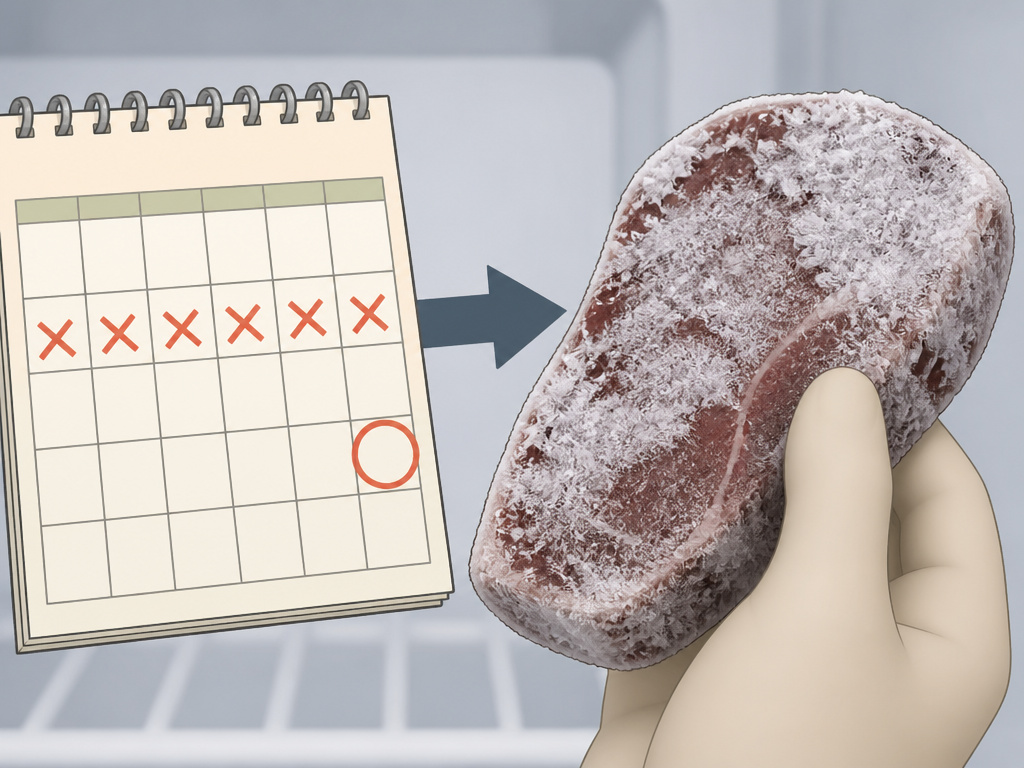 While safety isn’t an issue at 0°F, quality has a strict calendar. The USDA and university extensions provide clear timelines for optimal texture and flavor. Think of these as “best by” dates for your freezer.
The North Dakota State University freezer storage guide provides a clear breakdown. Storing meat longer won’t make you sick, but it will increase the risk of noticeable quality loss.
Uncooked Cuts: Steaks, chops, and roasts have the longest lease, at 4 to 12 months. Their dense structure protects them better.
Uncooked Ground Meat: Lasts only 3 to 4 months. The increased surface area from grinding exposes more meat to air, speeding up quality decline.
Cooked Meat: Whether it’s leftovers or a prepared meal, aim to use it within 2 to 3 months. The cooking process alters the protein structure, making it more susceptible to texture changes.
Poultry: A whole uncooked chicken or turkey can last 12 months, while cut-up parts are best within 9 months. Cooked poultry should be used within 4 months.
Common mistake: Using the refrigerator’s freezer compartment for long-term storage. If it can’t hold a steady 0°F or is opened frequently, use it only for items you’ll eat within a month.
How to Prevent Freezer Burn (The Methods That Work)
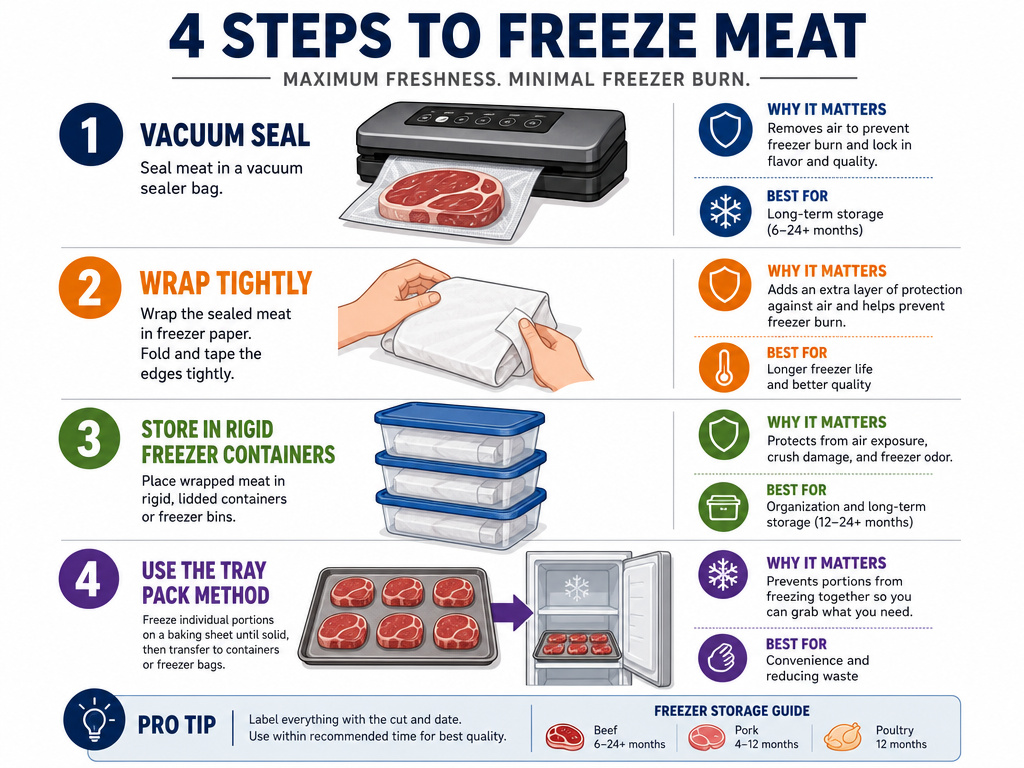 Prevention is about creating a barricade against air. The goal is to eliminate the air pocket around the meat and use materials that block moisture vapor.
- Vacuum Sealing: This is the gold standard. A quality vacuum sealer removes almost all air from a specially designed bag, creating an airtight seal. It’s the most effective method for long-term storage of valuable cuts.
- The Double-Wrap Method: If you don’t have a vacuum sealer, this is your next best bet. First, wrap the meat tightly in freezer paper (the kind with a plastic coating on one side). Then, place that bundle inside a heavy-duty freezer bag. Squeeze out as much air as possible before sealing.
- Use Freezer-Specific Containers: For liquids like stews or broths, use rigid freezer safe containers. Leave about half an inch of headspace to allow for expansion, and make sure the lid seals tightly.
- Prep Before Freezing: Pat meat dry with paper towels before wrapping. Excess surface moisture turns into larger, more damaging ice crystals. For individual portions, use the “tray pack” method: freeze them unwrapped on a baking sheet for 1-2 hours until solid, then package. This prevents them from freezing together in a clump.
Skip the flimsy produce bag or the original styrofoam supermarket tray for anything you plan to keep longer than a week. They are designed for the grocery case, not the deep freeze.
Frequently Asked Questions
Does freezer burn mean the meat is bad?
No, “bad” in a food safety sense means contaminated with harmful bacteria. Freezer burn does not make meat unsafe if it was frozen at 0°F. It means the quality, texture and flavor, is significantly degraded. It’s “bad” in the sense of being unpalatable, not poisonous.
Can you get sick from eating freezer-burned meat?
You cannot get sick from the freezer burn itself. The dehydration and oxidation that cause freezer burn do not produce toxins. However, if the meat thawed and was kept at unsafe temperatures (above 40°F for over two hours) before developing freezer burn, it could be unsafe. The burn is a separate issue from temperature abuse.
What does freezer-burned meat taste like?
The taste is often described as bland, stale, or like cardboard. The characteristic “meaty” flavor diminishes because the compounds that create it are lost with the moisture. In severe cases, oxidized fats can add a slightly rancid or off note. This is why heavily burned meat is best discarded.
How can you tell if meat is freezer burned?
Look for dry, leathery patches that are grayish-brown or white. The texture in these spots will be tough and fibrous. There may also be a layer of frost or large ice crystals on the surface or inside the packaging. The meat may also have a faint, stale smell when thawed, distinct from its fresh scent.
Is it better to trim freezer burn before or after cooking?
You can do either. Trimming before cooking gives you a cleaner start and ensures the burned bits don’t affect the cooking oil or pan sauce. Sometimes, cooking makes the desiccated areas more pronounced and easier to cut away after. For stews or ground meat mixtures, it’s often easier to trim before adding to the pot.
The Bottom Line
Freezer-burned meat sits in a practical gray area. It’s almost always safe, but frequently not worth eating. Your decision hinges on two things: how much of the meat is affected, and what you’re willing to tolerate on your plate.
The real win is prevention. Invest in a roll of freezer paper, a box of heavy-duty freezer bags, or a vacuum sealer. Set your freezer to 0°F and verify it with a thermometer. Use the USDA quality timelines as a guide, not a limit. That way, the question shifts from “can I eat this?” to “how do I keep this perfect?”, which is a much better problem to have.
