Does Sugar Have a Shelf Life? Manufacturer Facts Most Skip
This post contains affiliate links. As an Amazon Associate, we earn from qualifying purchases.
Sugar has an indefinite shelf life because it doesn’t support microbial growth. It will not spoil or make you sick. However, its quality, texture, flavor, and ease of use, can degrade over time, leading to hardening, clumping, or flavor loss.
That indefinite claim is printed on manufacturer websites and extension service documents. The real question isn’t whether sugar spoils. It’s what “indefinite” actually means for your pantry and your baking.
What follows: the specific timelines manufacturers assign for quality, the physical reasons sugar fails, and the storage rules that keep it usable for decades. You’ll also see why a two-pound bag of brown sugar is a different beast than a twenty-five-pound sack of industrial granulated.
Key Takeaways
- Sugar is non-perishable. It will not grow bacteria or mold, so it is safe to eat indefinitely.
- Quality degradation is the real issue. Granulated sugar can harden into a brick; brown sugar can dry into concrete; powdered sugar can clump into unusable lumps.
- Manufacturers give specific “best-by” timelines for quality: 2-3 years for granulated, 2 years for powdered, and 6 months to 2 years for brown sugar.
- Moisture is the enemy. Store all sugar in a cool, dry place inside an airtight container. Never refrigerate or freeze dry sugars.
- The type of sugar dictates its shelf life. Pure, dry granulated sucrose lasts longest; moist brown sugars and liquid syrups have the shortest usable life.
The Short Answer: Indefinite, But Not Unchanging
The direct, technical answer from every primary source is identical. The Utah State University research page states commercial sugars have an “indefinite shelf life due to their resistance to microbial growth.” The Michigan Sugar Company is more blunt: “Sugar does not spoil.”
Commercial sugars (granular, syrup, and honey) have an indefinite shelf life due to their resistance to microbial growth. However, sugars have a best-if-used by date of approximately 2 years for quality concerns. – Utah State University Extension
This is a definition of shelf life rooted in food safety, not quality. When a regulator like Food Standards Scotland talks about shelf life, they’re defining the period a food is “considered safe for consumption.” For sugar, that period never ends.
But your baking results depend on quality. A bag of sugar that has absorbed moisture and hardened into a solid block is safe. It’s also useless unless you’re building a wall.
How Different Sugars Fare Over Time
Not all sugars are created equal. Their shelf life is a function of purity and moisture content. Dry, refined sugars are champions of longevity. Anything with inherent moisture or added liquid starts the clock.
Granulated White Sugar
This is the gold standard for storage. Pure sucrose, with almost all moisture removed, has nothing to feed spoilage. Manufacturers still assign a “best-by” period for quality assurance.
- C&H Sugar: Best used within 3 years of purchase.
- Utah State University: Best-if-used by approximately 2 years.
- Michigan Sugar Company: Under good conditions, can keep “indefinitely.”
The worst that happens is hardening. This occurs when sugar absorbs ambient moisture, then dries out, cementing the crystals together. Large temperature swings accelerate this.
Brown Sugar (Light & Dark)
Brown sugar’s enemy is its own moisture. The molasses that gives it color and flavor also makes it hygroscopic. It wants to dry out.
- Domino Sugar: Best used within six months of purchase for maximum flavor (though shelf life is indefinite).
- C&H Sugar: Best used within two years of purchase.
- Industrial Grades (Michigan Sugar): 6-month shelf life due to faster quality loss in bulk.
Once brown sugar loses its moisture, it becomes a rocky, dense lump. Reviving it is possible, but never as good as starting soft. This is why dedicated containers to store brown sugar that include terra cotta discs or moisture seals are a baker’s best friend.
Powdered Sugar (Confectioners’ Sugar)
Powdered sugar is granulated sugar pulverized and mixed with a small amount of cornstarch to prevent caking. That cornstarch is the weak link.
- C&H Sugar: Best used within 2 years of purchase.
- Storage Note: The fine particles and cornstarch make it supremely prone to clumping when exposed to even slight humidity. It also absorbs odors more aggressively than other sugars.
Liquid Sugars & Syrups
Here, the “indefinite” rule breaks. Liquid sucrose, honey, maple syrup, and molasses can spoil if contaminated after opening.
- Michigan Sugar Company: Liquid sucrose has a 30-day shelf life.
- General Rule: An unopened, commercially sealed bottle of pure syrup or honey is stable for years. Once opened, it can allow mold growth or fermentation. Always store in a cool, dark place and never allow it to freeze or overheat, which encourages crystallization.
The Manufacturer’s Shelf Life Table (What “Best By” Really Means)
Manufacturers provide these timelines for quality, not safety. They are guarantees against hardening, clumping, and flavor loss under ideal storage. The table below, compiled from the Ingredi.com document, shows how specific product types get specific numbers.
| Sugar Product Type | Typical Shelf Life (Quality) | Key Risk |
|---|---|---|
| Granulated White Sugar | 2–3 years | Hardening into a solid mass |
| Powdered / Confectioners’ Sugar | 1–2 years | Clumping from moisture absorption |
| Brown Sugar (Consumer) | 6 months – 2 years | Drying into a hard, unusable block |
| Liquid Sucrose | 30 days | Microbial spoilage after contamination |
| Raw / Demerara Cane Sugar | 2–3 years | Faster quality loss than refined white |
| Brownulated® / Quick-Dissolve | 9–12 months | Clumping due to added processing |
Where this goes sideways: Treating a “best-by” date as an expiration date. Sugar past its recommended date is not bad. It might just require chopping, sifting, or reviving before use. Tossing it is a waste.
These timelines assume proper storing sugar long-term protocol. Break those rules, and the clock speeds up.
Why Sugar Fails: The Science of Hardening and Clumping
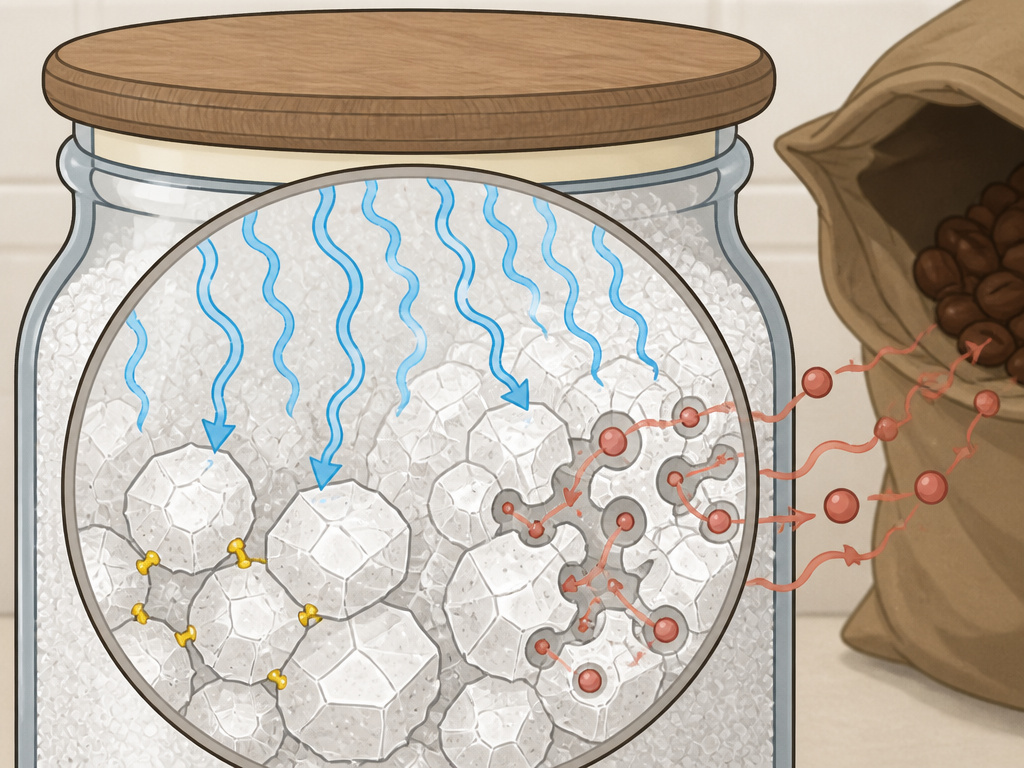 Sugar doesn’t just sit there. It interacts with its environment. Knowing the mechanisms explains all the storage rules.
1. Moisture Absorption (Hygroscopy): Sugar crystals attract water from the air. When humidity is high, they grab moisture and get sticky. When the air dries out, that moisture evaporates, leaving the crystals fused together at the points where they touched. That’s hardening.
2. Temperature Fluctuations: Warm air holds more moisture than cool air. A cycle of warm/humid followed by cool/dry causes sugar to repeatedly absorb and release water, accelerating the hardening process. This is why a pantry near an oven or a sun-facing cabinet is a terrible spot.
3. Odor Absorption: The porous structure of sugar crystals can trap volatile compounds from the air. That’s why sugar stored near coffee, spices, or cleaning supplies can taste “off.” The odor molecules have nowhere to go.
4. The Cornstarch Problem (Powdered Sugar): The anti-caking cornstarch in powdered sugar is itself a fine powder that gels when wet. A tiny bit of humidity makes it glue the sugar particles into tiny, stubborn clumps.
The takeaway is physical, not biological. You’re fighting physics, not bacteria.
How to Store Sugar for Maximum Shelf Life
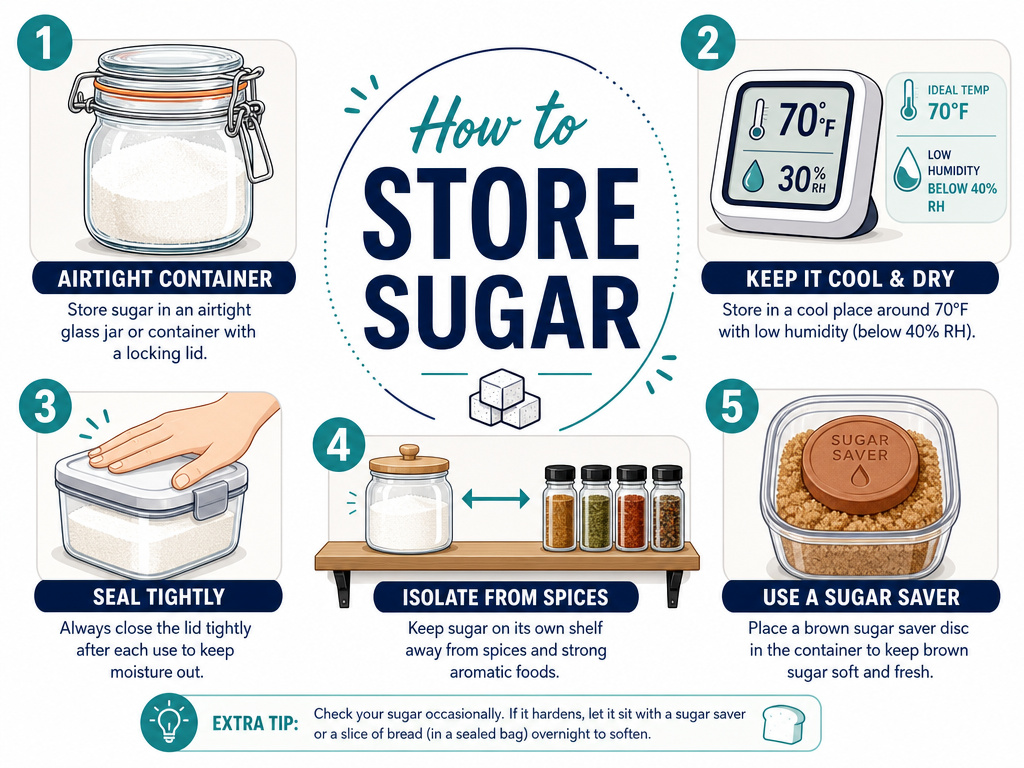 The rules are simple, born directly from the failure modes above. Your goal is to create a stable, dry, sealed environment.
- Choose an Airtight Container. The flimsy paper bag from the store is a temporary wrapper, not storage. Transfer sugar to a rigid, airtight container. Glass, food-grade plastic, or stainless steel with a tight-sealing lid are all excellent. The best containers for baking staples create a true moisture barrier.
- Find a Cool, Dry, Dark Place. A consistent pantry shelf away from heat sources, steam, and sunlight is ideal. The recommended temperature range is 60–75°F (15–24°C) with humidity below 70%. Never store dry sugar in the refrigerator or freezer, the cold, moist environment inside a fridge is a hardening accelerator.
- Keep It Sealed. Open the container, scoop what you need, and close it immediately. Prolonged exposure to kitchen air, especially on humid days, is an invitation for trouble.
- Store Away from Strong Odors. Keep your sugar canister away from the spice rack, the coffee bin, or any household chemicals. A dedicated shelf is best.
- For Brown Sugar, Add a Moisture Guardian. A terra cotta brown sugar saver soaked in water, a marshmallow, or a slice of bread in the container can help maintain the moisture balance. Even with these aids, plan to use opened brown sugar within a few months for best results.
For bulk long-term sugar storage, food-grade buckets with gamma-sealed lids or Mylar bags with oxygen absorbers are the professional choice. Oxygen removers aren’t needed for safety, but they do prevent oxidation of any minor impurities, keeping color and flavor pristine.
Frequently Asked Questions
Can old sugar make you sick?
No. Sugar cannot support the growth of bacteria, mold, or other pathogens that cause foodborne illness. It is chemically stable. The official shelf life guidance document defines shelf life primarily around safety, for sugar, that risk is zero.
How can I soften hardened sugar?
For a brick of granulated sugar, break it up with a hammer (inside a bag) and then pulse the chunks in a food processor or blender. For brown sugar, the microwave or oven methods work temporarily: place a damp paper towel over the sugar in a microwave-safe bowl and heat in 30-second bursts, or warm in a 250°F oven for a few minutes. It will re-harden as it cools, so only soften what you’ll use immediately.
Does powdered sugar go bad faster than granulated?
Yes, from a quality perspective. The cornstarch and ultra-fine texture make it clump much faster when exposed to humidity. It’s best used within the manufacturer’s 2-year guideline and stored in the most airtight container for sugar you have.
Should I freeze sugar to make it last longer?
Absolutely not. Freezing introduces moisture (frost) when you take it out, and the freeze-thaw cycle can cause clumping. Every manufacturer and extension service explicitly advises against freezing dry sugars. The only exception is if you live in an extremely dry climate and need to store brown sugar for over a year, even then, it’s a last resort.
Is the shelf life on the package an expiration date?
No. It’s a “best-by” or “best-if-used-by” date for optimal quality. Sugar is safe well beyond that date, though it may require some effort to use. This is a key difference between sugar and truly perishable foods with long shelf life like grains or legumes, which can eventually become rancid.
The Bottom Line
Sugar doesn’t have a shelf life in the way milk or meat does. It’s a permanent pantry staple. Your focus shouldn’t be on “Is this safe?” but on “Is this still good for my recipe?”
Invest in proper storage. A set of airtight glass containers pays for itself by preventing waste. Understand that brown sugar is a short-term player, while white granulated is a long-haul champion.
Stop worrying about spoilage. Start managing moisture. Your sugar will outlast your interest in baking with it.
