The Complete Guide on How to Properly Store Rice at Home
This post contains affiliate links. As an Amazon Associate, we earn from qualifying purchases.
Store rice by controlling three things: moisture content (12-13% for over a year), storage temperature (consistently below 70°F, ideally 59°F), and oxygen exposure (use sealed containers with oxygen absorbers). White rice lasts decades; brown rice lasts months due to its oils.
That 12-13% moisture figure is the critical line between rice that stays fluffy for thirty years and rice that turns rancid in ten months. The oils in rice bran, even in polished white rice, start oxidizing the moment you bag it.Control the water, control the air, control the heat, and you control the clock.
What follows is the mechanic’s view: the exact moisture percentages that match your storage timeline, the container specs that actually block oxygen, and the one mistake with grain temperature that cracks kernels and ruins texture. This process is about stopping time.
Key Takeaways
- Target 12.5% moisture throughout your storage container for multi-year stability. Mixing dry grain with moist grain causes fissuring.
- Oxygen absorbers are non-negotiable for long-term storage. They stop insect eggs and slow fat oxidation cold.
- White rice stored at a constant 70°F lasts up to 10 years. Drop the temperature to a cool 40-50°F, and the shelf life stretches to 30 years.
- Brown rice is a short-term player. Its higher oil content limits shelf life to about 6 months, even in ideal conditions.
- The Fatty Acid Value (FAV) is the chemical red flag. When FAV exceeds 30 mg KOH/100g, the rice is considered spoiled, it will taste off and cook poorly.
Why Rice Spoils: It’s a Chemistry Problem
Rice is a biological package that degrades through three main channels: moisture migration, fat oxidation, and insect infestation. You’re not just keeping it dry; you’re halting chemical reactions.
Moisture is the primary driver. Rice acts as a hygroscopic material, meaning it pulls water vapor right out of the air. Above 14% moisture, you’re in the danger zone for mold and accelerated enzyme activity. But the real damage happens subtly. As humidity in your storage area fluctuates, moisture moves to the coldest point in the container, often the bottom or sides. This migration can create localized wet spots where spoilage starts, even if the average moisture reads fine.
The second channel is lipid oxidation. All rice contains fats. Brown rice, with its intact bran layer, has significantly more. These fats break down over time, a process dramatically sped up by heat, light, and oxygen. The result is rancidity, that stale, cardboard-like taste. Scientists measure this breakdown with a metric called the Fatty Acid Value (FAV). Research on the high-quality indica rice Xiadao No.1 established that when the FAV exceeds 30 mg KOH/100g, the rice is considered unsuitable for storage. Your nose might not detect it yet, but the chemistry doesn’t lie.
Common mistake: Storing rice in a clear container on a sunny pantry shelf. Light and heat accelerate fat oxidation, and you’ll get that off-flavor within a year, regardless of your seal.
Insects are the third threat. Weevils and moths can infiltrate poorly sealed packages. Their eggs are often present in grain when you buy it; a sealed, oxygen-deprived environment is what prevents them from hatching.
The 13.5% Moisture & 15°C Sweet Spot
The frontier of rice storage research focuses on mapping the precise intersection of moisture and temperature where aging stops. A 2024 study in Frontiers in Nutrition provides that map.
Researchers stored Xiadao No.1 rice at different moisture contents (13.5%, 14.5%, 15.5%) and temperatures (15°C/59°F, 20°C/68°F, 25°C/77°F, 30°C/86°F) for 360 days. They tracked chemical markers and sensory scores. The results were stark.
Rice with initial moisture contents of 13.5% and 14.5% stored at 15°C maintained a sensory score higher than 60 throughout the 360-day period. When the fatty acid value (FAV) of rice exceeds 30 mg KOH/100 g, it is considered unsuitable for storage. Rice with an initial moisture content of 13.5% stored at 30°C reached an FAV higher than 30 mg KOH/100 g after 300 days.
This is your non-negotiable takeaway: 13.5% moisture at 59°F (15°C) is the gold standard for preserving quality within a year. Push the temperature to 86°F (30°C), and even that “safe” 13.5% moisture rice will spoil before a year is up. The study is a primary source you can cite, and it directly refutes the vague “cool, dry place” advice.
For timelines beyond a year, the targets get tighter. The IRRI Rice Knowledge Bank states that for storage over one year, moisture must be 9% or less. For 8-12 months, aim for 12-13%. This granularity is what most guides miss.
| Storage Duration | Target Moisture Content | Critical Risk If Exceeded |
|---|---|---|
| 2-3 weeks | 14-18% | Mold growth, clumping |
| 8-12 months | 12-13% | Fatty acid value rises, taste declines |
| 1+ years | 9% or less | Rancidity, total quality loss |
White Rice vs. Brown Rice: A Shelf Life Chasm
Treating all rice the same is how you end up with a bucket of spoiled grain. The processing difference creates a storage reality that’s almost opposite.
White Rice (Polished): The hull, bran, and germ are removed. This strips away most of the oils and enzymes that cause spoilage. What’s left is mostly starch, which is stable. The USU Extension confirms that white rice stored with oxygen absorbers at a steady 70°F lasts up to 10 years. In a cooler space (40-50°F), it can last 25 to 30 years. It’s the ultimate long-term storage carbohydrate.
Brown Rice: The bran and germ are intact. This means more nutrients, but also more oils and active enzymes. Those oils oxidize rapidly. Even in a perfect, oxygen-free environment in your fridge, brown rice has a shelf life of about 6 months to two years. At room temperature, expect rancidity in 3-6 months. You don’t store brown rice for the future; you buy it for the present.
If your goal is a multi-year food reserve, white rice is the only rational choice. For daily consumption, buy brown rice in small quantities and store it in the refrigerator.
The Gear That Actually Works
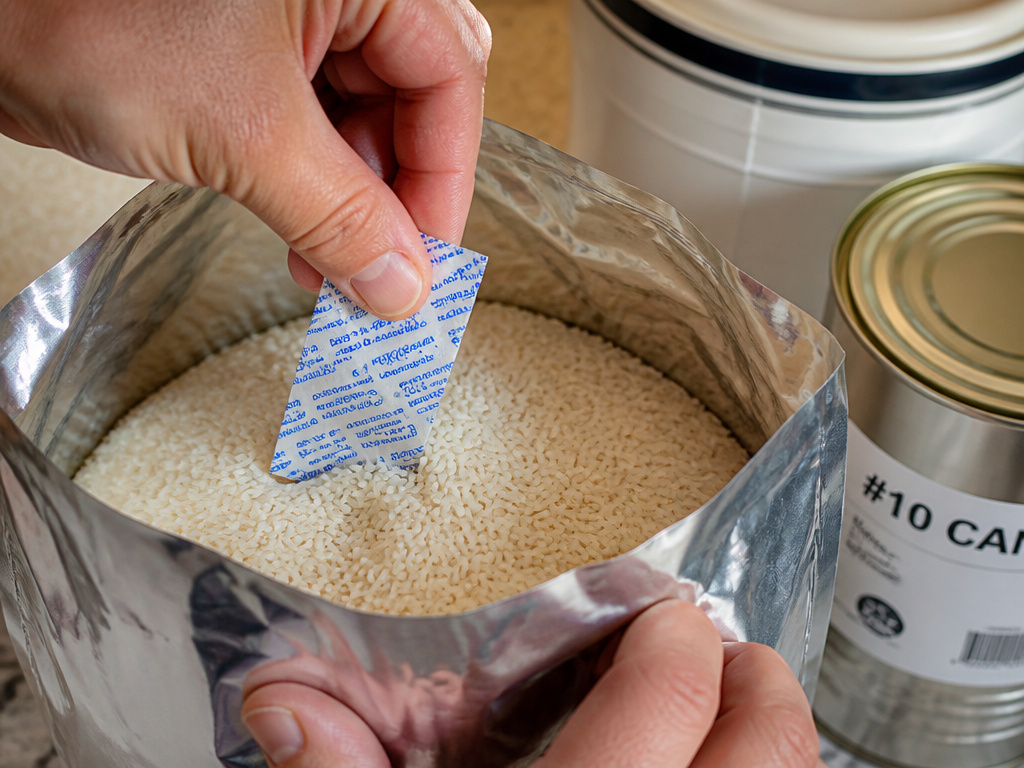 Your storage container is your first and last line of defense. The wrong choice undermines everything else. You need a barrier against moisture, oxygen, and light.
Food-Grade Buckets (5-Gallon): The workhorse for bulk storage. They must be HDPE plastic with a gasket in the lid. The gasket is critical, without it, the seal is useless. They block light and are rodent-proof, but they are slightly permeable to oxygen over very long periods (years). Best used with an inner Mylar bag.
Mylar Bags: A metallized polyester laminate that is an absolute barrier to oxygen, moisture, and light. This is what the prepper community and the ScienceDirect rice storage study on hermetic systems rely on. You heat-seal the bag closed. For best results, place the Mylar bag inside a bucket for physical protection. A 5-gallon bucket holds about 35 lbs of rice in a single Mylar bag.
#10 Cans: These are the commercial-sized cans with enamel-lined steel walls. The USU Extension notes they hold approximately 5.7 lbs of polished rice. They are impervious to oxygen, light, and pests, and are stackable. They’re perfect for building a rotation of smaller, manageable portions.
Oxygen Absorbers: Not a “nice-to-have.” They are essential. These small packets contain iron powder that rusts, chemically binding all the oxygen in the container. This creates a nitrogen-rich atmosphere that kills insect eggs and drastically slows oxidation. Use the appropriate size for your container volume (500cc for a 5-gallon bucket, 100cc for a #10 can).
Glass Jars: Excellent for short-to-medium-term storage of rice you’re actively using. They provide a perfect seal and let you see the contents. Their weakness is light, you must store them in a dark cupboard. A one-gallon glass jar holds about 7 lbs of white rice.
Step-by-Step Guide to Long-Term Rice Storage
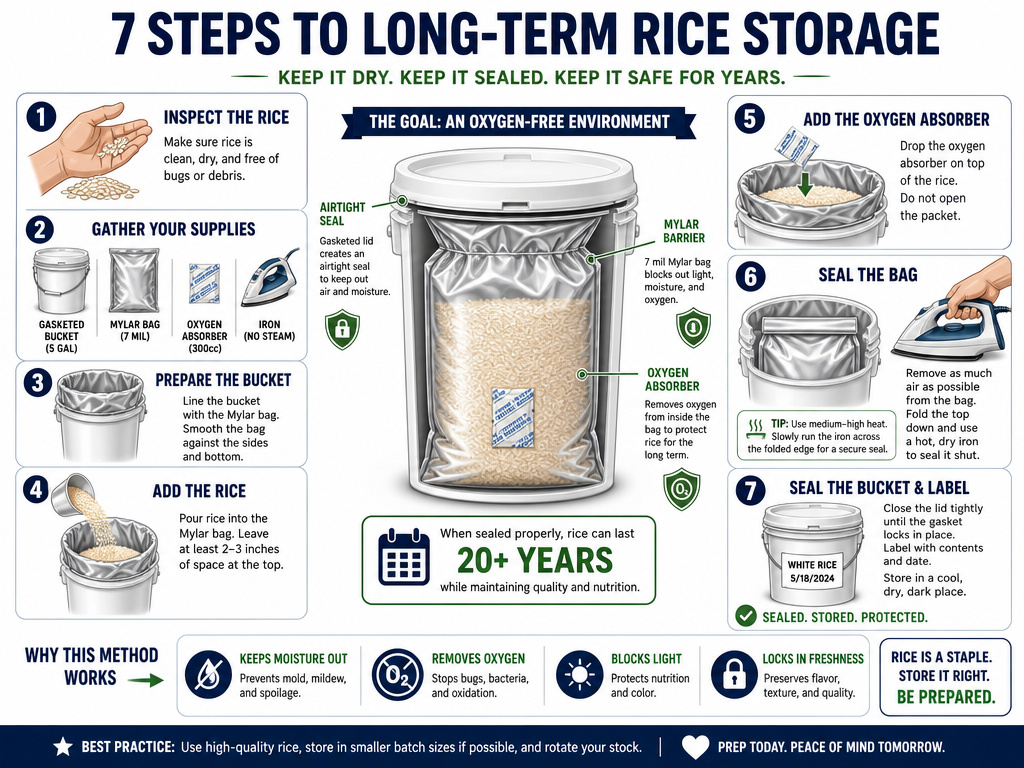 This process assumes you’re packing white rice for a multi-year shelf life. Rushing or skipping steps here guarantees failure.
- Source Your Rice. Buy from a store with high turnover. Inspect a handful for any signs of insects or moisture. This is your last chance to reject bad stock.
- Gather Supplies. You’ll need rice, food-grade buckets with gasketed lids, Mylar bags, oxygen absorbers (one 500cc per bag), and a flat iron for sealing.
- Insert the Mylar Bag. Place the Mylar bag inside the bucket, folding the top over the rim. This makes filling easier.
- Fill the Bag. Pour the rice into the Mylar bag, leaving at least 3 inches of headspace at the top.
- Add the Oxygen Absorbers. Drop the required number of absorbers on top of the rice. Do not open their outer packaging until you are ready to seal, they start working immediately.
- Seal the Mylar Bag. Press as much air out as possible by hand. Then use the flat iron on a cotton setting to heat-seal across the top of the bag. Make a second seal about an inch below the first for insurance.
- Close the Bucket. Fold the sealed Mylar top over, put the lid on the bucket, and press until the gasket clicks. Label the bucket with the contents and date.
Where this goes sideways: Adding an oxygen absorber to a container that isn’t truly airtight. The absorber will suck in outside air through microscopic leaks, becoming useless within days and leaving your rice unprotected.
For smaller batches using glass jars, the principle is the same: fill, add a correctly sized oxygen absorber (a 100cc is good for a quart jar), and screw the lid on tight. Store the jars in a dark cupboard.
Where and How Long to Store Rice
Location dictates longevity. The ideal storage space is dark, with a stable, cool temperature and low humidity. Your basement, if it’s dry, is often better than your kitchen pantry.
- Pantry (60-75°F): Suitable for rice in daily-use airtight containers. Expect a shelf life of 1-2 years for white rice. Brown rice will last 3-6 months here.
- Basement or Cellar (50-60°F): The sweet spot for long-term storage. White rice in Mylar bags or #10 cans can easily reach its 25-30 year potential here.
- Refrigerator (35-40°F): Excellent for extending the life of brown rice or opened packages of any rice. Use within 6 months for brown rice, 2-3 years for white. Ensure containers are sealed to prevent the rice from absorbing food odors.
- Freezer (0°F): This is more of a treatment than a storage method. Placing rice in the freezer for a week will kill any insect eggs. After that, you can move it to another storage location. It’s not necessary for long-term white rice storage if oxygen absorbers are used.
The Arkansas Rice Production Handbook adds a critical rule for large-scale storage: never operate aeration fans when the air temperature is below 32°F. This causes moisture migration and condensation within the grain mass, leading to spoilage. The same physics apply on a smaller scale, avoid wild temperature swings.
Frequently Asked Questions
Can you store rice in the original bag?
No. The plastic bags from grocery stores are thin and not airtight. They offer almost no protection against moisture, oxygen, or pests. Transfer rice to a proper storage container immediately.
How can you tell if stored rice has gone bad?
Your senses are the best tool. Look for discoloration, mold, or signs of insects (webbing, live bugs). Smell it, rancid rice has a distinct stale, almost paint-like odor. Taste a single grain; spoiled rice will have a bitter or sour flavor. If in doubt, throw it out.
Does vacuum sealing rice make it last longer?
Vacuum sealing removes most of the air, which is helpful. However, it doesn’t create the oxygen-free environment that an oxygen absorber does. For the very long term, combine vacuum sealing with an oxygen absorber inside the bag for the best results.
Is it safe to eat rice that’s been stored for 10 years?
If it’s white rice that was stored properly (low moisture, oxygen-free, cool temperature), it should be safe. Its nutritional value and taste will have degraded somewhat, but it will still be edible and provide calories. Always inspect and smell it first. The USU Extension cites studies of rice stored for 30 years that retained acceptable quality.
What about storing other grains like quinoa or barley?
The same principles apply: control moisture, oxygen, and temperature. However, each grain has a different oil content. Like brown rice, quinoa has a higher fat content and a shorter shelf life, treat it as a short-term storage item.
The Bottom Line
Proper rice storage is a system built on three pillars: moisture under 13.5%, temperature under 70°F, and an oxygen-free seal. Get those right, and a bag of white rice becomes a 30-year investment.Get one wrong, and you’re just postponing spoilage.
Start with your goal. For a multi-year food reserve, pack white rice in Mylar bags with oxygen absorbers inside buckets, and stash them in the coolest, darkest spot you have. For the rice you eat this month, a glass jar or quality plastic bin in the pantry is fine. The difference between the two approaches is decades. Choose your gear to match your timeline, and your rice will never let you down.
