The Guide on How to Seal a Chip Bag Without a Clip at Home
This post contains affiliate links. As an Amazon Associate, we earn from qualifying purchases.
To seal a chip bag without a clip, you need to remove all air and create a mechanical lock with the bag’s own plastic. The three folds that work are the basic roll-down (for immediate use), the corner-tuck fold (for bags half-full or less), and the triangle-ear fold (for a tight, multi-day seal). An opened bag stays fresh for about five to seven days in a cool, dry place, but humidity ruins crispness faster than air exposure.
The difference between a chip that snaps and one that bends isn’t just about the seal. It’s about the space left in the bag. A half-empty bag has a large air cavity that acts as a humidity exchange chamber every time you open the pantry. The folds that last are the ones that shrink that cavity to almost nothing before locking the plastic.
What follows: the mechanics of why the simple roll fails, the step-by-step for the two folds that actually hold, and the one condition where no fold works at all.
Key Takeaways
- The basic roll-down fold fails because it relies on gravity and bag weight; any shift in storage lets air back in within hours.
- For a bag that’s half-full or less, the corner-tuck fold creates a passive mechanical lock that lasts days.
- Humidity degrades crispness faster than oxygen. Even a perfect seal won’t save chips stored above 60% relative humidity.
- Small, single-serving bags lack the material length for a secure fold. If your bag is under 6 inches tall after flattening, just finish the chips.
- Always press out every bubble of air before you start any fold. The goal is zero headspace.
The Basic Roll-Down Fold (And Why It Fails)
You’ve done this one. Flatten the bag’s top, roll it down tight, and maybe tuck the end under the bag. It feels secure for about as long as the bag sits untouched on the counter.
The roll-down fold works by gravity and friction, not by sealing. The moment you move the bag or stack something on it, the tension releases and the bag unrolls enough to let in moist air.
The problem is physics. A simple roll has no locking mechanism. It depends on the plastic’s memory and the weight of the chips to keep it coiled. Pantry doors closing, other bags shifting, these small vibrations are enough to loosen the roll. You get a stale, chewy chip not from a fully open bag, but from a bag that’s relaxed just a quarter-inch. That’s all the space needed for a humidity exchange.
If you need a fold for the next hour, this is fine. For anything longer, it’s a placebo.
When to use it: Only when you plan to finish the bag within the same day and you’re just containing the mess. For actual multi-day freshness, you need a fold that mechanically locks.
The Corner-Tuck Fold for Half-Full Bags
This is the workhorse. It needs at least 4 to 5 inches of empty bag above the chips to execute cleanly, which makes it perfect for a bag that’s half gone. The goal is to use the bag’s own corners as locking tabs.
You need: A bag with at least 4 inches of empty space above the chips, a flat surface, and dry hands (grease weakens the fold).
- Settle and flatten. Shake the chips to the bottom. Lay the bag flat on a table and run your hand from the chip line to the opening at least three times. You’re pushing every cubic inch of air out. Miss this step and the trapped air will push the fold open overnight.
- Fold the top corners in. Take the left and right top corners of the bag and fold them diagonally toward the center. They should meet about 2 to 3 inches below the bag’s opening, forming two triangular flaps.
- Roll down from the folds. Starting just below where the corner folds meet, roll the bag down tightly toward the chips. Make three to four complete rolls. The tighter the roll, the more tension holds the corner flaps in place.
- Tuck the corner flaps. You’ll have the two triangular corner flaps sticking out. Tuck these flaps under the rolled portion you just created. This is the lock. The tension of the roll holds the flaps, and the flaps block the roll from unfurling.
Common mistake: Rolling too loosely. If you can see gaps between the rolls, humidity gets in. The roll should be tight enough that the plastic is under light tension.
This method creates a passive seal good for two to three days in a standard pantry. It’s the default for a reason, it’s reliable without being finicky.
| Step | Action | What Goes Wrong If You Skip It |
|---|---|---|
| 1. Settle & Flatten | Push chips down, press air out. | Trapped air expands, forces the seal open within hours. |
| 2. Fold Corners In | Create two triangular flaps. | Roll has nothing to lock against; it unfurls easily. |
| 3. Roll Tightly | Roll bag down 3–4 times. | Loose rolls provide no tension; the lock fails. |
| 4. Tuck Flaps Under | Secure flaps under the roll. | The roll can slide and unravel; seal breaks. |
The Triangle-Ear Fold (The “TikTok” Seal)
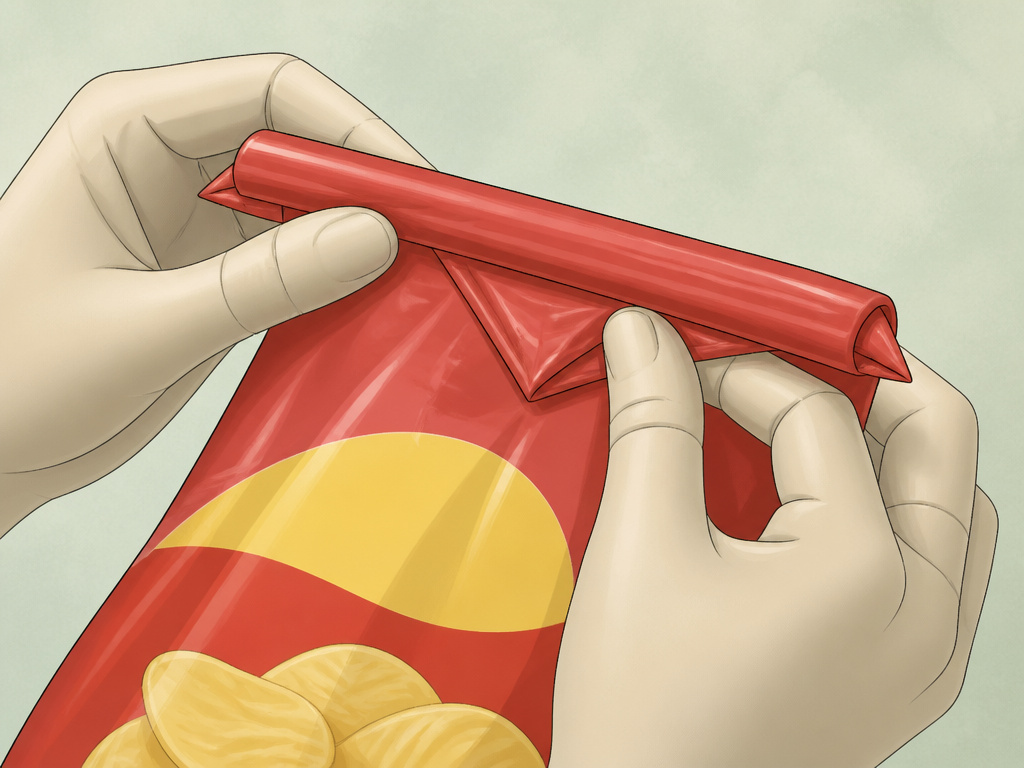 A viral video with over 6 million views demonstrates this method, often called the triangle-ear or pirate-hat fold. It’s more origami, but it creates the most secure seal of all the clip-less methods. It requires the most empty bag material, ideal when you’ve only had a handful from a family-sized bag.
The principle is similar to the corner-tuck, but you create larger “ears” and use them to form a cap over the entire opening.
- Flatten completely. This is non-negotiable. Any air left will pop the seal later.
- Create two triangle ears. Pinch the top-left corner and fold it diagonally down and inward, creating a triangle. Repeat on the top-right corner. The points of the triangles should almost touch in the middle.
- Roll the body. Starting from the base of the triangles, roll the bag down tightly towards the chips. You’ll roll over the triangular flaps.
- Fold and tuck the point. You’ll be left with a pointed tip of bag material at the top. Fold this tip down and tuck it firmly under the rolled band you created in step 3.
The result is a compact, flat package where the rolled band cinches the bag closed and the tucked point acts as a final lock. This seal can maintain crispness for four to five days because it minimizes the air pocket almost completely.
Why it works for large bags: The extra plastic length gives you material to work with. On a small, lunch-sized bag, you simply don’t have enough length to create the ears and the roll.
What No Fold Can Fix: Humidity and Bag Size
 A perfect fold is useless against two enemies: ambient humidity and a too-small bag.
Humidity is the real crisps-killer. Oxygen gets the blame, but it’s water vapor in the air that migrates into the potato starch and turns it soft. Storing chips in the fridge is a last-resort move for humid climates, it’s cold and dry, but it can introduce other odors. The better move is a cool, dark pantry shelf away from the stove or dishwasher.
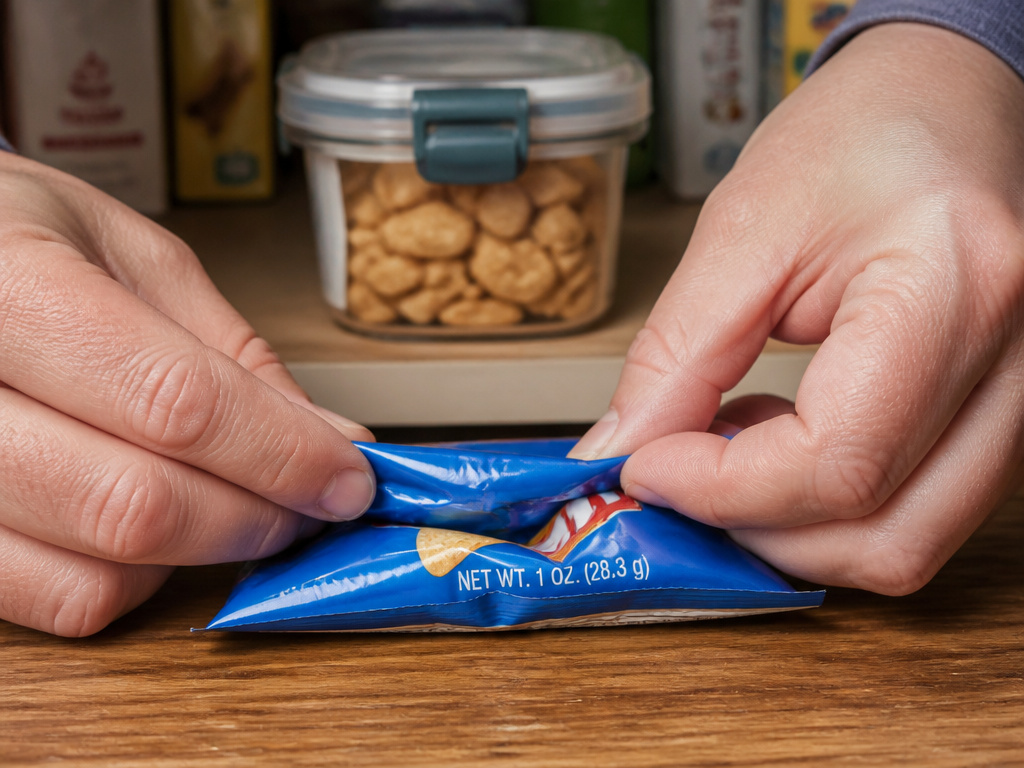
Bag size matters mechanically. The corner-tuck and triangle-ear folds need raw material. If your bag is a single-serving size (like a 1-ounce bag), you likely have less than 3 inches of bag above the chips once flattened. That’s not enough to create a locking fold with integrity.
Skip this if: Your chip bag is a small, single-serving size. The plastic is shorter and often thinner. You’ll fight it for a minute only to have it spring open. For those, your best storage is a dedicated chip bag sealer or a small airtight container.
The plastic itself is a variable. Thinner, eco-friendly packaging tears more easily under the stress of a tight fold. If the bag is already wrinkled or creased from the store, the plastic’s memory is compromised and any fold will be weaker.
How Long Do Fold-Sealed Chips Actually Last?
 An unopened bag of chips has a shelf life of two to three weeks from purchase, assuming good storage. Once opened, the clock changes dramatically.
| Storage Condition | Expected Freshness | Why |
|---|---|---|
| Opened, loose roll | 12–24 hours | Constant air exchange, no barrier to humidity. |
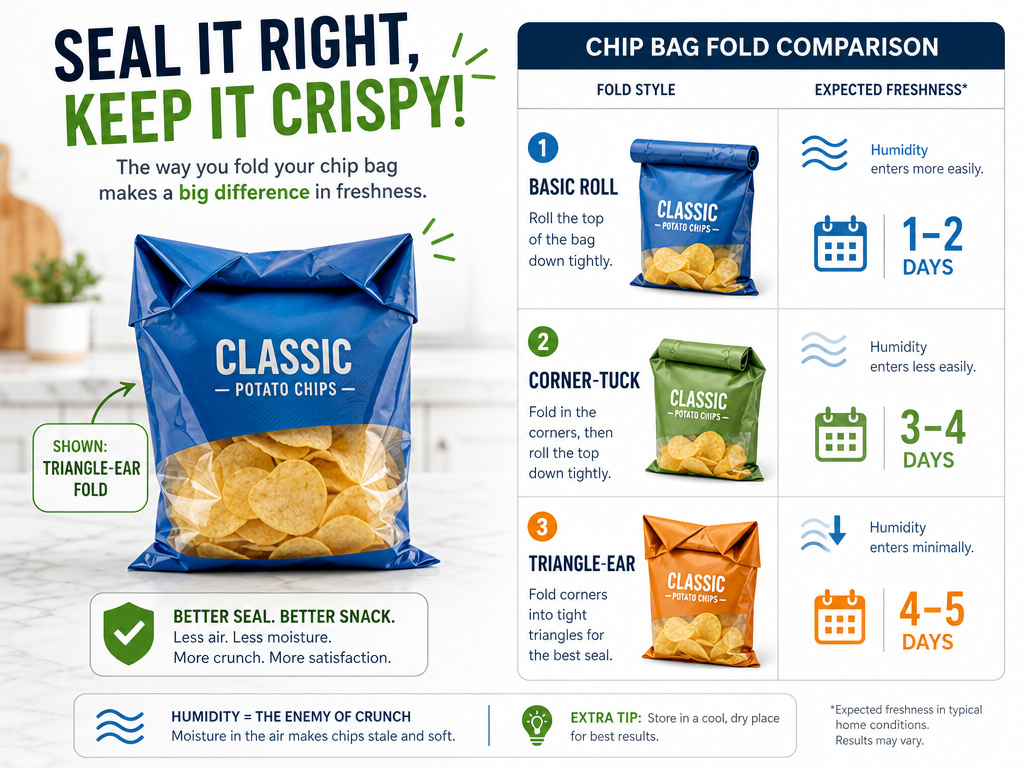
| Opened, basic roll-down fold | 1–2 days | Intermittent air exposure every time the bag relaxes. |
| Opened, corner-tuck fold | 3–4 days | Mechanical lock reduces air volume and exchange. |
| Opened, triangle-ear fold | 4–5 days | Minimal headspace, full plastic barrier. |
| In humid room (>60% RH) | 1–2 days max | Humidity permeates the plastic regardless of fold. |
| Transferred to airtight container | 7–10 days | Physical barrier against both air and humidity. |
The five-to-seven-day freshness window you see online assumes a near-perfect seal and ideal pantry conditions. In a real kitchen next to a kettle or a sink, you’re looking at three to four days with a good fold. After that, the starch absorbs enough moisture to lose its snap.
This is why methods for storing chips focus on environment as much as technique. The same principle applies to storing flour or coffee beans, it’s a battle against ambient moisture.
When to Use a Tool Instead
Folding is a skill. It’s also a stopgap. For long-term storage of more valuable snacks or ingredients, a tool wins every time.
For chip bags specifically: A dedicated chip bag sealer applies heat to melt the plastic layers together, creating a true hermetic seal. It’s the only method that genuinely resets the clock to near-unopened conditions.
For other dry goods: The same logic applies. If you’re dealing with a large bag of dehydrated food or a bulk purchase you want to portion, a mini sealer and cutter tool is more reliable than any fold. It seals and cuts in one motion, which is useful for repackaging.
For the simple, clip-minded: Sometimes you just want to clamp it shut. That’s where bag clips or bag sealers have their place. They’re faster than folding for a bag you’ll reopen in an hour, and they work on any bag size or thickness. A good clip applies even pressure across the whole bag mouth, which a fold can’t do.
Frequently Asked Questions
Can you use a hair straightener to seal a chip bag?
You can, but it’s risky. A hair straightener gets much hotter than a dedicated bag sealer. You risk melting through the thin plastic entirely or creating a weak, brittle seal that cracks. Dedicated bag sealing devices heat to a lower, controlled temperature designed for polymer films.
Does putting chips in the fridge keep them crisp?
It keeps them fresh, but not necessarily crisp. The fridge is cold and dry, which slows staling. However, the constant temperature cycling every time you take the bag out can cause condensation inside the bag, which is worse. For humidity control, it’s a last resort.
Why do my chips go stale even with a clip?
Clip only pinches the bag closed; it doesn’t remove the air inside. If you clip a bag that’s half full of air, that air still contains moisture that will migrate into the chips. Always press the air out first, then apply the clip.
What’s the best way to store an almost-empty chip bag?
Eat them. Seriously, if there’s only a serving or two left, the surface area of chips exposed to the remaining air is huge. No fold or clip will help much. Either finish them or transfer the leftovers to a very small, airtight container.
Can I use these folds for other bags?
Yes. The corner-tuck fold works well for any crunchy snack bag (pretzels, crackers) or even bags of frozen vegetables you’ve opened. The triangle-ear fold is best for large, lightweight bags like cereal liners. For wet or greasy foods, the folds might not hold due to residue on the plastic.
Before You Go
The corner-tuck fold is the one to learn. It needs a half-empty bag and dry hands, but it works for three days without fail. Remember that humidity, not just air, is what turns a chip soft. If your kitchen is humid, a fold buys you a day, maybe two. After that, you need an airtight container or a heat-sealing tool. For small bags, don’t fight the physics, just finish the chips.
