What Is a Mylar Bag? Structure for Long-Term Food Storage
This post contains affiliate links. As an Amazon Associate, we earn from qualifying purchases.
A Mylar bag is a flexible, multi-layer pouch made from biaxially-oriented polyester film (BoPET), laminated with a thin aluminum layer and a polyethylene sealing layer. This construction creates an airtight, light-blocking, and moisture-resistant barrier, extending the shelf life of dry foods to 25 years or more when used with oxygen absorbers and stored correctly. The critical variable is thickness, measured in mils: 4 mil protects for 1–5 years; 7 mil guards for 15–25 years.
That barrier isn’t magic. It’s engineering. The difference between a Mylar bag and a standard plastic zip bag is the difference between a brick wall and a screen door, one is a structure, the other is just a membrane. The aluminum layer blocks 99.9% of UV light. The polyethylene inner layer melts between 140°C and 180°C to form a permanent seal. The whole laminate has an oxygen transmission rate (OTR) as low as 0.01 cc/100 in²/day, which is roughly 15,000 times lower than a standard plastic bag.
What follows: a breakdown of the three-layer laminate using the manufacturer specs, a table that matches bag thickness to your storage horizon, the non-negotiable rules for avoiding botulism, and the one mistake that turns your long-term storage into a five-year gamble.
Key Takeaways
- Mylar is a brand name for BoPET film. The term now commonly refers to any multi-layer, aluminum-laminated pouch used for high-barrier storage.
- Thickness in mils dictates shelf life. A 4-mil bag is for 1–5 year storage; a 7-mil bag is for 15–25 year storage. Thinner bags puncture and fail.
- Never pack food with >10% moisture. Botulism bacteria thrive in the low-oxygen, high-moisture environment a sealed Mylar bag creates.
- Oxygen absorbers are mandatory for dry goods, but not for everything. Using them with salt or sugar will turn those products into a solid brick.
- They are not microwave-safe. The aluminum layer will spark, and the polyethylene inner layer can melt.
What Is a Mylar Bag? Beyond the Brand Name
“Mylar” is a trademark owned by DuPont (now part of Celanese Corporation) for its biaxially-oriented polyethylene terephthalate (BoPET) film. In everyday use, the term has become generic, like “Kleenex” for tissues. When people say “Mylar bag,” they almost always mean a flexible, stand-up pouch with a distinctive metallic sheen, used for long-term storage.
The manufacturer’s own packaging brochure includes a clear disclaimer: “This information is offered solely to provide possible suggestions for your own experimentations… Mylar Specialty Films makes no warranties and assumes no liability in connection with any use of this information.”
That legal clause matters. It means the published specs are guidelines, not guarantees for your specific conditions. Your storage temperature, how you handle the bag, and what you put inside it change the outcome. A Mylar bag is a tool, not a set-and-forget solution.
The core material, BoPET, is a polyester film stretched in two directions during manufacturing. This biaxial orientation gives it exceptional tensile strength, up to 31,000 psi, and dimensional stability. It’s the same material used in space blankets, emergency thermal sheets, and shiny balloons. For packaging, this strong film becomes the structural backbone of the bag.
The 3-Layer Construction (How a Mylar Bag Actually Works)
A standard Mylar bag isn’t a single sheet of foil. It’s a laminate, a sandwich where each layer has a dedicated job. This is the engineering that justifies its cost and reputation.
- Outer Layer: PET (Polyethylene Terephthalate). This is the 12-micron (µm) thick BoPET film. It provides the bag’s structural strength, puncture resistance, and printable surface. It’s what you see and touch.
- Barrier Layer: Vacuum-Metallized PET (VMPET). A microscopic coating of aluminum, just 350–450 Ångströms thick, is applied to the PET in a vacuum chamber. This layer is responsible for blocking 99.9% of UV light and providing the primary barrier against oxygen and moisture. It’s the “foil” you see, but it’s actually a vapor-deposited metal coating, not a thick sheet.
- Inner Layer: Polyethylene (PE). This is the 60–80 µm thick heat-seal layer. It’s a food-safe plastic that melts at a lower temperature (typically 140–180°C) than the PET layers. When you run a heat sealer across the bag’s opening, this PE layer flows to create a permanent, airtight weld.
| Layer | Material | Thickness | Primary Function | Critical Spec |
|---|---|---|---|---|
| Outer | PET (BoPET) | 12 µm | Structural strength, print surface | Tensile strength up to 31,000 psi |
| Middle | VMPET (Aluminum-coated PET) | 350–450 Å | Blocks light (99.9% UV), oxygen, moisture | Defines Oxygen Transmission Rate (OTR) |
| Inner | Polyethylene (PE) | 60–80 µm | Heat-seals to form airtight closure | Melts at 140–180°C for sealing |
This trio works as a system. The PET gives it shape, the aluminum blocks the elements, and the PE lets you close it for good. Damage any one layer, and the system fails.
The One Number That Decides Everything: Thickness (Mils)
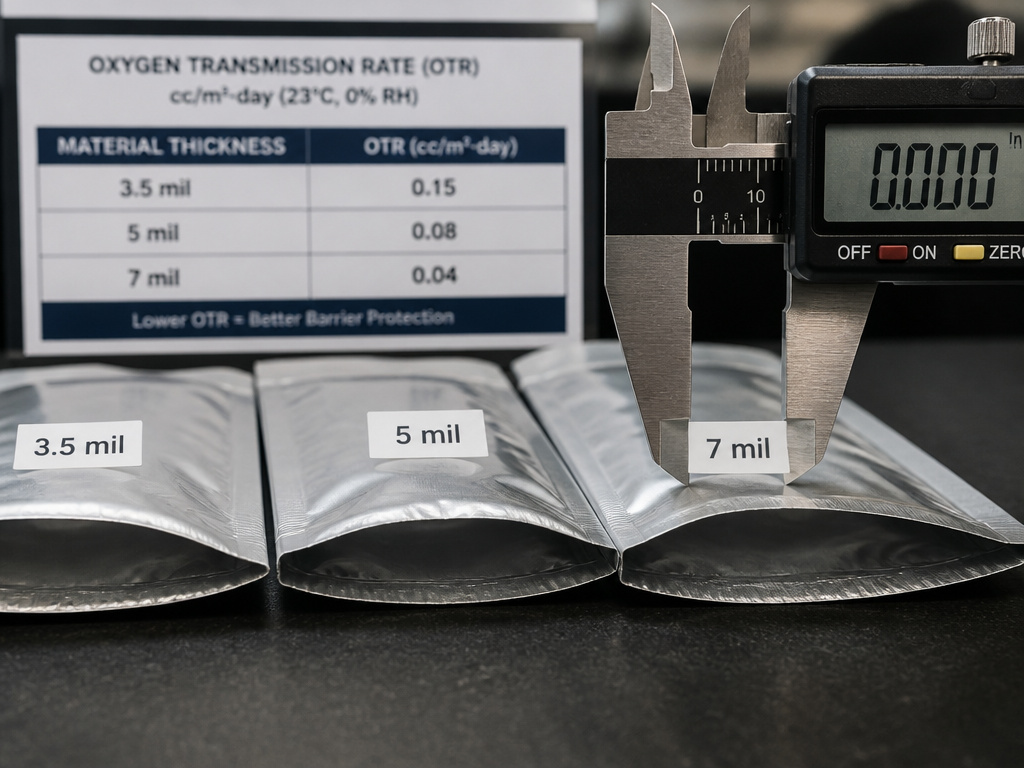
You’ll see bags labeled 3.5 mil, 5 mil, 7 mil. A mil is one-thousandth of an inch (0.001”). This total thickness, the combined measure of all three laminated layers, is the single biggest predictor of shelf life and durability. It directly correlates to the Oxygen Transmission Rate (OTR).
OTR is measured in cubic centimeters of oxygen that pass through 100 square inches of film per day at 23°C and 0% relative humidity (ASTM D3985). A lower OTR means a better barrier. Standard plastic bags have an OTR in the hundreds. A high-barrier Mylar bag has an OTR below 1.0. A 7-mil bag can achieve an OTR as low as 0.01.
Where this goes sideways: Choosing a 3.5-mil bag for 10-year storage. The thinner film is more prone to pinholes and flex cracking, and its higher OTR lets oxygen slowly migrate in. Your food will spoil years before you expect it.
This table matches thickness to a realistic storage horizon, based on laminate specs from industry sources.
| Thickness (Mils) | Approx. OTR (cc/100 in²/day) | Realistic Storage Horizon | Best For |
|---|---|---|---|
| 3.5 – 4 mil | < 0.5 – 1.0 | 1 – 5 years | Short-term bulk storage, high-turnover goods. |
| 5 – -5.5 mil | < 0.1 | 5 – 10 years | The standard for serious preppers; for rice, beans, wheat. |
| 6 – 7+ mil | < 0.01 – 0.05 | 15 – 25+ years | Emergency/lifetime storage. Requires cool (≤15°C), dark conditions. |
The takeaway is blunt: buy for your goal. If you’re rotating wheat every three years, a 4-mil bag is fine. If you’re putting away rice for a decade, you need 5-mil bags at a minimum. Forgetting this is the most common planning error.
What Can You Store in a Mylar Bag? (And What Will Ruin It)
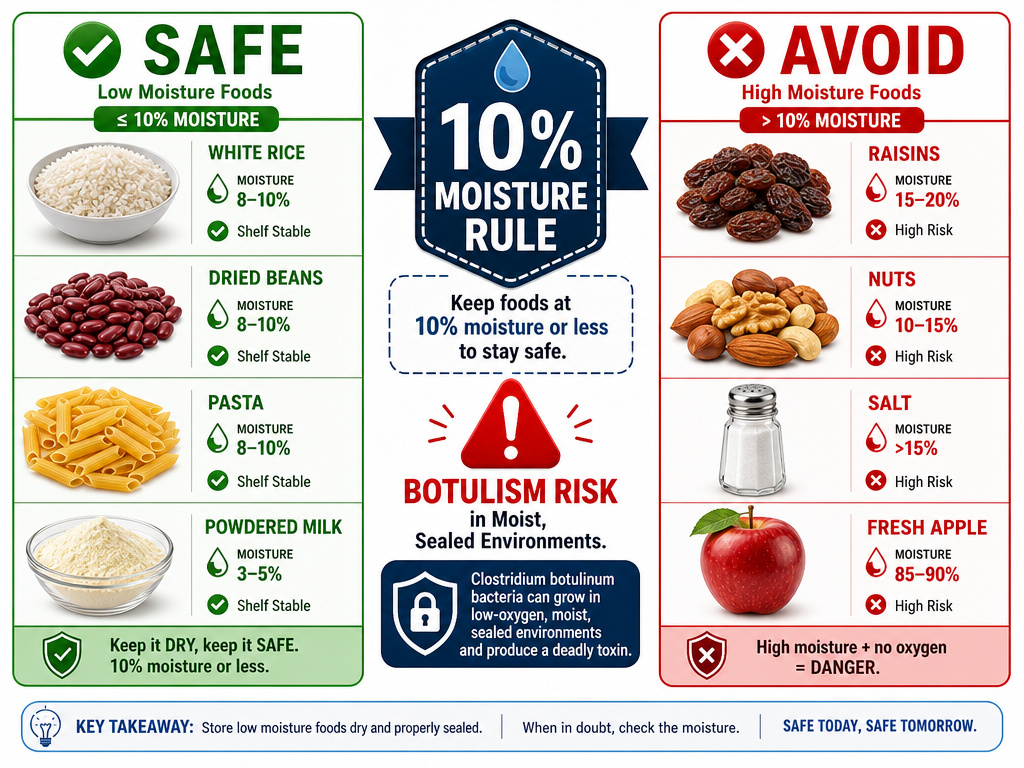
Mylar bags are designed for dry, low-moisture, low-fat foods. Their enemy is internal moisture and external physical stress.
Ideal Candidates:
- Grains (white rice, wheat, oats)
- Dried beans and lentils
- Pasta
- Powdered milk
- Dehydrated vegetables
- Flour (white)
- Spices
Problematic or Dangerous:
- High-moisture foods (>10% moisture): Raisins, dried fruit, jerky with unknown moisture content. These risk botulism.
- High-fat foods: Nuts, seeds, whole-grain flours. Fats oxidize and go rancid independently of oxygen. Absorbers don’t stop this.
- Salt, Sugar, Baking Soda: These do not spoil. Adding an oxygen absorber will cause them to harden into a solid block.
- Fresh produce, meats, or liquids. This is not a refrigeration substitute.
Common mistake: Using an oxygen absorber with brown sugar or whole wheat flour. The sugar hardens irreversibly. The oils in whole wheat flour will still go rancid. You’ve wasted both the food and the absorber.
The botulism risk is real and cited by every reputable source. Clostridium botulinum bacteria thrive in moist, low-oxygen environments, exactly what a sealed Mylar bag containing damp food becomes. This is why the 10% moisture rule is non-negotiable. If you wouldn’t eat it bone-dry, don’t seal it for the long term.
Mylar Bags vs. Other Storage Methods
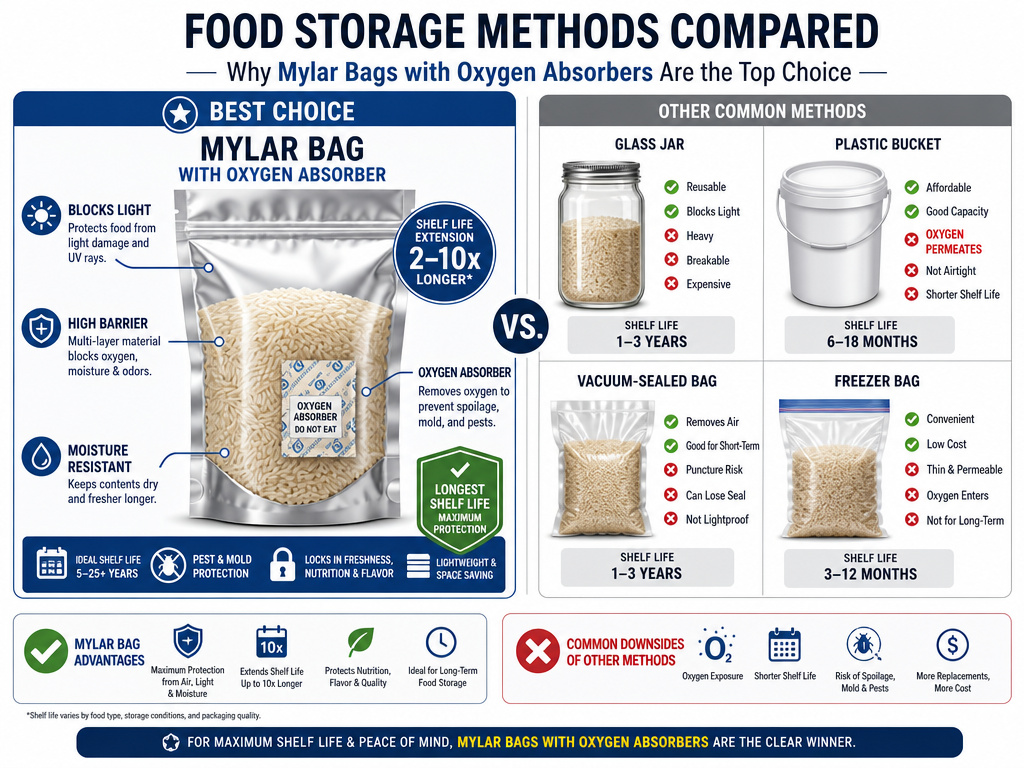
You have options. Each has a place, and Mylar isn’t always the winner.
- Vs. Glass Jars: Glass is impermeable and reusable. But it’s heavy, breakable, and doesn’t block light unless darkened. Mylar wins for bulk, portability, and light-blocking.
- Vs. Plastic Buckets (Pails): Food-grade buckets are great for bulk and rodent resistance. But unless paired with a Mylar bag liner, oxygen permeates through the plastic over time. For true 25-year storage, you use a Mylar bag inside a bucket.
- Vs. Vacuum Sealer Bags: Vacuum bags are excellent for short-to-medium term and for removing air from irregular shapes. Their plastic (usually nylon/PE) has a much higher OTR than metallized Mylar. They are not a true long-term barrier.
- Vs. Freezer Bags: A freezer bag is designed for sub-zero temperatures and preventing freezer burn via a different plastic formulation. It is not an oxygen barrier. Never confuse a Mylar bag for microwave or freezer use.
For the ultimate protection, many use a layered approach: seal food with an oxygen absorber in a 5-mil Mylar bag, then place that bag inside a sealed food storage container or bucket. This guards against punctures, pests, and light.
How to Use Mylar Bags Correctly: The Non-Negotiables
The process is simple, but the details are everything. Here’s the sequence that prevents failure.
- Choose the right bag. Match the thickness (mil) to your storage goal from the table above. For most long-term dry goods, start with 5-mil bags.
- Prepare your food. Ensure it is dry. If freezing to kill insect eggs, let the food return completely to room temperature in its original packaging before transferring to Mylar. This prevents condensation inside the bag.
- Add an oxygen absorber. Size it correctly (typically 300cc for a gallon bag). Drop it in immediately before sealing. Do not use absorbers with salt, sugar, or baking soda.
- Seal the bag. Use a dedicated heat sealer or a high-quality impulse sealer. An iron or hair straightener is a last-resort gamble that often fails. The seal must be a continuous, smooth strip about 1/2 inch wide. You must seal a Mylar bag properly; a weak seal is the number-one point of failure.
- Store the sealed bag. Place it in a cool, dark, dry place. A basement shelf is better than an attic. For decades-long storage, aim for a stable temperature at or below 15°C (59°F).
Your toolkit should include a reliable sealer, a large supply of correctly sized oxygen absorbers (store the extras in a glass jar), and bags you trust. Don’t buy the cheapest, thinnest bags and expect a 20-year result.
Frequently Asked Questions
Are Mylar bags food-safe?
Yes, the materials (PET, aluminum, polyethylene) are food-grade and BPA-free. Reputable manufacturers produce them in facilities following food safety standards (like ISO 9001 or BRC). The safety concern isn’t the bag, it’s what you put inside it and how you seal it.
Can you reuse a Mylar bag?
You can, if it’s undamaged. Carefully cut it open above the old seal, clean it thoroughly, ensure it’s completely dry inside, and make a new seal above the old one. However, each opening risks micro-tears. For critical long-term storage, a new bag is safer.
Why does my sealed bag still look puffy?
Oxygen absorbers only remove oxygen, which is about 21% of air. The remaining 78% is mostly nitrogen, which doesn’t react. A bag that looks slightly airy but firm is likely fine, the oxygen is gone. A bag that bulges soft over time indicates fermentation or botulism growth. That bag should be discarded.
Can you boil food in a Mylar bag?
For very short periods, like sous-vide, some bags might handle it. But it’s not recommended. The polyethylene layer softens around 105–130°C, and pressure can build, risking rupture. They are not designed for cooking.
Are Mylar bags rodent-proof?
No. The foil layer is thin and can be chewed through by mice or rats. Always store sealed Mylar bags inside a rigid, rodent-proof container like a metal bin or thick plastic bucket.
Before You Go
A Mylar bag is a specific tool for a specific job: creating an near-impermeable barrier around dry food. Its power comes from a three-layer laminate, polyester for strength, aluminum for blocking, polyethylene for sealing. That construction gives you control, but it also demands respect for its limits.
Remember the three rules. Thickness decides shelf life. Moisture content above 10% invites botulism. And oxygen absorbers are useless, or harmful, for certain foods. Get those right, and a bag of rice really will wait for you for 25 years. Get them wrong, and you’re just creating expensive, shiny future compost.
For most people building a practical pantry, a stock of 5-mil bags and a quality heat sealer is the starting point. Combine that with the correct oxygen absorbers, and you have a system that actually works.
