How to Soften Honey in a Plastic Container | Safe Warming Guide
This post contains affiliate links. As an Amazon Associate, we earn from qualifying purchases.
To soften honey in a plastic container, submerge it in a water bath held at 100°F (37.8°C). This temperature is warm enough to dissolve sugar crystals but stays below the 116°F (47°C) threshold that kills honey’s bioactive enzymes. It also prevents the plastic from warping or leaching chemicals. Stir every five minutes; a full 12-ounce bottle typically needs 15-20 minutes.
That 20-degree window between 100°F and 120°F is the entire game. Go a little cooler and the process drags for an hour. Go a little hotter and you trade liquid honey for a product stripped of what makes raw honey valuable. The plastic itself adds a second failure mode, heat it too much and it deforms, imparting a chemical taste that never leaves.
What follows: the exact water-bath procedure, the science behind the 100°F target, why plastic is a uniquely bad long-term storage choice, and the single best upgrade to make if you buy honey regularly.
Key Takeaways
- The safe heat ceiling is 100°F (37.8°C). Temperatures above 116°F (47°C) destroy honey’s natural enzymes and antioxidants.
- Never use boiling water or a microwave. Both will overheat the honey, damage its properties, and risk warping or melting the plastic container.
- Glass is the superior storage material. It withstands gentle reheating without risk, doesn’t leach odors, and preserves honey quality for years, not weeks.
- Stir every five minutes. Agitation is necessary to distribute heat and dissolve crystals evenly; passive soaking isn’t enough.
- Prevent re-crystallization by storing softened honey at a consistent, cool room temperature away from direct light.
Why Plastic is a Problem for Honey
Look at the label on your honey bottle. If it’s a squeezable plastic bear or a lightweight jug, you’ve chosen convenience over longevity. That’s a fine trade for a product you’ll use in a month. For anything else, you’re building in a future headache.
Where this goes sideways: Applying direct heat to a crystallized plastic bottle. The thin walls conduct heat unevenly, creating hot spots that can warp the plastic’s shape or, worse, cause chemical leaching into the honey within minutes. The result is a permanently misshapen container and honey that tastes faintly of plastic.
The core issue is reversibility. Glass containers solve crystallization easily because glass is inert and heat-resistant. You can safely use a warm water bath for years. Plastic, especially food-grade PET or HDPE, has a much lower thermal tolerance. A study in the journal ACS Omega on the physicochemical properties of honey notes that high thermal treatments are not accepted practice for quality standards, partly because of the interaction with packaging. When honey hardens in plastic, the honest recommendation from bottlers is often to accept the loss, the risk of ruining both container and contents is too high.
This isn’t about fear; it’s about material science. For long-term food storage safety, glass is the default. If your priority is shipping durability or short-term use, a plastic food container works. Know the trade you’re making.
| Container Material | Best For | Risk When Softening Honey | Long-Term Storage Outlook |
|---|---|---|---|
| Glass Jar | Any situation, especially long-term storage. | Virtually none. Withstands gentle, repeated reheating. | Excellent. Preserves flavor and quality indefinitely. |
| Food-Grade Plastic (PET/HDPE) | Short-term use, travel, or gifting. | Warping, leaching, and permanent flavor transfer if overheated. | Fair. Best used within 6 weeks; quality degrades faster. |
| Thin Plastic Pouch | Single-use, immediate consumption. | High risk of melting and leakage. Not recommended for softening. | Poor. Not designed for storage or reheating. |
The Science of Softening: Heat, Time, and Enzymes
Honey crystallizes because its glucose sugars precipitate out of solution. Reversing that requires adding energy back in as heat. The trick isn’t just to melt it, it’s to melt it without breaking the delicate compounds that define raw, unfiltered honey.
Bioactive enzymes, the proteins that give raw honey its reputed health benefits, are remarkably fragile. The consensus from honey producers and biochemists is that these enzymes denature, permanently unravel, at temperatures of 47°C (116°F) and above. Your target is to stay below that line.
Heating can decrease diastase activity and increase hydroxymethylfurfural (HMF) content, a known carcinogen. Viscosity decreases as temperature increases. . Summary of findings from honey rheology research
This means the “warm water bath” advice needs a number. 100°F (37.8°C) is that number. It’s the temperature repeatedly cited by commercial beekeeping equipment guides as the ideal for maintaining honey in a liquid state without degradation. At this temperature, decrystallization is a gentle, physical process of dissolving sugar crystals, not a chemical alteration of the honey itself.
Why not hotter? Because the relationship between time and temperature isn’t linear. A study on temperature effects showed honey at 90°C (194°F) decrystallized in 23 minutes, while at 75°C (167°F) it took 50 minutes. At 100°F, it might take 20 minutes. The extra 15 minutes is the price of keeping the enzymes intact. It’s a good trade.
The 100°F Water Bath: Step-by-Step
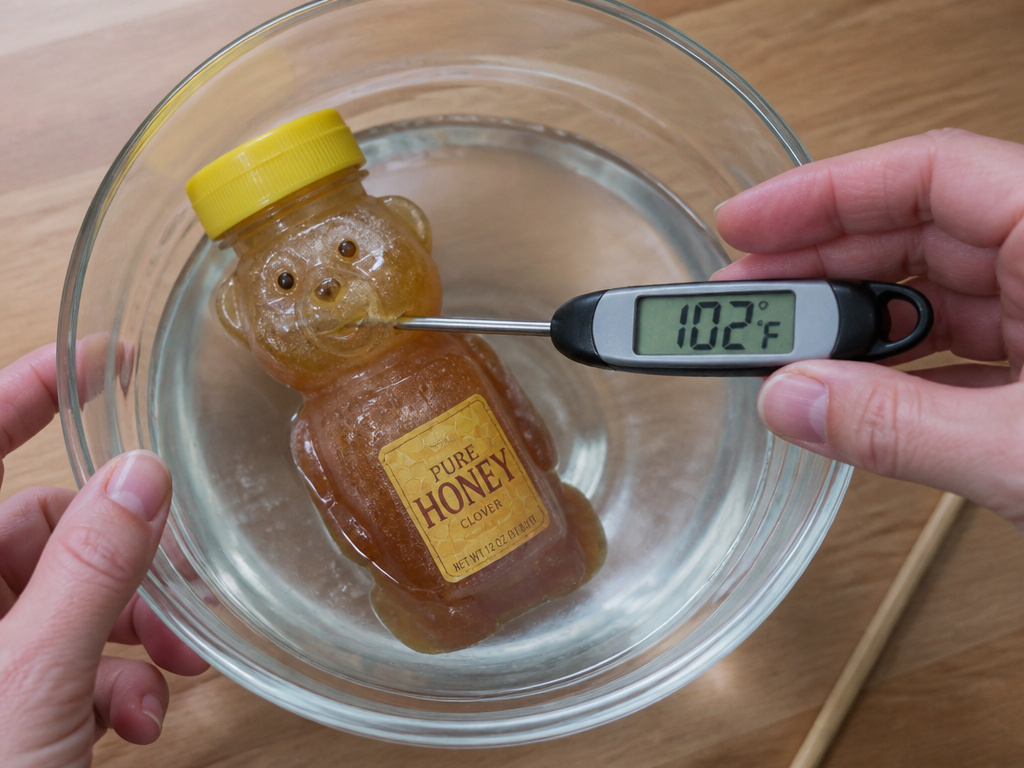
This method works for any sealed plastic honey container, from a small bear to a half-gallon jug. You need a thermometer. Guessing the water temperature is the most common point of failure.
You’ll Need:
- Your crystallized honey in its plastic container.
- A pot, bowl, or sink basin larger than the honey container.
- A cooking thermometer (digital instant-read is best).
- Warm tap water.
- A stirring utensil (a chopstick or long spoon).
Step 1: Check the Container and Fill Your Vessel
Ensure the bottle’s lid is on tightly. A leak will dilute your honey with water, making it prone to fermentation. Place the bottle in your empty pot or bowl.
Step 2: Heat and Monitor the Water
Fill your kettle or a separate pot with water and heat it. You are not boiling water for the bath. Heat it to about 110°F, then pour it into your vessel around the honey bottle. The goal is to create a bath that stabilizes at 100°F.
Use your thermometer to check the bath temperature, not the water from the kettle. Add cooler tap water if it’s above 105°F. The water level should sit just above the level of the honey inside the bottle.
Common mistake: Using water straight from a boiled kettle. That water is over 200°F and will superheat the plastic surface on contact, even if the bath eventually cools down. Always temper the water first.
Step 3: Soak and Stir in Cycles
Let the bottle sit for 5 minutes. This allows the heat to penetrate the plastic and begin warming the honey’s outer layer.
After 5 minutes, remove the bottle, dry it off, and open the lid. Stir the honey thoroughly, scraping the sides and bottom where crystals cling. This agitation is critical, it moves warmed, liquid honey into the still-cold, crystalline core.
Close the lid, place it back in the bath, and wait another 5 minutes. Repeat this soak-and-stir cycle.
Step 4: Know When It’s Done
The honey is ready when it pours smoothly with no granular resistance on the stirrer. For a standard 12-oz plastic bear, this typically takes 15-20 minutes total. A larger, one-quart jug may need 30-40 minutes.
Do not rush by turning up the heat. If you’re short on time, the only safe acceleration is more frequent stirring, not hotter water.
Step 5: Cool and Store Properly
Once softened, remove the bottle from the water bath, dry it completely, and let it cool to room temperature with the lid off for 10 minutes. This prevents condensation from forming inside the bottle when you seal it. Store it in a pantry or cupboard away from direct light and heat sources.
What NOT to Do: The Microwave and Other Shortcuts

The microwave is a terrible tool for this job. It heats unevenly, creating searing hot pockets that can exceed 150°F while other parts remain solid. This guarantees you’ll nuke the beneficial properties. It also poses a real risk to the plastic, which can warp or melt from the inside out.
Sunlight is another often-recommended shortcut. Leaving a plastic bottle in a sunny window might soften the honey over several days, but it subjects both honey and plastic to UV degradation and fluctuating temperatures that can still spike above the safe zone. It’s slow and unreliable.
The stove-top “double boiler” method is risky for plastic. It’s too easy for the bottom of the container, resting directly on the hot pot, to overheat even if the water isn’t boiling. Stick with the controlled, fully submerged water bath.
Your Next Upgrade: Moving Honey to Glass
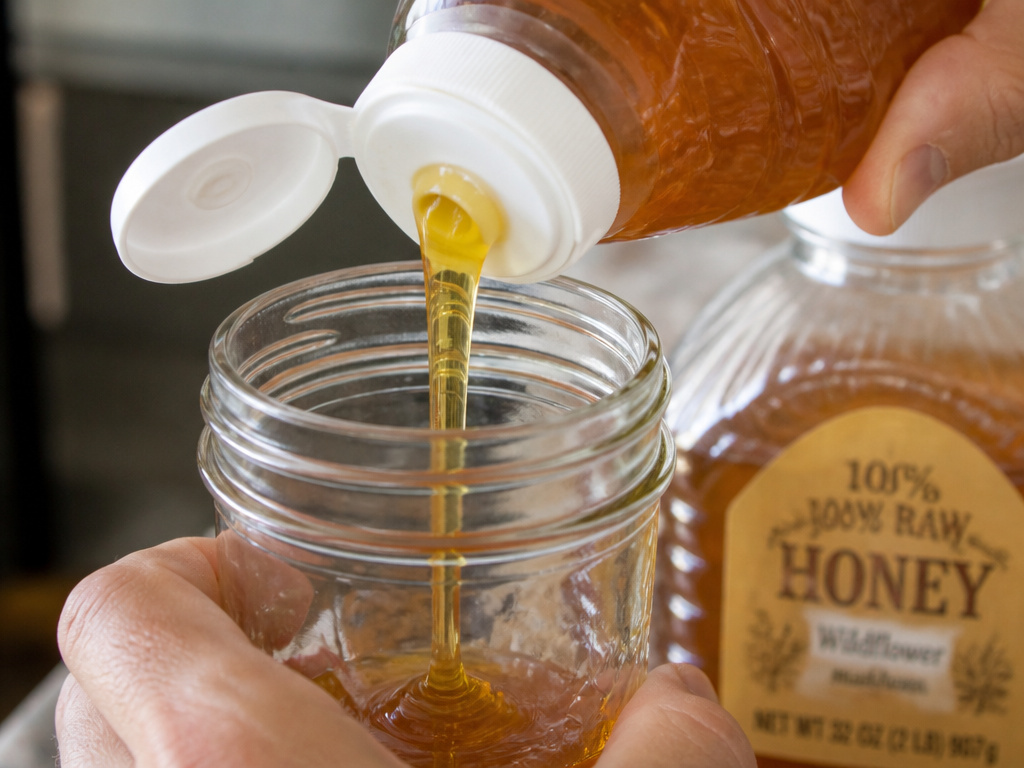
Once you’ve successfully softened your plastic-bottled honey, you have a decision to make. Will you let it crystallize again in the same problematic container? The better move is to transfer it.
Pour the liquefied honey into a clean, dry glass jar. A mason jar or a dedicated honey jar with dipper is perfect. Glass is impermeable, non-reactive, and can safely undergo this gentle warming process infinite times. It’s the definitive solution for ideal honey storage.
This shift aligns with moving away from plastic food containers for long-term staples. For items like honey or keeping brown sugar soft, glass or ceramic creates a stable environment that plastic cannot match. If you’re evaluating best non-plastic food storage containers, this is a practical place to start.
Frequently Asked Questions
Can I reuse the plastic honey bottle after softening?
You can, but inspect it first. If the plastic feels softer, has changed shape, or has any visible wrinkles, it has been compromised. Discard it. Even if it looks okay, be aware that repeated heat cycles will degrade the plastic over time, increasing the risk of leaching. For long-term food storage safety, one-time softening is the limit.
How long will the softened honey stay liquid?
It depends on the honey’s composition and your storage. Honey high in glucose (like clover or wildflower) may begin to recrystallize within a few weeks. Storing it in a glass jar in a cool, dark pantry at a steady 65-75°F can keep it liquid for months. Fluctuating temperatures accelerate re-crystallization.
Is it safe to soften honey in a plastic container labeled “microwave-safe”?
No. “Microwave-safe” means the plastic won’t melt or release large amounts of chemicals under short, typical microwave cycles. It is not a guarantee that the plastic is safe for prolonged submersion in hot water, nor does it protect the honey from thermal damage. The water bath method is gentler on the plastic but the temperature rules for the honey’s sake still apply. The safest practice is to transfer to a microwave-safe glass container if you must use any heat.
My honey fermented after I softened it. What happened?
Fermentation means water got into your honey, likely from a loose lid during the bath or from condensation when you sealed the bottle hot. Honey’s low water content naturally inhibits yeast; adding water removes that protection. Always ensure the lid is tight before bathing and let the container cool to room temperature before sealing. If fermentation occurs (bubbles, sour smell, alcoholic taste), the honey should be discarded.
What’s the best container to buy honey in from the start?
Look for honey sold in glass jars. Many local beekeepers and brands like Sioux Honey use glass. If you must buy in plastic for cost or convenience, plan to transfer it to a glass jar at home before it crystallizes. This makes future softening trivial and protects quality.
Before You Go
Softening honey in plastic is a salvage operation, not a best practice. The 100°F water bath is your careful, controlled tool for that job. It respects the honey’s chemistry and the plastic’s limits.
The real fix is upstream. Buy honey in glass, or decant it into a glass jar as soon as you get home. That simple switch turns a periodic hassle into a non-issue. Your honey stays usable, your flavors stay pure, and you never again have to wonder if the container will fail before the contents do.
