Mastering How to Store Green Onions: Key Methods Explained
This post contains affiliate links. As an Amazon Associate, we earn from qualifying purchases.
Store green onions at 0°C (32°F) with humidity above 95%. Keep them upright, avoid bruising, and do not let the temperature drop below -1.0°C (30.6°F). The standard home refrigerator can hold them fresh for about two weeks, but industrial cold-chain practices prove four weeks is possible with precise control.
That number — four weeks — is the ceiling. It comes from the UC Davis Postharvest Center’s research on commercial storage. Your kitchen is not a commercial warehouse, but the same three physical variables decide your results: temperature, humidity, and physical handling. Most home storage advice gets two right and misses the third.
What follows: the industry specs that set the real limits, the two home methods that match them closest, and the mistakes that turn a crisp bunch to slime in three days.
Key Takeaways
- The refrigerator’s crisper drawer is too warm. Its average 4–7°C (39–45°F) cuts green onion life by more than half compared to the ideal 0°C (32°F).
- Upright storage in water beats a plastic bag for long-term freshness because it maintains root hydration and mimics the high humidity (>95%) green onions need.
- Freezing injury starts at -1.0°C (30.6°F). A refrigerator’s coldest spot, often the back wall, can dip below this and cause irreversible water-soaked decay.
- Bruising during storage accelerates decay faster than temperature alone. Handle bunches gently and remove tight rubber bands immediately.
- Forget regrowing unless you plan to use them fast. Water-stored onions will regrow tops, but the flavor weakens with each cycle and the base eventually rots.
The 3 Variables That Control How Long They Last
Green onions are not dormant. They respire, lose moisture, and continue biological processes after harvest. Your storage method controls the speed of those processes.
The Global Cold Chain Alliance’s commodity manual states green onions must be precooled to at least 3.9°C (39°F) within six hours of harvest for maximum shelf life. They list one month at 0°C (32°F) as the commercial storage limit. Your home refrigerator rarely hits 0°C, and it never achieves the 95% or higher relative humidity the manual calls for. That gap explains why your results vary.
Green onions benefit from a Relative Humidity (RH) of 95% or higher. They are often packed with crushed ice in waxed cartons for distribution in order to maintain low temperature and high RH.
This industry blockquote reveals the core problem. Your refrigerator’s average humidity sits around 30–50%. Without intervention, green onions desiccate in days.
The UC Davis factsheet adds a critical threshold: freezing injury initiates at -1.0°C (30.6°F). Storage below that causes a water-soaked appearance and wilted, gelatinous leaves after thawing, followed by bacterial soft rot. That means the back wall of your fridge, where temperatures can fluctuate, is a risk zone.
| Variable | Ideal (Industry) | Typical Home Fridge | Consequence at Home |
|---|---|---|---|
| Temperature | 0°C (32°F) | 4–7°C (39–45°F) | Shelf life drops from 4 weeks to 7–10 days. |
| Humidity | >95% RH | 30–50% RH | Rapid wilting and loss of crisp texture. |
| Handling | Precooled in 4–6 hrs | Stored at ambient temp | Respiration and decay start before cooling. |
The table shows the mismatch. Your goal is to close that gap as much as possible with the tools you have.
Step-by-Step: The Two Methods That Actually Work
You have two proven paths. The water method sustains them for up to two weeks. The bag method works for about one week if you need drawer space.
Method 1: The Water Jar (Up to Two Weeks)
This mimics the high-humidity ice-pack used commercially.
- Trim the roots, but leave them intact. Do not cut them off completely. A quarter-inch trim removes dried tissue and opens fresh capillaries for water uptake.
- Remove any rubber band or tie. This prevents bruising at the binding point, which becomes a decay entry.
- Place the bunch upright in a jar or glass. Add enough water to cover the roots by half an inch. Do not submerge the white stems.
- Loosely cover the greens with a plastic bag. This creates a micro-environment of high humidity around the leaves without trapping ethylene gas.
- Store it on a refrigerator shelf, not in the crisper. The main body of the fridge holds a more stable, colder temperature than the drawer.
Change the water every three days. If the tops yellow, trim them back. The onions will regrow new green shoots, but the flavor diminishes each time — use them within two weeks for best taste.
Where this goes sideways: Storing the jar on the countertop. Room temperature respiration is 5–10 times faster than at 0°C. They will wilt in two days, not two weeks.
Method (2): The Damp Paper Towel Bag (About One Week)
Use this when refrigerator space is tight or you plan to use the onions quickly.
- Start with dry, clean onions. Pat them thoroughly after rinsing. Surface moisture speeds spoilage in a sealed bag.
- Line a plastic produce bag with a damp paper towel. The towel should be moist, not wet. Excess water pools and causes slime.
- Lay the onions horizontally in the bag. Avoid bending or crushing them. Curvature happens if shoots press against the bag for days.
- Expel as much air as possible and seal. This reduces oxidation and slows moisture loss from the greens.
- Place the bag in the coldest part of your refrigerator, usually the back bottom shelf.
Check the bag every three days. Remove any slimy or wilted pieces immediately to prevent mold from spreading to the rest.
What Most Guides Get Wrong About Freezing
Freezing green onions for long-term storage is possible, but the texture changes permanently. They become limp upon thawing because ice crystals rupture cell walls.
The professional take: freeze only if you will cook them. Do not expect to use thawed green onions in salads or garnishes.
How to freeze correctly:
- Wash, dry, and chop them to your usual size.
- Spread the pieces in a single layer on a parchment-lined tray.
- Freeze solid (about two hours), then transfer to a freezer bag.
- Squeeze out all air before sealing.
Frozen green onions keep for six months. Add them directly to soups, stews, scrambled eggs, or sauces. They will not crisp up, but the flavor remains.
Common mistake: Freezing whole bunches in a bag. They freeze into a solid block that requires thawing the entire batch, leading to repeated freeze-thaw cycles and faster quality loss.
How to Tell When They’ve Gone Bad
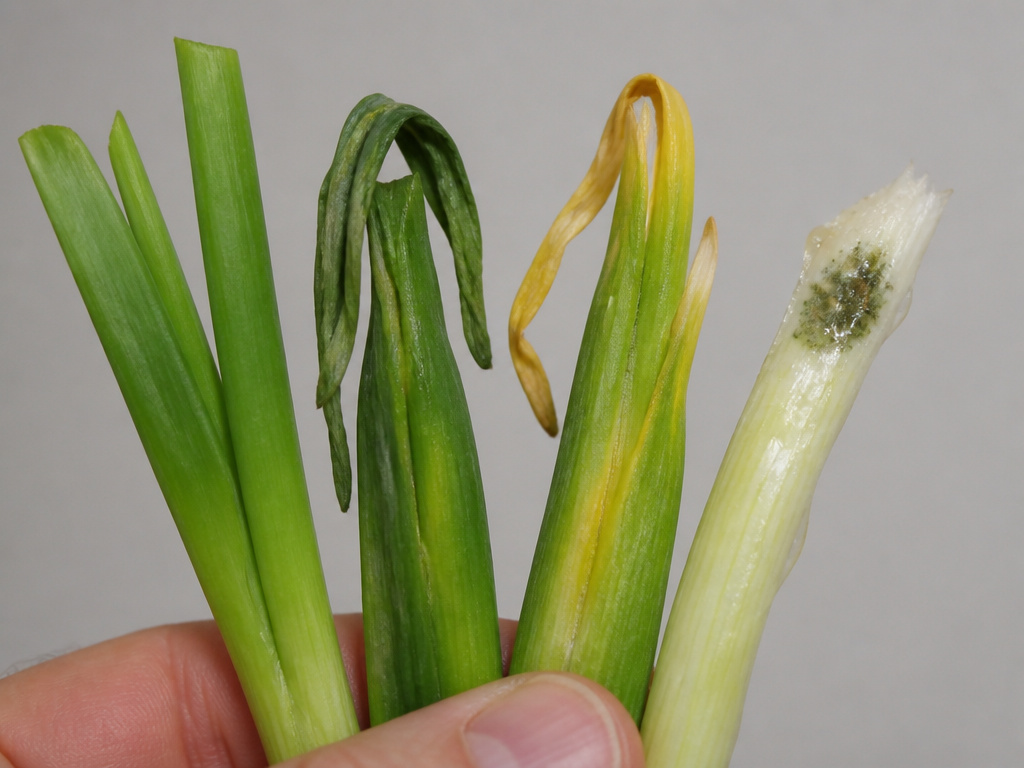 Decay follows a predictable sequence. Catching it early saves the rest of the bunch.
Stage 1: Wilting. The green tops lose rigidity and droop. This is simple dehydration. They are still safe to eat. The water jar method can revive them within hours. Stage 2: Yellowing. The tips turn pale yellow, then progress down the leaf. This is aging and nutrient loss. Trim off the yellowed portions; the remaining green part is usable. Stage 3: Sliminess. A slippery film develops on the white stem or inner leaves. This is bacterial growth. Discard slimy onions immediately. Stage 4: Mold. White or green fuzzy patches appear. This is full spoilage. Discard the entire bunch.
The smell test is final. Fresh green onions have a sharp, clean scent. Spoiled ones smell sour, musty, or of fermentation.
The Science Behind the Recommendations
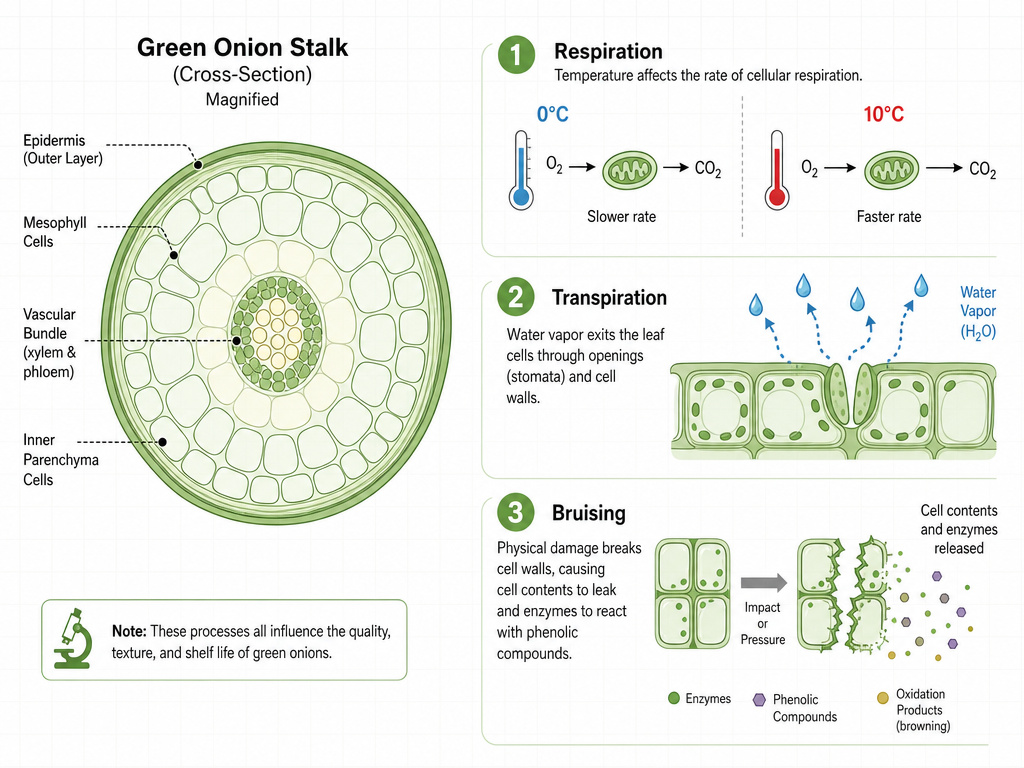 Why does temperature matter so much? Respiration.
At 0°C (32°F), metabolic activity slows to a crawl. At 10°C (50°F), the rate multiplies, burning through stored sugars and moisture. The UC Davis data shows shelf life at 10°C is just 7 to 10 days. Your crisper drawer likely sits around 5°C (41°F), which already cuts the potential four-week life in half.
High humidity prevents transpiration — water loss through the leaves. A relative humidity below 95% creates a vapor pressure deficit, pulling moisture from the plant tissue into the drier air. The onion wilts as its cells lose turgor pressure.
Bruising matters because physical damage breaks cell walls. Released nutrients and moisture become a breeding ground for bacteria and fungi. This is why the Ohio State University extension guide stresses selecting onions free of decay and handling them carefully.
Controlled atmosphere storage (2% oxygen, 5% carbon dioxide) can extend commercial life to 6–8 weeks. Your home methods cannot replicate this gas mix, but the water jar’s loose plastic bag cover slightly elevates carbon dioxide around the leaves, which may slow respiration a small amount.
Green Onions vs. Other Alliums: Storage Rules Differ
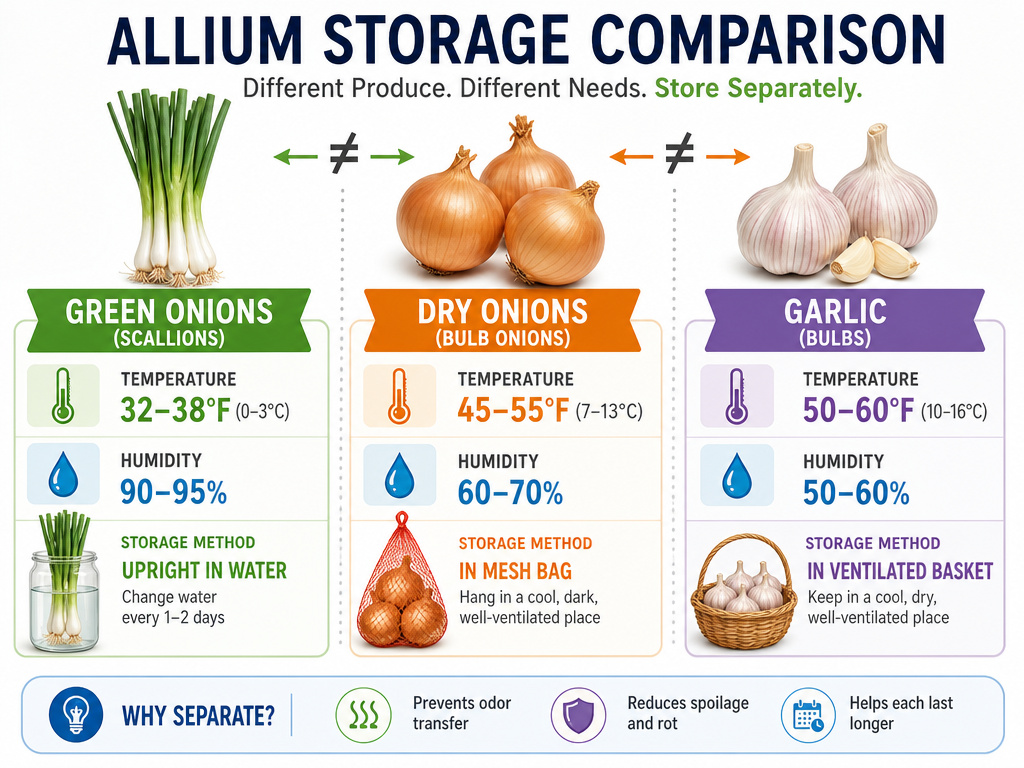 Green onions are not dry onions. They are not garlic. Each has its own rules, and mixing them leads to faster spoilage.
Dry onions (yellow, red, white) need cool, dry, dark conditions with about 65–70% humidity. Storing them with high-humidity green onions promotes mold on the dry onions’ papery skins. For a complete guide on that distinction, see our article on the best onion storage methods.
Garlic prefers even drier, ventilated conditions. The garlic storage tips we outline keep bulbs from sprouting.
Fresh herbs like cilantro share green onions’ need for high humidity and cold temperatures. The techniques for keeping cilantro fresh are similar to the water jar method.
| Allium Type | Ideal Temperature | Ideal Humidity | Key Home Method |
|---|---|---|---|
| Green Onions | 0°C (32°F) | >95% | Upright water jar |
| Dry Onions | 4–10°C (40–50°F) | 65–70% | Mesh bag in pantry |
| Garlic | 4–10°C (40–50°F) | ~60% | Ventilated container |
The table makes the difference clear. Treating green onions like dry onions is the most common reason they wilt prematurely.
Frequently Asked Questions
Can you store green onions in the freezer?
Yes, but only if you plan to cook them. Chop, tray-freeze, then bag. They will be limp when thawed, so use them in cooked dishes like soups or stir-fries.
How long do green onions last in the refrigerator?
With the upright water method: up to two weeks. With the damp paper towel bag method: about one week. Stored loosely in the crisper drawer: 5–7 days.
Is it safe to eat green onions that have wilted?
Yes, if they are only wilted (limp) and not slimy or moldy. Wilting is dehydration. Revive them in ice water for 15 minutes or use them in cooking.
Can I store green onions with other vegetables?
Store them away from ethylene-producing fruits (apples, bananas, tomatoes). Ethylene gas accelerates yellowing and decay. They can share a drawer with other low-ethylene veggies like carrots.
Do green onions need to be washed before storing?
Yes, to remove soil and potential contaminants. But you must dry them thoroughly before bag storage. For the water method, you can wash them just before placing in the jar.
The Bottom Line
Green onions need cold, wet, and gentle handling. Hit 0°C (32°F) and >95% humidity, and you get four weeks. Miss those, and you get days.
The upright water jar is the closest home substitute for commercial ice-pack storage. Use it. Skip the crisper drawer unless you’re using the onions within the week. And remember: freezing is for the pot, not the plate.
For related storage deep-dives, our resources on how to store cut onions and long-term onion curing and storage apply the same principles of temperature and humidity control to different problems.
