Defining a Food Pantry: How They Work and Key Principles
This post contains affiliate links. As an Amazon Associate, we earn from qualifying purchases.
A food pantry is a public or private nonprofit organization that distributes free food directly to people in need, typically providing enough for three to seven days to relieve situations of emergency and distress. It operates under specific health and safety standards, including maintaining refrigerators at 35–40°F, and is legally protected by Good Samaritan laws.
That definition comes straight from the U.S. Code. It frames the pantry not as a casual charity but as a formal part of the emergency food system. The gap between a pantry’s mission and its daily operation is where most public confusion lives.
What follows: the legal line that separates a pantry from a food bank, the two main distribution models that decide what your visit looks like, and the non-negotiable storage rules that keep donated food safe. You’ll also see how pantries source their food and why volunteer management is their real engine.
Key Takeaways
- Food pantries are distinct from food banks; pantries distribute directly to individuals, while banks warehouse and supply pantries.
- Federal law (7 USCS § 7501) defines them as nonprofits serving low-income and unemployed households.
- Strict temperature control is mandatory: refrigerators at 35–40°F, freezers at -10 to 0°F, with daily logs.
- The “client-choice” model lets recipients select their own items, unlike pre-packed food boxes.
- Most pantries operate under Good Samaritan laws, which protect them from liability when donating food in good faith.
The Legal Definition: More Than a Closet of Cans
The term “food pantry” isn’t just a friendly label. It carries a specific legal weight. According to U.S. Law, specifically 7 USCS § 7501, a food pantry means “a public or private nonprofit organization that distributes food to low-income and unemployed households, including food from sources other than the Department of Agriculture, to relieve situations of emergency and distress.”
This definition does three things. It establishes the pantry’s nonprofit status, which is crucial for tax exemptions and grant eligibility. It identifies the served population. And it clarifies the purpose: emergency relief. This legal footing is why pantries can’t operate out of a private home or garage—they must function as a recognized community entity, often with a formal 501(c)(3) designation.
University of Tennessee food pantry guide notes that pantries are typically run by nonprofit organizations and staffed by volunteers, operating from community centers, houses of worship, or schools.
The legal structure is what enables partnerships with larger networks and access to government programs. It’s the framework that turns a well-intentioned donation spot into a sustainable part of the social safety net.
Food Pantry vs. Food Bank: The Critical Difference
People use these terms interchangeably, but the distinction is operational and fundamental. A food bank is a large warehouse organization. It sources food in bulk from manufacturers, retailers, farms, and government programs like The Emergency Food Assistance Program (TEFAP). The food bank then stores, sorts, and redistributes this food to its member agencies.
Those member agencies are the food pantries. The pantry is the front-line distribution point where individuals and families directly receive food. Think of the food bank as the wholesale distributor and the pantry as the retail outlet. Some pantries are entirely supplied by a food bank; others supplement with independent local donations and purchases.
This relationship dictates a pantry’s inventory. What’s available on a given day depends on what the food bank received that week and what local donations have come in. This is why creating a versatile well-stocked pantry at home requires different planning than managing a community pantry’s variable supply.
How Do Food Pantries Operate?
The experience of visiting a pantry hinges on its operational model. There are two primary systems, and your local pantry likely uses one or a hybrid.
The Client-Choice Model operates like a grocery store. Recipients walk through the pantry and select their own items within set limits. This model respects dignity and reduces waste, as people take what they will actually use. It requires more space and volunteer staffing but leads to better nutritional outcomes.
The Pre-Packed Box Model is more traditional. Volunteers assemble boxes or bags of food based on family size, and recipients receive a standard assortment. This is faster and requires less floor space, but it can result in unwanted items being discarded. Some pantries use this model for drive-through distributions, especially post-2020.
Beyond distribution, daily operation rests on logistics. A pantry needs a coordinator to manage food pantry items, a volunteer scheduler, and someone handling client intake. Intake often involves minimal paperwork to track demographics and need, which is vital for the pantry’s own grant reporting and for justifying its existence to the food bank that supplies it.
| Operational Aspect | Client-Choice Model | Pre-Packed Box Model |
|---|---|---|
| Recipient Experience | Self-select items, grocery-style | Receive a standard pre-assembled box |
| Volunteer Labor | Higher (guiding, restocking) | Concentrated (packing shift) |
| Space Requirement | Larger (display shelves, aisles) | Smaller (storage, packing tables) |
| Primary Advantage | Reduces waste, promotes dignity | Faster distribution, simpler logistics |
The Rules Every Pantry Must Follow
 Running a pantry isn’t just about goodwill. It’s governed by food safety regulations and institutional standards to protect public health. Major food bank networks require member pantries to adhere to strict protocols.
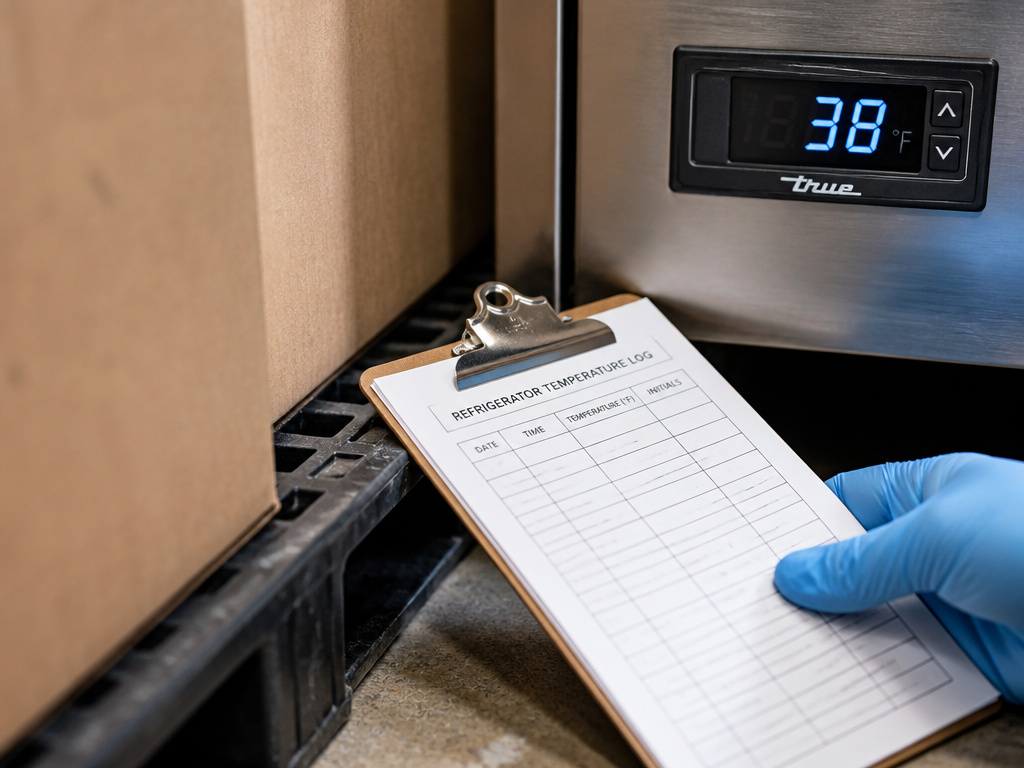
Temperature control is non-negotiable. Per the Food Bank of Alaska guide and others, refrigerators must maintain 35-40°F, and freezers must stay between -10 and 0°F. Pantries must keep daily temperature logs for each unit. A single reading above 40°F can condemn an entire fridge’s contents.
Storage layout follows clear rules. Food must be stored at least 6 inches off the ground and, according to some networks, 3 inches away from walls to allow for air circulation and pest inspection. Non-food items, like cleaning supplies, cannot be stored within 20 feet of food products. This discipline directly informs how to organize a pantry effectively, even at home.
Common mistake: Storing dry goods directly on a concrete floor. Moisture wicks up, cardboard boxes disintegrate, and you get weevils in the rice within a month. Pallets are mandatory.
These rules exist because pantries handle food that is often near the end of its commercial shelf life. “Best by” dates are for quality, not safety, but proper storage is what keeps that food safe to eat long after that date passes. This principle is central to all long-term food storage.
Where Does the Food Come From?
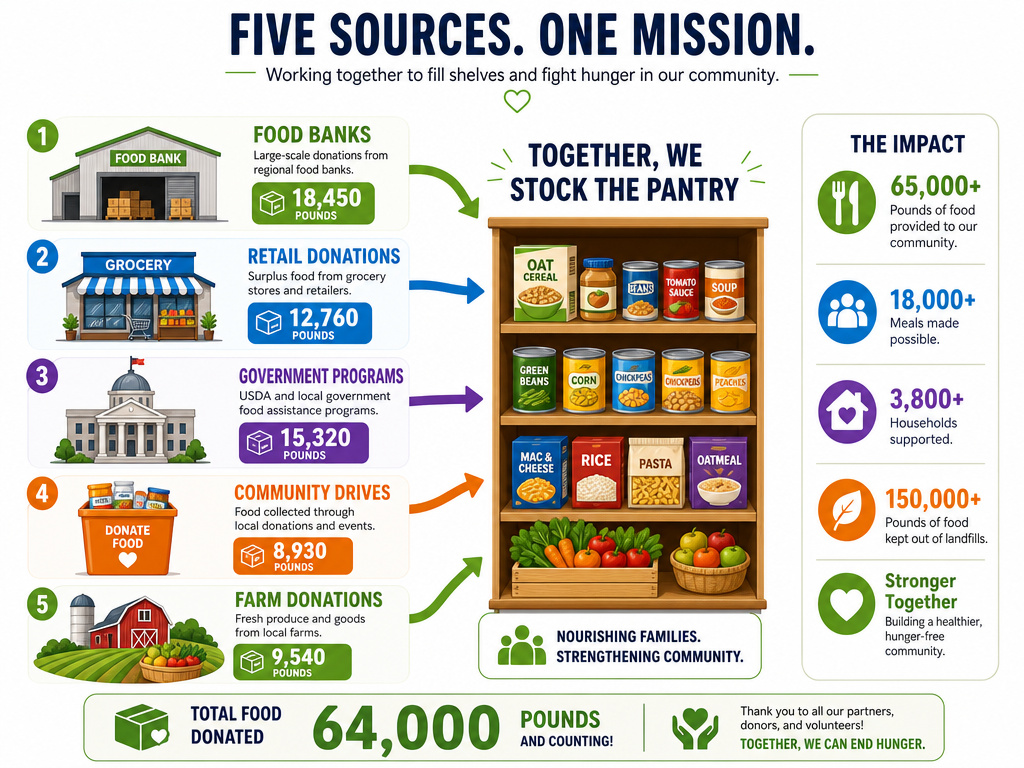 Pantry shelves are filled through a multi-stream supply chain. Understanding these sources explains the sometimes-unpredictable variety.
- Food Banks: The primary source for most pantries. They provide bulk dry goods, canned items, and sometimes frozen meat and produce for a small shared maintenance fee.
- Retail Store Donations: Grocery stores donate unsold but still-safe products like day-old bread, near-expiry dairy, and blemished produce. This is often facilitated by organizations like Feeding America.
- Government Programs: The USDA’s TEFAP program distributes commodity foods like peanut butter, canned vegetables, and pasta to states, which then channel them through food banks to pantries.
- Community Drives: Local schools, churches, and businesses hold food drives, which typically stock a pantry with shelf-stable, non-perishable donation items like canned soup and cereal.
- Direct Farm Donations: Farmers may donate surplus or imperfect produce. This provides fresh food but requires immediate distribution or proper refrigeration.
The balance of these sources determines a pantry’s inventory. A pantry rich in retail donations might have more fresh food but less consistency. One reliant on government commodities will have steady basics but less variety. Smart pantry managers use pantry storage solutions like heavy-duty shelving and clear pantry storage containers to manage this fluctuating inventory.
The Role of Volunteers and Community
A pantry’s engine is its volunteers. From board members setting policy to weekly sorters checking expiration dates, the operation is almost entirely volunteer-powered. The University of Tennessee food pantry guide explicitly notes that pantries “are often staffed by volunteers” who may be managing high demand with limited numbers.
Effective volunteer programs have clear roles: intake coordinators, stockers, client guides in a choice model, and drivers for pickup. Training is essential, particularly for food safety. A volunteer who doesn’t know that a dented can is a risk can undo a pantry’s compliance status.
The community connection goes beyond labor. Pantries often become hubs, offering referrals for SNAP benefits (food stamps), job assistance programs, or housing services. They rely on community goodwill not just for food drives but for financial donations that cover unavoidable costs like rent, utilities, and refrigerator repairs. Building a home pantry is a personal skill; sustaining a community pantry is a collective civic effort.
Frequently Asked Questions
Are food pantries only for homeless people?
No. Food pantries serve a wide range of low-income and unemployed individuals and families, including the working poor, seniors on fixed incomes, and people facing a temporary crisis like a medical bill or job loss. The legal definition targets households in “emergency and distress,” not any single demographic.
Do I need to prove I’m poor to use a food pantry?
Requirements vary. Many pantries, especially those supplied by large networks, do require some form of identification and proof of residence within their service area. Some may ask for income information, while others operate on a self-declaration of need. It’s best to call your local pantry directly to understand their specific intake procedure.
Is the food from pantries safe to eat?
Yes, when the pantry follows established food safety protocols. Reputable pantries adhere to strict temperature controls, inspect all donations, and follow “first-in, first-out” stocking. They are also protected by Good Samaritan laws, which encourage food donation by limiting liability when food is donated in good faith.
Can I choose my own food at a food pantry?
This depends on the pantry’s distribution model. “Client-choice” pantries allow you to select items, much like grocery shopping. Others provide pre-packed boxes or bags. You can often find this information on the pantry’s website or by calling ahead.
How can I find a food pantry near me?
The best resource is Feeding America’s online pantry locator, or you can contact your local United Way chapter. Your state or county’s Department of Health and Human Services website may also maintain a directory of emergency food resources.
The Bottom Line
A food pantry is a regulated, community-based nonprofit that turns surplus into sustenance. Its job is to bridge an emergency gap, not provide a full diet. The operation hinges on a simple but rigid framework: legal nonprofit status, a clear distinction from food banks, strict adherence to food safety codes, and a volunteer workforce.
The most effective pantries today are moving toward the client-choice model, treating recipients with the dignity of choice while using professional pantry organization systems to manage inventory. Whether you’re looking to donate, volunteer, or seek assistance, understanding these mechanics shows how a simple concept—giving food—becomes a complex, vital service.
