The Complete Guide on How to Store Boiled Rice Safely at Home
This post contains affiliate links. As an Amazon Associate, we earn from qualifying purchases.
Store boiled rice by cooling it to below 40°F within one hour of cooking. Divide it into containers no deeper than three inches, cover with cling film or foil, never a cloth, and refrigerate. Reheat to 165°F. The bacteria Bacillus cereus produces heat-stable toxins in rice left in the 40°F–140°F danger zone, and reheating does not destroy them.
That one-hour clock starts the second the rice stops steaming. The threat isn’t visible spoilage; it’s a tasteless, odorless toxin that multiplies while the rice sits warm on your counter. This is why commercial kitchens treat cooked rice as a high-risk item.
What follows: the three specs that matter (temperature, time, depth), the one covering material you must never use, and the 8-minute boiling trick that keeps refrigerated rice from turning to gravel.
Key Takeaways
- Cool cooked rice to below 40°F within one hour. The bacteria Bacillus cereus produces toxins in the “Danger Zone” (40°F–140°F) that survive reheating.
- Use shallow containers no deeper than 3 inches (or 10 cm). Deep pots trap heat and can keep rice in the danger zone for over 90 minutes.
- Cover with cling film, aluminum foil, or a clean lid, never a kitchen cloth or towel. Cloths harbor bacteria and cross-contaminate.
- For best texture after refrigeration, boil rice for 8 minutes before steaming. A peer-reviewed study found this cut hardness by 53% over 7 days versus 81% for 16-minute boils.
- Reheat stored rice to an internal temperature of 165°F and consume within 3–5 days.
The Temperature Danger Zone and the 1-Hour Rule
The rule exists because of a specific bacterium with spores that survive cooking. Bacillus cereus lives on uncooked rice. Cooking kills the active bacteria, but the spores endure. When the cooked rice cools into the 40°F to 140°F range, those spores germinate and the bacteria multiply rapidly. They produce two types of toxins: one causes vomiting, the other diarrhea.
The “Danger Zone” is 40°F to 140°F. Cooked rice must pass through this range in under one hour to prevent Bacillus cereus toxin production. Reheating to 165°F kills bacteria but does not destroy the toxins already present.
This is the core of all proper rice storage safety. The one-hour countdown is the University of California’s Agriculture and Natural Resources division standard. Coventry City Council in the UK allows a maximum of 1.5 hours, but that’s for professional kitchens with blast chillers. At home, one hour is your safe ceiling.
The consequence of missing it isn’t always obvious. The rice won’t necessarily smell bad or look slimy. The toxins are tasteless and odorless. You could eat a perfectly normal-looking bowl and be sick within one to five hours.
| Scenario | Time in Danger Zone | Risk Level | Visible Sign? |
|---|---|---|---|
| Left on stove to cool | 2–3 hours | High | No |
| Portioned into shallow dish | 20–30 minutes | Low | No |
| Left in deep ceramic pot | 90+ minutes | High | No (until >4 hours) |
How do you beat the clock? The answer is in the next section. It’s not about a faster fridge; it’s about not giving the rice a chance to stay warm.
How to Cool Rice Fast Enough
Cooling is a physics problem. A large, dense mass of rice holds heat like a thermal battery. The goal is to increase its surface area so heat can dissipate quickly. This is where most home methods fail.
Step 1: Spread it out immediately. The second the rice is done, transfer it from the pot or cooker. Use a clean sheet pan, a large platter, or several shallow containers. The University of California guideline specifies a depth no greater than 3 inches. The Western Australia and Gladstone Council guides use the metric equivalent: less than 10 cm deep. This isn’t a suggestion. It’s the difference between 30-minute cooling and 90-minute cooling.
Step 2: Don’t stack containers. If you use multiple containers, leave space between them in the fridge. Stacking them insulates the bottom one and defeats the purpose.
Step 3: The water method (for large batches). If you’ve cooked a huge pot for meal prep, use the method outlined in the Gladstone City Council food safety PDF. Place the hot rice in a clean colander and run cold water through it, stirring gently, until it’s cool to the touch. Then portion it into shallow containers. This can cut cooling time from hours to minutes.
Common mistake: Leaving rice in the cooking pot to cool. The pot’s thick walls and the rice’s own mass form an insulator. The center can stay above 140°F for over an hour while the surface feels cool.
The right container is half the battle. The other half is what you put on top.
Container Choice and Covering
Your covering material is a barrier, not a breathable blanket. The Coventry City Council guide is explicit: “Cloths and towels should not be used as a cover because they can carry harmful bacteria.”
A damp kitchen towel is a bacteria ferry. It can transfer pathogens from your hands, the counter, or the sink directly onto the rice’s surface. Even a dry towel can harbor spores.
Acceptable covers:
- Cling film (plastic wrap). Press it directly onto the rice’s surface to minimize air exposure.
- Aluminum foil. Mold it over the container rim for a tight seal.
- A clean, dedicated container lid. This is the best option for airtight rice containers.
The cover goes on after the rice is cool, not while it’s hot. Putting cling film on steaming rice creates condensation, which can drip back and create a wet environment where bacteria thrive.
This principle of a clean, sealed environment applies to all dry pantry staples, from rice to flour. The goal is isolation.
Refrigeration vs. Hot Holding
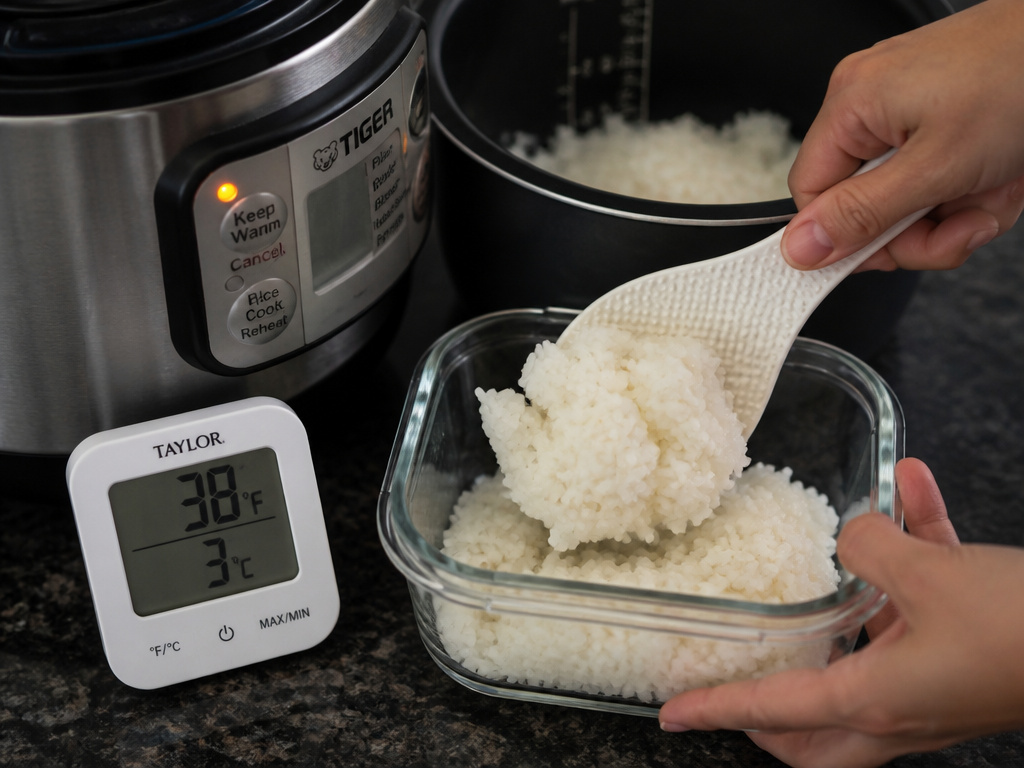
You have two safe paths after cooking: get it cold fast, or keep it hot continuously. There is no safe middle ground at room temperature.
Refrigeration means below 40°F (5°C). At this temperature, bacterial growth slows to a near halt. Properly cooled and covered rice will stay safe for 3 to 5 days in the fridge. The quality will decline, but the safety risk is low.
Hot holding means keeping rice above 140°F (60°C), specifically at 63°C or hotter per the Coventry guide. This is what a rice cooker’s “keep warm” function is for. If your cooker maintains that temperature reliably, the rice is safe. But most home rice cooker “warm” settings hover at the lower edge of the safe zone and can dip below over time.
Where this goes sideways: Trusting a home rice cooker’s “keep warm” function overnight. Many models cycle on and off, allowing the temperature to drop into the danger zone for periods. If you’re not eating it within two hours, refrigerate it.
A 2022 study in AIMS Agriculture and Food found panelists preferred the taste and texture of specific rice varieties stored inside a rice cooker for 9 hours over refrigeration. However, this is a quality preference, not a safety recommendation. For safety, the official rice cooling guidelines are clear: cool and refrigerate.
The 8-Minute Boil for Better Texture
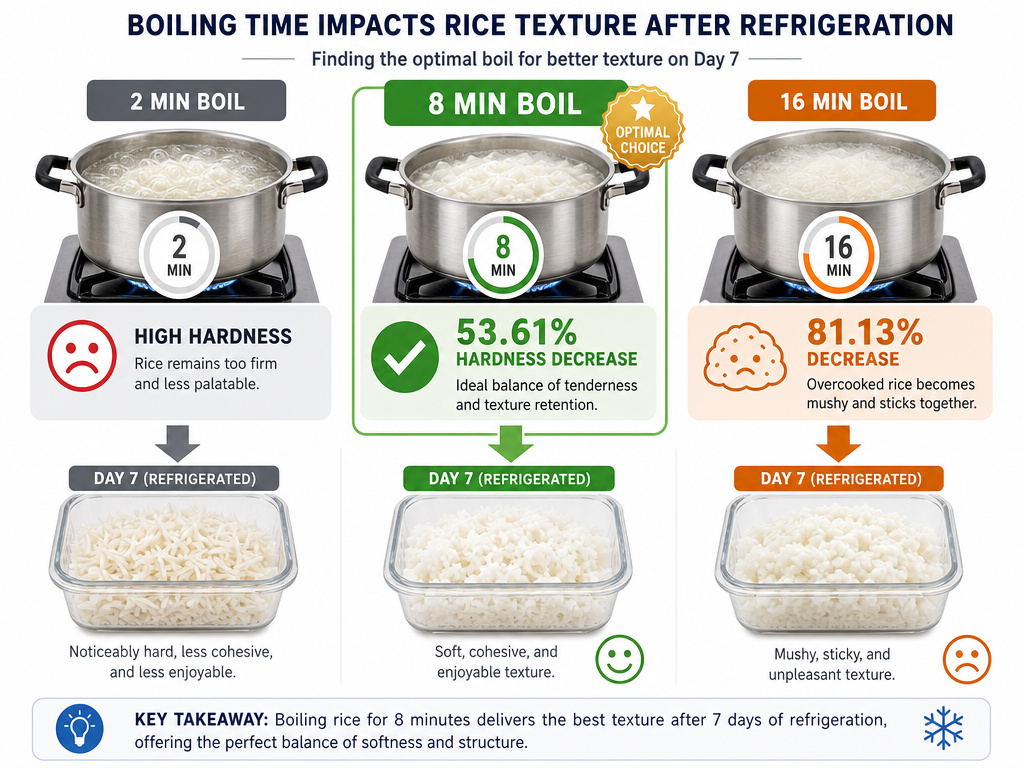
Storage isn’t just about safety; it’s about quality. Refrigerated rice often turns hard and dry. A 2024 study on PubMed analyzed the “Effects of boiling time on physicochemical properties of refrigerated rice.” The finding was specific.
Boiling rice for 8 minutes before steaming resulted in the best texture and microstructural stability over 7 days of refrigeration. The hardness of the 8-minute-boiled rice decreased by 53.61% over that week. Rice boiled for 16 minutes lost 81.13% of its hardness, it became much softer, almost mushy upon reheating. Rice boiled for only 2 minutes remained unpleasantly hard.
| Boiling Time | Hardness After 7 Days | Crystallinity | Best For |
|---|---|---|---|
| 2 minutes | High (small decrease) | 17.89% | Not recommended |
| 8 minutes | Moderate (53.61% decrease) | Not specified | Optimal refrigerated texture |
| 16 minutes | Very soft (81.13% decrease) | 8.04% | Immediate consumption |
The study’s takeaway is that the boiling phase sets up the starch structure. An 8-minute boil creates a broth gel that helps retain moisture and maintain grain integrity during cold storage. It’s a specific, sourced number that changes how you should cook if you know you’ll have leftovers.
If you’re selecting rice for storage, starting with the right variety and this cooking method gives you a head start.
Reheating Stored Rice Safely
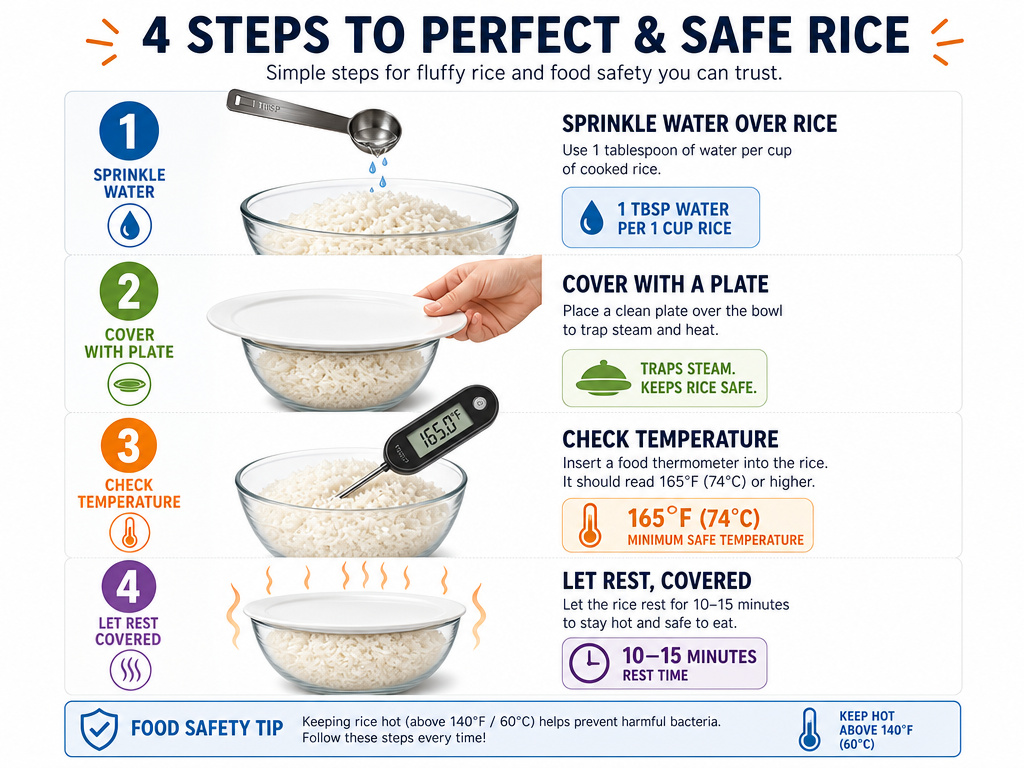
Reheating is your last chance to kill any active bacteria, but it is not a reset button. As the UC guide states, the toxins produced earlier are heat-stable. Proper reheating is about reaching a temperature that destroys any bacteria that may have grown during storage.
The target is 165°F internal temperature. Use a food thermometer. Don’t guess.
- Add moisture. For each cup of rice, sprinkle 1–2 tablespoons of water over it. This creates steam and prevents drying.
- Cover loosely. Use a microwave-safe lid or a plate to trap steam.
- Heat thoroughly. Microwave on high for 3–4 minutes, then stir. Check the temperature in the center with a thermometer.
- Let it stand. Leave it covered for a minute after heating to let the heat distribute evenly.
Never use your hands to break up cold rice clumps. Use a clean fork or spoon. The Coventry guide calls this out specifically to avoid introducing new bacteria.
This reheating protocol is part of broader food storage principles. The same rule applies to most cooked leftovers: heat them to 165°F and serve immediately.
Frequently Asked Questions
Can you store boiled rice at room temperature?
No. Cooked rice must not be left at room temperature for more than one hour (maximum 1.5 hours in commercial settings). The risk of Bacillus cereus toxin formation is too high.
How long does boiled rice last in the fridge?
Properly cooled and stored rice is safe to eat for 3 to 5 days. Its quality, texture and flavor, will gradually decline. For the best quality, use it within 2–3 days.
Can you freeze boiled rice?
Yes. Freezing is an excellent method for long-term rice storage. Portion the cooled rice into freezer-safe bags or containers, press out excess air, and freeze. It can last for several months. Reheat from frozen in the microwave, adding extra water.
Does reheating rice kill the bacteria?
Reheating to 165°F kills active Bacillus cereus bacteria. However, it does not destroy the toxins the bacteria may have already produced while the rice was cooling slowly. This is why fast initial cooling is non-negotiable.
Why does my refrigerated rice get so hard?
The starch in rice retrogrades (recrystallizes) when chilled, squeezing out moisture. Using the 8-minute boiling method and adding water during reheating mitigates this. Also, ensure your storing flour and other grains are kept airtight, as dry kitchen air can affect all stored grains.
The Bottom Line
Store boiled rice with respect for the clock and the thermometer. Get it shallow, get it cold within an hour, and keep it covered with something clean. The 8-minute boil is your secret weapon for palatable leftovers. Remember, the danger is invisible, but the rules to defeat it are concrete: 40°F, 1 hour, 3 inches, 165°F. Follow those, and your next fried rice or rice salad will be both safe and good.
