The Best Way to Store Fresh Basil & Avoid Chilling Damage
This post contains affiliate links. As an Amazon Associate, we earn from qualifying purchases.
To store fresh basil, keep it at 12–15°C (54–59°F) with humidity above 90% inside a sealed low-density polyethylene (LDPE) bag. Standard refrigerator temperatures of 5°C (41°F) cause chilling injury, leaf cells rupture, leading to black necrosis within 1–3 days. This specific temperature-humidity-packaging trio extends shelf life to 8–12 days.
That gap between 12°C and 5°C is where the whole storage game is won or lost. Your fridge sits at 5°C. Basil’s tropical cells freeze internally at that point, and the leaves you planned for pesto turn to black sludge by Thursday. The fix is a different storage environment entirely, not a warmer fridge.
What follows: the exact temperature thresholds from university research, the one packaging material that changes the rules, and the counterintuitive edge case where cold storage can work if you nail two other variables first.
Key Takeaways
-Sweet basil suffers chilling injury below 12°C (54°F). Black necrosis appears in 1 day at 0°C or 3 days at 5°C. -The optimal storage zone is 12–15°C (54–59°F) with >90% relative humidity. This slows decay without freezing leaf tissue. -Low-density polyethylene (LDPE) bags maintain humidity and can, in combination with 90–95% RH, allow storage at 5°C for up to 10 days with quality retention, an exception that proves the humidity rule. -For short-term counter storage, treat basil like cut flowers: stems in water, away from direct sun. This lasts 4–7 days. -Never store loose basil leaves in a dry paper towel inside a standard fridge crisper. That combination guarantees wilting followed by black spots within 72 hours.
The 12°C Rule and Why Your Fridge Fails
Your refrigerator averages 5°C (41°F). For basil, that’s a freezing point.
Basil stored at 5°C lasts an average of 3.2 days before becoming unmarketable due to black necrosis, while basil stored at 12°C lasts 8.3 days. At 0°C, shelf life drops to 1.6 days. (Frontiers in Plant Science, 2023)
Chilling injury is cellular, not wilting. Tropical plants like basil have cell membranes that stiffen and fracture when temperatures drop below their tolerance threshold.Water leaks from the ruptured cells, then oxidative browning turns the tissue black. You see it as dark, soggy spots that spread across the leaf surface. Once that starts, the leaf is done.
The injury zone is specific: moderate damage occurs between 7.5–10°C, and severe, total injury happens at 5°C and below. The safe zone begins at 12°C. This is why the Rutgers NJAES basil postharvest guide lists 55°F (12.8°C) as the optimal storage temperature. Your fridge misses that mark by 7–8 degrees.
So where do you find 12–15°C? Not many home spaces hit that range consistently. A very cool cellar might. A dedicated beverage fridge with an adjustable thermostat can. For most people, the answer is a package that creates its own microclimate, not a location.
Packaging: LDPE Bags vs. Paper Towels
If you can’t control the room, control the air around the basil.
A low-density polyethylene (LDPE) bag is a specific material, not just any plastic. It’s chemically inert, a good moisture barrier, and gas-permeable. Research from a 2018 study on ‘Genovese’ basil showed that 20g of leaves sealed in LDPE and stored at 5°C with 90–95% humidity maintained superior biochemical quality after 10 days compared to unpackaged leaves at ambient temperature.
Where this goes sideways: Wrapping basil in a dry paper towel. The towel wicks moisture from the leaves, dropping local humidity around the basil to maybe 50–60%. At fridge temperatures, you now have cold stress plus dehydration. The leaves wrinkle, then blacken.
The LDPE bag works because it traps transpired water vapor, pushing the relative humidity inside the bag above 90%. That high humidity reduces the leaf’s water loss stress, which appears to mitigate some chilling injury effects. It’s the combination that matters: a sealed bag plus high humidity creates a buffer.
| Packaging Method | Humidity Created | Risk If Used in 5°C Fridge | Best Use Case |
|---|---|---|---|
| LDPE bag, sealed | >90% RH inside | Low—can extend shelf life to 10+ days at 5°C if bag is pre-humidified | Long-term storage when temperature control is imperfect |
| Paper towel wrap | ~50-70% RH around leaves | High—accelerates dehydration and chilling injury blackening within 3 days | Not recommended for basil; better for hardy herbs like rosemary |
| Glass with water (counter) | ~100% RH at stem base | N/A—counter storage avoids cold | Short-term (4–7 day) storage for immediate use |
| Open tray / no packaging | Ambient room humidity (30-60%) | Very high—leaves wilt in 1–2 days even at 12°C | Do not use |
For home use, look for produce bags that are thin, clear, and have a slight stretch, many grocery store produce bags are LDPE. Avoid thick, crinkly plastic bags or zipper bags meant for snacks; those are often different polymers with lower gas permeability.
Humidity and the Edge Case for Cold Storage
The research edge case is critical. The PMC study on basil packaging effects found that LDPE bags with 90–95% RH allowed storage at 5°C with preserved chlorophyll and antioxidant levels. The leaves didn’t blacken. This contradicts the blanket “never refrigerate basil” rule and shows the real variable is water loss, not cold alone.
High humidity does two things. First, it keeps cells turgid, which may help maintain membrane integrity under cold stress. Second, it slows enzymatic activity that leads to decay. The official UC Davis Postharvest Center herbs factsheet recommends >95% RH for most herbs to prevent water loss.
How do you get >90% RH inside a bag? 1. Lightly mist the basil leaves with water before sealing them in the bag. Don’t soak them, a fine spray is enough. 2. Include a damp (not wet) paper towel in the bag with the basil. This acts as a humidity reservoir. 3. Seal the bag completely. Fold the top over and clip it, or use a bag sealer. The goal is to keep the moist air in.
This prepared bag can then go into a standard fridge crisper. The crisper’s own higher humidity helps, but the bag is the primary buffer. Check after two days. If condensation beads inside the bag, that’s good, humidity is high. If the paper towel is dry, replace it.
This method is a workaround, not an ideal. The ideal remains 12°C. But if you must use the fridge, this is how you beat the odds.
Step-by-Step: Three Methods Matched to Your Timeline
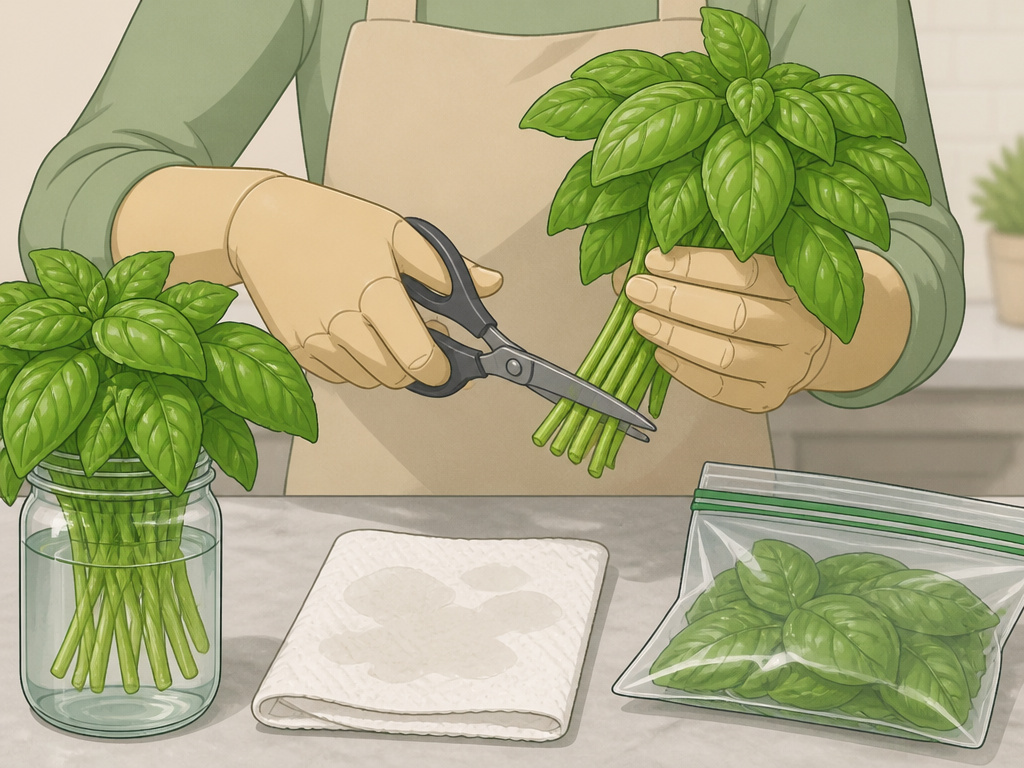 Your goal dictates your method. Choose based on how many days you need the basil to last.
For 4–7 Days: The Countertop Vase Method
This is for basil you’ll use within the week. It avoids cold entirely.
- Trim the stems. Use a sharp knife or scissors to cut about half an inch off the bottom of the stems at an angle. This opens the vascular tissue for water uptake.
- Place in water. Use a tall glass or jar. Fill with enough water to cover the trimmed stems by about one inch.
- Leave at room temperature. Keep it on a counter away from direct sunlight and heat sources (not next to the stove or a sunny window).
- Change the water daily. Fresh water prevents bacterial growth at the stem ends, which can clog the vessels and cause wilting.
This method treats basil like cut flowers. It works because the plant continues to take up water, maintaining turgor pressure in the leaves. The shelf life is about a week, after which leaves will gradually yellow and drop.
For 8–12 Days: The Controlled Microclimate Method
This is the research-backed long-storage play.
- Gently rinse and dry. Pat the leaves dry with a clean towel or use a salad spinner. Surface moisture can promote fungal growth in a sealed bag.
- Prepare the LDPE bag. Lightly mist the inside of the bag with water or place a barely-damp paper towel at the bottom.
- Add basil and seal. Place the basil inside, press out excess air, and seal the bag tightly.
- Store in a cool spot. The best location is a cellar, a cooler set to 12°C, or the warmest part of your fridge (often the top shelf or door). If using a fridge, place the bag in the crisper drawer.
Check the bag every three days. You’re looking for condensation, not pooled water. If you see free water, open the bag, dab it dry with a paper towel, and reseal.
For 2–3 Days: The Quick-Use Refrigerator Method
Sometimes you just need a short hold. If your fridge is your only option, this minimizes damage.
- Do not wash. Moisture accelerates chilling injury in the dry fridge air.
- Wrap loosely in a dry paper towel. This is the one case where a paper towel is acceptable, it’s for very short-term absorption of any ambient moisture, not for creating humidity.
- Place inside a perforated plastic bag. A few small holes punched in a produce bag allows some air flow, preventing ethylene buildup.
- Put in the crisper drawer immediately. Use it within 48 hours.
This is a stopgap. The basil will begin to show signs of stress by day three.
What Not to Do: Common Mistakes That Turn Basil Black
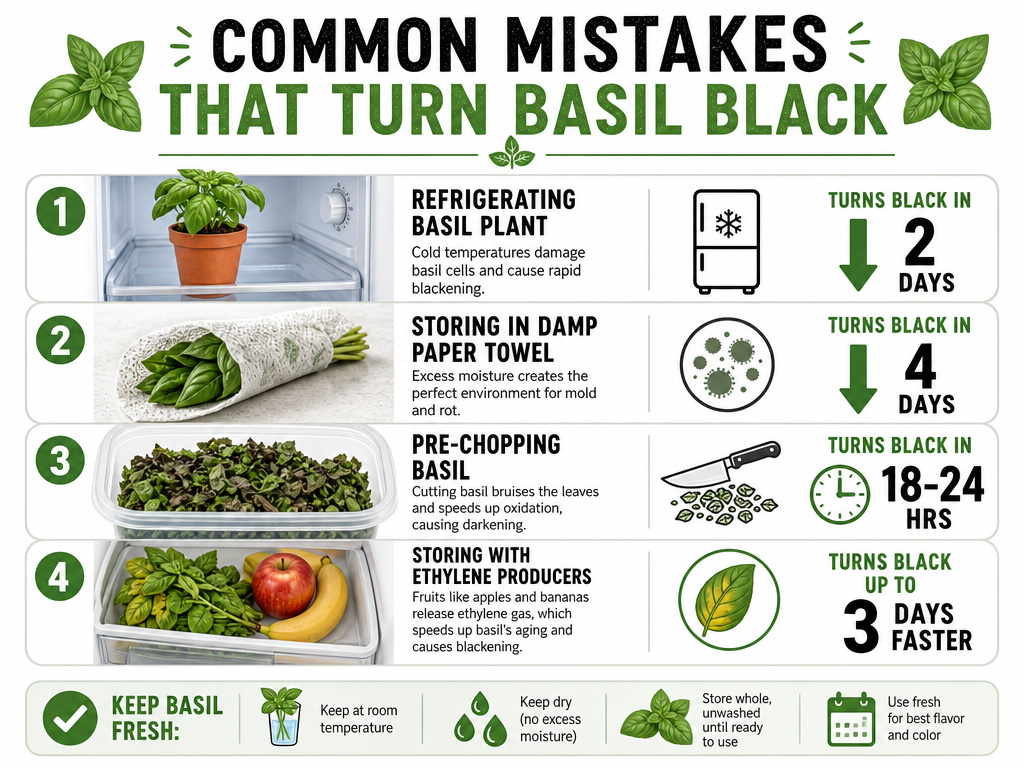 The timeline between a mistake and a visible consequence is short.
Common mistake: Storing a whole basil plant, pot and all, in the fridge. The soil retains cold, chilling the roots, and the leaves above blacken within two days. The plant may not recover.
Mistake 1: The Wet Paper Towel in a Warm Room
A damp towel around basil stored at 20°C creates a perfect incubator for bacteria and fungi. The leaves develop gray mold (Botrytis) within four days. The towel should only be used inside a sealed bag in cold storage to provide humidity, never for room-temperature storage.
Mistake 2: Chopping Before Storage
Once you cut or tear basil leaves, you rupture cells and release enzymes that start oxidative browning immediately. Pre-chopped basil in a bag turns dark at the edges in under 24 hours, regardless of temperature. Always store whole sprigs.
Mistake 3: Storing Near Ethylene Producers
Basil is sensitive to ethylene gas, which accelerates senescence. Apples, bananas, and tomatoes release ethylene. Storing basil in the same drawer as these fruits causes yellowing and leaf drop 30% faster.
| Mistake | Likely Outcome | Timeline to Failure |
|---|---|---|
| Whole pot in fridge | Leaf blackening, root chill | 2 days |
| Wet leaves in sealed bag at 20°C | Gray mold growth | 4 days |
| Chopped leaves in any container | Edge browning (oxidation) | 18–24 hours |
| Shared drawer with apples | Yellowing, abscission (leaf drop) | 3 days faster than normal |
How to Store Other Fresh Herbs (The Contrast)
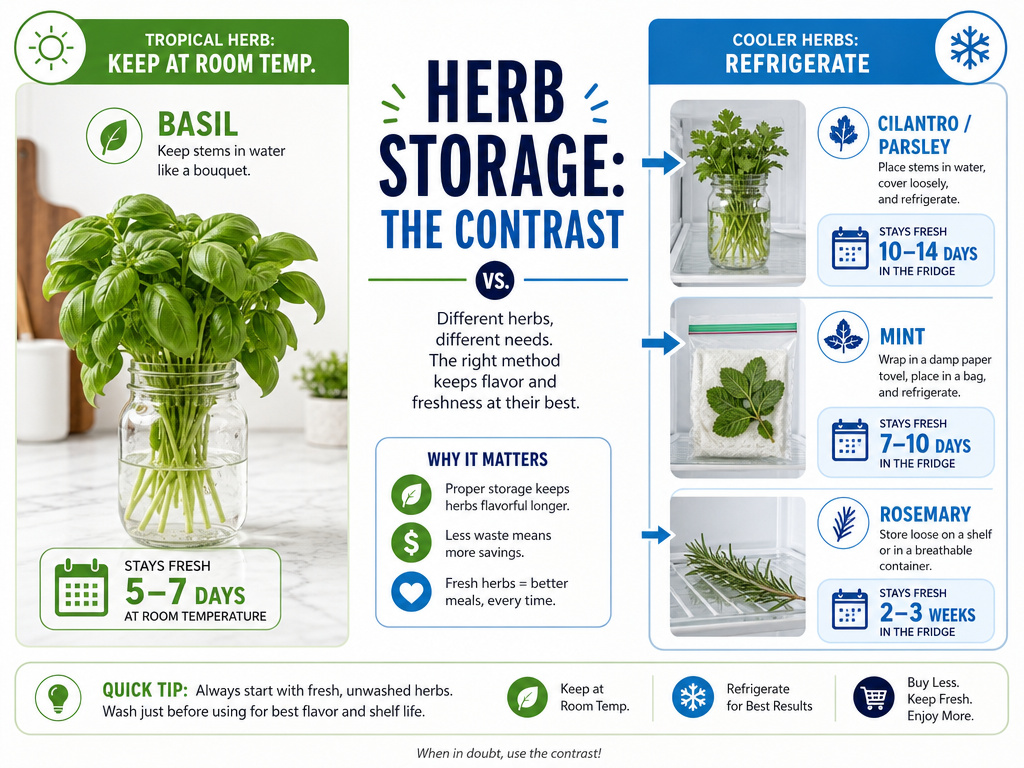 Basil is the outlier. Most other common culinary herbs are cold-tolerant and benefit from standard refrigeration.
Cilantro and Parsley prefer cold, moist conditions. The best way to store cilantro in the fridge is stems-down in a jar with water, covered with a plastic bag. Same for parsley.
Mint and Rosemary are hardy. You can store mint wrapped in a damp paper towel in a sealed bag in the fridge for two weeks with little loss. Rosemary can handle near-freezing temperatures.
The rule of thumb: If the herb is native to temperate climates (rosemary, thyme, sage, oregano), refrigerate it. If it’s tropical (basil, cilantro, mint), check its specific cold threshold. Basil has the lowest tolerance of all.
This is why a general guide to storing fresh herbs will often fail for basil, it groups it with cold-tolerant plants.
Extending Shelf Life Before Storage: Pre-Cooling
For basil that will face cold during transport (like from a farmer’s market on a hot day), a one-day conditioning period can help.
The Ontario Ministry of Agriculture basil page notes that chilling-sensitive crops can be hardened by storing them at 10°C for one day before exposing them to lower temperatures. This brief acclimation triggers the plant’s stress-response pathways, accumulating protective sugars and antioxidants that bolster cell membranes.
At home, if you buy basil on a 30°C day and know you’ll need to refrigerate it, don’t rush it into the cold. Let it sit in its bag on a cool counter (about 20°C) for a few hours first. Then move it to a 12°C space if you have it, or prepare your LDPE microclimate bag for the fridge. That gradual step-down can buy you an extra day of quality.
Frequently Asked Questions
Can you freeze fresh basil?
Yes, but not for fresh use. Freezing ruptures cell walls due to ice crystal formation. The leaves will turn black and mushy upon thawing, but the flavor is preserved. Frozen basil is fine for cooked dishes like sauces and soups where texture doesn’t matter. For freezing, blanch leaves briefly, pat dry, and store in airtight containers.
Does storing basil in water on the counter really work?
For 4–7 days, yes. It works by maintaining the plant’s water supply, keeping leaves turgid. It fails after a week because the cut stems eventually succumb to bacterial clogging and the leaves exhaust their nutrient reserves. Change the water every day to maximize duration.
Why does my basil turn black in the fridge even when wrapped?
Because wrapping alone doesn’t raise humidity enough to offset the 5°C chill. A dry paper towel in a plastic bag might create 70% RH. Basil needs >90% RH to mitigate chilling injury at that temperature. Your wrap likely created a cold, moderately dry environment, the worst of both.
What’s the best container for fridge storage?
The best containers for fresh produce are ones that seal tightly and are sized appropriately to avoid crushing leaves. For basil, a tall container that accommodates upright stems is ideal. Many refrigerator storage containers are designed for stackability, not for delicate herb sprigs.
How long does fresh basil last?
At optimal conditions (12°C, >90% RH, LDPE bag): 8–12 days. On the counter in water: 4–7 days. In a standard fridge in a dry bag: 2–3 days before blackening begins. These are averages for ‘Genovese’ or sweet basil; purple or Thai basil may have slightly different tolerances.
The Bottom Line
Store basil like the tropical plant it is. The 12°C threshold is non-negotiable if you want green leaves past a week. Your fridge is too cold. The workaround is an LDPE bag with humidity so high it fogs the plastic.
For most home cooks buying a bunch for the week: use the countertop vase method. It’s simple and sidesteps the cold problem entirely. For gardeners with a glut or shoppers at a wholesale club: master the microclimate bag. It’s the only way to stretch shelf life toward two weeks.
And when your basil does eventually wilt or blacken, don’t toss the whole batch. Salvage the unaffected leaves and consider methods to preserve basil like drying or making pesto for freezing. Even a perfect storage system has its limit.
