
How to Preserve Meat with Salt: Dry Curing & Brining Guide
This post contains affiliate links. As an Amazon Associate, we earn from qualifying purchases.
To preserve meat with salt, you must act within five hours of slaughter and match the method to the cut. Dry curing, rubbing salt directly onto meat, works for thick, whole-muscle cuts like hams. Brining, submerging meat in a saltwater solution, is for thinner strips or flat pieces. The salt draws out moisture and lowers water activity, creating an environment where spoilage bacteria cannot thrive. Properly salted and dried meat can last 4–6 months at room temperature.
That five-hour window is the hard line between preservation and spoilage. Microbiological growth that starts before salt penetrates the meat cannot be reversed by later salting.The clock starts the moment the animal is bled.
What follows breaks down the two core methods, the exact salt ratios, the critical drying conditions, and the storage mistakes that ruin months of work. By the end, you’ll know which cut needs which treatment and how to read your environment for success.
Key Takeaways
- Salt must be applied within five hours post-slaughter to inhibit irreversible microbial growth.
- For meat cut into strips or flat pieces, a 14% brine solution (140g salt per liter of water) is the target.
- Dry meat is extremely sensitive to humidity. Aim for a warm, dry environment with about 30% relative humidity for optimal drying.
- Never package salted meat in a cold, damp room. Condensation on the meat surface introduces moisture and guarantees mold.
- Used brine must be renovated or replaced often to avoid becoming a vector for microbial contamination itself.
The Clock Starts at Slaughter: Why Timing is Everything
Meat begins to spoil the moment the animal dies. Your first job is chilling. A 150-pound hog carcass needs 12 to 15 hours in 32–35°F refrigeration to reach a safe internal temperature of 40°F.This step prevents “ham sour”, spoilage from anaerobic bacteria deep in the lymph nodes or joints that salt can’t reach later.
Oklahoma State University meat curing guide states rapid chilling is a must to prevent spoilage before salt can penetrate to the center of a cut.
But chilling only buys you time. The real deadline comes from the microbiology of the muscle itself. According to a United Nations guide to carne-de-sol, salting must occur within five hours post-slaughter. After that window, massive microbiological growth establishes itself in the warm tissue. Once that population blooms, adding salt later cannot reduce it. The meat is already on a path to spoilage, and your preservation effort fails before it starts.
This is why historical butchers salted meat the same day. It wasn’t just tradition. It was observing a biological deadline.
Dry Curing vs. Brining: Which Method Fits Your Cut?
The shape and thickness of your meat decide the method. Get this wrong, and the salt never reaches the center in time.
| Method | Best For | Risk If Skipped |
|---|---|---|
| Dry Curing | Whole-muscle cuts: ham, shoulder, brisket, round. | Salt forms a crust on the outside but doesn’t penetrate; the inner core spoils. |
| Brining | Strips, flat pieces, or meat under 5cm thick. | Uneven salt distribution; pockets of unsalted meat become bacterial breeding grounds. |
Dry Curing: The Rub-Down for Whole Muscles
Dry curing means coating the meat entirely in coarse salt. Use pure sodium chloride without anticaking agents. The salt pulls moisture from the surface, creating a concentrated brine that then slowly soaks inward. For a large ham or brisket, this process takes days.
The technique is simple but physical. Rub the salt into every crevice, seam, and bone joint. Pile the salted cuts or place them in a non-reactive container. The meat will weep liquid, this is the “pickle” you want. Drain it daily. Over 3-7 days, depending on size and temperature, the salt migrates to the center.
Where this goes sideways: Skipping the daily drain. The expelled liquid dilutes the surface salt concentration, slowing penetration and creating a stagnant pool where bacteria can grow.
Brining: The Bath for Strips and Flats
Brining is for speed and uniformity. By submerging meat in a salt solution, you guarantee every surface is treated instantly. For the traditional preservation techniques used to make products like charque, this is the standard.
The target is a 14% salt solution for meat cut into strips. That’s 140 grams of salt per liter of water. For a saturated brine used on thicker pieces, like the 5kg slabs for charque, you submerge the meat for about one hour.
The Numbers That Matter: Salt Ratios, Dimensions, and Time
Preservation is applied food science. These numbers are your checklist.
For Brining Strips: 14% solution. 140g salt / 1 liter water.
For Charque Pieces: Maximum thickness of 5 centimeters. Weight about 5kg. Brine time: ~1 hour in a saturated solution.
Final Product Specs: True preserved meat like charque or jerked beef has a water activity (Aw) up to 0.80 and at least 12% salt. It should have 40-50% moisture.
FAO technical document on charque specifies that fresh meat for charque is cut into pieces of about 5 kg, not exceeding 5 cm thick, and submerged in saturated brine for about one hour.
Why do dimensions matter? Salt penetrates meat at a predictable rate. A piece thicker than 5cm won’t cure through to the center before the outer layers become overly salty and tough. You end up with a leathery shell and a dangerous, soft core.
The Drying Environment: Your Make-or-Break Variable
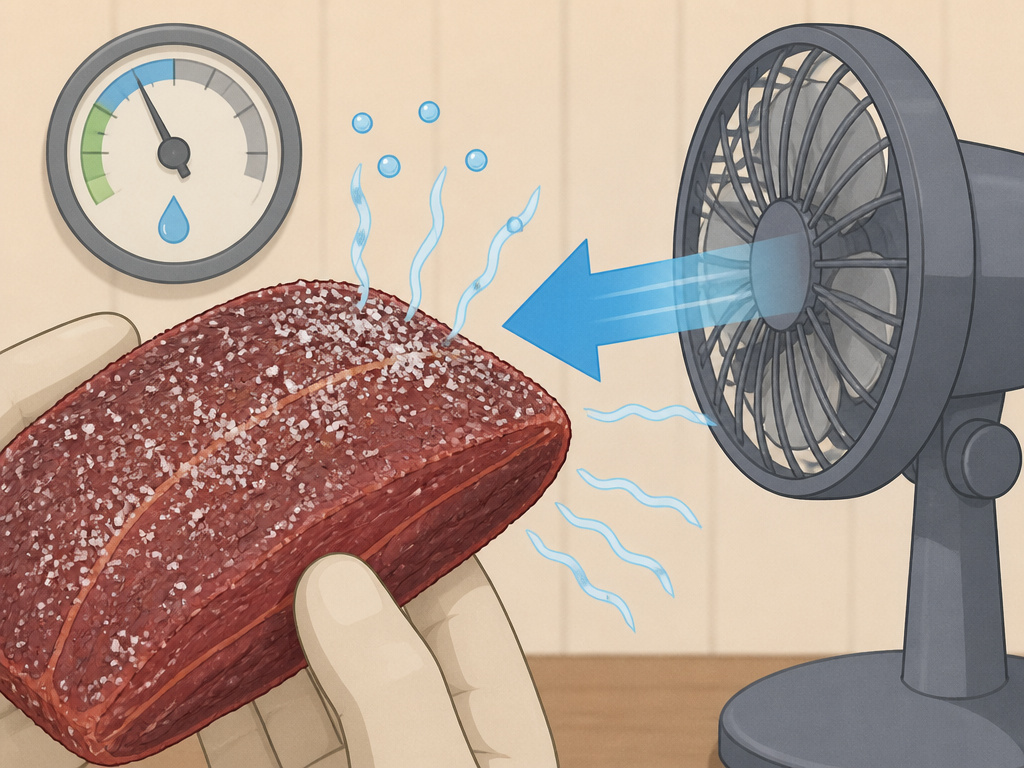
Salting is only half the process. Drying removes the moisture that salt drew out, locking in the preservation. This stage is where most home efforts fail because they ignore the environment.
Optimal Conditions: Warm, dry air with low humidity, about 30%. This is why many traditional methods are tied to specific, arid climates or winter months.
What to Avoid: Cold, damp rooms. Never package meat in these conditions. Water will condense on the meat surface, rehydrating it and introducing mold spores.
Dry meat is extremely sensitive to changes in ambient temperature and relative humidity. Think of it like a sponge. In a humid room, it will absorb moisture from the air.
If you must dry in a less-than-ideal climate, force airflow. A fan moving air over the meat helps mimic a dry environment by constantly sweeping moisture away from the surface. The YouTube transcript context from a creator in Minnesota highlights this: doing this in a warmer climate requires a fan for airflow, while cold winter air acts like a natural refrigerator.
How to Store It for Months (Not Days)
The goal is shelf-stable storage without refrigeration. For that, you need a waterproof barrier.
- Do: Store in vacuum-sealed bags or waterproof containers. Pressed charque is often vacuum-packed in nylon/polythene laminate film for long-term distribution.
- Do Not: Store in jute sacks if the product retains moisture, or leave packaged meat uncovered in a room. Even packaged meat should be covered with plastic sheets for extra protection against dust and ambient moisture.
These products can be preserved for 4-6 months at room temperature. But that clock resets the moment the seal is broken or moisture is reintroduced.
Common Failure Modes and How to Avoid Them
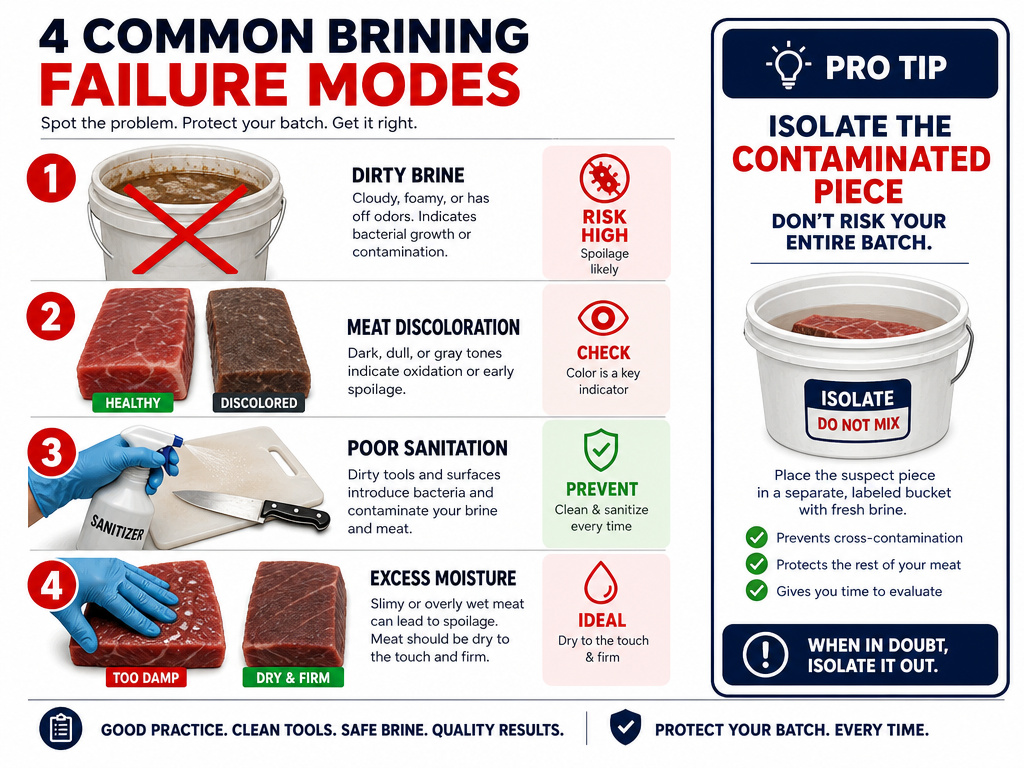
You can follow every ratio and still ruin the batch. Here are the subtle traps.
- Using Dirty or Old Brine: Brine must be renovated often. Some commercial plants test brine daily. Reusing brine without boiling or replacing it turns it into a microbial soup that inoculates your fresh meat.
- Ignoring Raw Meat Quality: Avoid meat from stressed animals. It’s often dark with a high pH, which resists salt penetration and spoils rapidly. This is a key point in the FAO meat preservation manual.
- Poor Hygiene During Handling: All equipment and surfaces must be cleaned with hot water (70–75°C) and sanitized. Sodium hypochlorite is a suitable disinfectant. One contaminated strip can spoil a whole batch.
- Rushing the Dry: If meat feels cool or damp to the touch, it’s not done. Packaging it wet is an invitation for rapid bacterial and mold growth. This is the core principle behind preserving meat without refrigeration, the drying must be complete.
The part nobody mentions: If a piece gets contaminated during handling, you can’t restore its original quality. Soak it in a separate salt solution bucket after rinsing, dry it separately, and use it first. Never mix it back with your clean batch.
Frequently Asked Questions
Can I use table salt to preserve meat?
You can, but it’s not ideal. Standard table salt contains anticaking agents like sodium silicoaluminate. These additives can create a cloudy brine and impart off-flavors. For best results, use pure kosher salt or pure sea salt with no additives. The size of the crystals in kosher salt also makes it easier to measure by volume consistently.
How do I know when the meat is fully preserved?
Fully preserved, dried product like charque will be stiff and leathery but still pliable. It should not feel cool or damp anywhere. The color will be a deep, uniform reddish-brown. Most importantly, it should have a mild salty taste, not an intense saltiness or any off-odors. A slightly rancid flavor from fat oxidation is common in older pieces but indicates it should be used soon.
What’s the difference between charque and jerked beef?
Both are intermediate-moisture, salted meats. The main differences are in moisture limits and processing. Jerked beef has a maximum moisture of 50%, while charque can go up to 60%. Charque is typically made from larger, flat pieces (5kg, 5cm thick) briefly brined, while traditional jerked beef often involves dry salting and longer air-drying. Both, however, rely on the same science of smoking meat principle of low water activity for preservation.
Is preserved salted meat safe to eat without cooking?
Traditionally, yes. Products like charque or carne-de-sol are often eaten as-is, thinly sliced. The combination of high salt concentration and low water activity (Aw below 0.80) makes the environment inhospitable to pathogens like Salmonella or E. Coli. However, for absolute safety, especially with home-prepared batches, lightly cooking or rehydrating and cooking it is a prudent step. It also improves the texture.
How does this compare to dry aging meat?
They are different processes with different goals. Dry aging meat in a controlled refrigerator is about enzymatic tenderization and flavor concentration over weeks. Preservation with salt is a chemical and physical process to stop microbial growth for months or years. Salt is the active preservative agent; aging relies on controlled decomposition. You would not heavily salt a steak you intend to dry age.
Before You Go
Preserving meat with salt hinges on three non-negotiable rules: speed, specificity, and environment. Hit the five-hour window. Match the brining or dry-curing method to the thickness of your cut. Control your drying humidity.
Forget the vague advice. Remember the numbers: 5 hours, 14% brine, 5cm thick, 30% humidity. This turns a folk practice into a repeatable, safe method. It’s how cultures without refrigeration secured protein for centuries, and it still works with the same precision today.
Your salt is your guarantee. Your timing is your leverage. Get both right, and the rest is patience.
