
How to Preserve Meat Without Refrigeration: A Complete Guide
This post contains affiliate links. As an Amazon Associate, we earn from qualifying purchases.
To preserve meat without refrigeration, you must control three specific numbers: lower the pH below 5.2, drop the water activity (aw) below 0.95, or apply heat above 100°C (sterilization). A combination of these hurdles, like salting to reduce aw and smoking to add antimicrobial compounds, creates a stable product that can last for months without cooling.
The science is defined by organizations like the FAO with exact thresholds that stop microbial growth. If you miss one hurdle, you must compensate with another.A product with a pH of 5.3 needs refrigeration; the same product with an aw of 0.88 does not.
What follows is a breakdown of those three numbers, the four methods that hit them, and the storage rules that catch failure before it spoils your work.
Key Takeaways
- Shelf-stability requires hitting a threshold: A pH below 5.2, a water activity (aw) below 0.95, or a heat treatment above 100°C.
- Drying is about thickness: Meat strips thicker than 7 cm will not dry evenly; the center stays moist and spoils.
- Check dried meat monthly: Open one package from your batch every 30 days. Look for mold, smell for rancidity.
- Salt strength matters more than quantity: Calculate the brine strength (water-phase salt), not just the percent of salt you add.
- “Hurdle technology” is the professional secret: Combine two or more preservation methods (e.g., salt + smoke + drying) for a more reliable, better-tasting result than any single method alone.
The Core Science: pH, Water Activity, and Temperature
Forget vague ideas about “keeping air out” or “making it dry.” Preservation without refrigeration works by making the environment inside the meat impossible for microbes to live in. Three specific variables control that environment.
A pH below 5.2 or a water activity (aw) below 0.95 defines a shelf-stable product. If a product has a pH above 5.2 AND an aw above 0.95, it is highly perishable and requires refrigeration at or below 5°C.
pH measures acidity. Most bacteria that cause spoilage and illness cannot multiply in a highly acidic environment. The critical line is pH 5.2. Meat products with a pH above that are “highly perishable.” Products below that are “shelf-stable,” provided other factors are controlled. This is why fermented sausages are safe, lactic acid bacteria drop the pH during fermentation.
Water activity (aw) measures how much of the water in the meat is available for microbes to use, on a scale from 0 to 1. Pure water has an aw of 1.0. By removing water (drying) or binding it with salt or sugar, you lower the aw. The magic threshold is aw 0.95. Below this, most bacteria stop growing. For long-term shelf-stability without any refrigeration, aiming for aw below 0.91 is the goal, as stated in the FAO meat preservation manual.
Temperature destroys microbes outright. There’s a crucial divide: * Pasteurization (up to 100°C): Kills most vegetative cells but not all bacterial spores. Products treated this way often need another hurdle, like low pH, or careful storage below 25°C. * Sterilization (above 100°C): Achieved with a pressure canner at 240°F (116°C). This destroys even the tough spores of Clostridium botulinum, making low-acid foods like plain meat shelf-stable. The University of Alaska food preservation guide states this temperature is non-negotiable for safe canning.
| Preservation Hurdle | Target Threshold | What It Stops | Method Example |
|---|---|---|---|
| Acidity (pH) | Below 5.2 | Most bacterial growth | Fermentation, vinegar pickling |
| Water Activity (aw) | Below 0.95 | Bacterial growth; below 0.91 for long-term shelf-life | Drying, heavy salting |
| Temperature | Above 100°C | All microbial life, including spores | Pressure canning |
These hurdles are additive. This is called “hurdle technology.” A product that is slightly dried (aw 0.93) and lightly smoked (adds antimicrobials) is far more stable than one that only meets a single threshold. It’s the core principle behind most traditional meat storage methods.
Method 1: Drying (Lowering Water Activity)
Drying is the most straightforward method to lower water activity. It’s also the one where geometry matters as much as time.
The rule is simple: meat thickness must not exceed 7 cm (about 2.75 inches). According to the FAO dried meat techniques, thicker pieces will not dry uniformly. The outside becomes leather while the center stays moist, creating a hidden pocket where bacteria thrive. Cut strips between 20 and 70 cm long for easy handling, but keep that cross-section thin.
Where this goes sideways: Faulty drying gives you a too-strong smoke flavor on the outside, brittle pieces that won’t rehydrate, and a hidden, spoiled center in the thicker bits. The failure appears within the first month of storage.
The ideal environment is warm, dry air with low humidity (around 30%) and good circulation. Drying takes four to five days for uniformly cut strips. You’re not just waiting for it to look dry; you’re waiting for the internal water activity to drop below the safety threshold.
The 5-Step Drying Process:
- Trim and cut: Remove all visible fat and connective tissue. Fat turns rancid. Cut into uniform strips no thicker than your thumb.
- Cure (optional but recommended): Rub with salt and optional spices. This draws out moisture, lowers aw further, and adds flavor. Let it sit for a few hours to a day.
- Arrange for airflow: Hang strips so air can flow on all sides. Don’t let them touch each other.
- Monitor: In a good setup, the strips will feel stiff and leathery in 4-5 days. In humid conditions, it can take weeks.
- Condition: Place the dried strips in a single layer in a cardboard box or breathable container for a week. This allows remaining moisture to equalize throughout all pieces.
After conditioning, store in airtight containers. You must check your stash monthly. Open one package, smell the meat, and look for any signs of mold or dampness. This monthly check is in the FAO guidelines as a mandatory step for safe storage.
This method is the foundation for products like biltong, which can last several months without any packaging and over a year when vacuum-sealed.
Method 2: Salting and Curing (Lowering aw and pH)
Salt does more than add flavor. It preserves by drawing water out of meat cells via osmosis, directly lowering water activity. In high enough concentrations, it creates an environment where microbes cannot take up water and simply die.
Dry Curing vs. Brining:
- Dry Curing: Meat is packed in or rubbed thoroughly with a mixture of salt and often nitrites/nitrates (pink curing salt). The salt draws moisture out, forming a brine on the surface that is reabsorbed, carrying the salt inward. This is a slow process, taking days to weeks depending on thickness.
- Brining (Wet Curing): Meat is submerged in a saltwater solution. This is faster and can result in a more evenly salted, juicier end product.
Common mistake: Measuring salt by volume or by “percent of meat weight.” The real metric is brine strength or water-phase salt, the concentration of salt in the actual water content of the final product. A salometer measures brine strength.
For true shelf-stability, the goal is to combine salting with drying. Pastirma, a Turkish dried meat, is a perfect example. After salting and drying, it’s coated with a paste of garlic and spices (the garlic acts as an antifungal). Its final aw is around 0.88, and it can sit mold-free for months at room temperature.
Salting is rarely used alone for long-term preservation. It’s the first, crucial step in a sequence that usually includes drying or smoking. For a deep dive on the specifics, see our guide on how to preserve meat with salt.
Method 3: Smoking (Adding Antimicrobials and Drying)
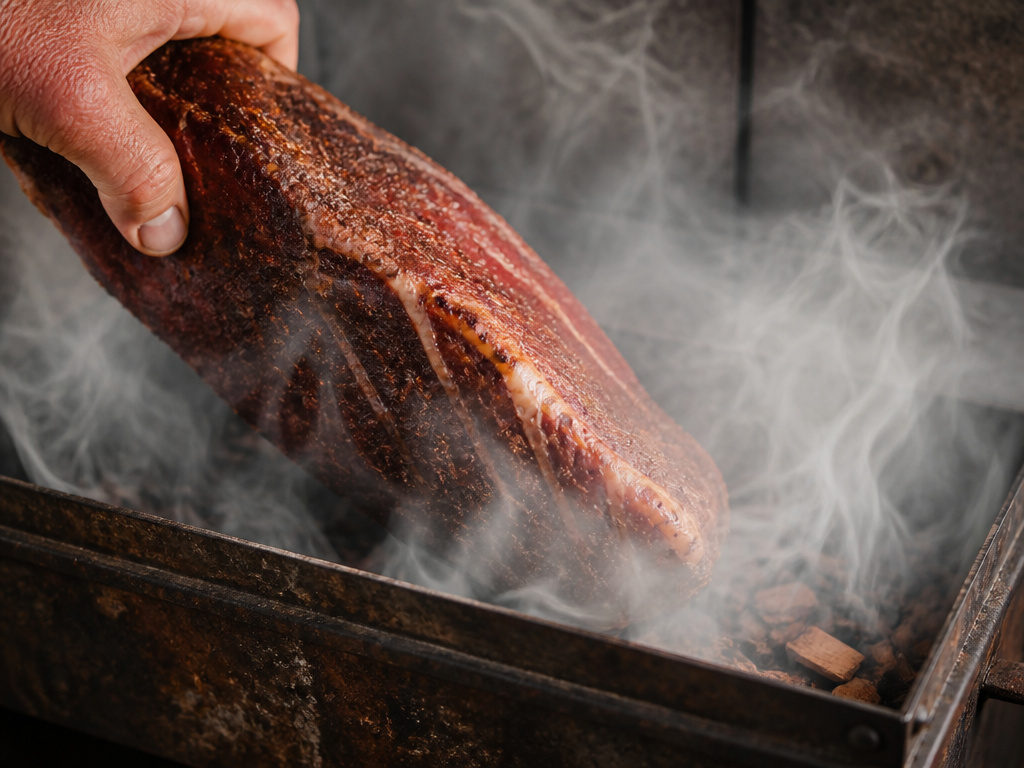
Smoking is a dual-purpose method. It applies heat, which dries the meat, and it deposits compounds from the smoke onto the meat’s surface that have antimicrobial and antioxidant effects.
Hot Smoking vs. Cold Smoking:
- Hot Smoking: Cooks and smokes the meat simultaneously at temperatures between 52°C and 80°C. It yields a fully cooked, edible product with a shorter preservation window because the internal moisture remains higher.
- Cold Smoking: Smokes the meat at temperatures below 29°C. This can take days or weeks. It does not cook the meat; its purpose is purely preservation and flavor. The meat must already be cured or dried to be safe for cold smoking.
The key to smoking meat as a preservation method is the combination of factors: the antimicrobial phenols in the smoke, the drying effect of the air flow, and the initial curing with salt. Smoking alone, especially hot smoking without prior curing, is not a reliable preservation method.
Smoking is a powerful hurdle to combine with others. A cured, then cold-smoked, then dried piece of meat has three separate layers of protection against spoilage.
Method 4: Heat Canning (Sterilization)
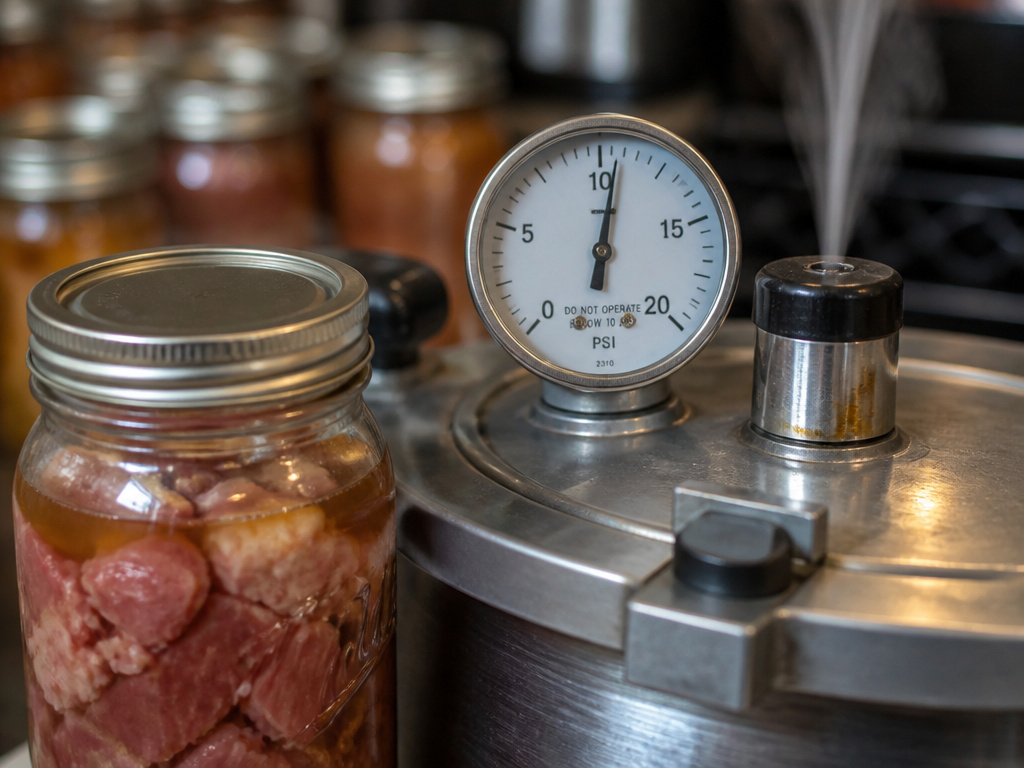
Canning uses high heat to destroy all microorganisms, creating a sterile, shelf-stable product. For meat, which is low-acid (pH above 4.6), this requires a pressure canner.
| Canning Method | Temperature | Use Case | Critical Failure If Skipped |
|---|---|---|---|
| Boiling Water Bath | 100°C (212°F) | High-acid foods only (fruits, pickles) | Botulism risk in low-acid meats. Absolutely banned. |
| Pressure Canner | 116°C (240°F) | All low-acid foods (meat, poultry, vegetables) | Not venting the canner properly for 10 minutes before pressurizing. Trapped air lowers effective temperature. |
The process is precise: raw or cooked meat is packed into jars, covered with liquid (water, broth, or its own juice), leaving specific headspace. Lids are fastened fingertip-tight. Jars are processed in the pressure canner at the correct pressure (usually 10 or 11 PSI depending on altitude) for the exact time specified by a tested recipe, like those from the Alaska CES food preservation publication.
Why the pressure canner is non-negotiable: The botulism spore is a hard shell that only cracks open and is killed at temperatures above the boiling point of water. 240°F is that temperature.
Storing Your Preserved Meat
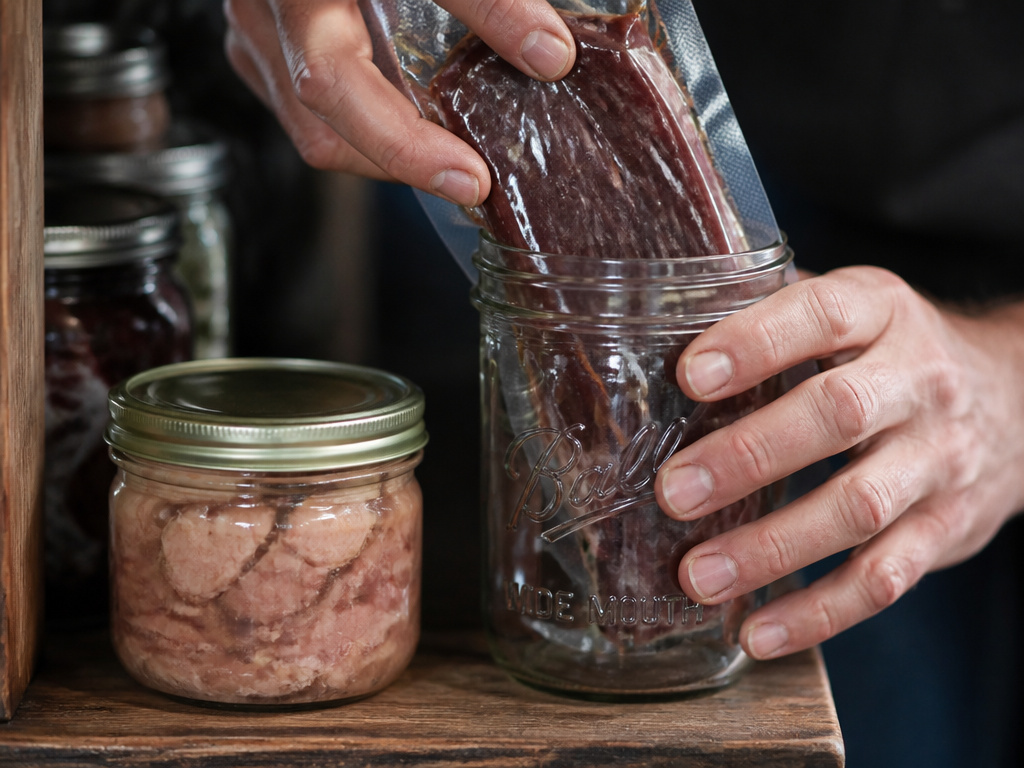
How you store the finished product depends on which hurdles you cleared.
For Dried and Cured Meats (Low aw):
- Packaging: Airtight is best to prevent reabsorption of moisture. A vacuum sealer for meat is ideal. Glass jars with tight lids or moisture-proof Mylar bags work well.
- Environment: Cool, dark, and dry. A pantry is fine. Avoid temperature swings and humidity above 60%.
- Monitoring: Perform the monthly check. Open, smell, look. Discard anything with off odors, mold, or signs of moisture.
For Canned Meats (Sterilized):
- Packaging: The sealed jar is the package. Check lids are concave and sealed before storage.
- Environment: Same as above, cool, dark, dry. Temperatures should not exceed 20-25°C for long-term storage.
- Monitoring: Before opening, check the lid seal. Upon opening, listen for a “whoosh” of air (should be a slight vacuum sound, not a rush of gas). Smell the contents. If in doubt, boil the meat for 10 minutes before tasting.
These storage principles apply whether you’re keeping meat at home or need strategies for camping without a fridge.
Frequently Asked Questions
Can you preserve raw meat without refrigeration?
Yes, but not by a single, simple method. Preserving raw meat requires transforming it through a combination of processes, like salting and drying, that change its fundamental properties (pH and water activity). You cannot just seal raw meat in a jar and leave it on the shelf.
How long can salt-preserved meat last?
It depends on the final water activity. A heavily salted and thoroughly dried product like biltong can last 6-12 months in an airtight container at room temperature. A lightly salted, moist product might only last a few weeks, even in cool conditions.
Is it safe to eat years-old dried meat?
Safety and quality are different. A properly dried and stored product with a very low aw (below 0.85) may be microbiologically safe for years. However, chemical spoilage, rancidity of fats, will occur over time, degrading flavor and nutritional value. It may be safe but unpleasant.
What’s the difference between drying and dehydrating?
In this context, they are the same goal: removing moisture. “Drying” often refers to traditional air-drying or smoking, while “dehydrating” implies using an electric dehydrator with controlled heat and airflow. The dehydrator is faster and more consistent, especially in humid climates.
Can I use a refrigerator to help preserve meat?
Absolutely. Refrigeration is another hurdle, it lowers temperature to slow microbial growth. It’s essential for products that only meet one hurdle (like a pH of 5.3). Many dry aging techniques rely on a controlled refrigerator environment.
The Bottom Line
Preserving meat without refrigeration is applied food science that relies on hitting specific, measurable targets for acidity, moisture, or temperature. The most reliable results come from combining two or more of these hurdles, curing then drying, or smoking then sealing.
Start with drying. Cut your meat thin, keep the air moving, and be patient over those four to five days. That monthly check after storage is your best insurance. For the ultimate shelf-stable pantry item, a pressure canner is the only safe path for canned meats.
The goal isn’t just survival food; it’s delicious, time-tested food. From biltong to pastirma, these methods work because the numbers behind them don’t lie.
