Is Kosher Salt the Same as Canning and Pickling Salt? Know
This post contains affiliate links. As an Amazon Associate, we earn from qualifying purchases.
No, kosher salt is not the same as canning and pickling salt. The difference concerns grain size and density, not purity, as both are sodium chloride. A 2025 University of California study measured Morton Canning & Pickling Salt at 18.9 grams per tablespoon and Diamond Crystal Kosher Salt Flakes at 8.2 grams.That’s a 2.3x weight difference. Using kosher salt by volume in a canning recipe means you’re adding less than half the intended salt, which can cause fermented pickles to rot and brined vegetables to spoil.
That number, 2.3, is where your batch succeeds or fails. It’s the gap between a crisp, safe jar of sauerkraut and a cloudy, soft mess you have to throw out. Every extension office from Maine to California publishes the same warning for the same mechanical reason.
What follows: the exact grain-size science, a table for converting between brands, the one type of salt you must never use, and the step-by-step method for using kosher salt safely if it’s all you have.
Key Takeaways
- Weigh, don’t measure. A tablespoon of canning salt weighs 2.3 times more than a tablespoon of Diamond Crystal kosher flakes. Volume measurements between salts are worthless.
- Fermentation fails first. Under-salting a fermented pickle or sauerkraut by using the wrong salt stops the good bacteria and lets pathogens grow. The batch rots.
- Anti-caking agents cloud. Table salt contains calcium silicate or sodium aluminosilicate to prevent clumping. These agents don’t dissolve and turn your brine milky.
- Sea salt discolors. Minerals like magnesium and calcium in sea salt can cause pickles to darken or develop off-flavors. It’s safe chemically, but ugly.
- The safe swap. If you only have kosher salt, use a kitchen scale. For every 1 tablespoon of canning salt a recipe calls for, weigh out 18.9 grams of your kosher salt.
The Core Difference: Weight, Not Chemistry
Both salts are sodium chloride. The chemistry is identical. The physical shape is not.
Canning salt is milled into tiny, uniform cubes about 0.5 mm across. They pack tightly. Kosher salt, especially the flake style, is pressed into thin, irregular sheets. Those sheets stack like potato chips, leaving huge air gaps. Fill a measuring cup with each, and the cup of flakes holds far less actual salt.
A 2025 analysis by the University of California Master Food Preserver program found Morton Canning & Pickling Salt has a bulk density of 18.9 grams per tablespoon. Diamond Crystal Kosher Salt Flakes has a density of 8.2 grams per tablespoon. You need 2.3 tablespoons of the flakes to equal the salt mass of one tablespoon of the canning salt.
This is a major variance. It represents the difference between a 2.5% brine that fosters lactic acid bacteria and a 1.1% brine that does nothing.In a water bath canning recipe for pickles, the salt is for flavor. In a fermented sauerkraut, the salt is the preservative. Get it wrong, and the preservation fails.
What Happens When You Use the Wrong Salt?
The consequence depends on what you’re making. For plain canned green beans, salt is only for taste. Skip it, use table salt, use kosher salt, the jar will still be safe. For anything involving a brine, especially fermentation, the salt concentration is a safety lever.
Where this goes sideways: Substituting kosher salt by volume in a fermented recipe. The brine concentration drops too low to inhibit mold and bad bacteria. The good lactic acid bacteria never take hold, and the batch will smell foul within a week.
For quick-pack vinegar pickles, the primary preservative is the acid from the vinegar. Salt enhances flavor and texture. Under-salting can make pickles soft and bland, but they won’t spoil from it. Over-salting makes them inedibly salty. The real risk is using table salt with anti-caking agents.
Iodized table salt causes visual defects. The iodine can react with pigments in the food. Cauliflower turns pink. Garlic turns blue-green. The pickles are still safe to eat, but they look wrong. The anti-caking agents, calcium silicate or sodium aluminosilicate, do not dissolve in the brine. They sink to the bottom of the jar as a fine white sediment, making the liquid permanently cloudy.
Sea salt introduces minerals. These extra minerals (magnesium, calcium, potassium) are safe to consume. But they can cause unpredictable discoloration and sometimes a faint metallic aftertaste. For the clear, bright brine most home canners want, sea salt is a gamble.
The Penn State Extension guide on salt’s role is blunt: use canning salt for predictable results. Everything else is a compromise.
A Guide to Every Salt Type for Preserving
You’ll see five salts on a grocery shelf. Here’s what each one does to your preserved food.
| Salt Type | Best Used For | Risk in Canning/Pickling |
|---|---|---|
| Canning/Pickling | All home preservation: fermenting, pickling, canning. | None. This is the benchmark. |
| Kosher (Flake) | Cooking, seasoning. | Major risk: Volume measurement under-salts by up to 2.3x. Ferments fail, brines are weak. |
| Kosher (Granulated) | Cooking. | Moderate risk: Density varies by brand. Weigh it. |
| Iodized Table | General table use. | Cloudy brine, possible discoloration (pink cauliflower, blue garlic). Safe but ugly. |
| Sea Salt | Finishing cooked dishes. | Unpredictable mineral content can darken pickles or add off-flavors. |
Kosher salt isn’t one thing. The term “kosher” refers to the process of drawing moisture from meat, not the salt itself. Brands differ wildly. Morton’s kosher salt is denser than Diamond Crystal’s. You cannot swap them by volume. Ever.
If you must use kosher salt in a canning recipe, you have one path: use a scale. Ignore the cup and tablespoon lines in the recipe. Find the weight equivalent. For example, if a recipe calls for 1/4 cup of canning salt, that’s about 75.6 grams (4 tablespoons x 18.9 g). Weigh out 75.6 grams of your kosher salt.
This method is endorsed by the National Center home canning guide, the USDA’s official manual. Their position is that flake salt varies in density and is not recommended. But if you weigh it, you can hit the target.
The One Rule for Fermented Pickles and Sauerkraut

This is non-negotiable. Fermentation relies on salt to create an environment where lactic acid bacteria thrive and everything else dies. The margin for error is small.
Never alter the salt quantity in a fermented recipe. The Oklahoma State University guide states that using kosher salt by volume instead of canning salt “can put the safety of the product at risk.” The brine concentration is too low.
Here’s what happens in the jar day by day if you under-salt using kosher flakes: 1. Day 1-2: Nothing. Vegetables sit in brine. 2. Day ,3-4: Mold spores (always present in the air) land on the surface and begin to grow. The weak brine doesn’t stop them. 3. Day 5-7: The mold spreads. The vegetables below the surface may start to smell putrid as bad bacteria multiply. 4. Day 8+: The batch is spoiled. You must discard it.
A correct brine, using weighed canning salt, creates a hostile environment for mold from the start. The lactic acid bacteria produce carbon dioxide (bubbles) and acid, lowering the pH safely. You see bubbles, not fuzz.
This principle is the same across all methods for preserving vegetables that use fermentation. It applies to kimchi, sauerkraut, and brined pickles. The safety is in the salt weight.
How to Substitute Safely: A Step-by-Step Conversion
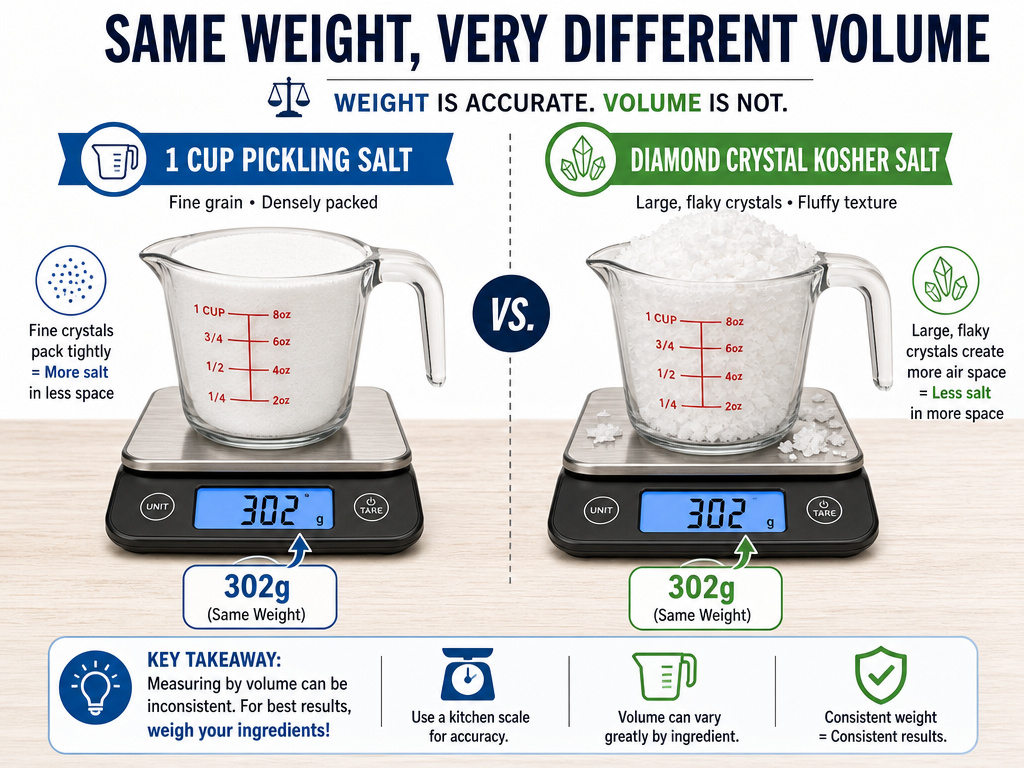
You ran out of canning salt. The recipe is from your grandmother and calls for “1 cup pickling salt.” You have a box of Diamond Crystal Kosher Salt Flakes. What now?
Step 1: Find the target weight.
Canning salt weighs about 18.9 grams per tablespoon. One cup is 16 tablespoons. 16 x 18.9 = 302.4 grams. Your target is 302 grams of salt.
Step 2: Calibrate your scale.
Place an empty bowl on your kitchen scale. Tare it to zero. Your scale should measure in grams.
Step 3: Weigh your kosher salt.
Slowly pour your kosher salt flakes into the bowl until the scale reads 302 grams. This will look like a massive volume of salt, nearly two and a half cups of flakes. That’s correct.
Step 4: Proceed with the recipe.
Add this weighed salt to your brine or fermentation vessel as directed. The rest of the process is unchanged.
Common mistake: Thinking “1 cup of salt” means any cup of any salt. It doesn’t. A cup is a volume; salt works by mass. This is why professional recipes for preserving meat with salt always specify weight.
If your recipe already provides a weight (e.g., “3 ounces of salt”), you’re ahead. Just weigh your kosher salt to match that number. The type becomes irrelevant.
Storing Your Salt for the Long Haul
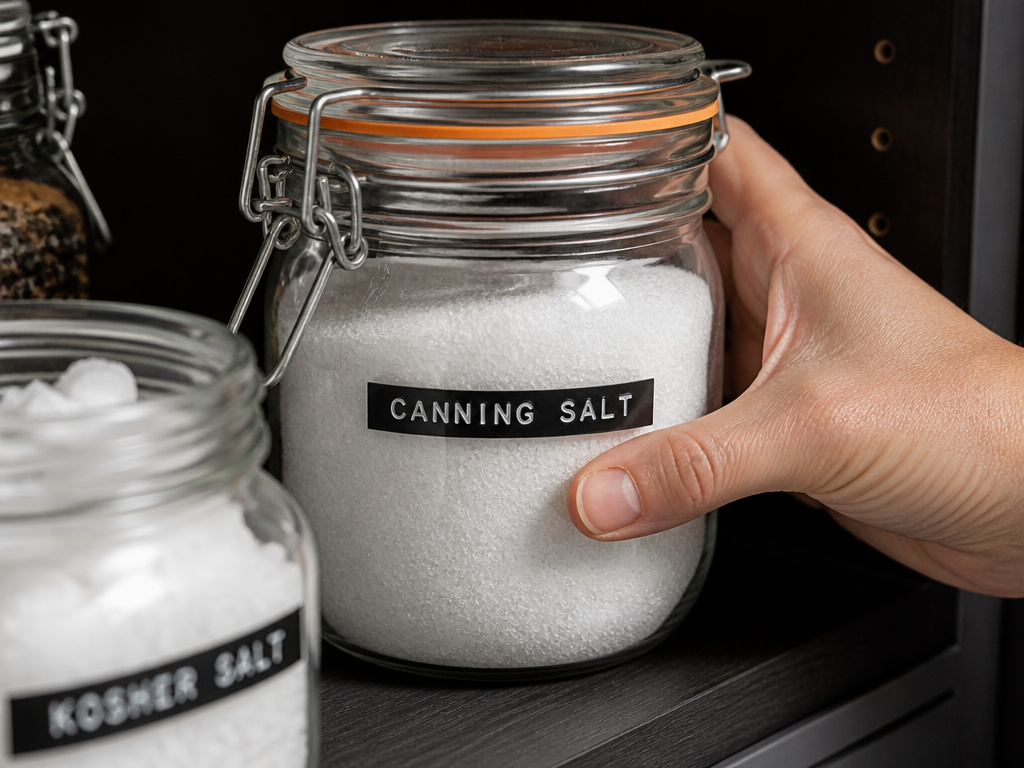
Salt doesn’t spoil, but it can clump. Canning salt, having no anti-caking agents, is prone to absorbing moisture and hardening into a brick in humid conditions.
Keep your salt in an airtight, moisture-proof container. A glass jar with a rubber gasket seal is ideal. Store it in a cool, dark cupboard, not above the stove. Properly stored, pickling salt remains usable for years. The University of Maine salts guide notes that the purity of canning salt is what keeps your brine clear batch after batch.
This is part of general long-term salt storage practice. The right salt storage containers keep it dry and ready for your next canning project, whether you’re canning potatoes or preserving tomatoes.
Frequently Asked Questions
Can I use Himalayan pink salt or other colored salts?
No. These salts contain non-soluble minerals that give them their color. Those minerals will settle as sediment in the bottom of your jar and can discolor the food. They are not recommended for any type of home canning or pickling.
Is “pickling salt” different from “canning salt”?
No. The terms are interchangeable. Both refer to pure, fine-grained sodium chloride without additives. You might see “Canning & Pickling Salt” on the label, like the Morton product.
Why does my pickle brine get cloudy?
Two likely causes. First, you used iodized table salt. The anti-caking agent is the cloud. Second, you used hard water with high mineral content. For the clearest brine, use canning salt and soft or distilled water. Cloudiness from table salt is cosmetic, not a safety issue.
Can I skip salt in canning recipes?
For plain canned vegetables (beans, carrots, corn), yes. Salt is for flavor only in these recipes. For pickles and all fermented foods, no. Salt is critical for safety, texture, and flavor. Do not omit it.
What’s the best brand of canning salt?
Morton and Ball both produce widely available, reliable canning salts. They are functionally identical, fine-grained, pure sodium chloride. The best salt for canning is whichever of these you find on your grocery shelf.
Before You Go
Kosher salt and canning salt are not the same. The 2.3-times weight difference is the line between a successful preserve and a failed one.
For vinegar pickles, weigh your kosher salt to match the canning salt target. For fermented sauerkraut or brined pickles, use canning salt. It’s the one ingredient where a substitution affects both taste and whether the jar stays safe on the shelf.
When you’re ready to start, use clean pickling jars and follow a tested recipe from a source like the National Center for Home Food Preservation. The salt is the easiest part to get right, once you know to use the scale.
