How Can I Preserve Fresh Cilantro For 3+ Weeks | Easy Tricks
This post contains affiliate links. As an Amazon Associate, we earn from qualifying purchases.
You can preserve fresh cilantro for up to two weeks in the refrigerator using a water jar method, for months in the freezer, or for a year dried. The method you choose depends entirely on how you plan to use it: refrigerated for fresh garnishes, frozen for cooked dishes, or dried for long-term seasoning.
That gap between two weeks and a year is where the real decision lives. Your goal is to match the preservation technique to the flavor and texture you need on your plate a month from now, preventing the cilantro from turning into a slimy black mess in the crisper drawer.
What follows: the exact science of why cilantro fails, three proven preservation paths (refrigerator, freezer, dry), and the one commercial trick that stretches shelf life to 21 days.
Key Takeaways
- Cilantro’s aroma fades days before it looks bad. At room temperature, it smells “off” after just one day, even if it still looks green.
- The water jar method works, but only if you change the water every other day. Stagnant water breeds bacteria that travel up the stems and rot the leaves from the inside.
- Freezing captures flavor but destroys cell structure. Frozen cilantro turns to mush when thawed, use it directly from frozen in cooked dishes only.
- Drying requires precise heat control. Convective drying at 70°C (158°F) for two hours preserves the most aroma; a standard home dehydrator on its lowest setting is your best bet.
- Your starting point matters. Cilantro that’s already wilted at the store will not magically recover, regardless of your preservation skill.
Why Cilantro Is So Damn Perishable (It’s Not Just Water)
Cilantro is a delicate herb that acts as a biological respirator on overdrive. The moment it’s cut, its metabolism shifts into high gear, burning through stored sugars and releasing water vapor and ethylene gas.This spoilage is a measurable process.
A University of Lisbon postharvest study recorded cilantro’s respiration rate at 114.1 mL of CO2 per kilogram per hour at 20°C (68°F). At that rate, a standard 50-gram bunch is essentially hyperventilating itself into a soggy, aromatic grave within days.
That high respiration rate does two concrete things to your bunch. First, it pumps moisture out of the leaves, making them wilt. Second, the moisture condenses on the inside of a plastic bag, creating a humid swamp where mold and bacteria thrive. This is why a sealed supermarket clamshell is a death sentence unless you open it immediately.
The aroma, the very reason you buy cilantro, is the first casualty. Volatile organic compounds like decanal and (E)-2-dodecenal, which give cilantro its bright, citrusy signature, are highly unstable. They evaporate quickly at room temperature and break down under the plant’s own enzymatic activity. Your nose gives up on the cilantro long before your eyes do.
The Water Jar Method (And Its Critical Detail)
This is the go-to method for keeping cilantro crisp and green for fresh use. It works because it addresses the plant’s most immediate need: hydration. The stems continue to draw water, which keeps the leaves turgid. But most guides gloss over the part that actually determines success or failure.
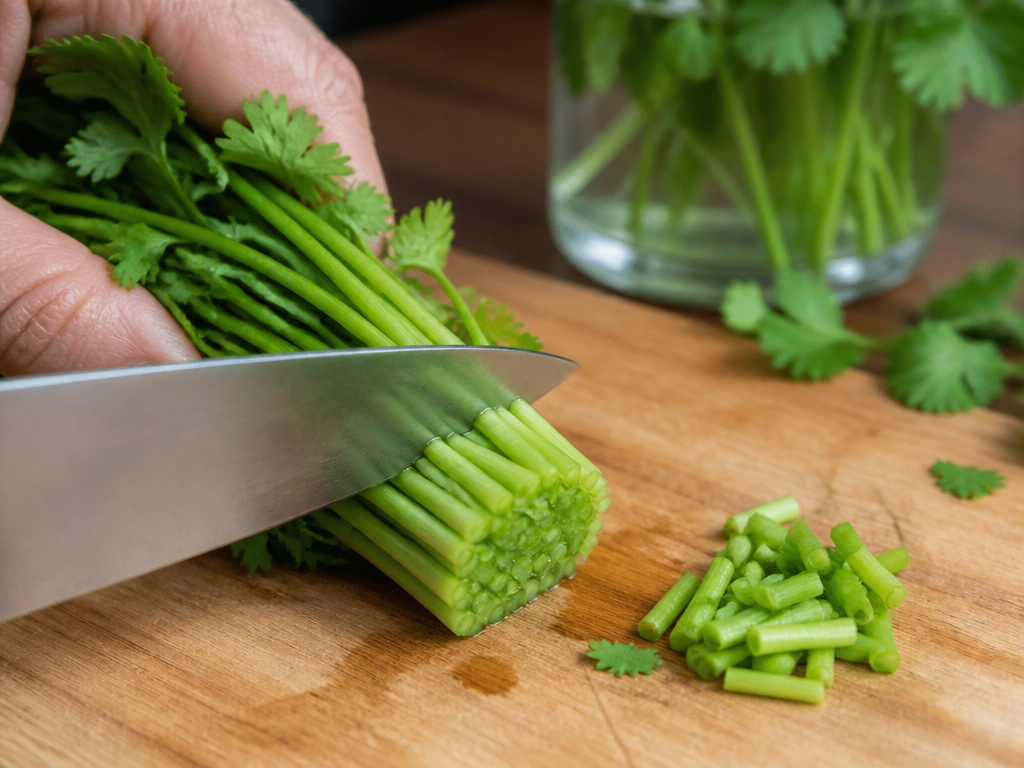
Cut the very bottom of the stems. Use a sharp knife and take off about half an inch. This opens the vascular bundles that have sealed over since harvest, restoring the stems’ ability to drink. Simply jamming an uncut bunch into water is like trying to sip a smoothie through a plugged straw.
Fill a jar or glass with about two inches of cold water. Submerge only the cut ends of the stems. Do not let the leaves touch the water. Then, loosely cover the leaves with a plastic produce bag or a large zip-top bag. This creates a high-humidity microclimate around the leaves without sealing them in, which would trap ethylene gas and accelerate yellowing.
Where this goes sideways: Forgetting to change the water. After two days, the water becomes a bacterial soup. Those microbes climb the stems, invade the leaf tissue, and cause rot from the inside out. You’ll see slimy, translucent stems days before the leaves show it.
Place the jar in the refrigerator, preferably in the door or towards the front where it’s slightly warmer than the deep chill of the back. Cilantro is not particularly chilling-sensitive, but you’re not trying to freeze it. This setup, done correctly, can keep a bunch looking and tasting fresh for 10 to 14 days.
This method is a form of short-term refrigerate cilantro, and it’s the foundation for most other methods for storing cilantro.
| Step | Action | Why It Matters |
|---|---|---|
| 1. Trim | Cut 0.5″ off stem bottoms with a sharp knife. | Opens sealed vascular tissue so stems can uptake water. |
| 2. Hydrate | Place stems in jar with 2″ cold water; leaves stay dry. | Rehydrates the plant without waterlogging the leaves. |
| 3. Cover | Loosely tent leaves with a plastic bag. | Creates >95% humidity without trapping ethylene gas. |
| 4. Maintain | Change water every 48 hours. | Prevents bacterial growth that causes internal rot. |
| 5. Store | Place jar in fridge (not coldest spot). | Slows respiration and microbial growth. |
The Freezer Is Your Friend (But Not For Garnish)
Freezing is the best method for preserving cilantro’s flavor for the long term, but it completely sacrifices texture. The ice crystals that form during freezing rupture the plant’s cell walls. When thawed, the leaves release all their stored water and become a wet, mushy paste. This makes frozen cilantro useless as a fresh garnish but perfect as a cooked ingredient.
You have two main paths here: loose-leaf freeze or herb ice cubes.
For loose-leaf freezing:
- Wash and thoroughly dry the leaves and tender stems. Any surface water will freeze into clumps.
- Chop the cilantro to the size you typically use.
- Spread the chopped herb in a single, thin layer on a parchment-lined baking sheet.
- Flash-freeze for 1-2 hours until the pieces are solid.
- Transfer the frozen cilantro to a labeled, airtight freezer bag or container. Squeeze out as much air as possible.
For herb ice cubes (the “sofrito” method):
- Blend clean cilantro leaves and stems with a small amount of water, oil, or both until it forms a coarse paste.
- Spoon the paste into an ice cube tray.
- Freeze solid, then pop the cubes out and store them in a freezer bag.
The oil or water in the cube acts as a barrier against freezer burn and locks in the volatile aromatics. One cube is roughly equivalent to two tablespoons of chopped fresh herb. Toss it directly into simmering soups, stews, sauces, or rice during the last few minutes of cooking.
Frozen cilantro retains peak flavor for about three months. After that, oxidation slowly dulls the taste, though it remains safe to eat. This technique is a cornerstone of long-term food preservation techniques, especially for delicate herb storage.
Drying Cilantro: A Race Against Volatile Oils
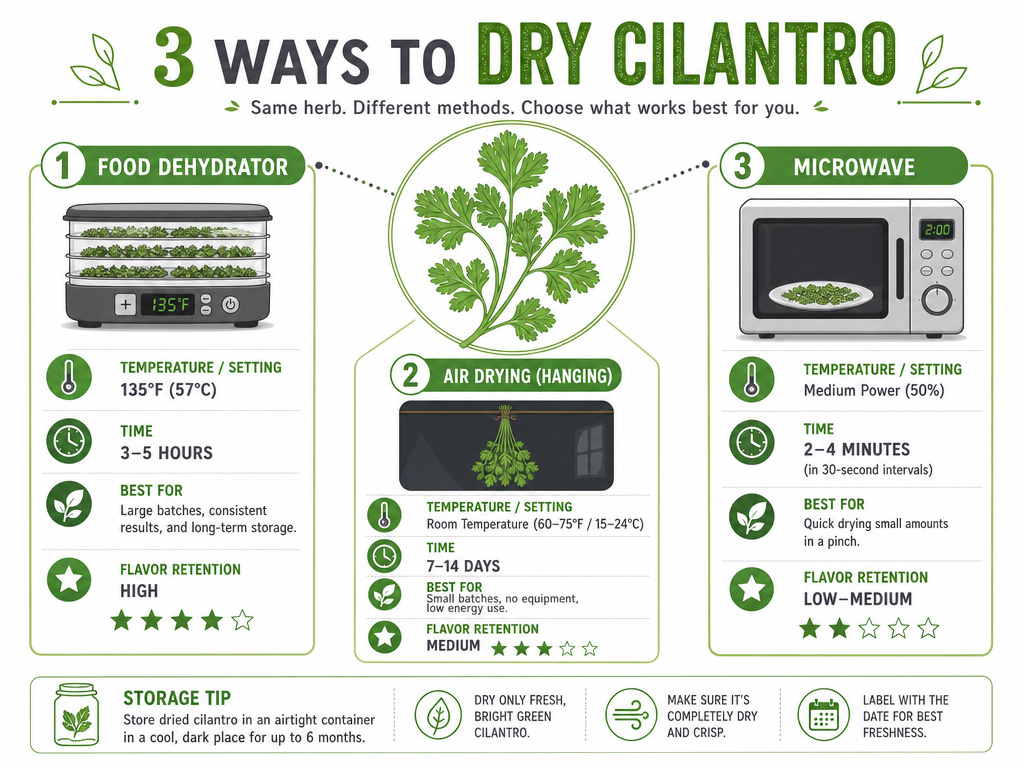
Drying is the trickiest home preservation method for cilantro because its defining flavor compounds are so heat-sensitive. The goal is to remove moisture quickly enough to prevent mold, but gently enough to not drive off all the aroma. Standard oven-drying on a baking sheet almost always fails, it’s too slow and uneven.
The best home-appliance option is a food dehydrator. Set it between 95°F and 115°F (35°C–46°C), the range that preserves essential oils in most delicate herbs. Spread washed and thoroughly dried cilantro sprigs in a single layer on the trays. Drying will take 4 to 8 hours. The cilantro is done when the leaves crumble easily between your fingers and the stems snap.
Common mistake: Drying cilantro in direct sunlight or a very hot oven. Temperatures above 120°F (49°C) begin to vaporize the volatile oils. What you’re left with is hay-scented cellulose, not coriander.
For small batches, the microwave method outlined in the UMass Extension preserving herbs guide can work. Place a single layer of leaves between two paper towels and microwave on high in 30-second bursts, checking for brittleness after each cycle. It’s fast but requires close attention to avoid scorching.
Once dried, strip the leaves from the stems and store them whole in an airtight container in a cool, dark place. Crush them just before using. Properly dried and stored cilantro will hold a decent flavor for about one year.
| Drying Method | Temperature / Setting | Time | Best For | Flavor Retention |
|---|---|---|---|---|
| Food Dehydrator | 95°F – 115°F (35°C – 46°C) | 4–8 hours | Large batches, best control. | High – preserves volatile oils. |
| Air Drying | Room temp, dark, ventilated area | 1–2 weeks | Small bunches in low-humidity climates. | Medium – slow process allows aroma loss. |
| Microwave | High power, 30-second intervals | 2–4 minutes | A few tablespoons for immediate use. | Low-Medium – risk of scorching or uneven drying. |
The Commercial Secret: 21 Days of Shelf Life
Home kitchens can’t replicate industrial food science, but knowing how it’s done reframes what’s possible. Commercial producers don’t just rely on cold temperatures. They use integrated techniques to put the cilantro into a state of suspended animation.
Research published in Food Chemistry demonstrated that a pretreatment with 50 parts per million of kinetin, a plant growth hormone, followed by packaging in 25-micron polypropylene bags, extended the shelf life of minimally processed cilantro leaves to 21 days at 8°C (46°F). Kinetin delays senescence, the natural aging process that leads to yellowing and texture loss.
The bags create a Modified Atmosphere Packaging (MAP) environment. As the cilantro respires, it consumes oxygen and gives off carbon dioxide, naturally creating a low-oxygen, high-CO2 atmosphere inside the sealed bag. This dramatically slows down respiration and microbial growth.
You can mimic a poor man’s MAP at home. After using the water jar method for a week, if your bunch is still strong, you can pat it completely dry, seal it in a zip-top bag with as much air removed as possible, and return it to the fridge. It might buy you a few extra days by slowing everything down. This principle of atmosphere control is a key finding in the UC Davis Postharvest Center factsheet on fresh herbs.
Cilantro vs. Parsley vs. Basil: Why One Method Doesn’t Fit All
Soft herbs like cilantro, parsley, and basil are often lumped together. They shouldn’t be. Their different physiologies demand tailored approaches.
- Cilantro has thin, tender leaves and a high water content. It’s relatively cold-tolerant. The water jar and freezing work well.
- Parsley (especially flat-leaf) has slightly sturdier leaves and a lower respiration rate. It often lasts a few days longer than cilantro with the same jar method, and it holds its texture better when frozen.
- Basil is chilling-sensitive. Storing it below 50°F (10°C) causes blackening and rapid decay. The best method for basil is the water jar, but kept on the counter, not in the fridge. It’s a different game entirely, as detailed in guides on how to preserve basil.
If you’re dealing with a mix of herbs, treat each according to its own rules. Don’t refrigerate the basil with the cilantro. Don’t expect parsley to freeze with the same result as cilantro. This granular knowledge is what separates effective preserving fresh herbs from a disappointing, slimy drawer.
Frequently Asked Questions
Can I revive wilted cilantro?
Sometimes, if it’s only wilted from dehydration and not yet slimy or yellow. Recut the stems and submerge the entire bunch (leaves and all) in a bowl of ice water for 15-30 minutes. The cold shock can rehydrate the cells and perk up the leaves. It won’t bring back lost aroma, but it can restore crispness for immediate use.
Is it better to wash cilantro before storing?
No. Wash it just before you use it. Introducing water before storage adds moisture that promotes bacterial and fungal growth. It also leaches water-soluble flavor compounds. If your bunch is very dirty, wash it, but then you must dry it completely with a salad spinner and paper towels before attempting any storage method.
Why does my frozen cilantro taste bitter?
Freezing can rupture cells and release compounds that are less noticeable in fresh herbs. More likely, the cilantro was beginning to decline before you froze it. As cilantro ages, its flavor profile shifts. Always freeze cilantro at its peak freshness, within a day or two of purchase.
Can I dry cilantro in the oven?
It’s not recommended. Most home ovens, even on the lowest “warm” setting, are too hot (often above 150°F/65°C). This cooks the herbs rather than drying them, resulting in a burnt or hay-like flavor. If you must use an oven, prop the door open slightly to lower the temperature and circulate air, and check every 15 minutes.
How do I know when cilantro has gone bad?
Trust your senses. Look: Yellowing or black spots, a slimy film on leaves or stems. Smell: The bright, citrusy aroma is replaced by a sour, musty, or rotten odor. Feel: Leaves that are mushy or slimy to the touch. When in doubt, throw it out.
Before You Go
Preserving cilantro requires matching the right tool to the job rather than a single magic bullet. For instance, you need a specific method for a crisp garnish next week.The water jar method, with diligent water changes, is your answer. Making a big batch of curry next month? Chop and freeze it solid. Want a shelf-stable seasoning for your pantry? Low-and-slow drying in a dehydrator is the only reliable path.
The real secret is acting fast. The clock on cilantro’s quality starts ticking the moment it’s harvested. Your most powerful move is to treat preservation not as a last-ditch effort, but as the first thing you do when you get home from the market. That shift, more than any jar or freezer bag, is what keeps flavor on your side.
