What is a Manual Defrost Freezer? Long-Term Storage Explained
This post contains affiliate links. As an Amazon Associate, we earn from qualifying purchases.
A manual defrost freezer is a simple, energy-efficient appliance that cools food without an automatic ice-melting cycle. You must periodically unplug it, remove the food, and let the accumulated frost melt away, typically when it reaches about a 1/2-inch thickness, to maintain efficiency. This design excels at long-term storage and is common in chest freezers and specialized lab units.
That 1/2-inch rule comes straight from GE’s manuals. It’s not a suggestion. Cross it, and the freezer’s compressor starts fighting a losing battle against restricted airflow. The unit runs longer, your energy bill climbs, and your food’s safety window shrinks.
What follows is a breakdown of how these workhorses operate, when you should absolutely buy one, and the exact steps to defrost them without ruining your food or the appliance. We’ll cover the energy math, the humidity trap, and why labs still swear by them.
Key Takeaways
- Manual defrost freezers use a simpler cooling system with no internal heater, making them 10-30% more energy-efficient than frost-free models.
- Defrost when frost reaches 1/2 inch (13mm), waiting longer forces the compressor to overwork and can damage food quality.
- These units are the default for chest freezers and are essential in laboratory/medical storage where temperature stability is non-negotiable.
- High humidity climates may require defrosting 3-4 times a year, not the standard two.
- Properly wrapped food suffers less freezer burn in a manual defrost unit due to stable, non-fluctuating temperatures.
Manual Defrost vs. Frost-Free: The Core Difference
The split isn’t about brand or shape. It’s about how each design handles the inevitable, water vapor in the air turning to ice inside the cold box.
A frost-free freezer has a timer, a heater, and a drain. Every 6 to 12 hours, the heater kicks on for a few minutes to melt frost off the evaporator coils. The water drains away, and you never see ice build up. Convenience wins.
A manual defrost freezer has none of that. It’s just a cold box, a compressor, and coils. Moisture freezes where it lands. Over weeks and months, a layer of frost builds on the walls and coils. You are the defrost timer, the heater, and the cleanup crew.
The Follett Scientific lab equipment guide notes a critical advantage: manual defrost ensures no rise in product temperature during the defrost cycle. For vaccines, tissue samples, or sensitive reagents, that stability is worth the manual labor.
That’s the trade in a nutshell. One asks for your time a couple of times a year. The other asks for more electricity every single day and introduces temperature swings. Which cost matters more to you?
How a Manual Defrost Freezer Actually Works
Forget the jargon. The cooling mechanism is straightforward. A refrigerant gas gets compressed, heats up, and loses that heat through coils on the back of the unit. Then it expands inside the evaporator coils lining the interior, getting very cold in the process.
Those cold coils suck heat out of the air inside the freezer. When you open the lid, warm, moist air rushes in. The moisture in that air contacts the sub-zero coils and instantly freezes. This is the frost.
Because there’s no heater to periodically melt it, the frost layer grows. It acts as insulation. The coils must work harder and get colder to pull heat through the frost barrier. The system strains.
This is why the freezer operation is so simple, and so dependent on your maintenance. The basic mechanics of a freezer are laid bare.
The 1/2 Inch Rule (And What Happens If You Ignore It)
GE’s manual for models like the FCM16 is explicit: “To have your freezer operate most efficiently, do not permit more than 1/2 inch (13 mm) of frost to accumulate on the shelves.”
Let’s translate that from manual-speak. At a quarter-inch, airflow is mildly restricted. The compressor runs a few extra minutes each hour. By half an inch, the frost is a serious insulator. The compressor runs nearly constantly, trying to punch through.
The result? Three things break, in this order: 1. Your energy efficiency plummets. You’re paying to cool a block of ice. 2. The compressor wears out prematurely from the non-stop workload. 3. The temperature in the freezer cavity can become inconsistent. Food at the back near the iced-over coils might be rock-solid, while items near the front creep above safe freezing temps.
The timeline depends entirely on your humidity and how often you open the freezer. In a dry climate with careful use, you might hit that half-inch mark in six months. In a humid garage where you’re in and out daily, it could be six weeks.
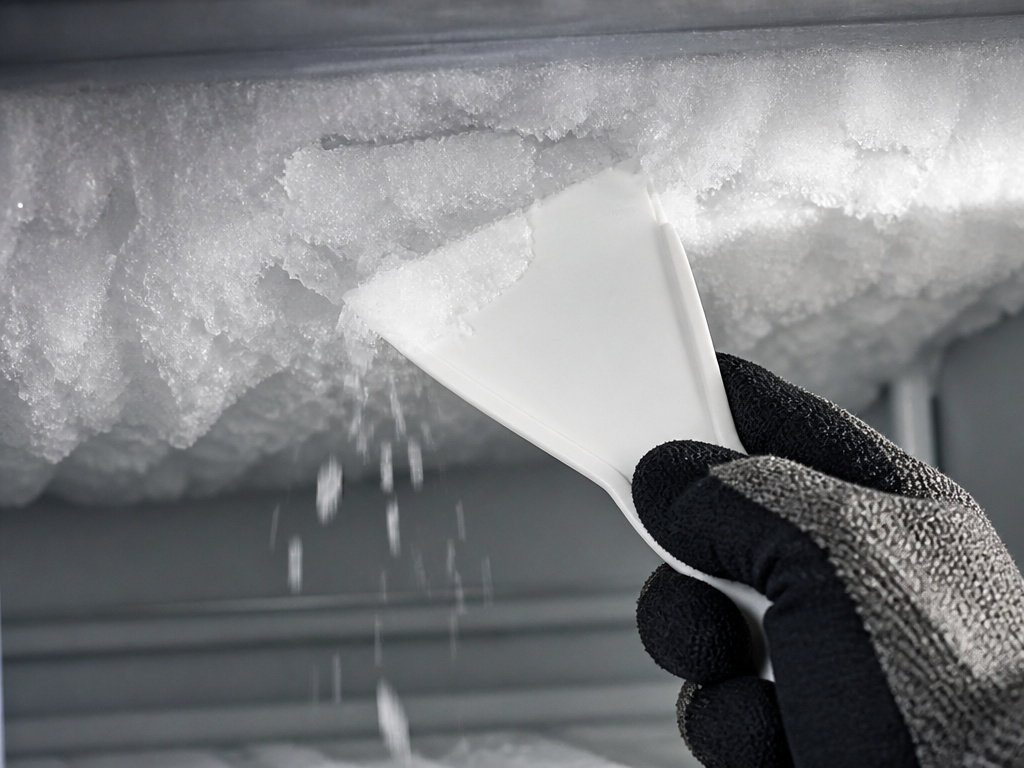
Common mistake: Waiting for the frost to look “bad” before defrosting. By the time it’s a visible, fluffy wall, it’s already well past the 1/2-inch mark and costing you money.
Why Choose Manual Defrost? The Real Advantages
 This isn’t about nostalgia for older appliances. There are concrete, measurable benefits that make this design the better choice for specific uses.
Energy Efficiency. This is the big one. Without an energy-hungry heating element cycling on multiple times a day, a manual defrost freezer simply uses less power. Follett Scientific confirms it: manual units “can be more energy-efficient than automatic defrost if the automatic defrost routine uses an external electrical heating element.” For a unit that runs 24/7/365, that saving compounds.
Temperature Stability. No defrost cycles mean no periodic warming. The temperature line on a graph is flat. This is why laboratories use them. It’s also why freezer burn is less common in manual units, the constant, dry cold prevents the sublimation that causes those dry, leathery patches. If you’re storing meat for a year or garden vegetables until next season, this matters.
Cost and Simplicity. Fewer parts mean a lower purchase price and lower repair costs. The system is rugged. There’s no defrost timer to fail, no heater to short out, no drain line to clog.
Capacity. Manual defrost is the standard for chest freezers. The top-opening design loses less cold air, and the simple system allows manufacturers to pack in more storage space per dollar. If bulk storage is your goal, a deep freezer with manual defrost is the undisputed champion.
| Consideration | Manual Defrost Freezer | Frost-Free Freezer |
|---|---|---|
| Energy Use | Lower (no heater) | Higher (defrost heater cycles) |
| Temperature Stability | Excellent (no cycles) | Fluctuates during defrost |
| Maintenance Required | Hands-on defrost 1-4x/year | Hands-off; automatic |
| Upfront Cost | Generally lower | Generally higher |
| Best For | Bulk/long-term storage, labs, energy savers | Frequent access, convenience-focused homes |
The Inconvenient Truth: Defrosting Day
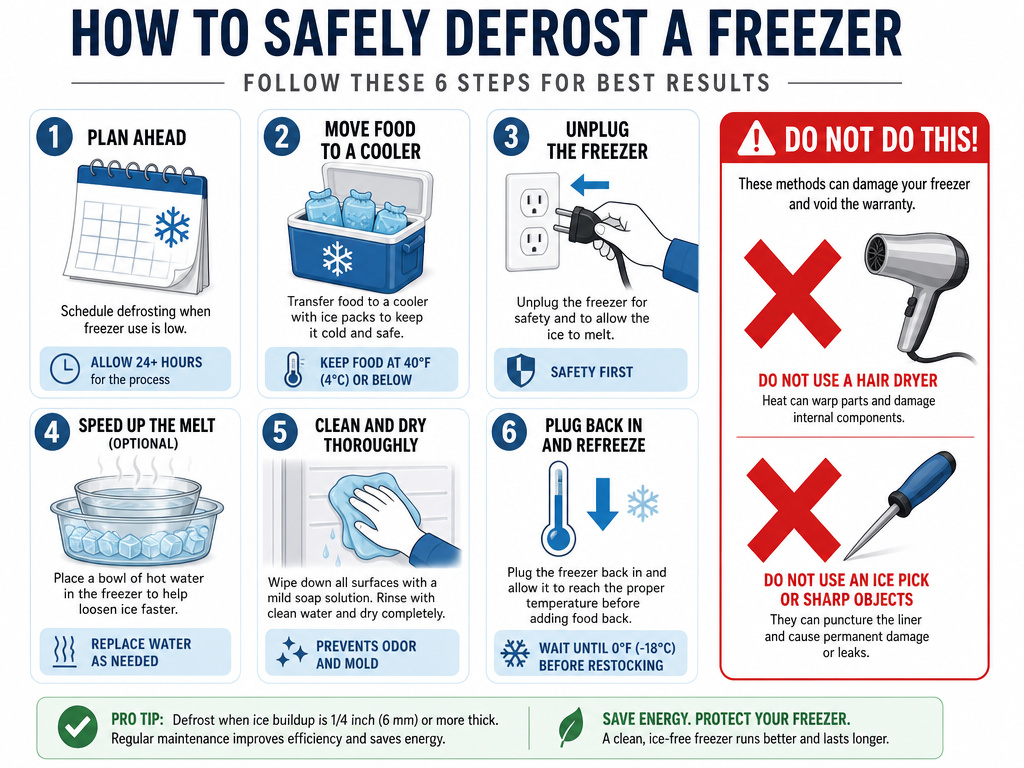 You must schedule this. It’s a half-day project. The GE manual outlines a safe defrosting process, and skipping steps risks water damage or food loss.
Here is the non-negotiable sequence:
- Plan Ahead. Pick a cool day. You’ll need coolers, ice packs, and towels. Have a fan and a shallow pan ready.
- Empty the Freezer. Remove all food. Pack it into coolers with ice packs or blankets. The goal is to keep it frozen.
- Power Down & Prep. Turn the control to OFF and unplug the unit. This is a critical safety step. Place the pan beneath the drain plug (if your model has one).
- The Wait. Leave the lid open. Place bowls of hot (not boiling) water inside to speed melting. Do not use any electrical device or ice pick inside the freezer. A fan blowing into the opening helps.
- Clean Up. Once melted, wipe all surfaces dry. This is your chance for a deep cleaning. Remove shelves, wash with mild soap, dry thoroughly.
- Restart. Plug the freezer back in, set the control, and let it run for an hour or two to reach temperature before restocking.
The most common point of failure is step 3. People try to chip at ice or use hair dryers. This can puncture the liner and the refrigerant tubing behind it, a costly, hazardous repair. Patience is the only tool you need.
For those short on time, our guide on how to defrost quickly covers safe methods to speed up the melt without damage.
Is a Manual Defrost Freezer Right for You?
This isn’t a “depends on your needs” cop-out. The answer is clear if you answer two questions.
Do you open the freezer more than once a day? If yes, a frost-free model is probably worth the energy trade-off for the convenience. The frequent door openings in a busy kitchen introduce too much moisture for a manual unit to handle gracefully.
Is your primary goal long-term, bulk storage of already-frozen food? If yes, the manual defrost chest freezer wins. Its efficiency, stability, and lower cost are unmatched. This is the choice for buying a side of beef, freezing garden harvests, or meal prepping for months.
For everyone in the middle, say, a household that uses a freezer supplementally but doesn’t live out of it, the calculation leans manual if you value lower bills and don’t mind a biannual chore. It leans frost-free if your time is the scarcer resource.
Manual Defrost in Specialized Settings
Your home freezer isn’t the only place this technology shines. In fact, it’s critical elsewhere.
Laboratory & Medical Freezers: Companies like Follett Scientific use hot gas automatic defrost systems in their high-end units, a hybrid that uses the compressor’s own hot discharge vapor to melt frost in 3-5 minutes with minimal internal temperature rise. However, for the most temperature-sensitive applications, pure manual defrost remains the gold standard because it guarantees zero warming.
Commercial Bulk Storage: Restaurants, farms, and hunters use large chest freezers because the manual defrost system scales reliably. The energy savings on a 25-cubic-foot unit running for a decade are substantial.
Off-Grid & Backup Power Scenarios: With no defrost heater to power, a manual defrost freezer has a lower peak wattage draw. This makes it easier to run on a generator or solar battery system during an outage.
Frequently Asked Questions
How often do I need to defrost a manual freezer?
GE states “in most climates, defrosting will be necessary only about twice a year.” This assumes moderate humidity and sensible use. In humid coastal or southern regions, or if you have a large family accessing it constantly, plan on 3-4 times a year. Let the 1/2-inch frost rule be your guide, not the calendar.
Can I convert my manual defrost freezer to frost-free?
No. The frost-free system requires a heater, a timer, a different evaporator coil design, and a drain, components that are not present and cannot be retrofitted. They are fundamentally different appliances.
Why does food last longer in a manual defrost freezer?
The constant, non-fluctuating temperature is the key. Frost-free freezers undergo warm defrost cycles that accelerate moisture loss from food surfaces. The stable cold in a manual unit, combined with good packaging tips, dramatically reduces the risk of quality loss.
Are manual defrost freezers louder?
They are generally quieter. You hear only the compressor and occasional ticking from the liner contracting. Frost-free models add the sounds of fans circulating air and water dripping during the defrost cycle.
What’s the biggest mistake people make with these freezers?
Putting off defrosting until it’s a crisis. A thick layer of ice makes the job take twice as long and risks food thawing during the process. A regular cleaning your freezer and defrost schedule is the only maintenance it asks for.
The Bottom Line
A manual defrost freezer is a tool for a specific job. It’s not the convenient, set-and-forget appliance that dominates kitchens. It’s the efficient, stable, purpose-built storage vault.
Choose it when your priority is preserving quality and quantity over the very long term, and when you can commit to its simple but non-negotiable upkeep. For bulk meat, garden harvests, or any situation where the freezer is more archive than daily pantry, its advantages are real and measurable.
For the weekly grocery load and frequent meal prep, the frost-free model’s convenience tax is probably worth paying. But know what you’re trading: a bit of energy, a bit of temperature steadiness, and a bit of your food’s ultimate quality for the luxury of never thinking about frost again.
