
Will a Freezer Work in a Cold Garage | The 40°F Threshold
This post contains affiliate links. As an Amazon Associate, we earn from qualifying purchases.
A freezer will work in a cold garage only if the garage’s temperature stays above the minimum ambient operating temperature specified by the freezer’s manufacturer. For most standard units, that threshold is 40°F to 50°F. Below that, the compressor may cycle too little, allowing the freezer’s internal temperature to rise and thaw food.
That 40°F number isn’t a guess. It’s printed in the Whirlpool owner’s manual as the point below which operation becomes inefficient. Another manual, for a Frigidaire FFUE0726AW, states operation may become inconsistent below 50°F, risking warm internal temperatures. Garage-ready models are engineered to function correctly down to much lower temperatures, often as low as 0°F or even -15°C, by using different thermostat logic or added heating elements.
What follows is a breakdown of the exact temperature specs from four major OEMs, the mechanical reason cold air breaks standard freezers, and how to decode a model’s “climate class” to match your garage’s winter lows.
Key Takeaways
- Standard freezers fail near 40°F. The Whirlpool W10675483A manual states operation is most efficient above 40°F (5°C). Below this, the compressor may not run enough.
- Inconsistent operation means thawing. The Frigidaire FFUE0726AW manual explicitly warns that running a freezer below 50°F ambient may lead to inconsistent operation and internal temperatures becoming “too warm.”
- Climate class is your decoder ring. A Bosch “SN” class freezer is rated for 50°F to 90°F (10°C to 32°C). An “N” class needs at least 60°F (16°C). Using an SN unit in a 35°F garage voids its performance guarantee.
- Garage-ready models use a different playbook. They either have a separate freezer thermostat, a “Garage Mode” that alters compressor logic, or a small heater to trick the main thermostat into running the compressor in cold weather.
- Heat is as dangerous as cold. Every manual reviewed sets a maximum ambient temperature of 110°F (43°C). Exceeding this stresses the compressor and can lead to failure.
The 40°F Threshold That Changes Everything
Look up the owner’s manual for your specific model. The answer is in the installation section, usually under “Location” or “Ambient Temperature.” You are looking for a number, not general advice.
The Frigidaire FFUE0726AW manual states: “If you run your freezer in an ambient temperature below 50°F, it may not operate consistently. For example, the freezer temperature may become too warm and the contents may defrost.”
That is a non-negotiable spec from the manufacturer. It’s not a suggestion; it’s the boundary condition for the design. Ignore it, and the warranty likely won’t cover a freezer full of spoiled food.
Here is a comparison of minimum ambient temperatures pulled directly from OEM manuals. These are the hard floors.
| Brand / Model Reference | Minimum Ambient Temperature | Source & Consequence |
|---|---|---|
| Whirlpool (W10675483A) | 40°F (5°C) for efficient operation | Owner’s manual. Below this, the unit may not cycle enough to maintain 0°F. |
| Frigidaire FFUE0726AW | 50°F (10°C) to avoid inconsistent operation | User manual. Warns internal temps may become “too warm.” |
| Electrolux (A10092403) | 32°F (0°C) and below will NOT affect operation | Owner’s guide. A rare example of a standard unit rated for very cold spaces. |
| Bosch Climate Class SN | 50°F (10°C) | User manual. Rated for +10°C to +32°C. Operation below +5°C is not recommended. |
The variation is why you must check your own manual. An Electrolux might be fine at 32°F, while a Frigidaire next to it would be failing. Most standard kitchen freezers cluster around the Whirlpool and Frigidaire numbers.
Why does this happen? A standard freezer has one thermostat, usually located in the refrigerator compartment if it’s a combo unit, or in a neutral spot in a standalone freezer. That thermostat measures the ambient air around it. If your garage is 35°F, the thermostat senses “35°F—job done” and doesn’t signal the compressor to run. But the freezer compartment needs to be at 0°F. The compressor stays off, the freezer warms up, and your ice cream turns to soup. This is the single-thermostat problem.
Garage-ready models solve this by either using a separate thermostat for the freezer or by adding a small heater near the main thermostat. The heater creates artificial demand, forcing the compressor to run even when the garage is cold, which keeps the freezer at its proper temperature.
How Garage-Ready Models Actually Work
A “garage-ready” or “garage optimized” label means the manufacturer has tested the unit to perform across a wider temperature range, typically from 0°F to 110°F. The technology behind the label varies.
Dual Thermostats: This is the most robust solution. One thermostat controls the fresh food compartment (or the general cooling), and a completely independent thermostat controls the freezer. Cold garage air might satisfy the fridge thermostat, but the freezer thermostat still demands -18°C, so the compressor keeps running. You find this in higher-end refrigerator-freezer combos marketed as garage-ready.
Garage Mode: This is a setting, often a button on the control panel, that alters the compressor’s logic. When engaged, it may lower the temperature threshold at which the compressor activates or increase the run time. It’s a software fix for the single-thermostat problem. KitchenAid’s product help guides note this mode should be activated during certain low-temperature ranges.
Compressor Heater Kits: Some manufacturers, like Frigidaire, explicitly advise against adding aftermarket heater kits to their standard units. However, their own garage-ready models may have such heaters integrated from the factory. The heater warms the area around the thermostat, tricking it into calling for cooling.
Common mistake: Assuming a “garage-ready” upright freezer uses the same mechanism as a “garage-ready” chest freezer. Upright models often rely on Garage Mode logic. True garage-ready chest freezers, like many from Whirlpool or GE, frequently use a physical heater wrapped around the thermostat bulb, a more mechanical and reliable solution for a space where the cold air settles to the floor.
The safest path is to buy a model explicitly designed for the job. A dedicated garage-ready chest freezer is often a better bet than trying to force a standard kitchen upright freezer for garage to work.
Decoding Climate Classes and Garage Specifications
European brands like Bosch and Beko use a standardized “climate class” system instead of the “garage-ready” marketing term. This is a more precise way to match an appliance to its environment. The class is always in the manual, often on the rating plate inside the unit.
| Climate Class | Ambient Temperature Range | Typical Use Environment |
|---|---|---|
| SN (Subnormal) | 50°F to 90°F (10°C to 32°C) | Unheated rooms, cellars, some garages in mild climates. |
| N (Normal) | 60°F to 90°F (16°C to 32°C) | Heated kitchens, indoor spaces. |
| ST (Subtropical) | 60°F to 100°F (16°C to 38°C) | Kitchens in warmer climates. |
| T (Tropical) | 60°F to 110°F (16°C to 43°C) | Kitchens in hot, humid climates. |
If your garage dips to 35°F (2°C) in winter, an SN-class freezer is already operating 8 degrees below its rated minimum. Bosch notes an SN appliance operated at +5°C “will not be damaged,” but they don’t guarantee performance. The internal temperature will likely rise.
For a garage that sees true winter, you need a model whose specified lower limit is at or below your garage’s coldest expected temperature. Some garage-ready freezer models advertise operation down to 0°F or even -15°C. That’s the spec you compare to your garage thermometer.
The Risks of Ignoring the Specs
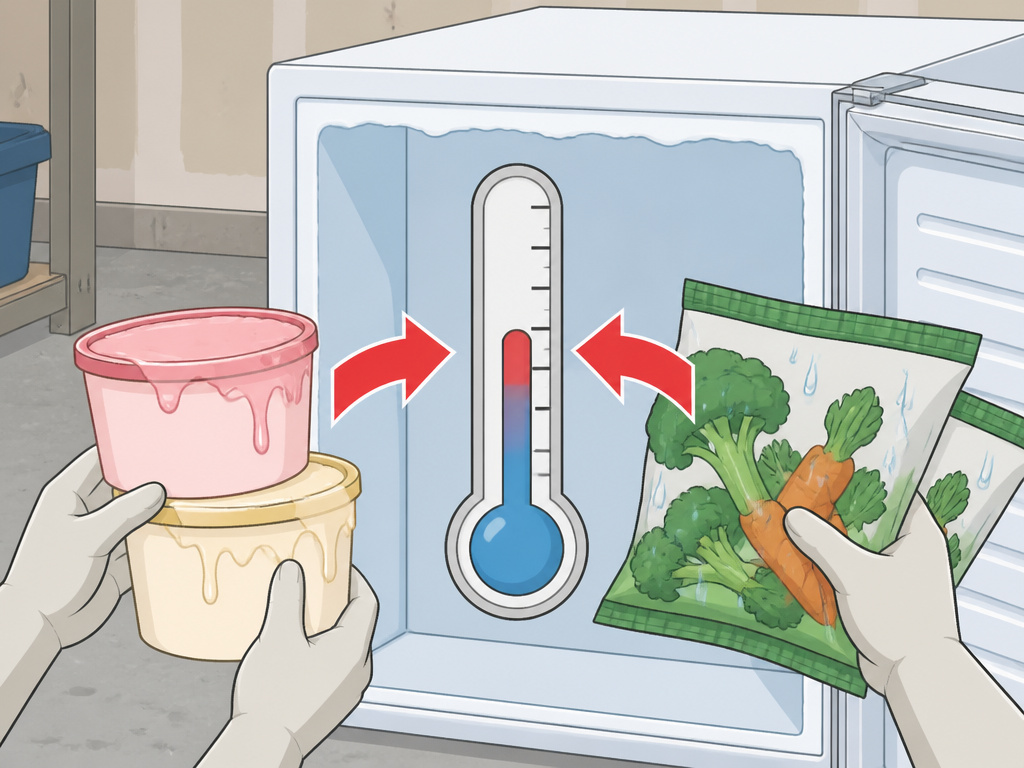
Putting a standard freezer in a cold garage doesn’t just mean lukewarm frozen peas. The consequences follow a predictable timeline.
Short-Term (First cold snap): The freezer stops cycling. The internal temperature climbs from 0°F to, say, 25°F over 24-48 hours. Ice cream softens. Frozen vegetables begin to sweat inside their bags. You might not notice unless you open it.
Medium-Term (A week of cold weather): The temperature stabilizes in a dangerous zone—between 15°F and 30°F. This is the “temperature danger zone” for frozen food. Bacterial growth is slowed but not stopped. Ice crystals melt and re-form, puncturing cell walls in meat and produce. This is called freeze-thaw damage, and it ruins texture and flavor. Food safe for 12 months at 0°F may spoil in weeks at 20°F.
Long-Term (Seasonal): The compressor, designed for regular cycles, experiences extremely long off-periods. When it finally does kick on, it may be under a heavy load if the garage then warms up suddenly. This on-off cycling stresses components. Furthermore, in a humid garage, the prolonged off periods can lead to massive frost buildup on the evaporator coils, which then causes a different set of problems when the unit finally runs.
Where this goes sideways: Adding an external heater or leaving the light on inside the freezer. This adds heat directly to the compartment you’re trying to keep cold, making the compressor work even harder during its already-too-infrequent cycles. It solves nothing and increases energy use. The Frigidaire manual for the FFUE0726AW explicitly states: “Additional compressor heaters are not recommended.”
The correct mitigation is to ensure the ambient temperature around the thermostat stays within spec. Sometimes that means moving the freezer to a warmer part of the garage, insulating the garage itself, or simply choosing a different feasibility of a garage freezer.
Garage Freezer Alternatives and Final Recommendations
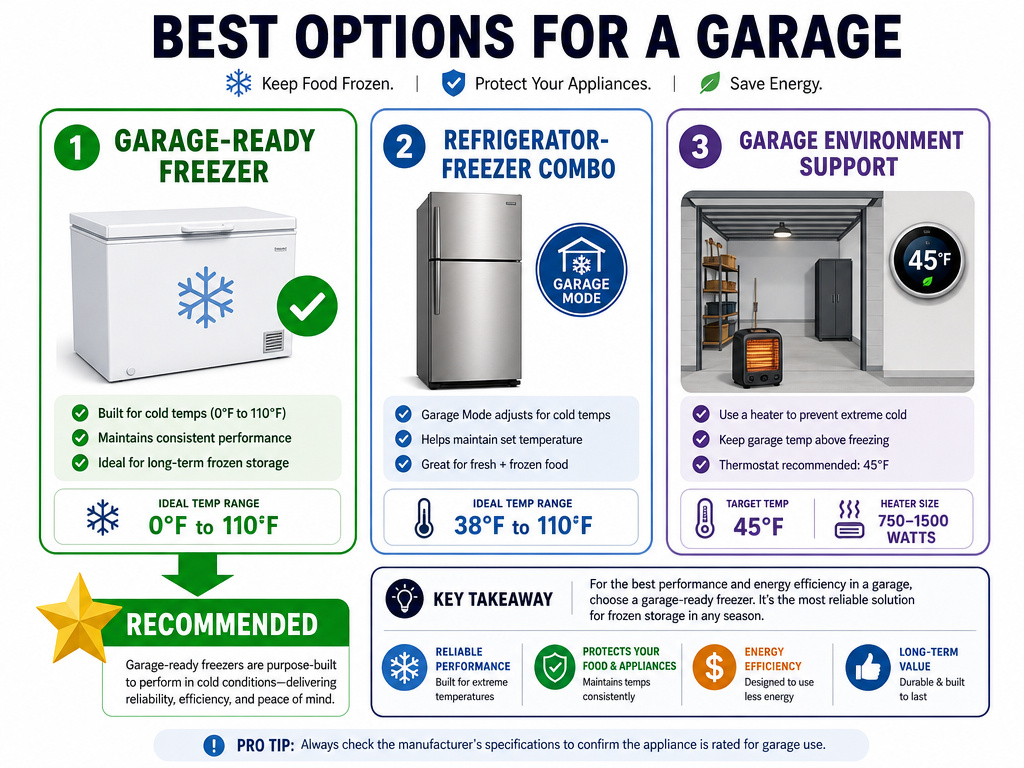
If your garage gets too cold for a standard freezer, you have three clear paths.
- Buy a True Garage-Ready Freezer. This is the simplest solution. Look for models that specify an operating range that includes your garage’s lowest temperature. Brands like Whirlpool, GE, and Frigidaire have dedicated lines. For large capacity, a garage-ready chest freezer is often the most reliable. For easier access, consider a garage-ready upright freezer.
- Use a Garage-Ready Refrigerator-Freezer Combo. If you need both refrigeration and freezing, a combo unit with a dedicated “Garage Mode” is your best bet. These are more common than standalone garage-ready freezers. Check out options for a garage-ready refrigerator freezers.
- Control the Garage Environment. This is the most expensive but most flexible option. Installing a small space heater connected to a thermostat set to kick on at, say, 45°F can keep the entire garage bay within a standard freezer’s operating range. This also makes the space more usable for you. The cost of running that heater over a winter must be factored in.
For the vast majority of people, the first option is the right one. The extra upfront cost of a garage-ready model is less than replacing hundreds of dollars worth of spoiled food or paying for an emergency appliance repair.
The default pick: If your garage sees temperatures below 40°F for more than a day or two each winter, buy a freezer marketed and tested as “garage-ready.” Don’t gamble with a standard kitchen model. The manufacturer’s temperature range isn’t a guideline; it’s the rulebook.
Frequently Asked Questions
What temperature is too cold for a regular freezer?
For most standard freezers not designed as garage-ready, temperatures below 40°F to 50°F (5°C to 10°C) are too cold. At these ambient temperatures, the compressor may not run often enough to maintain safe freezing temperatures inside the unit, leading to thawed food.
Can I use a freezer in an unheated garage in winter?
You can only use a freezer in an unheated garage if the model is specifically rated for the lowest temperature your garage reaches. Check the owner’s manual for the “minimum ambient operating temperature.” If your garage gets colder than that number, the freezer will not work properly.
How do I know if my freezer is garage-ready?
Check the owner’s manual or the manufacturer’s website for your exact model number. Look for phrases like “garage-ready,” “garage optimized,” or an expanded ambient temperature range (e.g., “operates from 0°F to 110°F”). A standard manual will list a narrow range like 40°F to 110°F.
Will a freezer work in a hot garage?
Yes, but with strain. All freezers have a maximum ambient temperature, usually 110°F (43°C). Above this, the compressor works excessively to reject heat, which can lead to premature failure. In a hot garage, ensure plenty of ventilation around the freezer and try to provide shade.
Before You Go
The question isn’t just will a freezer work, but how it works—or stops working—under specific conditions. The manuals give you the numbers: 40°F, 50°F, 32°F. Match your garage’s coldest reality to a freezer’s published minimum. If they don’t match, your food isn’t frozen. It’s just cold.
Skip the DIY heater hacks and the hope that “it’ll probably be fine.” Go straight for a model built for the temperature swing. Your freezer’s job is to be predictable. The right choice makes sure it is.
