Where Must You Store TCS Foods? Follow the 40°F/140°F Rule
This post contains affiliate links. As an Amazon Associate, we earn from qualifying purchases.
Store TCS foods either at or below 40°F (4°C) for cold holding, or at or above 140°F (60°C) for hot holding. They must never remain in the temperature danger zone of 41–135°F (5–57°C) for more than two hours, or one hour if ambient temps exceed 90°F. Physical placement inside storage units is equally critical: raw meats go on the bottom shelf, all food must be at least 6 inches off the floor, and containers should be labeled with contents and a use-by date.
That 6-inch rule isn’t just about cleanliness. It’s a hard barrier against pests and floor-level condensation, both of which transfer bacteria directly to your containers. Skip it, and you’ve built a bridge for contamination right into your storage.
What follows is a breakdown of the three non-negotiable layers of TCS food safety: the exact temperatures, the physical layout inside your fridge or hot-holding unit, and the procedural rules that catch mistakes before they make anyone sick. We’ll also touch on the rare exceptions, like when a product assessment can reclassify a food, and the specific, tighter rules for food served on airplanes and trains.
Key Takeaways
- Cold TCS food must be held at or below 40°F (4°C), and hot TCS food at or above 140°F (60°C). The “temperature danger zone” between these points is where bacteria double every 20 minutes.
- Organize your refrigerator with raw meat, poultry, and fish on the bottom shelves. Ready-to-eat foods always go above them to prevent cross-contamination from drips.
- All food, in any storage area, must be kept at least 6 inches off the floor. This prevents pest access and avoids the “splash zone” from mopping and floor condensation.
- Label every container with the contents and a use-by date. For prepared TCS foods held at 41°F or below, that date cannot exceed 7 days from preparation.
- The two-hour rule is absolute for leftovers: discard any TCS food that has been in the danger zone for more than two hours (one hour if the room is hotter than 90°F).
The Cold Storage Commandments
Your refrigerator is your first and most important line of defense. Its job isn’t just to keep things cold; it’s to organize the cold in a way that contains risk.
Cold TCS foods must be stored at or below 40°F (4°C) at all times, as specified in both the South Carolina TCS food guide and the Oregon TCS food job aid. This temperature halts the growth of most pathogenic bacteria, though it doesn’t kill them.
The temperature is only half the battle. Where you place items inside the unit decides whether a single leak becomes a facility-wide recall.
Store raw meats, poultry, and fish on the bottom shelves. This isn’t a suggestion. It’s a containment strategy. Even in sealed containers, raw proteins can drip. Placing them below everything else ensures those drips don’t contaminate ready-to-eat foods like cooked vegetables, cheeses, or prepared salads. Your raw meat storage protocol should be this rigid. The same logic applies to raw fish storage, it gets the bottom shelf treatment, period.
Ready-to-eat foods claim the upper shelves. This includes cooked foods, washed fruits and vegetables, and items like hard-boiled eggs storage or cheese storage. The goal is to create a physical barrier of safety.
Don’t overload the unit. Cool air needs to circulate. If you pack shelves solid, you’ll create warm pockets where the temperature can creep into the danger zone, even if the thermostat reads 38°F. A crowded fridge is a warm fridge.
The 6-Inch Floor Rule and Why It Exists
Every food item, in walk-in coolers, dry storage, or even temporary holding, must be stored at least 6 inches off the floor. Health inspectors measure this.
The reason is twofold: pests and moisture. Cockroaches and rodents don’t climb smooth container walls easily, but they can scale shelving legs. A six-inch gap creates a dead zone they are less likely to cross. More insidiously, floors are cold. When warm, moist air in a storage area hits a cold floor, it condenses. That condensation, along with anything mopped or spilled, can wick up into cardboard boxes or sit against container bottoms, creating a direct path for bacteria. This rule is a cornerstone of proper food storage and applies equally to dry goods like flour storage bins.
Hot Holding: The Other Side of the Coin
If cold storage is about suppression, hot holding is about sustained lethal heat. The principle is simple but unforgiving.
Hot TCS foods must be maintained at 140°F (60°C) or higher. At this temperature, bacterial growth is prevented, and existing pathogens are gradually reduced.
The equipment matters. A steam table with a weak heating element or a soup kettle left on “warm” instead of “hold” will drift into the danger zone within an hour. You need a calibrated thermometer, not a guess.
Stirring is part of the process. Heat distributes unevenly in thick foods like stews or mashed potatoes. The surface might be 145°F, but the center of the mass could be 120°F, squarely in the danger zone. Stirring brings the cooler core material to the edges to be reheated. Do it at least every 30 minutes.
The container must be designed for the job. A stainless-steel hotel pan under a heat lamp loses temperature faster than a lidded, insulated cambro. The FSSAI food storage manual emphasizes using appropriate, clean equipment for hot holding to maintain safety. Don’t use a cold-storage container for hot food; most plastics not rated for high heat will warp or leach chemicals.
What about buffet lines? That’s where the two-hour rule comes down hard. Even on a heating element, a shallow pan of food at the end of a line can drop below 140°F. From that moment, you have a maximum of two hours before it must be discarded. In a busy restaurant, that timer starts sooner than you think.
The Temperature Danger Zone and the 2-Hour Rule
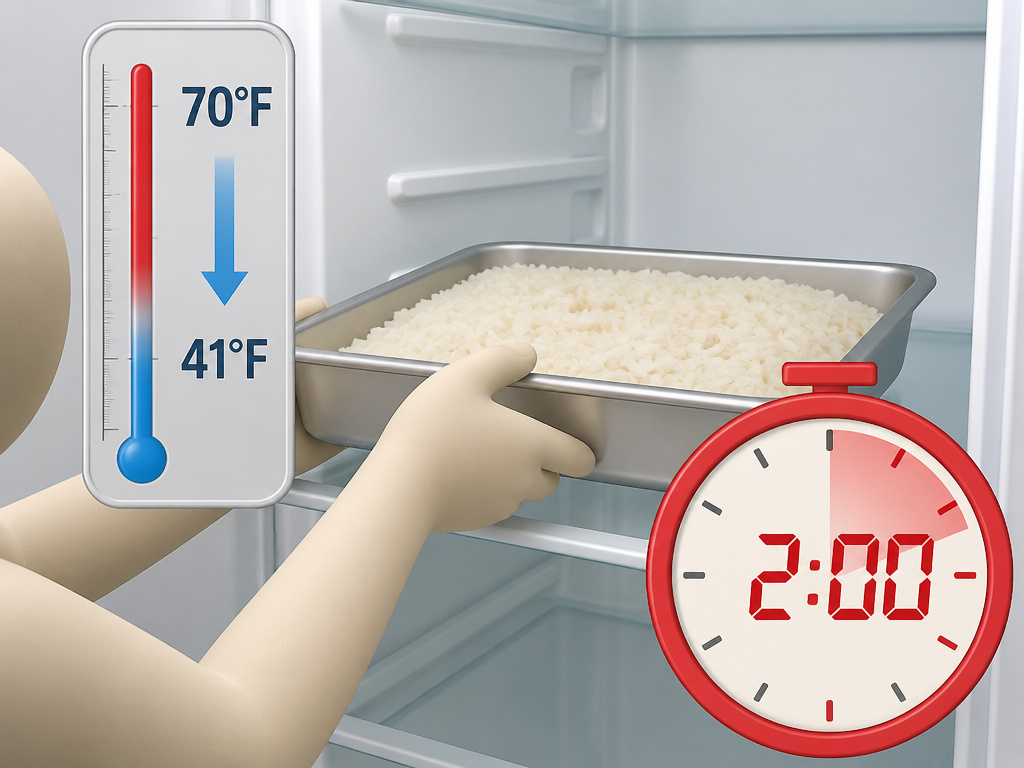
The range between 41°F and 135°F (5°C to 57°C) is called the temperature danger zone for a reason. Here, bacteria like Salmonella, E. Coli, and Staphylococcus aureus find their ideal breeding conditions.
Bacteria can double in number every 20 minutes. This isn’t theoretical. A single cell becomes over 1,000 in just four hours. The “2-Hour Rule” is the public health firewall. It states that TCS food cannot remain in the danger zone for more than two hours total. If the ambient air temperature is 90°F or hotter (like at a summer picnic), the limit shrinks to one hour.
Common mistake: Letting food “cool on the counter” before refrigerating. A large pot of soup can take 6+ hours to drop from 135°F to 70°F on its own, spending the entire time in the prime growth range.
The correct method is two-stage cooling: get the food from 135°F to 70°F within two hours, then from 70°F down to 41°F within the next four hours. Use shallow pans, ice baths, or blast chillers. This is especially critical for cooked rice storage, as Bacillus cereus spores can survive cooking and rapidly produce toxin in room-temperature rice.
| TCS Food Scenario | Maximum Time in Danger Zone | If Exceeded |
|---|---|---|
| Leftovers on dining table (75°F room) | 2 hours | Discard immediately |
| Picnic potato salad (95°F outdoors) | 1 hour | Discard immediately |
| Cooling a large stockpot | 2 hrs to reach 70°F | Reheat to 165°F or discard |
| Food delivery without temp control | 2 hours cumulative | Reject delivery |
This timeline is cumulative. If you pull chicken from the fridge to prep (30 minutes), let it sit before cooking (20 minutes), then rest after cooking (15 minutes) before refrigerating, you’ve already used 65 minutes of your 120-minute budget.
Dry Storage and the “Non-TCS” Exception
Not everything belongs in the fridge. Dry storage, for items like canned goods, proper onion storage, and garlic storage, has its own rules. The area must be cool (50-70°F), dry (humidity below 60%), and well-ventilated. The 6-inch floor rule still applies here.
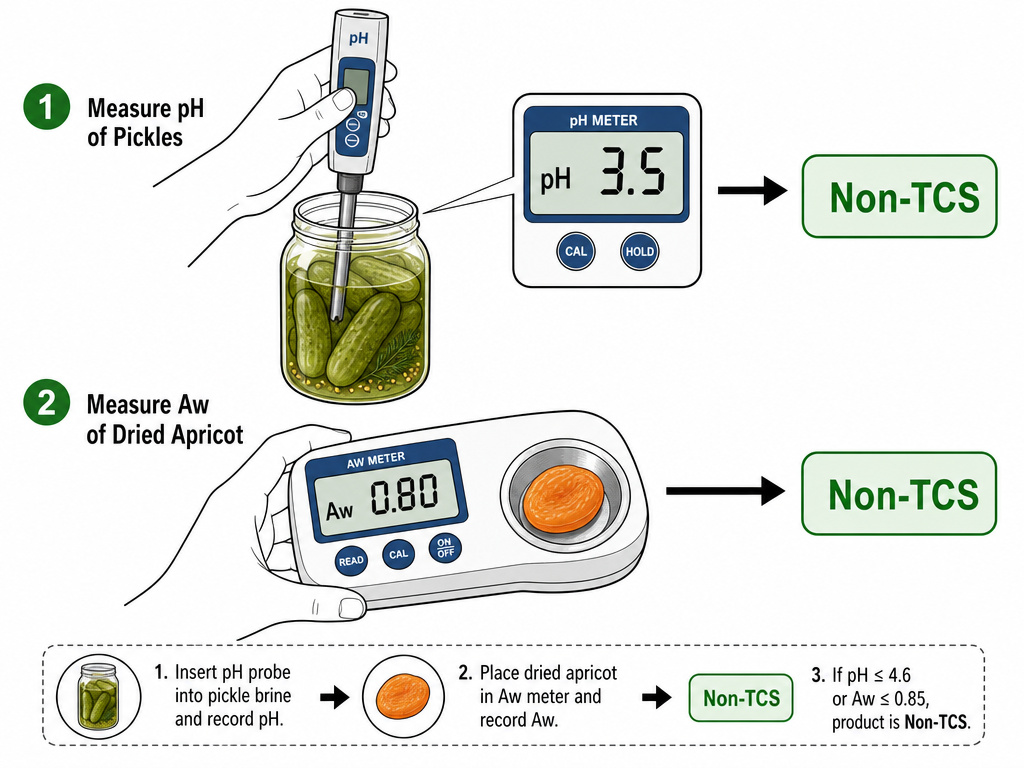
Some foods escape the TCS classification through science, not intuition. Regulators use two key factors: pH (acidity) and water activity (Aw), which measures available moisture.
A food with a pH of 4.6 or below is generally too acidic for most pathogens. Similarly, an Aw value of 0.85 or lower means there’s not enough free water for bacteria to use. The official Oregon TCS food job aid provides tables that cross-reference pH and Aw. If a food’s values land in a “Non-TCS” box on those tables, it doesn’t require time and temperature control.
Where this goes sideways: Assuming a homemade garlic-in-oil mixture is safe. Raw garlic in oil has a neutral pH and high moisture, creating an anaerobic environment where Clostridium botulinum (botulism) can grow. It is a TCS food and must be refrigerated and used within a week.
A “product assessment” is a formal study that can prove a food is non-TCS despite not meeting the standard pH/Aw thresholds. This is for manufacturers, not home cooks. For everyone else, when in doubt, treat it as TCS.
Special Case: Food on the Move (Conveyance Industry)
The rules tighten significantly for food served on airplanes, trains, cruise ships, and ferries. These guidelines account for the loss of precise temperature control during transit.
Cold food must be held at or below 40°F (4°C). If it’s being kept cool with ice packs or dry ice and the temperature rises above 40°F, service must be completed within two hours of that point, and any leftovers discarded. There is no grace period.
Hot food must be held at 140°F (60°C) or above. The logistics of reheating food to a safe temperature in a galley kitchen are complex, which is why airlines often use pre-plated meals that are either fully chilled or fully heated before loading.
The margin for error is zero. A single lapse can affect hundreds of people in a confined space, making these some of the strictest hazardous food storage protocols in the industry.
Frequently Asked Questions
What are 5 examples of TCS foods?
Five common examples are raw chicken, cooked rice, cut melons, hard-boiled eggs (once peeled), and soft cheeses like brie. Each provides the moisture and nutrients pathogens need, and each requires specific cold storage temperatures and time limits.
Is bread a TCS food?
Typically, no. Most bread has a low water activity (Aw) that inhibits bacterial growth. However, bread used for moist sandwiches or stuffing, or bread containing TCS ingredients like meat or cheese, becomes part of a TCS combination food and must be refrigerated.
How long can TCS food be left out?
TCS food can be left out at room temperature for a maximum of two hours. If the room temperature is 90°F or higher, the limit is one hour. This includes time during preparation, serving, and cooling.
Where should you store raw meat in a refrigerator?
Always store raw meat, poultry, and seafood on the bottom shelf of the refrigerator. This prevents their juices from dripping onto and contaminating ready-to-eat foods stored on shelves below. Use leak-proof containers or place them on a tray.
What is the proper temperature for a refrigerator storing TCS food?
The refrigerator must maintain a temperature at or below 40°F (4°C). Use a calibrated appliance thermometer to monitor this, as the fridge’s built-in dial is often inaccurate. Check the temperature in the front and back of the middle shelf regularly.
The Bottom Line
Store TCS foods cold (≤40°F) or hot (≥140°F), never in between. Map your refrigerator like a hazard zone: raw proteins on the bottom, ready-to-eat foods above. Keep everything 6 inches off the floor, label everything with a date, and obey the two-hour timer the moment food leaves safe temperature.
The rules are specific because the consequences are specific. A single misstep with storing cooked rice or proper raw meat placement isn’t just a violation; it’s the starting point for an outbreak. Treat the guidelines not as a checklist, but as the physical logic of keeping food safe.
