Does a Freezer Kill Bacteria? Sub-Lethal Damage Explained
This post contains affiliate links. As an Amazon Associate, we earn from qualifying purchases.
A home freezer set to -18°C (0°F) does not kill most bacteria. It stops them from multiplying and can cause sub-lethal damage, but surviving cells can reactivate after thawing. Pathogens cannot grow below -1°C, and spoilage microbes stop below -10°C to -12°C. Freezing is a pause button, not a kill switch.
That distinction between stopping growth and causing death is where food safety lives. Getting it wrong means treating your freezer like an autoclave, a mistake that puts you at risk when that frozen chicken thaws.
What follows is a breakdown of the mechanics, drawn from regulator reports and peer-reviewed studies. We’ll cover the three temperatures that matter, the documented survival of pathogens like Listeria, and the one practice the UK’s Food Standards Agency flags as adding risk.
Key Takeaways
- Freezing causes sub-lethal damage to bacterial cells; many recover and multiply after thawing if conditions are right.
- Pathogenic bacteria cannot grow below -1°C, but they can survive frozen for months or years.
- The UK Food Standards Agency notes that freezing food on its use-by date introduces a measurable risk window during thawing and storage.
- Your freezer must hit -18°C (0°F) to safely preserve quality and minimize bacterial activity.
- Thawing in the refrigerator and consuming within 24 hours is the only safe default for previously frozen ready-to-eat foods.
The Freezer’s Real Job: Stasis, Not Sterilization
Your freezer’s primary function is to press pause. It drops the temperature so low that bacterial metabolism and reproduction grind to a halt. This is not the same as killing.
The science is specific. According to a comprehensive review by the UK Food Standards Agency, pathogenic bacteria are generally unable to grow below -1°C. Spoilage microorganisms, which make food look or smell bad, hit their limit between -10°C and -12°C. Your home freezer’s target of -18°C (0°F) provides a safety buffer well below both thresholds.
While some microorganisms are killed during the freezing process, the majority can survive freezing for a long period of time. Cellular damage or death occurs due to dehydration of the cell caused by formation of extracellular ice or injury due to formation of intracellular ice.
This blockquote from the FSA report captures the core mechanism. Ice crystals physically rupture cell walls and membranes. But survival is common.
Does Freezing Kill Bacteria Instantly?
No. Death is a function of time, temperature, and bacterial strain.
Study after study cited in the FSA report shows freezing leads to a decrease or no change in bacterial counts. For example, research on Listeria monocytogenes found no change in levels on frozen broccoli and cauliflower after 168 days, in cheese after 30 days, or in ground beef after 14 weeks. The bacteria simply waited.
Another study on E. Coli showed counts continued to decrease gradually over eight weeks of storage at -22°C. It was a slow decline, not an immediate wipeout.
The most critical concept is sub-lethal damage. Freezing can wound bacteria without killing them. These damaged cells enter an extended lag phase but can slowly recover and multiply once thawed into a welcoming environment (like a warm kitchen). This is why thawing protocol is non-negotiable.
The Mechanics: How Freezing Affects Different Bacteria
Not all bacteria respond to freezing equally. The matrix, whether it’s meat, fruit, or bread, matters. The initial bacterial load matters more.
| Bacterium | Effect of Freezing (Documented Findings) | Key Risk |
|---|---|---|
| Listeria monocytogenes | Survives unchanged for months in various foods (cheese, beef, produce). | Ready-to-eat foods thawed and held too long. |
| E. Coli | Counts may decrease slowly over weeks, but sub-lethal damage is common. | Recovery and growth if thawed improperly. |
| Salmonella | Generally survives freezing well; reduction is often minimal. | Cross-contamination from raw frozen poultry drips. |
| Campylobacter | More sensitive to freezing; numbers can drop significantly. | Still a risk if initial contamination is high. |
The freezer kill salmonella myth persists because people see “reduction.” A reduction is not elimination. You should handle frozen chicken with the same caution as fresh chicken, as our article on freezer kill salmonella explains in detail.
Where this goes sideways: Assuming a “frozen” label means “safe from all germs.” The bacteria present when you hit the freeze button are largely the ones you’ll get back at thawing. Freezing doesn’t clean a contaminated product.
This is why the starting quality is paramount. Freezing locks in the status quo. A piece of meat beginning to spoil will still be a piece of spoiled meat after it thaws, it just won’t have gotten more spoiled in the interim.
Safe Freezing Practices: The Three Rules
Your safety depends on what you do before, during, and after the freeze. These rules are synthesized from the NDSU Food Freezing Guide and the FSA freezing effects study.
1. Freeze Fresh, Freeze Fast.
Only freeze food that is at peak freshness. Portion it, seal it in airtight packaging (like a vacuum sealer or heavy-duty freezer bags) to prevent freezer burn, and get it to 0°F as quickly as possible. The NDSU guide recommends setting your freezer to -10°F about 24 hours in advance when adding a large amount of unfrozen food to speed up the process. Slow freezing creates larger ice crystals, causing more cellular damage to both the food and any bacteria, potentially increasing the risk of sub-lethal damage and recovery.
2. Maintain -18°C (0°F) Religiously.
Buy a standalone freezer thermometer. The average home freezer in one UK study ran at -20.3°C, but individual units varied from -5.6°C to -37°C. A temperature above -18°C accelerates quality loss and inches closer to that -1°C pathogen growth threshold. Consistent temperature is key for long-term storage, whether you’re using a standard freezer or a specialized medical-grade unit.
3. Thaw in the Fridge, Consume Within 24 Hours.
This is the FSA’s cardinal rule. Thawing at room temperature gives any surviving bacteria a head start on multiplication. In the refrigerator (1-5°C), thawing is slow and safe. Once thawed, the clock starts. Consume ready-to-eat foods within 24 hours. For foods to be cooked, cook them immediately after thawing. This 24-hour rule is the critical safety margin that accounts for potential bacterial recovery.
The Use-By Date Freeze: A Calculated Risk
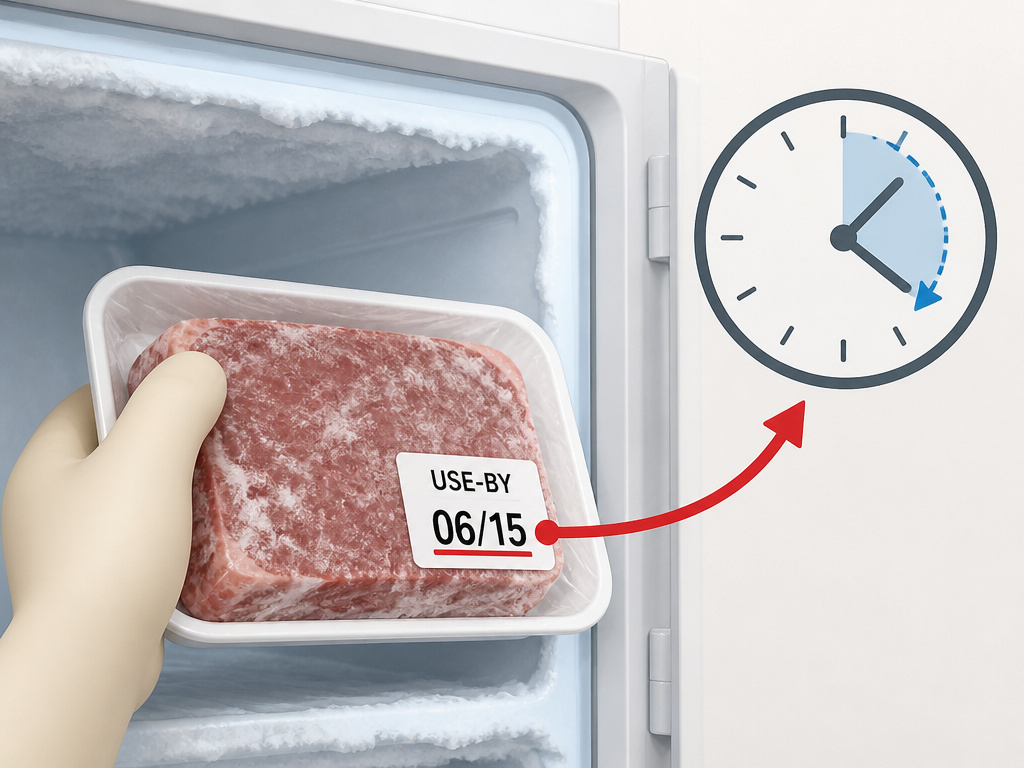 The UK Food Standards Agency explicitly states you can freeze pre-packed food “right up to the use-by date.” But their own scientific review attaches a significant warning.
The risk isn’t the freezing itself. It’s the combined timeline of freezing (which can take hours), thawing, and the subsequent 24-hour refrigerated storage period. If the food was already at the edge of its safe shelf life when frozen, this multi-step process can push it into a danger zone. The report concludes that a Food Business Operator does not build in a safety margin for consumer freezing practices. You assume that margin yourself.
Easy to miss: Freezing on the use-by date is technically allowed, but it stacks risk. The safer habit is to freeze food when it’s at its freshest, well before that date.
This is especially true for unlabeled foods from deli counters or butchers, where you have no guide on suitability for freezing. When in doubt, freeze sooner.
Freezer Management and Food Quality
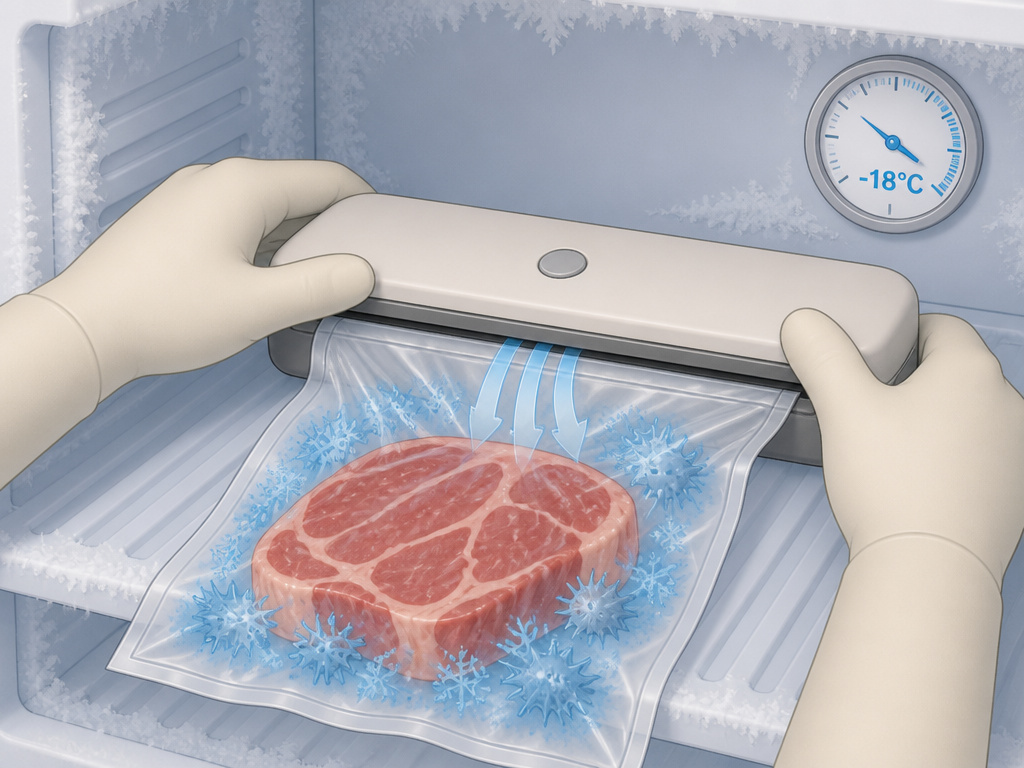 Safety and quality are partners. Proper management prevents issues that force you to ask, “is freezer burned meat safe to eat?”
- Prevent Freezer Burn: This is dehydration caused by air exposure. It ruins texture and flavor but isn’t a direct safety issue. Use airtight packaging, squeeze out excess air, and consider a vacuum sealer for long-term storage. Our guide on freezer burn causes and prevention covers the science.
- Regular Defrosting: Frost buildup insulates the coils, making the freezer work harder and potentially struggle to maintain -18°C. Learn how to defrost a freezer efficiently.
- Cleanliness: Spills can harbor bacteria. A regular freezer cleaning routine with mild detergent prevents odors and maintains a clean environment.
If you ever face a power outage, remember the rule: a full, closed freezer keeps food frozen for about two days. If items still have ice crystals or are below 40°F, they can be safely refrozen.
Frequently Asked Questions
Can a freezer kill viruses?
Freezers are even less effective against viruses. Viruses are not living organisms that “die”; they are inactivated. While freezing can preserve viruses for long periods (which is how lab samples are stored), it does not reliably inactivate them on food. Food safety regarding viruses depends on proper cooking and avoiding cross-contamination.
Does freezing kill parasites in fish?
Yes, but with strict conditions. For example, to kill parasites like anisakis in fish intended for raw consumption (sushi), the U.S. FDA requires freezing at -20°C (-4°F) or below for 7 days, or at -35°C (-31°F) until solid and stored at -35°C for 15 hours. Your home freezer likely cannot achieve or verify these temperatures reliably, so sourcing commercially frozen “sushi-grade” fish is safer.
Is it safe to refreeze thawed meat?
Only if you thawed it in the refrigerator and it has not exceeded 40°F. The USDA states you can refreeze foods that still contain ice crystals or feel refrigerator-cold. However, each freeze-thaw cycle degrades quality significantly due to moisture loss. The best practice is to thaw only what you plan to cook immediately.
How does freezing compare to canning or dehydrating for safety?
Canning and dehydrating are preservation methods that actively reduce microbial loads by creating environments hostile to life (low moisture, high acidity, sterile seals). Freezing merely suspends activity. For long-term, shelf-stable safety without refrigeration, freezing is the weakest of the three methods.
What freezer temperature kills bacteria?
No temperature achievable in a home freezer guarantees to kill all bacteria. Commercial blast freezers that rapidly reach -30°C or below cause more bacterial death but still not sterilization. The “kill” function is not the goal; the “stop” function is. For true sterilization, you need methods like high-pressure processing (HPP) or thermal treatment (canning), as outlined in the Food Standards Agency bulk freezing guide for commercial operations.
The Bottom Line
Your freezer is a powerful tool for extending the safe window of food, but it is not a sanitizer. Trust it to halt the progress of spoilage and pathogens, not to rewind it.
Respect the three rules: freeze fresh and fast, maintain -18°C, and always thaw in the fridge with a 24-hour consumption deadline. Understand that freezing on the use-by date is a gamble with the safety margin. By treating your freezer as a pause button rather than a magic eraser, you’ll keep your food both safe and high-quality for as long as possible.
