Where Must You Store Potentially Hazardous Food? Key Rules
This post contains affiliate links. As an Amazon Associate, we earn from qualifying purchases.
Store potentially hazardous food at or below 41°F (5°C) or at or above 135°F (57.2°C). This is the core rule across U.S. State codes and international standards like the Australia Food Standards Code. The storage location must also prevent contamination: at least 6 inches off the floor, away from sewer lines, and with raw meat placed on bottom shelves.
The 41°F threshold isn’t arbitrary. It’s the temperature at which pathogenic bacteria like Listeria and Salmonella slow their growth to a near standstill. Go above that line, and the clock starts. Most regulations give you a two-hour window at unsafe temperatures before discarding is mandatory.
What follows is the breakdown of where the rules are absolute and where they have loopholes. We’ll cover the exact thermometer accuracy required by law, the one common setup that legally operates at 45°F, and the specific, non-negotiable placement for raw chicken in a shared fridge.
Key Takeaways
- The universal safe zone is ≤41°F or ≥135°F. Thermometers must be accurate to ±3°F.
- Salad bars and serving lines can legally hold food at 45°F for up to 12 hours, but this is a limited exception, not a new standard.
- Store all food at least 6 inches (15 cm) above the floor to avoid splash and pest contamination.
- Raw meat, poultry, and fish must be stored on the bottom shelf, separate from and below all other foods.
- In a power outage or flood, your first call is to the local health department—don’t guess if the food is safe.
The Two Hard Temperature Rules
You have two targets, with no middle ground. Keep potentially hazardous food cold or keep it hot. The danger zone between 41°F and 135°F is where bacteria multiply fastest.
Potentially hazardous food requiring refrigeration must be maintained at 41 °F (5 °C) during storage. Each refrigerated facility must have a temperature measuring device accurate to ± 3 °F (1.5 °C) located in the warmest part. Hot food must be held at 135 °F (57.2 °C) or above, with a device in the coolest part. — Paraphrased from Montana and North Carolina state administrative codes.
The ±3°F accuracy is a mandated spec. A cheap, uncalibrated fridge thermometer doesn’t cut it for commercial settings. If your thermometer reads 38°F but the actual warmest spot in the fridge is 44°F, you’re already out of compliance. The warmest spot is usually the top shelf near the door or the dairy compartment.
Why 41°F? Research shows that Listeria monocytogenes, a particularly dangerous pathogen, can still grow slowly down to about 34°F. The 41°F rule builds in a safety buffer. For home cooks, this means your fridge should be set to 37°F or 38°F to ensure no corner drifts above 41°F.
The 45°F Loophole for Salad Bars
This is the most misunderstood exception. California’s law explicitly allows potentially hazardous food on a serving line or salad bar to be held above 41°F but not above 45°F for a maximum of 12 hours in any 24-hour period. Unused portions must be thrown out after that window.
This isn’t a license to set your fridge to 45°F. It’s a concession to the reality of open-air buffet service, where consistent 41°F is mechanically difficult. The clock is strict, and the exception does not apply to display cases or general refrigeration.
| Situation | Maximum Temperature | Time Limit | Notes |
|---|---|---|---|
| Standard Refrigeration | 41°F (5°C) | Continuous | The baseline rule for all stored PHF. |
| Serving Line / Salad Bar | 45°F (7.2°C) | 12 hours per 24 | California exception; food must be discarded after the period. |
| Transportation (Short Haul) | Excursion allowed | Less than 30 minutes | Allowed if the total time out of temp control is under half an hour. |
| Onboard Service (e.g., Plane) | Excursion allowed | 2 hours max | Canadian conveyance guideline; leftovers must be discarded. |
Where (and How High) to Put Food
Location matters as much as temperature. Contamination from the floor, pests, or dripping sewer lines can spoil food even at 38°F.
Common mistake: Storing bags of flour or boxes of pasta directly on the basement floor. It’s dry food, so it seems fine. But rodents can chew through packaging, and a minor flood contaminates everything. The rule is for all food.
Montana’s code is clear: food must be stored at least 6 inches (15 centimeters) above the floor. The only exceptions are unopened beverages in crates or canned goods on pallets. This elevation prevents splash from mopping, deters pests, and improves air circulation.
Your storage area must also be clean, dry, and nowhere near a contamination source. The regulations list specific banned locations: * Toilet or dressing rooms. * Garbage or mechanical rooms. * Under unshielded sewer lines or leaking water lines. * Under open stairwells.
The Raw Protein Rule
This is non-negotiable and spelled out in North Carolina’s rules for child care centers: raw meats, poultry, fish, shellfish, and eggs must be stored on shelving beneath and separate from other foods.
The reason is purely physical. These items are most likely to drip juices containing pathogens. Storing them on the bottom shelf ensures those drips don’t contaminate ready-to-eat foods below. “Separate” often means in a dedicated bin or on a tray, even if it’s on the bottom shelf.
TL;DR: Bottom shelf for raw animal products. Every time. No exceptions.
Equipment and Monitoring Mandates
You can’t manage what you don’t measure. The law requires the right tools in the right places.
First, you need enough refrigeration and hot-holding capacity to maintain temperature under peak load. A fridge packed solid won’t circulate air, creating warm pockets where food spoils silently.
Second, you need those accurate thermometers. Each fridge must have one in the warmest part (to ensure the entire unit is safe). Each hot-holding unit like a steam table needs one in the coolest part. If the device can’t be installed directly (like in a insulated transport carrier), you must use a probe thermometer to check internal food temperatures at least every two hours.
| Equipment Type | Temperature Device Requirement | Placement Rule |
|---|---|---|
| Refrigeration Unit | Numerically scaled, ±3°F (1.5°C) accurate | In the warmest part of the unit |
| Hot Holding Unit | Numerically scaled, ±3°F (1.5°C) accurate | In the coolest part of the unit |
| Transport Carrier (Cold) | Probe thermometer (if built-in not practical) | Check internal food temperature |
| Transport Carrier (Hot) | Probe thermometer (if built-in not practical) | Check internal food temperature |
This isn’t just for restaurants. If you operate a home-based daycare or sell food at a farmers’ market, these equipment rules apply to you. The Montana food storage rule frames them as universal requirements for anyone storing potentially hazardous food for public consumption.
When Things Go Wrong: Power Outages and Floods
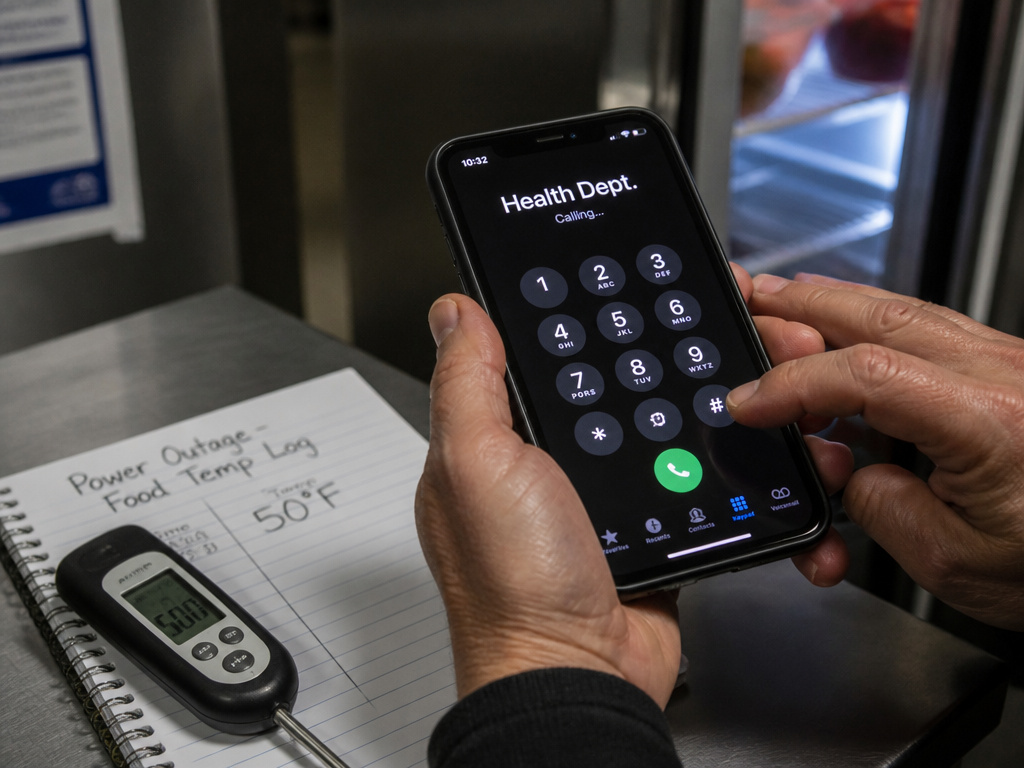
The rules assume normal operation. Your plan for abnormal events is just as important.
Montana’s regulation states that in a fire, flood, or power outage that affects food temperatures, the person in charge must immediately contact the regulatory authority (the local health department). North Carolina’s rule gives a choice: discard the food or contact the health department for guidance.
Do not guess. A fridge full of food after a 4-hour power outage represents a significant financial loss. The health department can advise based on the specific temperatures recorded and the type of food. They might authorize salvaging certain items, like unopened commercial jars, while mandating the disposal of others.
The part nobody mentions: Your insurance may require a report from the health department to process a claim for spoiled food. Making that call creates a paper trail.
Special Cases and Edge-Case Storage
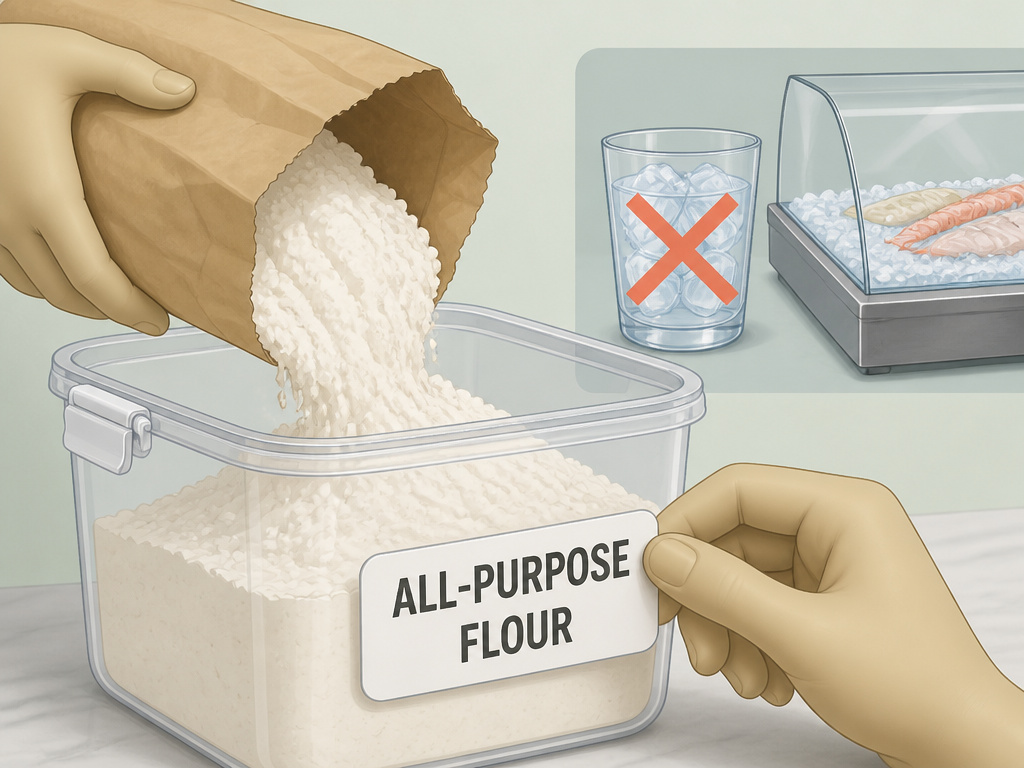
Beyond the fridge and hot box, a few specific scenarios have their own rules.
Dry Storage for Bulk Goods: Once opened, bulk dry goods like flour or sugar must be transferred to a clean, tightly covered container labeled with the common name of the food. This prevents pest infestation and moisture absorption, key parts of general food storage hygiene.
Ice for Cooling vs. Consumption: Ice used to chill food containers in a display must never be used for drinks. This prevents cross-contamination from packaging or drip.
Transportation: The rules relax slightly for short trips. The California food storage law exempts transportation of less than 30 minutes from strict temperature control, acknowledging it’s impractical to keep a delivery van at 41°F for a short run. The Canadian guideline for airplanes and trains is stricter: if food goes above 40°F during onboard service, it must be served within 2 hours and leftovers discarded.
Frequently Asked Questions
Can I store food in its original packaging?
Yes, but only if the package is intact and protects the contents. Once opened, you must move the food to a clean, covered container designed for food storage. This is a key step in preventing contamination during long-term storage as well.
Where does raw meat go in a refrigerator?
Always on the bottom shelf. Place it on a tray or in a container to catch any drips, and keep it separate from other items. This is the only way to prevent juices from contaminating ready-to-eat foods below. Our dedicated guide on storing raw meat covers this in detail.
Is 45°F a safe temperature for my home fridge?
No. The 45°F exception is only for certain commercial serving situations with a strict time limit. Your home refrigerator should be set to maintain 37°F to 40°F to ensure all contents stay at or below the 41°F safety threshold.
What type of thermometer do I need?
You need a numerically scaled thermometer accurate to ±3°F (1.5°C). A simple analog dial thermometer is often insufficient. Digital probe thermometers are reliable for spot-checking internal food temperatures and fridge warm spots.
Can I store food in a plastic container?
It depends on the plastic. Only use containers labeled as “food-safe.” Not all plastics are suitable, as some can leach chemicals or absorb odors. For safest long-term food storage, glass or stainless steel airtight containers are often recommended over plastic containers.
The Bottom Line
Safe storage for potentially hazardous food boils down to three things: temperature, location, and vigilance. Hold it at 41°F or below, or 135°F or above. Keep it up off the floor and raw proteins on the bottom shelf. Use an accurate thermometer.
The regulations, from the Australia Food Standards Code to your local health code, exist because the alternative is foodborne illness. They are not suggestions. Treat your refrigerator and storage areas as critical food safety equipment, not just cold boxes. When in doubt, throw it out—or better yet, call your health department before the doubt even sets in.
