Does Freezer Kill Salmonella? The 1.27 Log Reduction Explained
This post contains affiliate links. As an Amazon Associate, we earn from qualifying purchases.
Freezing does not kill Salmonella bacteria. It puts them into a state of suspended animation where they cannot grow, but they remain alive and infectious upon thawing. Industrial cryogenic freezing at -82°C can cause a 1.27 log reduction (about 94% decrease) in Salmonella populations on foods like shrimp, but this is a damage effect, not sterilization.
That distinction between stopping growth and causing death is the whole game. Your home freezer operates at about -18°C (-0.4°F). At that temperature, bacterial metabolism halts. Salmonella cannot multiply, but its cellular machinery remains intact, waiting for warmer conditions.
What follows is the breakdown of why “kill” is the wrong word, what the rare exceptions are, and the only methods that guarantee elimination. You will see the numbers from the studies that changed the guidance and where the real risk sits after your food thaws.
Key Takeaways
- Your home freezer stops Salmonella growth but does not kill it. Bacteria survive frozen for months.
- Industrial cryogenic freezing at -82°C can reduce Salmonella by about 94%, but this is not a method for home food safety.
- The only reliable ways to kill Salmonella are heat (cooking to 165°F/74°C internally) and gamma irradiation, a process not used for home food.
- Thawing frozen food in the refrigerator is critical to prevent Salmonella from multiplying during the temperature danger zone.
- Cross-contamination from thawing raw meat juices is a higher risk than the freezer itself.
The Short Answer: Freezing vs. Killing
Your freezer is a pause button, not a delete button. The U.S. Food and Drug Administration states it plainly: freezing does not kill Salmonella. The bacteria can survive for several weeks in dry environments and several months in wet, frozen ones.
The mechanism is straightforward. Pathogens like Salmonella cannot grow below approximately -1°C. Your freezer’s job is to drop the food temperature so far that any bacterial growth is impossible. The cells enter a dormant state. They are not dead. When you thaw the food, especially if you leave it on the counter, those cells wake up and can start multiplying rapidly if the food enters the temperature danger zone between 4°C and 60°C.
Freezing causes damage or death due to dehydration of the cell from extracellular ice formation or injury from intracellular ice formation. Most studies report either a decrease or no change in Salmonella spp. Levels when stored at freezing or refrigerator temperatures. UK Food Standards Agency report on consumer freezing
This technical blockquote highlights the “decrease or no change” outcome. A decrease is possible, but it’s not guaranteed and certainly not complete. Relying on your freezer to make contaminated food safe is a dangerous gamble. The safety comes from preventing growth until you cook it.
What Actually Kills Salmonella?
If freezing doesn’t kill it, what does? The answers fall into two categories: methods you can use at home and industrial processes you cannot.
Heat is the home cook’s weapon. Cooking food to a safe internal temperature destroys Salmonella by denaturing its proteins. For poultry, that’s 165°F (74°C). For ground meats, 160°F (71°C). For pork and steaks, 145°F (63°C). A reliable food thermometer is non-negotiable here. Visual cues like color are unreliable.
Gamma irradiation is the industrial standard. This process uses controlled radiation to disrupt the DNA of pathogens, rendering them unable to reproduce or cause infection. It’s highly effective and doesn’t make the food radioactive. The radiation D10 value, the dose needed to reduce a bacterial population by 90%, for Salmonella on frozen shrimp is approximately 0.56 kGy.
The industrial edge case is cryogenic freezing combined with irradiation. One study using a Cryo-Test Chamber achieved a 1.27 log reduction of Salmonella on shrimp by freezing at -82°C for 3 minutes. Following that with a 2.25 kGy gamma radiation dose produced a >5 log reduction, effectively eliminating it. This is a pilot-scale industrial process, far beyond any how a freezer works in a home kitchen.
The Science of Survival: How Salmonella Endures
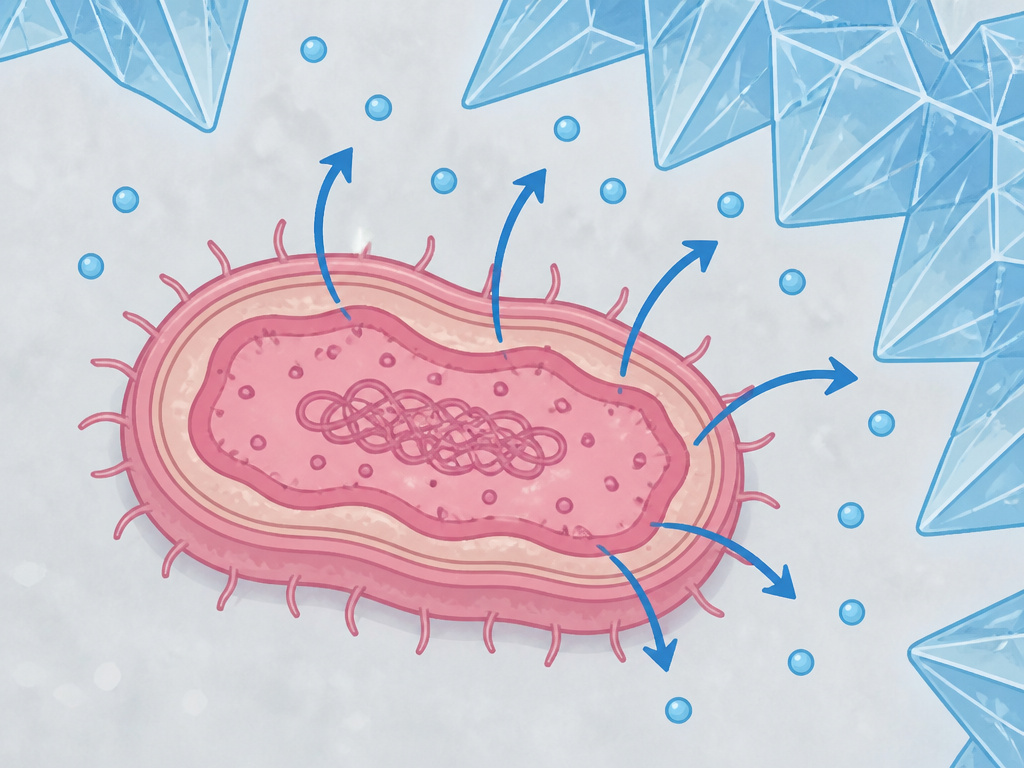
To understand why freezing fails to kill, you need to look at the bacterial cell itself. Salmonella, like all bacteria, is a single cell surrounded by a protective membrane. This membrane is a fluid bilayer of lipids.
When freezing occurs slowly, as in a home freezer, ice crystals form outside the cell first. This draws water out of the cell through osmosis, causing dehydration and shrinkage. It’s stressful and can damage the cell, but many cells survive this extracellular ice formation. If freezing is extremely rapid, intracellular ice can form, which is more likely to puncture and destroy the cell membrane. This is the principle behind the 1.27 log reduction seen in cryogenic freezing.
A 2018 Penn State study aimed to find out why some Salmonella die at lower temperatures. Their hypothesis was that heat, and by extension, the intense cold of cryogenic freezing, weakens the cell wall. As the lipids vibrate and the structure weakens, small ionic molecules leak out. This leakage, measured as a change in electrical conductance, correlates with cell death.
The takeaway is that survival is a numbers game. Freezing, especially slow freezing, is a selective pressure. It may kill some of the population, but it leaves a resilient subset perfectly capable of causing illness. This is why the FDA Salmonella facts page emphasizes that freezing is not a kill step.
Freezer Storage: Safety Rules vs. Quality Rules
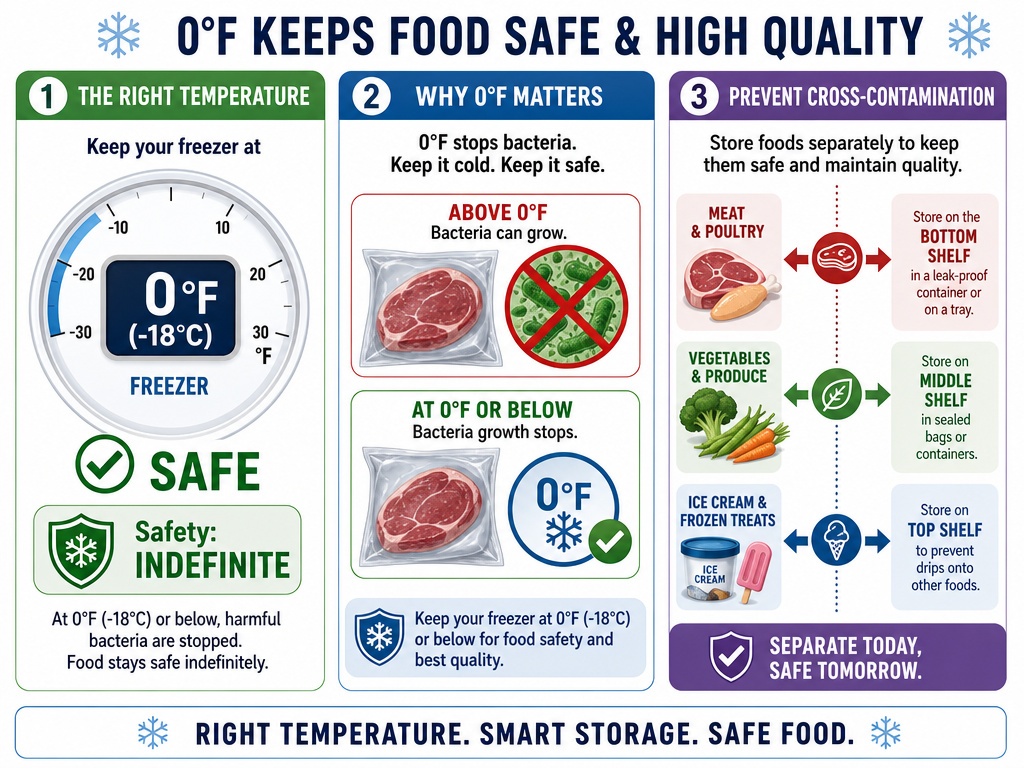
It’s critical to separate safety guidelines from quality guidelines. Authorities like Foodsafety.gov state that foods kept continuously at 0°F (-18°C) or below can be kept indefinitely from a safety perspective. The official cold food storage guidelines are for quality, preventing texture and flavor loss, not for safety.
Safety during frozen storage is about maintaining that 0°F temperature. If your freezer suffers a thaw cycle or rises above 0°F for an extended period, two things happen. First, any surviving Salmonella may begin to multiply slowly. Second, other spoilage bacteria become active, making the food unsafe in ways beyond Salmonella.
| Storage Factor | Safety Impact | Quality Impact |
|---|---|---|
| Temperature above 0°F | Allows pathogen growth | Speeds texture loss |
| Inadequate packaging (freezer bags) | Risk of cross-contamination, freezer burn | Causes freezer burn, flavor loss |
| Extended storage time | No safety limit at 0°F | Gradual degradation of taste and texture |
Proper packaging in freezer-safe containers or heavy-duty bags is a safety practice. It prevents leaks that can cross-contaminate other foods, like ice cream or frozen fruit, with Salmonella from raw meat juices. A regular freezer cleaning routine also mitigates this risk.
Thawing: The Most Dangerous Step
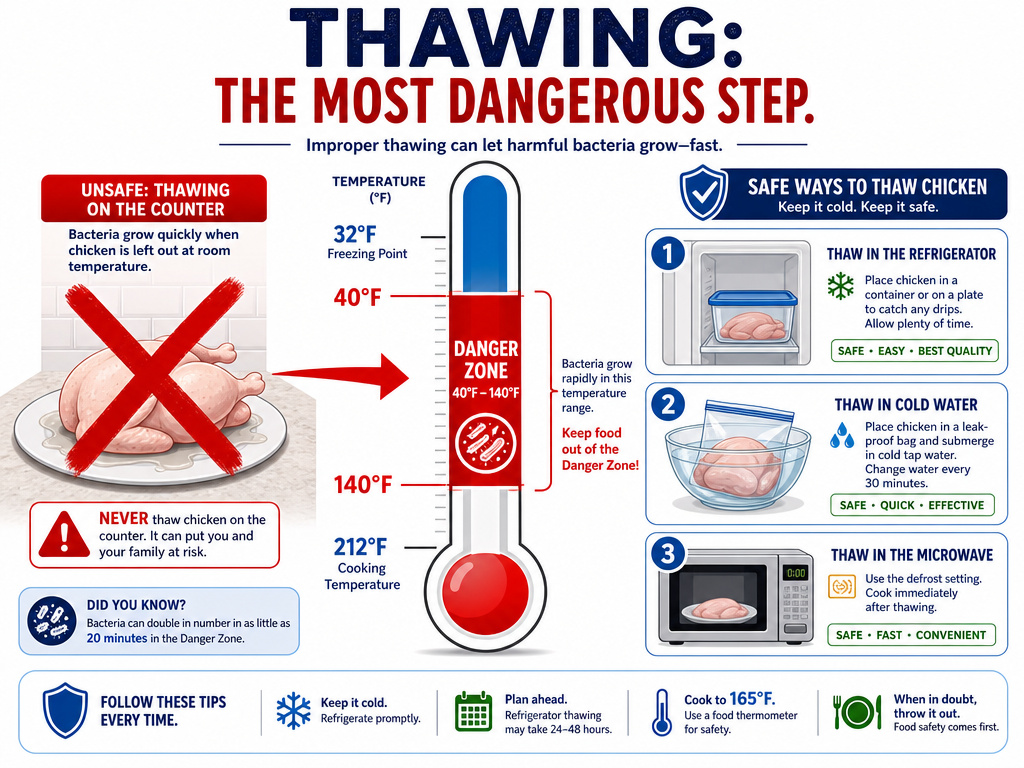
The period when frozen food is thawing presents the greatest opportunity for Salmonella to become a problem. The outer layers of the food warm up first, entering the temperature danger zone while the core is still frozen. Bacteria on the surface can multiply rapidly.
Common mistake: Thawing frozen raw chicken on the counter. The outer layer can reach room temperature in under an hour, allowing Salmonella to double every 20 minutes. By the time the core is thawed, the surface population can be dangerously high.
There are only three safe thawing methods, and all aim to keep the food out of the danger zone as much as possible.
- In the refrigerator. This is the best method. Plan ahead, it can take 24 hours for a package of chicken breasts. Keep the food in a dish or container to catch any drips.
- In cold water. Submerge the airtight package in cold water, changing the water every 30 minutes. This is faster than refrigeration but requires attention.
- In the microwave. Use the “defrost” setting and cook the food immediately after thawing. Partial cooking during microwaving can create warm spots where bacteria thrive.
Once thawed by any method, food should be cooked promptly. Do not refreeze thawed raw meat without cooking it first, as the freeze-thaw cycle further damages cell structure and can create more liquid for bacteria to grow in upon the second thaw. Following these freezer storage tips for packaging will make thawing cleaner and safer.
What About Freezing Leftovers?
Freezing cooked leftovers is generally safer than freezing raw foods in terms of pathogen load, but the same rules apply. Freezing does not kill any Salmonella that survived the initial cooking or that contaminated the food after cooking.
The key is to get the leftovers into the freezer quickly. Don’t let them cool on the counter for hours. Portion them into shallow containers for freezing to promote rapid cooling throughout. Label with the date. While safe indefinitely when frozen, quality degrades after 2-3 months for most cooked foods.
When reheating, bring leftovers to a rolling boil or an internal temperature of 165°F (74°C). Stir soups and sauces well to ensure even heating. This second kill step is your final safety net.
Frequently Asked Questions
Can I freeze food to kill Salmonella if my freezer goes extra cold?
No. Even if your home freezer has a “quick freeze” setting that drops to -24°C (-11°F), it is not comparable to the -82°C (-116°F) used in cryogenic studies. That extreme temperature, held for a precise three minutes in a liquid nitrogen vapor chamber, is what yielded the 1.27 log reduction. Home appliances cannot replicate this process or its effect.
How long can Salmonella live in the freezer?
Studies show Salmonella can survive for several months in frozen conditions. The FSA freezing and shelf-life study notes reports of the pathogen surviving 75 days at -22°C in beef with only a 0.5–0.7 log decrease. There is no definitive “death date.” The bacteria remain in a dormant, viable state.
Does freezing kill Salmonella in eggs or peanut butter?
No. The water activity and fat content of the medium do not change the fundamental fact that freezing is bacteriostatic (stops growth), not bactericidal (kills). Salmonella in frozen cookie dough or frozen peanut butter paste will survive. These products must be cooked or processed with a kill step (like roasting for peanut butter) to be safe.
Is it safe to freeze raw chicken that I suspect might be contaminated?
Freezing it will not make it safe. If you suspect contamination, the safest action is to cook it immediately to 165°F (74°C), then freeze the cooked meat. Freezing the raw chicken only preserves the Salmonella. When you thaw it later, you still must cook it thoroughly, but you have extended the time you are storing a hazardous product.
The Bottom Line
Your freezer is a powerful tool for preventing food waste and managing meal prep, but it is not a sanitizer. It works by putting Salmonella and other pathogens on hold. The real safety work happens at the point of cooking, with a food thermometer, and during careful thawing to avoid the temperature danger zone.
Remember the numbers: a 1.27 log reduction from industrial cryogenic freezing is the exception that proves the rule. For your kitchen, assume survival. Use your freezer to buy time, then use heat to deliver the final blow. That’s the sequence that actually keeps you safe.
