
How Do You Preserve Meat in the Wild | Field-Tested Methods
This post contains affiliate links. As an Amazon Associate, we earn from qualifying purchases.
Preserving meat in the wild requires matching the method to your environment and tools: freezing for cold climates, smoking for dry heat, and pressure canning for long-term shelf stability. The core principle is removing or halting the conditions bacteria need, moisture, warmth, and oxygen.
That principle is the concrete difference between a winter’s worth of meals and a dangerous bout of food poisoning within 48 hours. Each method, freezing, smoking, canning, works by attacking a different one of those three bacterial requirements.
What follows: the exact temperature and timing specs from university extension labs, the one mistake that turns smoked meat toxic, and the canning pressure that stops botulism dead. This is the applied food science that keeps game safe from field to plate.
Key Takeaways
- Freezing is only safe if you hit 0°F or lower and keep it there; a freezer that fluctuates above 10°F gives pathogens a window to grow.
- Smoking preserves meat by dehydration and chemical antimicrobials from the smoke, not just heat; the meat must be cut thin (under 1/4 inch) to dry all the way through.
- Canning wild game demands a pressure canner, not a water bath. The required 10-15 PSI for 75-90 minutes is the only way to reach the temperature needed to kill Clostridium botulinum spores.
- Vacuum sealing is a double-edged sword: it prevents freezer burn brilliantly but creates a perfect low-oxygen environment for C. Botulinum to grow if the meat thaws slowly or incompletely.
- Strong-flavored game like bear or old buck benefits from a pre-soak in brine (1 tablespoon salt per quart of water for one hour) before any preservation method to pull out blood and gaminess.
The Three Core Methods: Freeze, Smoke, Can
Your environment dictates your options. In a boreal forest winter, freezing is effortless. In a dry, hot scrubland, drying and smoking are your allies. For a permanent, weather-independent stash, canning is the answer. The goal is always the same: stop spoilage.
The science of meat preservation targets water activity. Bacteria need moisture to multiply. Freezing locks that water up as ice. Smoking and drying evaporate it. Canning uses heat to destroy the microbes, then seals the sterilized food away from new contamination.
Freezing is the most straightforward, but it’s not passive. It requires a sustained, deep cold. Smoking and drying are the oldest methods, leveraging heat and airflow to create an inhospitable environment for microbes. Canning is the most technical, using precise equipment to achieve commercial-level shelf stability.
You can’t just pick one. You need to understand the failure mode of each. A freezer that warms up, a smoke that doesn’t penetrate, a canner that never reaches pressure, each has a specific, ugly outcome.
Freezing: The Cold Hard Facts
Freezing doesn’t kill bacteria. It puts them in suspended animation. Think of your freezer as a pause button, not a sanitizer. The moment the temperature rises, the clock starts ticking again. This is why the specific numbers matter.
Your freezer must maintain 0°F or lower. According to the Ohio State University Extension, this temperature prevents microbial growth and preserves quality for the longest possible time. At 10°F, enzymatic activity continues, slowly breaking down the meat and affecting texture and flavor. You’ll smell the difference within months.
| Cut Type | Maximum Storage Time at 0°F | Quality Loss If Exceeded |
|---|---|---|
| Venison Steaks/Roasts | 6–9 months | Gradual onset of freezer burn, mild rancidity |
| Ground Venison | 3–4 months | Rapid fat oxidation, pronounced off-flavors |
| Liver/Heart/Kidney | 6 months | Texture becomes mealy, strong mineral taste amplifies |
| Poultry/Game Birds | Up to 12 months | Skin dries out, meat can become stringy |
Why these timelines? Fat oxidizes faster than muscle protein. Ground meat has more surface area exposed to air, accelerating this process. Organs are more enzymatically active. The dates aren’t arbitrary; they’re the calculated point where noticeable quality degradation begins in a stable freezer.
Where this goes sideways: Storing a freezer in direct sun or next to a stove. The compressor can’t maintain 0°F against that heat load, and the internal temperature will creep up. The meat won’t spoil immediately, but it will age prematurely, shortening your storage window by a third.
Packaging is the other half of the battle. The enemy is air. You have two good choices: vacuum sealing or the double-wrap method. A quality vacuum sealer for deer meat removes almost all oxygen, dramatically slowing oxidation and preventing freezer burn. The double-wrap method, first in plastic cling wrap pressed tightly to the meat, then in heavyweight freezer paper, is a strong, low-tech alternative.
But vacuum sealing has a critical caveat, noted by the Ohio State University Extension: it increases the risk of Clostridium botulinum growth during thawing. The low-oxygen environment you created for storage is the exact condition botulinum spores need to activate if the meat thaws too slowly or stays in the “danger zone” (40°F–140°F) too long. The fix is simple: thaw vacuum-sealed game in the refrigerator, not on the counter.
Smoking & Drying: Ancient Fire Science
Smoking is a slow, controlled dehydration with added antimicrobial chemistry. The heat drives out moisture.The smoke deposits phenols and other compounds that inhibit bacterial and fungal growth. The result is jerky or pemmican that can last for months without refrigeration.
The process is simple, but the margin for error is thin. Your meat must be lean and sliced no thicker than 1/4 inch. Fat doesn’t dry well; it goes rancid. Thick pieces will dry on the outside, trapping moisture inside where bacteria can thrive. This is the number one reason homemade jerky sometimes spoils.
The fire management rule: You want smoke, not flames. Use green wood, punk wood, or soaked hardwood chips. The ideal temperature range is between 160°F and 180°F. You can achieve this with a simple tripod and a canvas cover, as shown in many wilderness guides, including the techniques discussed in the NDSU game meat preservation guide. The meat is done when it’s dry and leathery throughout, bends without cracking, and shows no moist spots when torn.
I won’t recommend cold-smoking for true wilderness preservation. Cold-smoking (under 100°F) adds flavor but doesn’t preserve. It’s a two-step process: you cure the meat first with salt, then smoke it. In a field scenario, you likely don’t have the controlled curing time or the reliable temperature gauge. Stick with hot-smoking for safety.
Why does this work? Bacteria need a water activity (aw) level above about 0.85. Proper drying drops the meat’s aw below 0.70, effectively halting all bacterial growth. The smoke compounds add an extra layer of protection against molds. This combination is why humans have used this traditional preservation method for millennia.
For strong-flavored game, a pre-soak in brine makes a noticeable difference. As outlined in multiple extension guides, soaking strips in a solution of 1 tablespoon salt per quart of water for one hour pulls out blood and reduces the “gamey” taste, resulting in a milder, more palatable jerky. It’s a step worth the time.
Canning: The Pressure-Powered Pantry
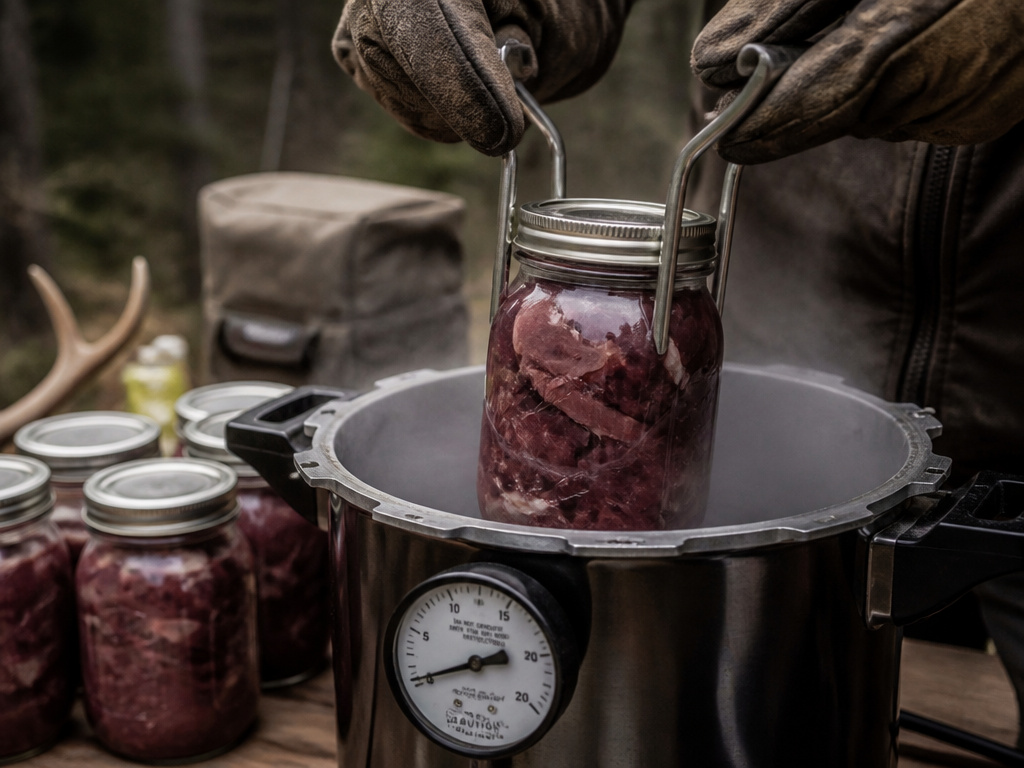 Canning is the only method here that truly sterilizes the food, making it shelf-stable for years. It’s also the most equipment-dependent and procedure-sensitive. For low-acid foods like meat, a pressure canner is non-negotiable. Water-bath canning cannot reach the 240°F–250°F needed to destroy botulism spores.
The University of California canning guide states it plainly: “Meat, poultry, and game are low-acid foods and must be processed in a pressure canner.” The required pressure, 10 PSI for weighted-gauge, 11 PSI for dial-gauge at altitudes under 2,000 feet, creates the high-temperature steam that penetrates every part of the jar.
Follow the process times verbatim. They are calculated for safety, not convenience. For pints of raw-packed venison chunks, it’s 75 minutes. For quarts, it’s 90 minutes. Shaving off time because the jars “look done” is how people get sick.
| Variable | Specification | Consequence of Deviation |
|---|---|---|
| Canner Type | Pressure canner (16-22 qt minimum) | Inadequate temperature; botulism risk |
| Pressure (Dial Gauge @ <2,000 ft) | 11 PSI | Spores survive; toxin can form in storage |
| Processing Time (Pints, raw pack) | 75 minutes | Insufficient heat penetration; center remains unsafe |
| Headspace | 1 inch | Seal failure or siphoning during processing |
| Altitude Adjustment | +1 PSI per 2,000 ft above sea level (dial gauge) | Lower boiling point; under-processing |
Raw pack vs. Hot pack. Raw packing (placing uncooked meat in jars) is faster and yields a firmer texture. Hot packing (pre-cooking meat until rare before jarring) removes more air from the tissue, often resulting in better liquid coverage and a lower risk of floating pieces. For beginners, hot pack is more forgiving.
Before you even light the stove, your workspace must be scrupulous. The Texas A&M wild game storage guide emphasizes sanitizing all surfaces and utensils with a bleach solution (1 tablespoon bleach per gallon of water). Any contamination introduced during packing can survive the canning process and spoil your entire batch.
After processing, you must verify the seal. Let the jars cool for 12-24 hours. The lid should be concave and not move when pressed. Any jar that didn’t seal must be refrigerated and consumed within a few days, or repacked and reprocessed within 24 hours. Never taste canned meat straight from the jar. Boil it for 10 minutes first, this destroys any botulinum toxin that may have formed.
The Supporting Cast: Curing, Brining & Sausage
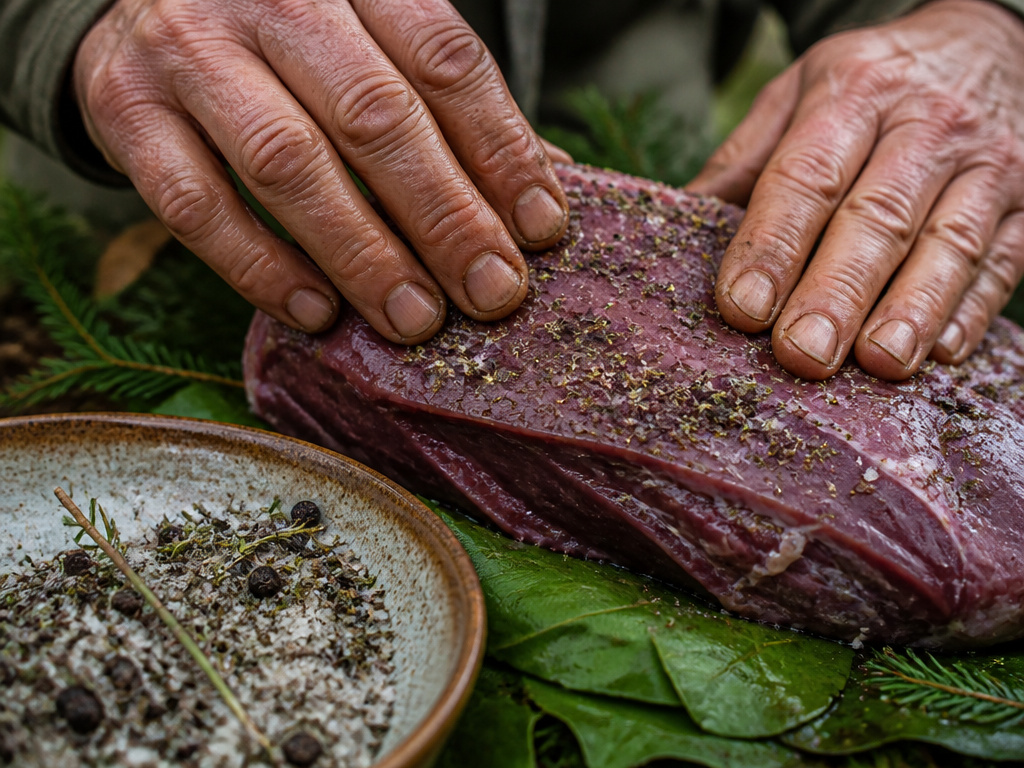 Freezing, smoking, and canning are the primary pillars. But other methods like curing and sausage-making are valuable skills that often work in tandem with the main three.
Dry curing is the original preserving meat with salt method. It uses high concentrations of salt (and often nitrates) to draw moisture out via osmosis and create an environment too hostile for bacteria. Making prosciutto or salami in the wild is unrealistic, but the principle informs simpler techniques. A dry cure rub can pre-treat meat before smoking, enhancing preservation and flavor.
Brining or corning involves soaking meat in a strong salt solution, sometimes with sugar and spices. As the NDSU publication notes, corning “takes out the musky wild flavor and tenderizes the toughest wild meats.” It’s an excellent way to handle older, tougher animals. The corned meat can then be smoked or canned.
Sausage-making is a form of preserving food that combines grinding, seasoning, and then either cooking, smoking, or drying the product. It’s a fantastic way to use trimmings and less desirable cuts. The key is maintaining a cold workspace (below 40°F) during grinding and mixing to prevent bacterial growth before the preservation step (like smoking to an internal temperature of 152°F) locks in safety.
Frequently Asked Questions
Can you preserve meat in the wild without any equipment?
Yes, but your options are limited to the environment. In sub-freezing temperatures, you can freeze meat naturally. In dry, hot, and windy conditions, you can make sun-dried jerky. In most temperate climates, you would need to create basic tools, a smoking rack, a container for brine, to achieve reliable preservation. Truly equipment-free storage is rare and risky.
How long will smoked meat last in the wild?
Properly smoked and dried jerky, stored in a cool, dry, and ventilated place, can last 1-2 months. If you pack it in rendered fat to make pemmican, it can last several years. The longevity depends entirely on how thoroughly you removed the moisture. Any residual softness is a warning sign.
Is it safe to can meat over an open fire?
It is possible but exceptionally difficult and not recommended. A pressure canner requires a steady, controllable heat source to build and maintain precise pressure. An open fire is too variable. Inconsistent heat can lead to under-processing or violent pressure fluctuations that cause jar breakage and seal failures. A stable camp stove is the minimum viable heat source.
What’s the biggest mistake people make when freezing game?
Packaging large, whole cuts. Large roasts take too long to freeze solid in the center, leading to ice crystal damage and texture loss. They also take forever to thaw safely. Always break down the carcass into meal-sized portions before freezing. This practice, highlighted in the AgriLife Extension handling procedures, ensures rapid freezing and better quality.
Can I use my home oven for drying meat instead of smoking?
You can, but it’s inefficient and often too hot. Most ovens don’t maintain temperatures low enough (160°F-180°F) without cycling, which can cook rather than dry the meat. If you must use an oven, prop the door open slightly, use the convection fan if you have one, and monitor the temperature closely with an oven thermometer. A dedicated dehydrator is a far better tool for this dry aging process.
Before You Go
Preserving meat in the wild boils down to controlling temperature, moisture, and time. Freezing captures the cold. Smoking masters dehydration. Canning conquers with heat and pressure. Your situation chooses the method for you.
Remember the numbers: 0°F, 1/4 inch thick, 11 PSI. They are the documented thresholds between safe, long-lasting protein and a wasted harvest. Start with the method your environment supports best, nail the procedure, and you’ll turn a single successful hunt into a lasting food supply.
