Your Guide on How to Canning Potatoes Using the Quart Rule
This post contains affiliate links. As an Amazon Associate, we earn from qualifying purchases.
To canning potatoes safely, you must use a pressure canner for 35 minutes at 11 PSI for pints or 40 minutes at 11 PSI for quarts if you are below 2,000 feet elevation. Potatoes are a low-acid vegetable, and only pressure canning reaches the 240°F needed to destroy botulism spores. Boil cubed potatoes for 2 minutes or whole potatoes for 10 minutes before packing, and treat them with ascorbic acid to prevent surface darkening.
That 40-minute quart rule is the hard floor. Go under it, and the center of a jar may not reach a safe temperature. The spores survive, multiply in the anaerobic jar environment, and produce a toxin that has no smell or taste. This isn’t a guess. It’s the processing time validated by the USDA’s Complete Guide to Home Canning and the National Center for Home Food Preservation.
What follows: the ascorbic acid ratio that stops graying, the altitude chart that changes your PSI, and the one storage mistake that makes canned potatoes taste sweet. We’ll walk through the hot-pack method step by step, from selecting 1-2 inch diameter potatoes to testing the seal after a 24-hour cool-down.
Key Takeaways
- Potatoes demand pressure. Water bath canning cannot reach the 240°F required to destroy botulism spores in low-acid vegetables. A dial-gauge pressure canner processed at 11 PSI for 40 minutes (quarts) is the only safe method.
- Altitude changes everything. For every 2,000 feet above sea level, you must increase the pressure by 1 PSI for a dial-gauge canner. At 6,000 feet, quarts require 14 PSI, not 11.
- Treat with ascorbic acid or they gray. Soak peeled potatoes in a solution of 1 teaspoon (3000 mg) of ascorbic acid per gallon of water before boiling. Skipping this step leads to surface darkening within hours of packing.
- Cold storage makes sweet potatoes. Storing raw potatoes below 40°F before canning converts their starches to sugars. The result is an unpleasantly sweet, off-flavor jar that you can’t fix.
- The seal test is non-negotiable. After the jars cool for 12-24 hours, press the center of each lid. If it doesn’t flex down and stay down, the jar is unsealed and must be refrigerated and used within days or reprocessed within 24 hours.
Why Pressure Canning Is the Only Safe Method
Potatoes, like all low-acid vegetables (pH above 4.6), provide the perfect anaerobic environment for Clostridium botulinum spores to germinate and produce toxin if not processed at 240°F under pressure for a scientifically validated time.
Water bath canning tops out at 212°F. That temperature kills active bacteria and molds, but it does nothing to the dormant, heat-resistant botulism spores that cling to garden soil. Those spores only die when held at 240°F or above. The only way to reach 240°F in a home kitchen is with a pressure canner, which increases the boiling point of water by building steam pressure inside a locked vessel.
Think of a pressure canner as a specialized tool, not just a big pot. Modern models like the Presto 23-Quart Pressure Canner have a weighted-gauge or dial-gauge regulator, a vent port, and a locking lid. Older Mirro canners use a different weighted-gauge style. The type dictates how you adjust for altitude, which is the next critical layer.
The 40-Minute Quart Rule and the Science Behind It
Processing times aren’t arbitrary. The 35 minutes for pints and 40 minutes for quarts for white potatoes are the result of thermal penetration studies. Researchers measure how long it takes for heat to travel from the outside of the jar, through the liquid, and into the center of the densest potato piece at the jar’s core. A quart jar has more mass, so it needs five extra minutes to ensure that center point hits 240°F.
The “hot pack” method—boiling potatoes for 2 minutes before jarring—is required because it shrinks the food, drives out air, and creates a more heat-conductive pack. A raw pack leaves too many air pockets, which insulate the center and can lead to under-processing even if the timer is correct.
This is why you must follow the published process exactly. Guessing or shortening the time because “the jars look done” is how people get sick. The timeline below is your reference.
| Jar Size | Processing Time | Starting PSI (0-2,000 ft) |
|---|---|---|
| Pints | 35 minutes | 11 PSI |
| Quarts | 40 minutes | 11 PSI |
The times are fixed. The pressure (PSI) changes with your altitude.
Altitude Adjustments Are Not Optional
At higher elevations, atmospheric pressure is lower, so water boils at a temperature below 212°F. To compensate and still reach 240°F inside the canner, you must increase the pressure setting. This is the most overlooked step in pressure canning, and the consequence is a batch that never reached a safe temperature.
If you use a dial-gauge canner, you adjust the pounds of pressure (PSI). If you use a weighted-gauge canner, you adjust the weight itself (typically 10 lb or 15 lb). The following chart is sourced from the South Dakota State University Extension guide.
| Altitude Range (Feet) | Dial-Gauge Pressure (PSI) | Weighted-Gauge Pressure |
|---|---|---|
| 0 – 2,000 | 11 PSI | 10 lb |
| 2,001 –130,000 | 12 PSI | 15 lb |
| 4,001 – 6,000 | 13 PSI | 15 lb |
| 6,001 – 8,000 | 14 PSI | 15 lb |
Do you know your elevation? Look it up now. A mistake of 1 PSI can drop the temperature inside by several degrees, which over 40 minutes means the difference between safe and hazardous. This is a core principle in all home food preservation.
The Ascorbic Acid Trick That Stops Gray Potatoes
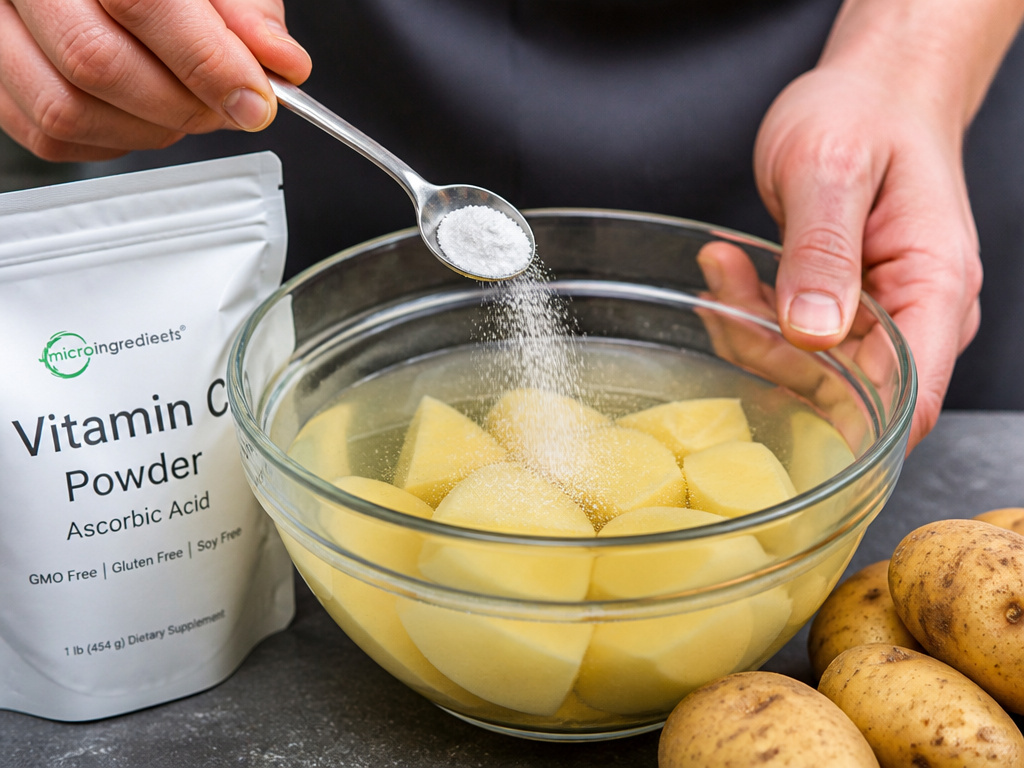
Peeled potatoes oxidize. Exposure to air turns the surface gray or black within minutes. You see it when you leave a peeled potato on the cutting board. That same reaction happens slowly inside the jar if you don’t treat the potatoes before packing.
The solution isn’t lemon juice or vinegar. It’s pure ascorbic acid (Vitamin C) powder. The Penn State Extension canning guide specifies the ratio: 3000 milligrams (about 1 teaspoon) of ascorbic acid per 1 gallon of water. Soak your peeled and cut potatoes in this solution until you’re ready to boil them. The ascorbic acid acts as an antioxidant, blocking the enzyme that causes discoloration.
Common mistake: Skipping the ascorbic acid soak because the potatoes will be covered in water anyway. The discoloration happens between peeling and boiling, and the gray color sets during processing. You’ll open a jar months later to find unappetizing, darkened potatoes that are safe to eat but look spoiled.
This pretreatment is a standard step in professional methods for preserving vegetables. It’s the difference between a jar that looks bright and fresh and one that looks suspect.
Step-by-Step: The Hot-Pack Method for Cubed Potatoes
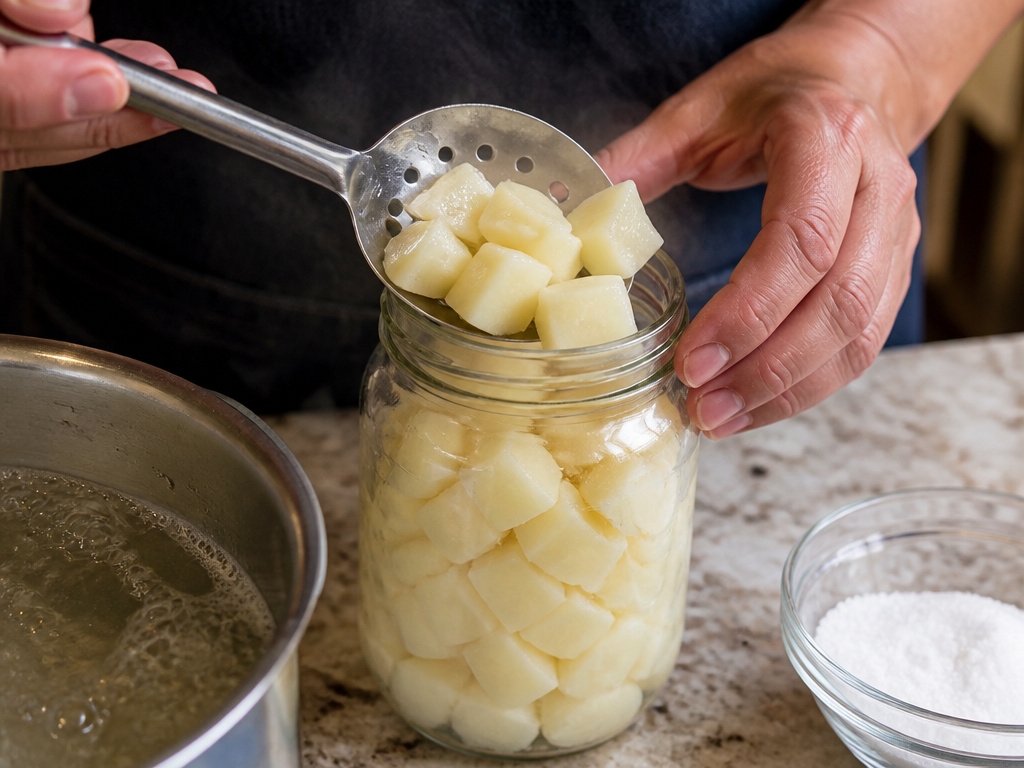
This sequence assumes you have cleaned canning jars and new canning lids. You do not need to sterilize jars for pressure canning—the 40-minute process does that—but they must be hot and clean.
- Prepare the Canner. Put 2 to 3 inches of hot water in your pressure canner. Place the rack inside. Begin heating it on the stove so it’s ready.
- Select and Prepare Potatoes. Choose firm, disease-free white potatoes. For whole potatoes, select those 1 to 2 inches in diameter. For cubes, peel and cut into ½-inch pieces. Immediately submerge in the ascorbic acid solution.
- Boil the Potatoes. Drain the acid solution. In a large pot, cover potatoes with fresh water and bring to a boil. Boil cubed potatoes for 2 minutes. Boil whole potatoes for 10 minutes. Drain.
- Pack the Jars. Using a slotted spoon, pack hot potatoes into hot jars, leaving 1 inch of headspace. Add ½ teaspoon of salt per pint jar, if desired. Cover with fresh, boiling water, maintaining the 1-inch headspace. Remove air bubbles with a tool like the Ball Bubble Freer.
- Seal and Load. Wipe jar rims with a clean, damp cloth. Apply lids and screw bands fingertip tight. Using a jar lifter, place jars on the rack in the preheated canner.
- Vent and Pressurize. Secure the canner lid. Heat on high with the vent port open or weight off until a steady stream of steam shoots out for 10 minutes. This vents air from the canner. Then close the vent or add the weight.
- Process. Once the canner reaches the required pressure for your altitude (see chart above), start your timer: 35 minutes for pints, 40 minutes for quarts. Maintain a steady pressure. Do not let it drop or wildly fluctuate.
- Cool Naturally. After processing, turn off the heat. Let the canner depressurize completely on its own. This takes about 30-45 minutes. Do not force-cool with water.
- Remove and Test. Once depressurized, open the vent, wait 2 minutes, then open the lid. Remove jars with a lifter, place them on a towel, and let cool undisturbed for 12-24 hours. Then test the proper canning jar seal.
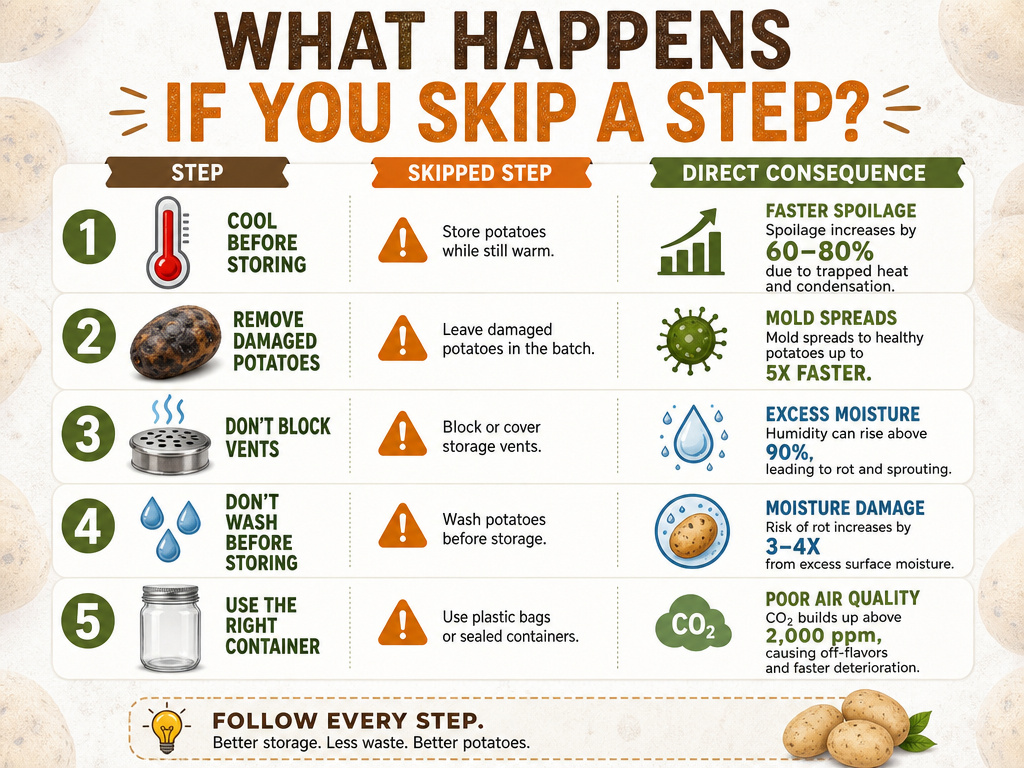
What Happens If You Skip a Step?
Where this goes sideways: Using potatoes from cold storage (below 40°F). The cold converts starch to sugar. Your canned potatoes will have a distinctly sweet, almost candied flavor that ruins savory dishes. Check your raw potato storage temperature before you start.
Every step has a physical consequence. Skip the ascorbic acid, and they gray. Shorten the venting time, and air trapped in the canner lowers the temperature. Force-cool the canner by running water over it, and the sudden pressure drop will suck liquid out of your jars, leading to sealing jars failures. The most dangerous skip is the altitude adjustment—it silently undermines the entire safety premise.
The table below matches common shortcuts with their outcomes.
| Skipped Step | Direct Consequence | Timeline |
|---|---|---|
| Altitude Adjustment | Internal temperature never reaches 240°F; botulism risk. | Immediate. |
| Ascorbic Acid Soak | Potatoes darken, look unappealing. | Within hours of packing. |
| 10-Minute Venting | Air pockets in canner cause uneven heating. | During processing. |
| Natural Depressurization | Siphoning occurs; jars lose liquid and may not seal. | During cooling. |
| 1-Inch Headspace | Jar may overflow or fail to seal under pressure. | During processing. |
Tools and Supplies You Actually Need
You don’t need a gourmet kitchen. You need the right few tools. A generic stockpot won’t work. Here’s the short list of non-negotiable gear for safe canning with a pressure cooker.
- Pressure Canner: A 16- or 23-quart model like the Presto 01781 or All American 921. Must have a dial or weighted gauge in good condition.
- Canning Jars: Standard Ball or Kerr quart and pint mason jars. No cracks, chips, or scratches.
- Lids and Bands: New, unused Ball lids for each jar. Bands can be reused if not rusty.
- Jar Lifter: The Ball Sure-Grip Lifter is essential for safely moving hot jars.
- Headspace/Bubble Tool: A plastic tool like the Ball Bubble Freer or a small silicone spatula.
- Ascorbic Acid Powder: Pure powder, often sold as Ball Fruit-Fresh or in vitamin sections.
- Large Pots: One for boiling potatoes, one for heating extra boiling water.
A canning pots guide can help you choose a canner if you’re buying new, but the critical part is the gauge. A dial-gauge canner should be tested for accuracy annually by your local extension office.
Frequently Asked Questions
Can you can potatoes without a pressure canner?
No. Potatoes are a low-acid vegetable. Water bath canning, or canning in a water bath, cannot reach the 240°F required to destroy botulism spores. Using a pressure canner is the only safe, USDA-recommended method.
Why did my canned potatoes turn out mushy?
Over-processing is the likely cause. While you must meet the minimum time, drastically exceeding it (e.g., processing quarts for 60 minutes) breaks down the potato’s cell structure. Stick to the 40-minute quart rule. Also, using very starchy potato varieties like Russets can lead to a softer texture.
How long do home-canned potatoes last?
When properly processed and sealed, home-canned potatoes are safe to eat for at least 1-2 years. For best quality, use them within 12 months. Always store in a cool, dark, dry place. Discard any jar with a broken seal, bulging lid, or off odor.
Can I leave the skins on when canning potatoes?
The National Center for Home Food Preservation guidelines specify peeling. The skin can harbor more soil-borne bacteria, and its texture becomes tough and unpleasant after processing. For safety and quality, peel your potatoes.
Do I need to add salt when canning potatoes?
Salt is optional for safety. It is added only for flavor. Use ½ teaspoon per pint jar of pure salt for canning (pickling salt), which contains no anti-caking agents that could cloud the liquid.
What’s the difference between canning white and sweet potatoes?
Sweet potatoes are denser and require much longer processing times: 65 minutes for pints and 90 minutes for quarts at the same pressure. Do not substitute white potato times for sweet potatoes. Always refer to a dedicated UMN Extension processing times guide for each vegetable.
The Bottom Line
Canning potatoes locks in a staple. The process is strict because the stakes are high. Remember the three anchors: pressure, time, and altitude. Your pressure canner is your safety appliance. The 40-minute quart timer is your non-negotiable clock. Your elevation, which you must look up, dictates your PSI.
Treat your potatoes with ascorbic acid so they stay bright. Pack them hot. Let the canner cool on its own. Then store your jars in a dark cupboard. When you open one next winter, you’ll have a foundation for soups, stews, and quick sides that you know is safe. That’s the whole point.
