
Expert Guide on How to Get Rid of Pantry Beetles for Good
This post contains affiliate links. As an Amazon Associate, we earn from qualifying purchases.
To get rid of pantry beetles, you must locate and discard the infested source, freeze or heat-salvage questionable items, deep clean, and store all future dry goods in airtight containers. Pheromone traps monitor survivors but won’t end an infestation. Insecticide sprays are ineffective and unsafe.
That freezer and heat method changes the game. Most people think an infestation means throwing away everything. University extensions say you can salvage unspoiled food by killing eggs and larvae with cold or heat, a specific temperature held for a precise time. This isn’t a vague “put it in the freezer.” It’s a protocol.
What follows is the five-step process used by integrated pest management programs. It covers identification, the exact freezing and heating specs from primary sources, why pheromone traps are a tool not a solution, and the one storage rule that prevents a repeat.
Key Takeaways
- Discard the source immediately. Infested flour or pet food is the breeding ground. Find it, bag it, and take it outside.
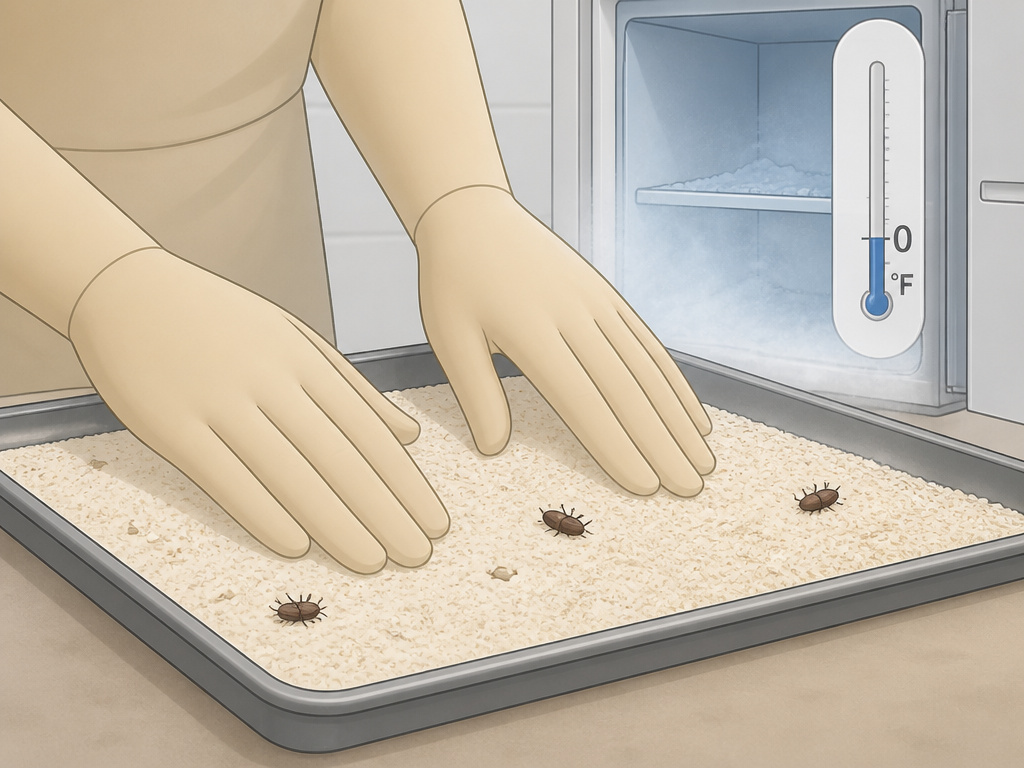
- Freeze or heat to salvage. Freeze at 0°F for four days or heat at 140°F for an hour to kill all life stages in less-infested items.
- Clean, then trap. Vacuum every crack and wash shelves with soapy water before placing pheromone traps to catch stragglers.
- Containers are non-negotiable. Cardboard and thin plastic are worthless. Transfer all dry goods to glass, metal, or heavy-duty plastic containers with locking lids.
- Isolate pet food. Store dry kibble in a sealed container away from the human pantry. It’s a top infestation source.
Identify the Beetle (And Its Favorite Food)
You’re looking at tiny, reddish-brown beetles, about 1/8 inch long. The three most common are the drugstore beetle, the sawtoothed grain beetle, and the flour beetle. They look similar at a glance, but their diets hint at the source.
The drugstore beetle eats nearly anything, flour, spices, pet food, even dried flowers. Its head tucks down, giving it a humped look. The sawtoothed grain beetle prefers grains, cereals, and birdseed. It has a flattened body with tiny saw-like teeth along its thorax. The flour beetle targets milled grains like flour and cake mixes. It can give infested flour a grayish tint and a foul odor.
Common mistake: Spraying the beetles you see. Adults are just the tip of the iceberg. The eggs and larvae are inside your food. Insecticides have no effect there, and spraying near food is a health hazard.
The first sign is often the adults wandering on a shelf. Or you might see fine dust (frass) at the bottom of a bag. Finding the source is a full pantry audit. Empty every shelf. Inspect every package, especially those opened months ago. Look for clumping in flour, tiny holes in pasta, or webbing in grains.
The 5-Step Elimination Process (And Why It Works)
This isn’t just cleaning. It’s a targeted removal of the infestation’s life cycle. Skip a step, and a new generation hatches in three weeks.
Step 1: Locate and Bag the Source
Pull everything out. The infested package is usually the oldest one, that bag of flour you bought for a holiday recipe six months ago, or the bulk rice. When you find it, seal it immediately in a plastic bag. Take it straight to the outdoor trash. Do not leave it in the kitchen bin.
Step 2: Decide: Discard or Salvage?
If a product is heavily infested, you see adults, larvae, and webbing, toss it. For lightly contaminated items you want to save, you have two science-backed options: freezing or heating.
| Salvage Method | Temperature | Minimum Time | Best For |
|---|---|---|---|
| Freezing | 0°F (-18°C) | 4 days | Flour, grains, nuts, pasta |
| Oven Heating | 140°F (60°C) | 1 hour | Grains, cereals, beans |
The University of Minnesota Extension specifies 0°F for four days. The Illinois Extension notes 140°F for an hour works. These temperatures kill eggs, larvae, and adults. After treatment, sift the product through a fine sieve to remove insect bodies.
Step 3: Deep Clean the Empty Pantry
Vacuum every shelf, corner, and crack. The vacuum bag holds eggs and larvae, empty it outside immediately or use a bagless model and dump the contents into the outdoor trash. Wash shelves with hot, soapy water. Let them dry completely.
Step 4: Deploy Pheromone Traps
Place pheromone traps after cleaning. They attract and trap male beetles, preventing reproduction and helping you monitor for survivors. The Cornell IPM pantry pest guide is clear: traps alone “will not eliminate an infestation.” They are a follow-up tool.
Step 5: Repackage Everything
This is the permanent fix. Every single dry good, even unopened boxes, must leave its original packaging. Cardboard and thin plastic are no barrier. Transfer contents into airtight containers. Glass jars or containers with locking silicone gaskets are ideal.
TL;DR: Find it, bag it, clean it, trap it, and seal it. The sequence matters.
Why Insecticides Are a Bad Idea (And What To Do Instead)
You might see a spray at the store labeled for pantry pests. Do not buy it. Every authoritative source agrees.
The California DPR pantry pest PDF and the UMN Extension pantry pest page explicitly state insecticides are not recommended for pantry beetle control. Sprays cannot penetrate food packages to kill internal infestations. Any food that contacts insecticide must be discarded for safety reasons.
The problem is location. The beetles you see are a symptom. The infestation is inside the food package, protected from surface sprays. Spraying cabinets risks contaminating nearby food and surfaces. It creates a chemical hazard without solving the root cause.
The integrated pest management approach uses physical and mechanical controls: removal, temperature extremes, and exclusion. It’s safer and more effective. Your goal is to make the environment uninhabitable, not to poison it.
The Freezer & Heat Method: Salvaging Your Food
Throwing away hundreds of dollars of food feels terrible. The good news is you don’t always have to.
Freezing is the easiest salvage path. Spread the questionable flour or grains in a thin layer on a baking sheet. Place it in a freezer that reaches 0°F. Leave it for four full days. This ensures the cold penetrates and kills all life stages, even the tiny eggs. After four days, remove it, let it come to room temperature, and sift it before transferring to an airtight container.
Oven heating works for larger, drier items like beans, rice, or pasta. Spread them on a baking sheet. Heat your oven to 140°F, use an oven thermometer, as many ovens have inaccurate low-temperature settings. Hold that temperature for one hour. Let the food cool completely before storing.
Where this goes sideways: Using a freezer that isn’t cold enough. Not all refrigerator freezers maintain 0°F. If yours doesn’t, extend the time to seven days. The Illinois Extension advises that longer freezing periods are better when temperature is a variable.
This method works because beetles, like all insects, are cold-blooded. Sustained sub-zero temperatures freeze their cell fluids. Heat denatures their proteins. Both are fatal.
Preventing a Reinfestation: The Two Rules
Elimination is half the battle. Prevention stops the sequel. Two rules handle 90% of future risk.
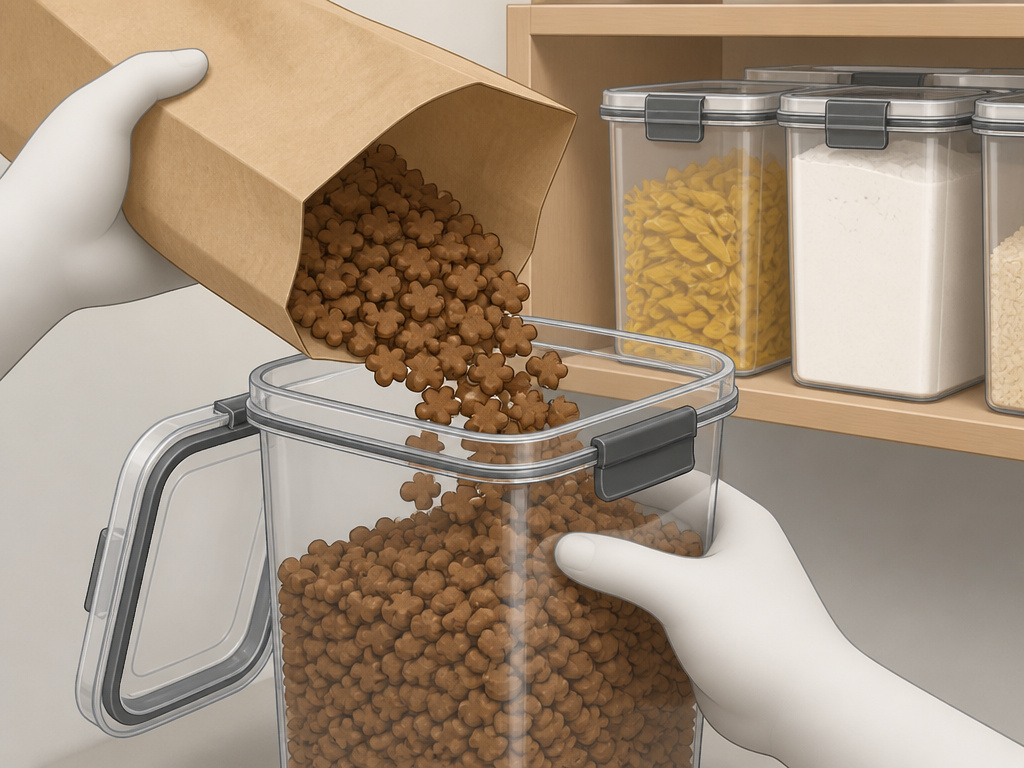
Rule 1: Everything goes into a sealed container. This is non-negotiable. After an infestation, you cannot trust any packaging. Invest in a set of uniform airtight containers. They keep beetles out and keep your food fresh. Transparent sides let you monitor contents without opening them.
Rule 2: Isolate pet food and birdseed. This is the edge case most guides miss. The Washington State University Pestsense fact sheet specifically advises keeping dry pet foods away from the general pantry in a tightly sealed container. Dog kibble and birdseed are frequent beetle sources. Store them in the garage, basement, or a separate cabinet in a dedicated container like a Vittles Vault.
Practice first-in, first-out rotation. Use older products before newer ones. Buy grains and flour in quantities you’ll use within two to four months. Bulk buying for long-term storage without proper flour storage techniques is an invitation.
Pantry Beetles vs. Pantry Moths: Your Action Plan Differs
You might have both. The response overlaps but has a key divergence.
Pantry moths (Indianmeal moths) are the ones that fly and leave silken webbing in food. Their larvae can crawl out of packages and spin cocoons on your ceiling. Pantry beetles (drugstore, sawtoothed grain) are more confined to the food source and don’t produce webbing.
The elimination steps are identical: find source, discard, clean, trap, seal. The difference is in the trap. You need species-specific pheromone traps. A pantry moth trap uses a different pheromone than a beetle trap. Using the wrong one is useless. For a mixed infestation, you need both types.
For severe, recurring cases, the process to exterminate moths is more intensive, involving inspecting for distant cocoons. Beetle reinfestation usually points to a missed food source or poor sealing.
Frequently Asked Questions
Can pantry beetles make you sick?
Physically, they are not poisonous. However, their presence, shed skins, and feces (frass) can contaminate food and trigger allergies or simply make it unpalatable. Heavily infested food should be discarded.
How long does it take to get rid of them?
If you follow the complete process, remove all infested material, clean thoroughly, and seal everything, you can break the cycle immediately. Adult beetles live only a few weeks. Without a food source, the population dies off. Pheromone traps can catch stray adults for a month or two after cleaning.
Will they spread to other rooms?
They can, but they won’t survive long. Pantry beetles need a dry food source. They may wander into living areas if the infestation is large, but they won’t establish themselves in your couch or curtains. They are looking for more food.
Can they get into sealed packages?
They can chew through thin plastic bags, cardboard, and paper. They cannot get through glass, metal, or thick, hard plastic with a tight-sealing lid. This is why repackaging is the ultimate solution. Proper flour storage techniques in such containers are your best defense.
Do bay leaves or cedar repel pantry beetles?
There is no scientific evidence that bay leaves, cedar chips, or other home remedies repel or kill pantry beetles. They may mask odors but do not create a barrier. Airtight sealing is the only proven physical exclusion method.
The Bottom Line
Pantry beetles are a nuisance, not a catastrophe. The fix is methodical, not magical. Find the source food and remove it. Use your freezer or oven to rescue what you can. Clean every surface. Then lock everything else away in containers beetles can’t penetrate.
The entire process hinges on breaking their life cycle by removing their food and breeding ground. Insecticides won’t help. Pheromone traps are just for monitoring. Your freezer and a set of good containers are the real tools that solve the problem.
Stop the infestation this weekend. Then, with everything in airtight containers, you’ll never have to do it again.
