How to Make Freezer Jam Quickly with Our Fail-Proof Method
This post contains affiliate links. As an Amazon Associate, we earn from qualifying purchases.
To make freezer jam, you match your fruit to a commercial pectin brand. Ball, Pomona’s, or Certo, and follow its recipe exactly. The process has three non-negotiable steps: crushing fruit, mixing with sugar and pectin, and filling containers with the correct headspace. Using a tested pectin recipe is the only way to guarantee a safe gel and a shelf life of up to one year frozen.
That guarantee hinges on the chemical reaction between fruit acid, sugar, and the specific pectin you buy. Deviate from the printed ratios, and the jam either stays syrupy or crystallizes in the jar. The pectin box isn’t a suggestion; it’s the formula for the reaction you’re paying it to perform.
What follows breaks down the three variables you control: picking a pectin, prepping the fruit, and storing the jam so it doesn’t freezer-burn or ferment. By the end, you’ll know which pectin fits your sugar preference and why the setting instructions on the box are the only timeline that matters.
Key Takeaways
- Your pectin brand dictates everything, sugar amount, mixing method, and whether the jam sets at room temperature or goes straight to the freezer. Ball RealFruit Freezer Pectin and Pomona’s Universal Pectin work differently.
- Leave ½ inch of headspace in rigid plastic or glass containers. Less space risks cracked glass; more space leads to freezer burn and ice crystals in the jam.
- Uncooked freezer jam maintains peak quality for up to one year in a standard freezer, per Oregon State University Extension. In the fridge, use it within three weeks.
- For a safe gel, never reduce the sugar in a full-sugar pectin recipe. If you want less sugar, buy a pectin formulated for it, like Pomona’s or Ball’s “no sugar needed” version.
- The most common failure is impatience: moving the jars before the pectin sets. If the box says 24 hours, give it the full 24 hours.
Why Pectin Choice Is the Whole Game
Freezer jam isn’t cooked, so heat isn’t driving the gel. The set comes from a precise chemical bond between fruit acid, sugar, and pectin molecules. Each commercial pectin brand uses a different type of pectin, high-methoxyl, low-methoxyl, or modified, that requires a specific sugar-to-acid ratio to work.
Common mistake: Swapping liquid pectin for powdered, or using a “regular” cooked jam pectin in a freezer recipe. The gelling mechanisms differ, and the jam will remain a sweet fruit soup.
Your first decision is sugar level. This locks you into a pectin category.
| Pectin Type | Sugar Required | Best For | Key Brand Example |
|---|---|---|---|
| Regular / Full-Sugar | High (usually 3-4 cups sugar per 4 cups fruit) | Traditional, sweet jam with a firm set | Ball RealFruit Freezer Pectin, Certo |
| Low/No-Sugar Needed | Low or none (uses alternative sweeteners or less sugar) | Diabetic diets, highlighting tart fruit flavor | Pomona’s Universal Pectin, Ball No-Sugar Needed Pectin |
| Reduced-Sugar / Flex-Batch | Moderate (allows some recipe scaling) | Flexibility in batch size and sweetness | Ball Flex-Batch Pectin |
Regular pectins like Ball RealFruit Freezer Pectin rely on a high sugar concentration to create the gel network. Reduce the sugar, and the network fails. Low-sugar pectins like Pomona’s use added calcium (included in the box) to form the gel, so sugar becomes a flavor agent, not a structural one.
The OSU Extension freezer jam guide states this plainly: “success depends on following the recipe developed for the specific brand of pectin you are using.” This isn’t fussiness. It’s chemistry.
The 3-Step Freezer Jam Process
Once you’ve chosen your pectin, the work is straightforward. The stakes are in the details.
Step 1: Prepare the Fruit
Use ripe, flavorful fruit. Wash it, and remove stems, pits, or peels as your pectin instructions specify. Crush or chop the fruit to the texture you want in the jam. Measure the crushed fruit exactly, don’t pack it down. A liquid measuring cup is fine here.
For berries, a potato masher works. For peaches or plums, a food processor on pulse gives a nice chop. Pureeing too finely can make the jam cloudy.
Why exact measurement matters: Pectin recipes are formulated by weight of fruit solids and liquid. If you use 5 cups of crushed strawberries instead of 4, you’ve diluted the pectin concentration. The jam may not set.
Step 2: Mix Sugar and Pectin
This is where the paths diverge. Read your box.
- For most freezer-specific pectins (like Ball RealFruit): You mix the dry pectin with the sugar first, then stir it into the crushed fruit. You then stir for a full 3 minutes. This dissolves the pectin and sugar evenly throughout the fruit juices.
- For some other pectins (like certain Certo or cooked jam pectins used for freezer recipes): You may need to dissolve the pectin in boiling water or juice first, then combine it with the fruit and sugar.
The mixing time is critical. Stir for the full duration stated on the box. This ensures the pectin is fully hydrated and distributed, preventing weak spots in the gel.
Step 3: Fill and Set the Containers
Immediately ladle the mixed jam into clean containers. Do not use thin, flimsy plastic or containers not meant for freezing. Half-pint or pint sizes are ideal.
Headspace is non-negotiable. The NDSU food preservation guide calls for ¼ inch for jams processed in a water bath. For true freezer jam, the OSU Extension and the UC ANR freezer jam recipes specify ½ inch. Use the ½-inch rule. It allows for expansion as the jam freezes, preventing lid rupture or cracked glass.
Now, the final variable: setting time. * Some pectins (Ball RealFruit): Set at room temperature for 30 minutes to 24 hours until gelled, then freeze. * Other pectins: Go directly to the freezer after filling.
Your pectin box has the answer. Do not guess. Do not refrigerate to speed it up. The gel forms at a specific temperature range; chilling it can interrupt the process.
Freezer Jam Containers and Storage
The right container prevents two problems: freezer burn and chemical leaching.
Rigid plastic containers made for freezer storage are the default choice. Look for ones with tight-fitting lids. Wide-mouth glass jars like Mason jars are also excellent, provided you leave that ½-inch headspace. Never use regular narrow-neck jars, the jam expands upward and can crack the glass at the shoulder.
Where this goes sideways: Using a repurposed yogurt tub or margarine tub. These plastics are not designed for long-term frozen storage. They become brittle and can impart off-flavors to the jam within a few months.
Before filling, wash containers in hot, soapy water. Sterilization isn’t required because the jam will be frozen, not shelf-stored. Dry them thoroughly.
Label every container with the date and type of jam. Freezer jam maintains best quality for up to one year. After that, it’s still safe but may lose flavor and bright color. Once thawed and opened, store it in the refrigerator and use it within three weeks. Since it’s uncooked, it will ferment at room temperature.
This storage timeline makes freezer jam a fantastic method for preserving plums in freezer when you have a sudden surplus, just as it works for berries.
Troubleshooting: Why Is My Freezer Jam Runny or Grainy?
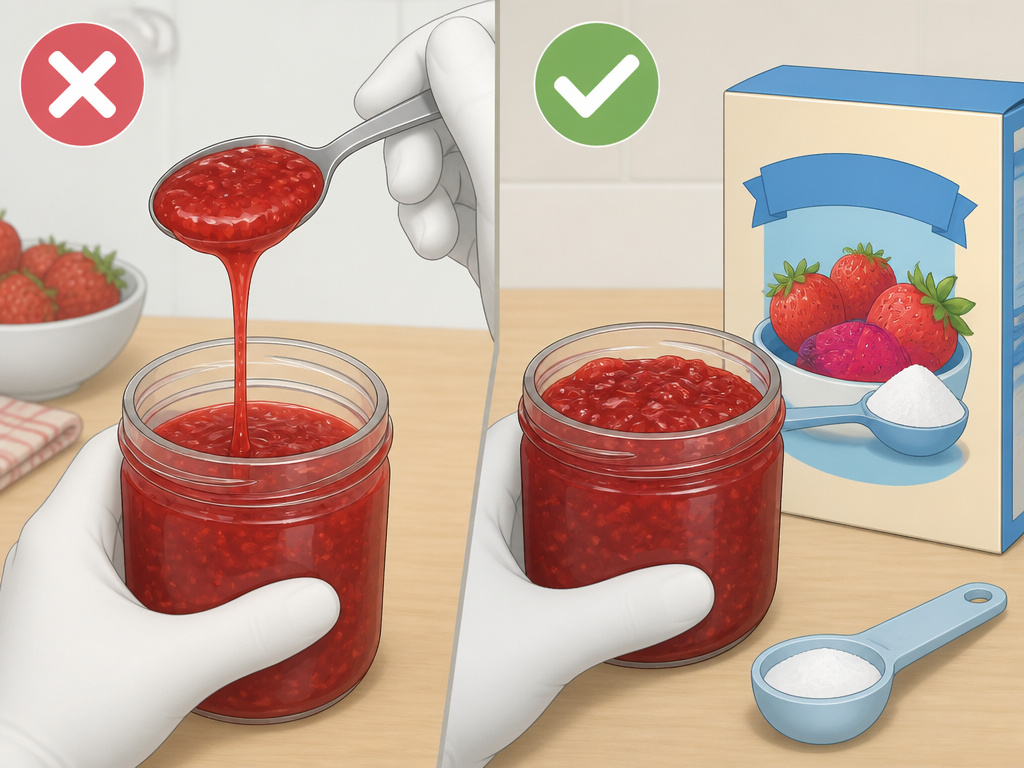 Even when you follow the steps, sometimes texture fails. Here’s what went wrong and how to fix it next time.
| Problem | Most Likely Cause | Can You Fix It? | How to Prevent Next Batch |
|---|---|---|---|
| Jam is runny, never set | Incorrect pectin type for freezer use; sugar reduced in full-sugar recipe; fruit was overripe (low acid/pectin). | No. Use it as a syrup over ice cream or yogurt. | Use a pectin labeled for freezer jam. Don’t alter sugar. Add 1 Tbsp lemon juice per cup of low-acid fruit. |
| Jam is too stiff, rubbery | Too much pectin for the fruit amount; over-stirring after gel begins. | Stir vigorously to break the gel and soften it. | Measure pectin precisely with a measuring spoon, not a dinner spoon. |
| Sugar crystals in jam | Sugar didn’t fully dissolve during mixing. | Stir the jam thoroughly after thawing. | Stir the sugar-pectin mixture into the fruit for the full time on the box (e.g., 3 full minutes). |
| Ice crystals on top / Freezer burn | Too much headspace; container not airtight. | Scrape off the icy layer. The jam below is fine. | Fill to ½ inch headspace. Ensure lid seals tightly. Use quality freezer-safe containers. |
| Jam separated after thawing | Natural fruit separation; common with juicy berries. | Stir it back together. | It’s cosmetic. For a more uniform texture, chop fruit more finely. |
The graininess or crystal issue is noted as normal by some sources. The NDSU guide mentions that “having a few sugar crystals remain in freezer jellies and jams is normal.” If it’s excessive, your mixing was too brief.
Frequently Asked Questions
Can I use honey or artificial sweetener in freezer jam?
You can, but only if your pectin recipe is designed for it. Pomona’s Pectin explicitly works with honey or alternative sweeteners. Regular Ball or Certo freezer pectin recipes will not gel properly if you substitute honey for granulated sugar. The chemical reaction needs the specific sugar molecule. Always follow the substitution guidelines on your pectin box.
Do I have to use commercial pectin?
Technically, no. Some high-pectin fruits like cooked apples or citrus can gel with just sugar and acid. But for a reliable set with uncooked fruit, especially low-pectin berries, commercial pectin is non-negotiable. The food preservation standards document from NDSU is clear: “Uncooked jellies and jams may be stored in the refrigerator for up to three weeks. For longer storage (up to six months), freeze. Commercial pectin and a higher percentage of sugar are used.”
Why did my jam mold in the freezer?
Freezer jam shouldn’t mold in the freezer. If you see mold, it likely formed during the room-temperature setting period or in the fridge after thawing. The jam was probably left out too long before freezing, or the container wasn’t clean. If you find mold, discard the entire container. Do not scrape it off. Research cited by the University of California indicates mycotoxins from surface mold can penetrate softer foods like jam.
Can I double a freezer jam recipe?
Only if your pectin instructions say you can. Most traditional pectin brands advise against doubling because the mixing time and dissolution rates change, leading to an uneven set. Ball Flex-Batch Pectin is an exception designed for scalable batches. When in doubt, make multiple single batches.
Is there a difference between freezer jam and regular jam?
Yes, in both process and outcome. The difference between jam vs preserve is about fruit chunk size, but both are cooked. Freezer jam is never cooked, so it retains a much brighter, fresher fruit flavor. The trade-off is a shorter shelf life and a requirement for constant refrigeration or freezing after the initial set.
Before You Go
Freezer jam is a capture of fresh fruit flavor, not a preservation project. Its goal is to lock in the taste of July strawberries for a January morning.
The method is simple: choose a commercial pectin matched to your sugar preference, follow its recipe to the letter, and store the jam in proper containers with ample headspace. The one-year freezer shelf life makes it a perfect partner for other frozen staples, like a batch of freezer corn.
Skip the improvisation. The pectin box is your blueprint. When you treat it as one, you get a jar of summer that actually sets.
