How to Store Carrots Long Term with the Critical Humidity Rule
This post contains affiliate links. As an Amazon Associate, we earn from qualifying purchases.
To store carrots long term, you need three things: a temperature of 32°F (0°C), a relative humidity of 98-100%, and tops removed to half an inch above the root. At these conditions, mature topped carrots last 5 to 9 months. Straying from this narrow band by even a few degrees cuts storage life by months and introduces sprouting or decay.
That 98-100% humidity figure isn’t a suggestion. It’s the hard ceiling from the WFLO Commodity Storage Manual and university extensions. Most home refrigerators hover around 30-50% humidity, which is why carrots go limp in a week unless you engineer a microclimate.
What follows is the translation of those industrial specs into home methods. We’ll cover the exact tools to hit 98% humidity, the one trimming mistake that invites rot, and the storage timelines for everything from bunched carrots to a 50-pound harvest.
Key Takeaways
- Mature, topped carrots need 32°F and 98-100% relative humidity for maximum storage life of 5-9 months.
- Trim tops to 1/2 inch, but leave the root hairs intact unless storing beyond 4 months—trimming them preemptively is a pro move for very long storage.
- Perforated plastic bags outperform mesh bags or open bins; a UMass study recorded 13% water loss in mesh versus under 2% in perforated plastic over three months.
- Never store carrots near ethylene-producing fruits like apples or pears; even trace amounts under 1 ppm cause irreversible bitterness.
- For root cellar or sand storage, use only moist, not wet medium; free moisture directly on the roots leads to decay in weeks.
The 3 Non-Negotiable Conditions for Long-Term Storage
Forget “cool, dark place.” Industrial and academic guides agree on a narrow window. Missing one variable collapses the whole system.
Mature topped carrots require a storage temperature of 32°F (0°C) and a relative humidity of 98 to 100% to achieve a storage life of 5 to 9 months. Condensation on the roots must be avoided, as free moisture promotes decay. These parameters are defined in the WFLO Commodity Storage Manual and corroborated by the University of Maine Cooperative Extension.
Temperature: 32°F (0°C) is the bullseye. Carrots freeze at 29.5°F. The space between 32°F and 40°F is a decay zone. Storage at 40°F sees sprouting and objectionable taste develop within 7 months. At 50°F, significant decay happens in 1-3 months. Your storage setup must be able to hold 32°F consistently, not just “cold.”
Humidity: 98-100% RH is non-negotiable. This is the number most home guides fudge. Below 95% RH, carrots wilt and shrivel. Your refrigerator’s crisper drawer, even on the highest setting, might hit 90-95%. To reach near-saturation, you need a sealed or semi-sealed environment like a plastic bag or a damp medium like sand.
Carrot Type: Mature vs. Immutable Changes Everything. A “mature” carrot is a full-sized, late-harvest root bred for storage, like the Bolero variety. An “immature” carrot is the typical grocery store “cello-pack” carrot, harvested young. Their storage lives are worlds apart. | Carrot Type | Optimal Storage Life at 32°F | At 37-41°F (Common Fridge Temp) | |———————–|———————————-|————————————-| | Mature Topped | 5 to 9 months | 3 to 5 months | | Immature Topped | 4 to 6 weeks | 2 to 3 weeks | | Bunched (with tops) | 8 to 12 days | 5 to56 days |
The variety matters. If you’re growing for storage, choose a known storage cultivar like Bolero, Sugarsnax, or Carson.
Step-by-Step: Refrigerator & Root Cellar Methods
Your choice depends on quantity and available tools. Both methods aim to create the same microclimate.
Method 1: Perforated Plastic Bag (Refrigerator)
This is the most reliable home method to approximate 98% RH.
What You’ll Need:
- Heavy-duty freezer bags (gallon or quart size)
- A hole punch or sharp knife
- Paper towel (optional)
- Carrots with tops trimmed to 1/2 inch
Steps:
- Trim and Dry: Cut greens to 1/2 inch above the shoulder. Do not wash. If roots are wet, let them air-dry in the shade until the surface is no longer shiny. This prevents free moisture in the bag.
- Prepare the Bag: Punch 8-10 small holes in a gallon freezer bag. This allows minimal gas exchange while retaining humidity.
- Pack and Seal: Place carrots inside. For extra humidity insurance, add a barely-damp paper towel. Force out excess air and seal the bag.
- Refrigerate: Place in the coldest part of your fridge, ideally where the temperature is closest to 32°F (often the back of the bottom shelf).
- Check Monthly: Open the bag every 4-6 weeks. Look for condensation. If the bag is wet inside, replace it. Remove any carrots showing signs of softening or mold.
Why the holes? A completely sealed bag leads to a carbon dioxide buildup and oxygen depletion, which actually promotes decay. The perforated bag creates a modified atmosphere that slows respiration without suffocating the roots.
Method 2: Sand or Sawdust Storage (Root Cellar or Cool Basement)
This traditional method works for larger quantities without refrigeration, provided your storage space stays between 32-35°F.
What You’ll Need:
- A wooden crate, plastic tote (with lid), or sturdy cardboard box
- Clean, moist sand or sawdust
- A spray bottle with water
Steps:
- Prepare the Medium: Moisten sand or sawdust until it clumps when squeezed but no water runs out. This is moist, not wet.
- Layer: Place a 2-inch layer of medium in the bottom of your container. Arrange a single layer of unwashed, trimmed carrots so they do not touch. Cover completely with 1-2 inches of medium.
- Repeat and Top: Continue layering. Finish with a 3-inch layer of medium on top.
- Store and Monitor: Place the covered container in your root cellar, unheated garage, or basement where temperatures stay consistently between 32-35°F. Check the medium monthly; if the top layer is dry, mist it lightly. Discard any carrots that become soft.
Common mistake: Using soaking wet sand. Free moisture from condensation or a wet medium is the fastest route to a container of rotten, slimy carrots. It’s the decay trigger the UC Davis Postharvest factsheet explicitly warns against.
The Prep Work: Trimming, Washing, and the Root Hair Debate
What you do in the first hour after harvest determines the next nine months.
Topping: Cut to 1/2 Inch. Remove all leafy green growth. The greens pull moisture from the root, causing wilting. Cut close enough to prevent sprouting, but not so close you damage the carrot’s shoulder.
Washing: Yes or No? The UMass Extension study found no increase in rot when carrots were washed before storage versus stored unwashed. The key is thorough drying afterward. If you wash, do it immediately after harvest. Let roots air-dry completely in the shade until the surface is matte, not glossy, before bagging. Storing wet carrots in plastic is an invitation for mold.
The Root Hair Question. Those tiny hair-like roots are the first part to rot. For storage beyond 4 months, some commercial growers trim them. For home storage under 4 months, it’s an optional, meticulous step. If you see them turning to “jelly” in storage, you’ll know why.
What Goes Wrong (And How to Spot It Early)
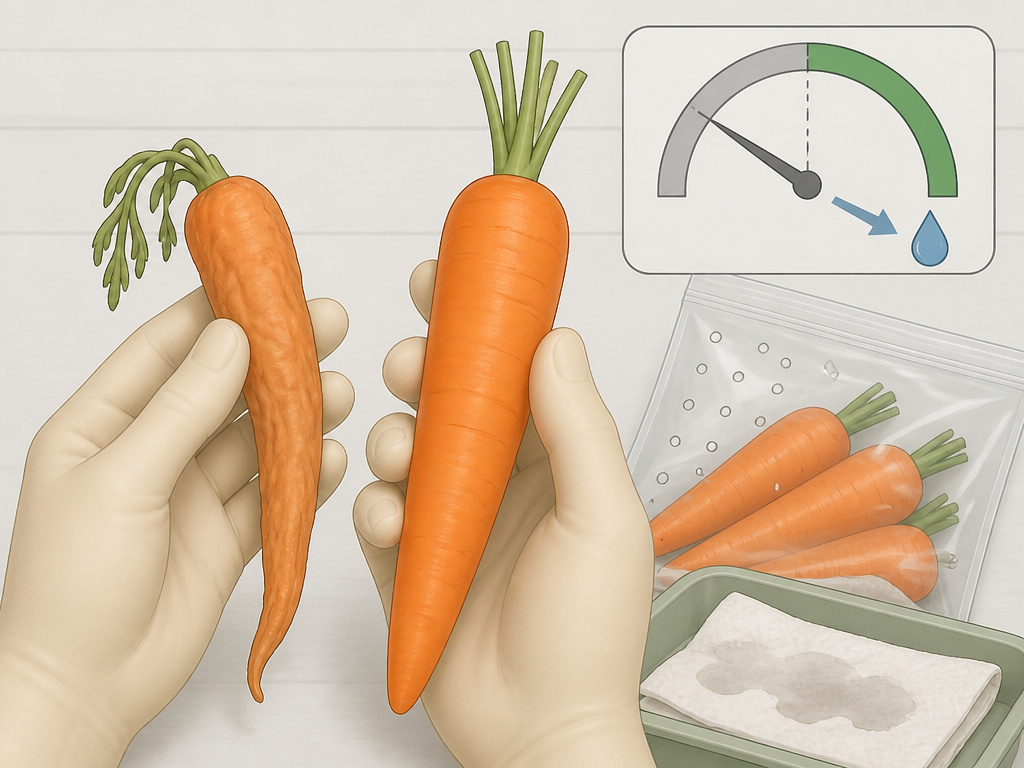 Even perfect conditions have failure modes. Here’s the diagnostic table.
| Symptom | Likely Cause | Timeline | Fix / Prevention |
|---|---|---|---|
| Limp, rubbery texture | Humidity too low (<95% RH) | 1-2 weeks | Move to a perforated plastic bag with a damp paper towel. |
| White, hairy sprouts | Temperature too high (>40°F) | 4-8 weeks | Find cooler storage. Sprouted carrots are still edible but use quickly. |
| Soft, watery decay spots | Free moisture on roots (condensation) | 2-4 weeks | Ensure carrots are dry before bagging; avoid temperature fluctuations. |
| Bitter taste | Exposure to ethylene gas (from apples, etc.) | Can happen anytime | Store carrots away from all fruits, especially apples, pears, and melons. |
| Black, mushy rot | Physical injury or disease present at storage | 1-3 months | Sort more carefully at harvest; discard any damaged roots. |
The Ethylene Problem is irreversible. The WFLO manual states even exposure to less than 1 part per million of ethylene at low temperatures will cause bitterness. This isn’t a minor flavor change—it makes the carrot unpalatable. A separate drawer or container is mandatory.
Frequently Asked Questions
Can you store carrots in water in the fridge?
Yes, but this is a short-term method for keeping carrots crisp for a week or two, not long-term storage. Submerging carrots in water leaches nutrients and sugars over time, and the water needs changing every few days to prevent bacterial growth. For storage beyond a month, the dry, high-humidity methods are superior.
Do carrots last longer with the tops on or off?
Infinitely longer with the tops removed. The leaves transpire, pulling water from the root and causing rapid wilting. Bunched carrots with tops last 8-12 days at best, while topped carrots can last months. Always cut the greens to about a half-inch above the crown as soon as possible.
What is the best container for storing carrots long term?
For the refrigerator, perforated plastic bags are the best container. For root cellar storage, a wooden crate or plastic tote filled with moist sand or sawdust works well. The common thread is a material that buffers humidity without trapping excessive moisture. Avoid sealed glass jars or solid plastic containers without ventilation.
How do you store garden carrots for the winter?
Harvest after a light frost for sweeter roots. Trim tops to 1/2 inch, brush off excess soil (do not wash if they will be sand-stored), and pack them in moist sand or sawdust in a container kept at 32-35°F. A root cellar is ideal, but an unheated garage monitored with a thermometer can work. Check the University of Maine Cooperative Extension guide for detailed basement storage plans.
Can you freeze carrots for long-term storage?
Yes, but freezing changes texture. Blanch sliced or diced carrots for 2-3 minutes, cool in ice water, pat dry, and freeze in a single layer before bagging. They’ll keep for a year but will be soft upon thawing, suitable only for cooked dishes. For raw, crisp carrot applications, cold storage is the only method.
Before You Go
Long-term carrot storage isn’t about a single trick. It’s about holding three numbers in balance: 32°F, 98% RH, and 5-9 months. The perforated plastic bag method gets you closest in a modern fridge. For a garden haul, the sand-in-a-crate method is your best bet, provided you can keep it cold.
Remember the two biggest pitfalls: letting humidity drop below 95%, and letting carrots sit near fruit. Get those right, and you’ll pull crisp, sweet carrots from storage long after the garden is under snow. The principles here for managing temperature and humidity are the same ones that govern successful long-term onion storage and keeping ginger root viable for months. It’s all about creating the right environment.
