How to Store Raw Fish in a Refrigerator: The Best Spot
This post contains affiliate links. As an Amazon Associate, we earn from qualifying purchases.
Store raw fish on the bottom shelf of your refrigerator, set to 40°F (4.4°C) or colder. Wrap it tightly in plastic or place it in an airtight container, and use it within 1 to 3 days. For whole fish or fillets you won’t cook immediately, pack them on ice in a pan, this is the professional method that pushes temperature toward 32°F.
That bottom shelf placement is not a suggestion. It’s a physical barrier against cross-contamination. Drips from a package of salmon can’t fall onto your lettuce if the fish lives below everything else.
What follows: the exact mechanics of the bottom shelf, the two approved container methods, the one type of seafood that must never be sealed, and the real-world timeline before spoilage bacteria win.
Key Takeaways
- The bottom refrigerator shelf is the only safe spot for raw fish, it physically stops drips from contaminating ready-to-eat foods below.
- Your refrigerator must read 40°F (4.4°C) or below on an appliance thermometer; the built-in dial is often wrong by five degrees.
- For maximum freshness, use the ice-pan method: place sealed fillets in a pan, cover them with ice, and drain the meltwater daily.
- Live shellfish like clams and oysters need air, store them in a shallow pan covered with a damp towel, never in a sealed container.
- If raw fish sits above 40°F for more than two hours, toss it. That includes time in the grocery bag and on the counter during unpacking.
The One Correct Shelf for Raw Fish
Put raw fish on the bottom shelf. Every time.
This is not about convenience. It is a direct application of gravity and fluid dynamics to prevent illness. Juices from raw seafood carry pathogens like Salmonella and Listeria. If a package leaks on an upper shelf, those juices drip down onto everything below, cooked leftovers, fresh produce, dairy. The bottom shelf has nothing below it but the refrigerator liner, which you can clean.
Common mistake: Storing fish in the middle for “easy access.” A single drip contaminates the vegetable drawer. The risk isn’t theoretical; it’s documented in every government refrigeration best practices guide.
The same rule applies to all raw meat and poultry. This creates a safe storage hierarchy: ready-to-eat foods on top shelves, raw chicken and fish in the middle, and the absolute highest-risk items, raw fish and ground meats, on the very bottom. Think of it as a contamination firewall.
TL;DR: Bottom shelf only. No exceptions.
Hitting the 40°F Target (Your Fridge is Lying)
The safety window closes fast above 40°F (4.4°C). Pathogenic bacteria enter their rapid growth phase in that zone. Your refrigerator’s built-in temperature dial is almost certainly inaccurate.
Buy an inexpensive appliance thermometer. Place it in the middle of the center shelf and wait 24 hours. Adjust the fridge’s temperature control until the thermometer reads between 35°F and 38°F. This gives you a buffer. A reading of 40°F at the thermometer means the back corners and door shelves are already warmer.
| Refrigerator Zone | Typical Temperature Range | Suitable For |
|---|---|---|
| Back, bottom shelf | 33–36°F (0.6–2.2°C) | Raw fish, meat (ideal for ice pan) |
| Middle shelves | 36–39°F (2.2–3.9°C) | Dairy, eggs, TCS foods |
| Door shelves | 39–45°F (3.9–7.2°C) | Condiments, juices (never raw fish) |
| Crisper drawers | 38–42°F (3.3–5.6°C) | Fruits, fresh greens |
If your refrigerator lacks a digital display, the thermometer is non-negotiable. Check it weekly. This is the single most effective step in general food storage safety.
Container Rules: Airtight vs. Ice Pan
You have two valid paths, chosen by your timeline.
For use within 24 hours: Keep the fish in its original store packaging if it’s intact and leak-proof. Place the whole package on a plate or shallow tray on the bottom shelf. The tray catches any micro-leaks. If you repackage, use a zip-top freezer bag, press out all the air, and seal it.
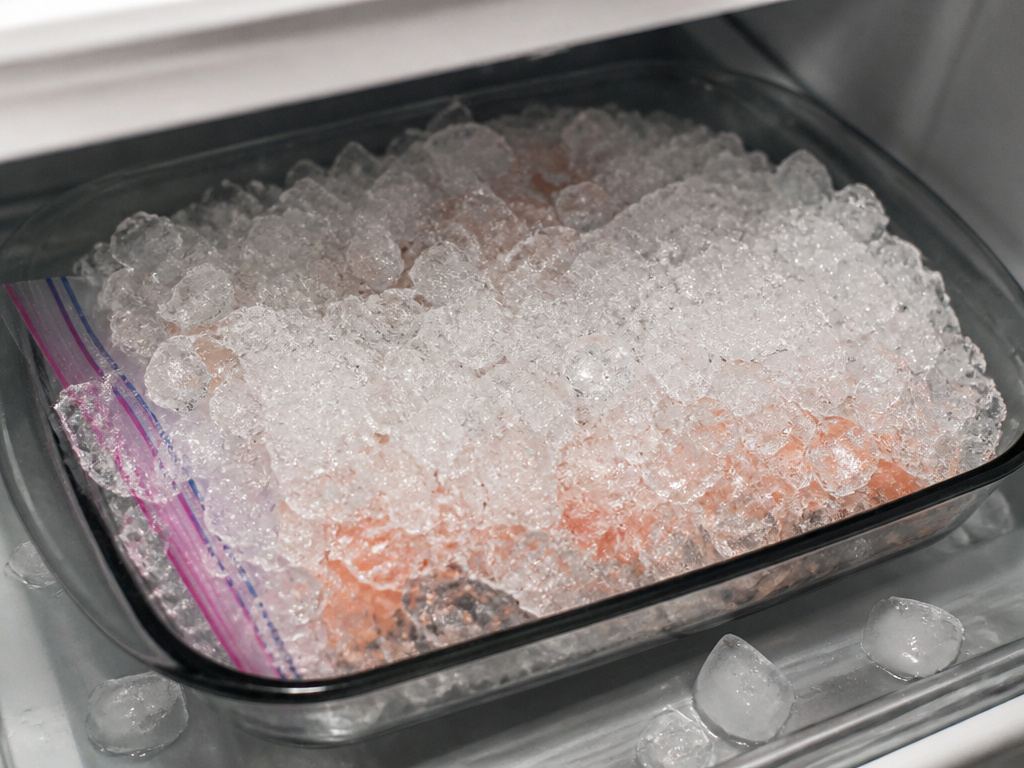
For 1-3 day storage (or optimal freshness): Use the ice pan method. This is the technique NOAA Fisheries specifies for home storage.
- Seal fillets or steaks in a plastic zip-top bag or airtight container.
- Place them in a shallow pan or dish.
- Cover the seafood completely with crushed or cubed ice.
- Place the pan on the bottom shelf.
- Drain the meltwater from the pan every 12 hours and add fresh ice.
The ice-pan method isn’t just for show. It holds the fish at a temperature much closer to 32°F, dramatically slowing bacterial growth and enzymatic spoilage. The fish stays firm and loses less moisture.
This method is why professional kitchens store fish on ice. It works because water at its freezing point is an incredibly efficient heat sink. Your home refrigerator’s air is dry and fluctuates; the ice bath is a stable, cold, humid microclimate.
The Clock is Ticking: Realistic Shelf Life
Forget the optimistic “3-5 days” you sometimes see. The countdown starts at the dock, not at your checkout line.
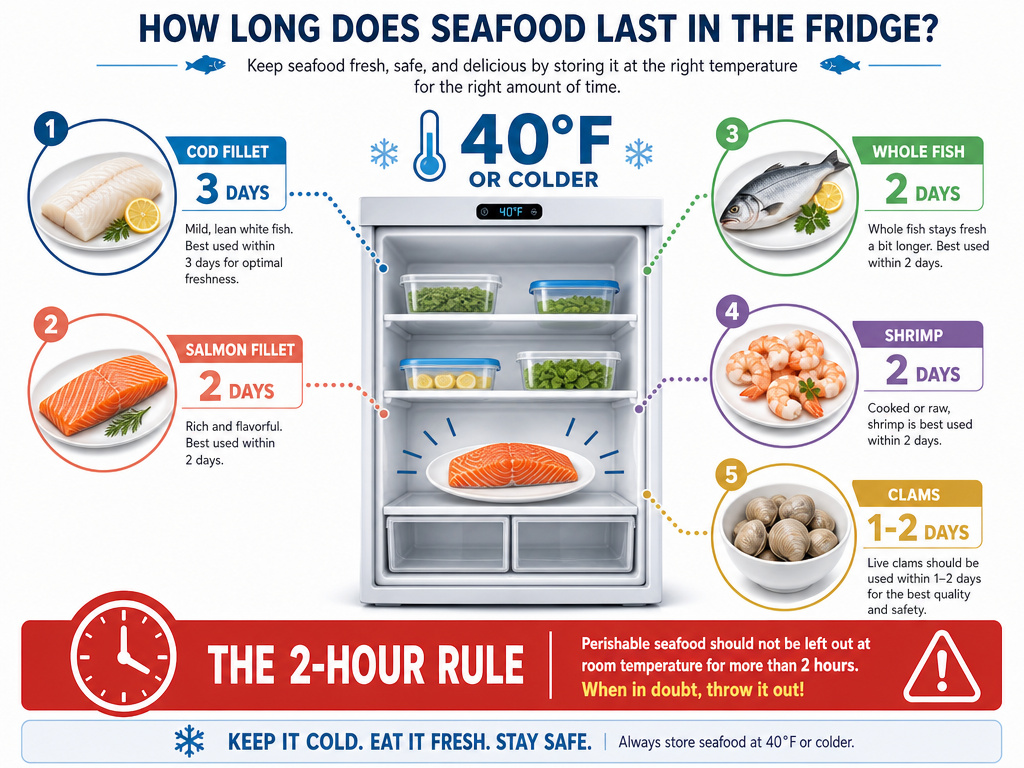
At a steady 40°F, you have a short window. The official refrigerator storage guidelines are your legal safety net.
| Seafood Type | Max Refrigerator Shelf Life (at 40°F/4.4°C) | Visual/Smell Tipping Point |
|---|---|---|
| Lean Fish Fillets (Cod, Haddock) | 3 days | Flesh becomes translucent, slips apart. |
| Fatty Fish Fillets (Salmon, Mackerel) | 2 days | Oils oxidize; smell is sharply fishy, not briny. |
| Whole, Dressed Fish | 2 days | Eyes cloud over; gills turn from red to brown. |
| Raw Shrimp, Scallops | 2 days | Develops a slimy feel and ammonia scent. |
| Live Shellfish (Clams, Mussels) | 1-2 days | Shells gape open and do not close when tapped. |
These are maximums, not targets. Plan to cook fish the day you buy it. Day two is the fallback. Day three is a gamble on the quality of the original product and the perfection of your storage.
The 2-Hour Rule: This is critical. If raw fish sits above 40°F for more than two hours cumulative, discard it. That time includes the drive home, sitting on the counter while you unpack, and any time the fridge door was open. Bacteria double rapidly in that zone.
Special Cases: Shellfish and Leftovers
Shellfish break the rules for finfish.
Live clams, oysters, and mussels are still breathing. They will suffocate and die in a sealed container, accelerating spoilage. Place them in a dry, shallow pan or bowl. Cover them with a damp paper towel or cloth. Do not submerge them in water. Store on the bottom shelf and use within 24 hours for the best flavor.
Cooked fish leftovers must be handled differently. Let them cool to room temperature within two hours of cooking, never put hot food directly into the fridge, as it raises the ambient temperature. Then, store in an airtight container. You can place it on an upper shelf, as the cross-contamination risk is gone. Eat within 3 days.
Always use separate, clean cutting boards and utensils for raw and cooked seafood. Wash everything with hot, soapy water immediately after use.
When Things Go Wrong: Power Outages and Smell Tests
A power outage doesn’t automatically mean lost food. Keep the refrigerator door closed. A full fridge will stay below 40°F for about four hours. If the outage is longer and the internal temperature rises above 40°F for more than two hours, discard the raw fish. Do not taste-test.
Your senses are good diagnostic tools, but they are not foolproof safety gauges.
- Smell: Fresh fish has a mild, clean, oceanic scent. Spoiled fish smells sharply of ammonia, sulfur, or overly sweet decay.
- Touch: Fresh fillets are firm and spring back when pressed. Spoiled flesh is mushy and leaves an indentation.
- Sight: Look for discoloration, yellowing or browning edges, and a milky, slimy coating.
If in doubt, throw it out. The cost of a fillet is lower than the cost of foodborne illness.
Frequently Asked Questions
How long can raw fish stay in the fridge before cooking?
At a verified 40°F or below, use raw finfish within 1-2 days for best quality, and absolutely within 3 days. Shrimp and scallops should be used within 2 days. These timelines assume perfect, immediate refrigeration from the store.
Can you store fish in the fridge without a container?
No. Always contain raw fish, either in its original leak-proof packaging, a sealed bag, or an airtight container. The sole exception is when using the ice-pan method, where the sealed fish is covered by ice, still providing a barrier.
What is the coldest part of the refrigerator for fish?
The back of the bottom shelf is typically the coldest spot, as cold air sinks and the compressor is usually at the back. This is the ideal location for your ice pan or sealed fish package.
Does fish go bad in the fridge faster than meat?
Yes, seafood is more perishable than most meats. Fish tissue is less dense and has different enzymes that promote faster spoilage. This is why the ice-pan method and strict shelf-life limits are so important for fish compared to raw chicken.
Is it safe to refrigerate fish after thawing?
Yes, but you must cook it within 24 hours. Do not refreeze thawed raw fish, as this significantly degrades texture and safety. Thaw in the refrigerator, not on the counter.
The Bottom Line
Store raw fish on the bottom shelf at 40°F or below, sealed in plastic or in an ice pan. Use it within two days. Verify the temperature with a standalone thermometer, it’s the only way to know your fridge is actually safe. This routine turns a high-risk ingredient into a simple, safe part of your weekly cooking.
