How to Store Sour Dough Bread: Best Methods for Freshness
This post contains affiliate links. As an Amazon Associate, we earn from qualifying purchases.
Store sourdough bread at room temperature, ideally between 18-21°C (64-70°F), in a breathable container like a cloth bag or bread box. Let the loaf cool completely for at least two hours before storing. Never refrigerate a whole loaf, cold temperatures accelerate starch retrogradation, drying it out faster than sitting on the counter. For long-term storage, freeze pre-sliced portions wrapped tightly in plastic and foil.
That temperature range isn’t just a suggestion. It’s the specific band where the crust stays crisp and the crumb’s natural acidity works against mold without trapping too much humidity. Go above it, and microbial spoilage accelerates. Go below it, and the staling process kicks into high gear.
What follows is a breakdown of the three storage tiers: room temperature for daily use, freezing for the long haul, and the industrial method that doubles shelf life. You’ll also get the specifics on what fails first, and how fast, when you get the humidity wrong.
Key Takeaways
- The ideal storage temperature is 18-21°C (64-70°F). Storing outside this range speeds up staling or mold growth.
- Let the bread cool for at least two hours before storing. Wrapping a warm loaf traps steam and guarantees a gummy crumb and early mold.
- A whole, uncut loaf will stay at its peak for 2-3 days at room temperature. Once sliced, the clock speeds up dramatically.
- Freezing is the only reliable long-term method. Wrap slices in plastic, then foil, and use within 2-3 months for best quality.
- Refrigeration is almost always wrong for a whole loaf, but sliced bread in a plastic bag at 8°C showed no mold growth after 10 days in a controlled study, a specific edge case for toast.
The Core Room Temperature Rule (And Why It’s Not Just a Range)
Most guides say “store at room temperature.” That’s useless if your kitchen is 25°C in summer or 15°C near a drafty window. The target is 18-21°C (64-70°F). This range balances two competing forces: the bread’s natural acidity inhibiting mold and the rate of moisture migration from the crumb to the crust.
Store sourdough bread in a cool, dry place with stable temperatures between 18 and 21 degrees Celsius (64 to 70 degrees Fahrenheit). This specific range minimizes the rate of starch retrogradation, which causes staling, while also keeping ambient humidity low enough to delay microbial growth. Use a breathable container like a linen bag or a vented bread box.
Storing above 21°C pushes the relative humidity inside any container higher. A 2021 study on German bread storage found that an atmosphere with 89.9% relative humidity dramatically provoked mold growth. Your plastic bag or sealed container creates that exact environment on a warm day.
Your Three Container Choices, Ranked
Your container manages humidity exchange. Get it wrong, and you choose between a tough crust or a moldy loaf.
| Container | Best For | Risk If You Pick Wrong |
|---|---|---|
| Cloth bag or paper sack | Preserving a crisp crust. | The crumb dries out within 2 days if your kitchen air is very dry. |
| Bread box (wooden or ceramic) | Balanced, medium-term storage (3-5 days). | A non-ventilated box becomes a humidity trap. Mold appears by day 6. |
| Loose plastic bag or beeswax wrap | Keeping the crumb soft for 1-2 days. | Condensation forms against the plastic if the bread wasn’t fully cooled. Surface mold follows within 4 days. |
The cloth bag is the default. It lets just enough moisture escape to keep the crust from turning rubbery. A dedicated bread box with ventilation holes is better, it buffers against daily temperature swings.
Where this goes sideways: Using a plastic bag because the crust softened. Plastic prevents moisture loss so effectively that the relative humidity inside the bag hits 80%+ within hours at room temperature. That 2021 study identified Penicillium spp. as the spoiling organism in sourdough stored this way after just 10 days.
The shape of your loaf matters too. A long batard has more surface area than a round boule. It will stale faster in the same bag. If you bake a batard, plan to eat it within 48 hours or freeze half.
How to Freeze Sourdough (Without the Freezer Burn)
Freezing is the only method that pauses the staling process almost completely. It’s not a compromise. Do it right, and a thawed slice tastes 90% as good as a fresh one. The goal is to prevent ice crystal formation on the crumb, which is what causes that dry, shredded texture.
Slice before you freeze. Thawing a whole loaf takes hours and often results in a soggy exterior while the core is still icy. Slices thaw in minutes in a toaster or at room temperature.
Here is the sequence that works every time: 1. Cool completely. Wait at least two hours after baking. Slicing warm bread compresses the crumb and creates a gummy texture. 2. Slice to your preferred thickness. Use a serrated bread knife. Thicker slices (over 1 inch) are better for hearty sandwiches and hold more moisture. 3. Wrap each slice or stack in plastic wrap. Press the wrap directly onto the bread surface to eliminate air pockets. This is the moisture barrier. 4. Place the plastic-wrapped stack into a freezer bag or wrap in aluminum foil. This is the secondary barrier against freezer odors and frost. 5. Label with the date. Quality is best within 2-3 months. After six months, the fat in the flour can begin to oxidize, giving a stale flavor.
For thawing frozen bread, you have two paths. For toast, put a frozen slice directly into the toaster, the heat drives off the ice crystals. For sandwiches, let the wrapped slices sit at room temperature for 45-60 minutes. Never microwave frozen sourdough to thaw it; the intense heat turns it rubbery and tough.
The Industrial Secret: Modified Atmosphere Packaging
Home bakers can’t use this, but knowing it exists frames why our methods are compromises. A 2022 study on PDO Tuscan bread tested Modified Atmosphere Packaging (MAP). Researchers replaced the air in plastic bags with different gases.
Common mistake: Thinking a plastic bag is just a plastic bag. In an industrial setting, the atmosphere inside is controlled. At home, it’s a stagnant, humid microclimate.
They found that a mix of 70% carbon dioxide and 30% argon doubled the bread’s shelf-life compared to air, significantly slowing staling. Carbon dioxide inhibits microbial growth, and argon, an inert gas, displaces oxygen without reacting with the bread.
| Storage Atmosphere | Effect on Shelf-Life | Why It Works (Or Doesn’t) |
|---|---|---|
| Air (Control) | Baseline staling and mold growth. | Oxygen promotes oxidation and microbial growth. |
| 100% Carbon Dioxide | Extended shelf-life, slower staling. | CO2 is toxic to many molds and bacteria. |
| 70% CO2 / 30% Argon | Doubled shelf-life vs. Air. | Argon is denser than air, providing a stable, inert blanket. |
This is why commercial bakery bread often lasts longer, it’s not just preservatives. It’s packaged in a controlled gas mix right after cooling. Your takeaway isn’t to buy argon tanks. It’s that the enemy is always oxygen and ambient humidity. Your wrapping method should aim to minimize both.
When to Break the “No Fridge” Rule
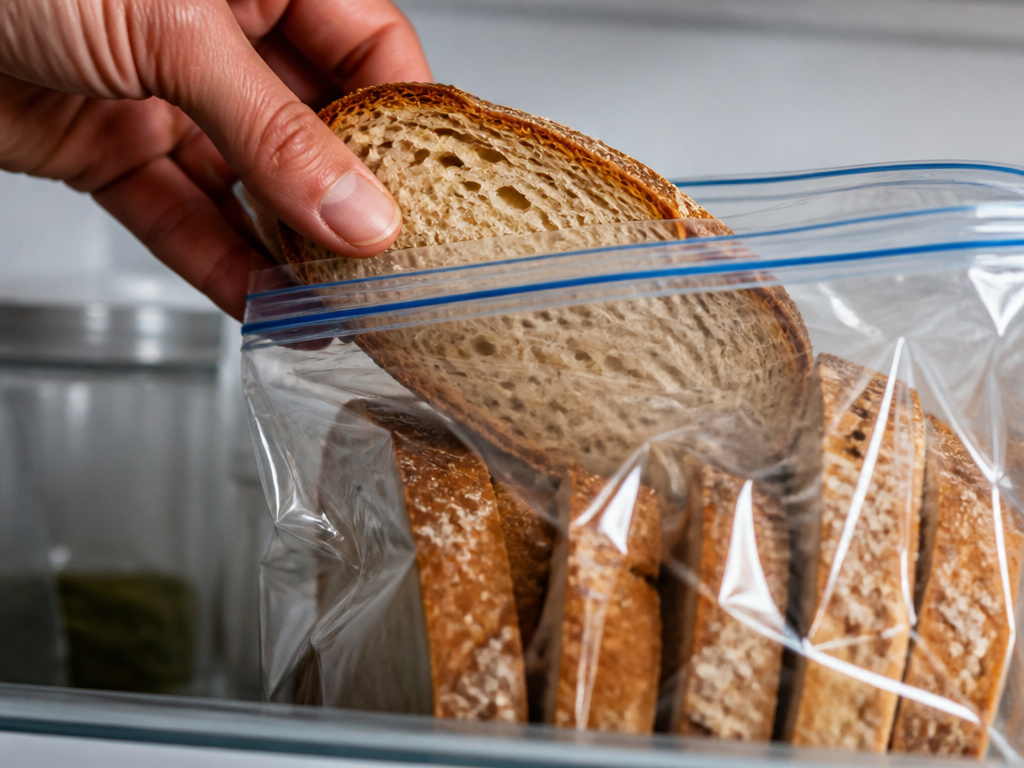
The universal advice is “never refrigerate sourdough.” It’s right for a whole loaf. The cold dramatically accelerates starch retrogradation, the reorganization of starch molecules that makes bread hard and dry. A loaf left on the counter might stale in 4 days. The same loaf in the fridge will be rock-hard in 2.
However, research reveals a narrow exception. The same 2021 German bread study stored mixed-type sourdough in a low-density polyethylene (LDPE) plastic bag at 8°C. No mold growth was detected after 10 days, even though that same plastic bag promoted spoilage at room temperature.
The edge case: You have pre-sliced sourdough that you plan to use for toast exclusively, and mold is a bigger concern than staleness. In that scenario, storing the slices in a sealed plastic bag in the fridge can prevent microbial growth for over a week. The texture will be poor, but toasting will re-crisp it.
For any bread with mix-ins like cheese, olives, or cooked meats, refrigeration is mandatory for food safety. Eat it within 2-3 days.
Frequently Asked Questions
How long does homemade sourdough bread last at room temperature?
Whole, uncut homemade sourdough loaf lasts 4-5 days at peak quality when stored correctly in a breathable bag or box at 18-21°C. It remains safe to eat for up to a week, but the crust will toughen and the crumb will dry noticeably after day 3. Once sliced, plan to consume it within 2-3 days.
Can you store sourdough bread in a microwave?
Yes, an unplugged microwave is an excellent makeshift bread box. It’s a dark, enclosed space that buffers against temperature swings. Place your cloth-wrapped loaf inside. Do not leave it in a plastic bag, as the lack of airflow will create a humid environment perfect for mold.
What is the best way to store a cut sourdough loaf?
Place the loaf cut-side down on a cutting board for the first day to protect the exposed crumb. For subsequent days, store the partial loaf in a bread box or wrap the cut end tightly in beeswax or cloth, leaving the crust exposed. This minimizes moisture loss from the cut surface while letting the crust breathe.
Why did my sourdough bread get moldy so fast?
Two likely causes: the bread was stored while still warm, trapping steam inside the bag, or it was kept in a sealed plastic container in a warm kitchen. Both create a high-humidity microenvironment. Mold spores are everywhere; they germinate rapidly when humidity exceeds 80%. Always cool completely and prefer breathable storage.
Is it better to store sourdough in a paper bag or plastic bag?
Use a paper bag if you value a crisp crust and will eat the bread within 2 days. Use a loose plastic bag only if your priority is a soft crumb for 1-2 days and your kitchen is cool (below 21°C). The plastic bag is a higher-risk choice due to humidity buildup.
The Bottom Line
For daily eating, a cloth bag in a cool kitchen corner is all you need. For holding quality beyond a few days, your freezer is the most powerful tool you have, slice and wrap tightly. Remember the 18-21°C target; it’s the difference between a loaf that stays enjoyable and one that forces you to make croutons by Wednesday. Finally, that industrial MAP data proves the point: managing the atmosphere around your bread is the entire game. At home, that means choosing the right container for the humidity you’ve got.
