How to Store Rice Krispie Squares: Keep Them Soft & Chewy
This post contains affiliate links. As an Amazon Associate, we earn from qualifying purchases.
Store Rice Krispie squares at room temperature in an airtight container for 2-3 days to keep them soft and chewy. Refrigeration below 40°F makes them hard and stale within hours, while freezing at 0°F preserves them for up to 3 months. The key is controlling humidity, above 60% makes them soggy, and leaving them uncovered guarantees a texture failure.
That answer hinges on two competing forces: food safety and texture. Refrigeration is safe but destroys the treat’s signature chew. Room temperature is perfect for texture but has a short shelf life because of the marshmallow’s moisture.
What follows is a breakdown of the three storage environments, the exact temperatures and timelines from university food safety guides, and the one mistake with humidity that turns perfect squares into a disappointing mess.
Key Takeaways
- Room temperature (50-70°F) in an airtight container is best for texture but lasts only 2-3 days.
- Refrigeration below 40°F turns treats hard and stale quickly; it’s a last resort for food safety in hot weather.
- Freezing at 0°F in a double-wrapped, airtight package preserves treats for 2-3 months with minimal quality loss.
- Humidity above 60% will make your squares soggy and lose their snap, as outlined in dry goods storage guidelines.
- Commercial Kellogg’s squares are formulated for ambient storage; homemade versions are more sensitive to moisture and temperature swings.
The Room Temperature Rule: Where Texture Wins
For the classic chewy, soft bite, room temperature is the only correct answer. This matches the ambient storage instruction on a Kellogg’s Rice Krispies Squares package. The goal is to keep the marshmallow binder pliable without introducing moisture from the air or drying it out.
Common mistake: Using a loose lid or plastic wrap. An unsealed container lets in ambient humidity, which the cereal absorbs. You get soggy squares with no snap left in them within a day.
The ideal range is between 50°F and 70°F, which aligns with the optimal dry storage conditions for cereals. At this temperature, the treat’s structure stays intact. The shelf life is short, about 2 to 3 days at peak quality. After that, the marshmallow begins to dry out and the cereal loses its crispness.
Your container choice matters more than the cupboard you use. A glass or plastic container with a tight-sealing lid beats a plate covered with foil. For long-term storage of dry pantry staples like the cereal itself, this principle is non-negotiable.
| Container Type | Advantage | Risk If Skipped |
|---|---|---|
| Airtight plastic/glass | Blocks humidity, maintains texture | Squares absorb moisture, become soggy in 24 hours |
| Plate with foil wrap | Quick, convenient | Edges dry out, center becomes tacky |
| Original box (sealed) | Fine for unopened commercial bars | Opened box offers zero protection |
If your kitchen is particularly warm or humid, the clock ticks faster. This is why mastering general food storage fundamentals applies directly to keeping treats fresh.
Refrigeration: The Texture Trade-Off for Safety
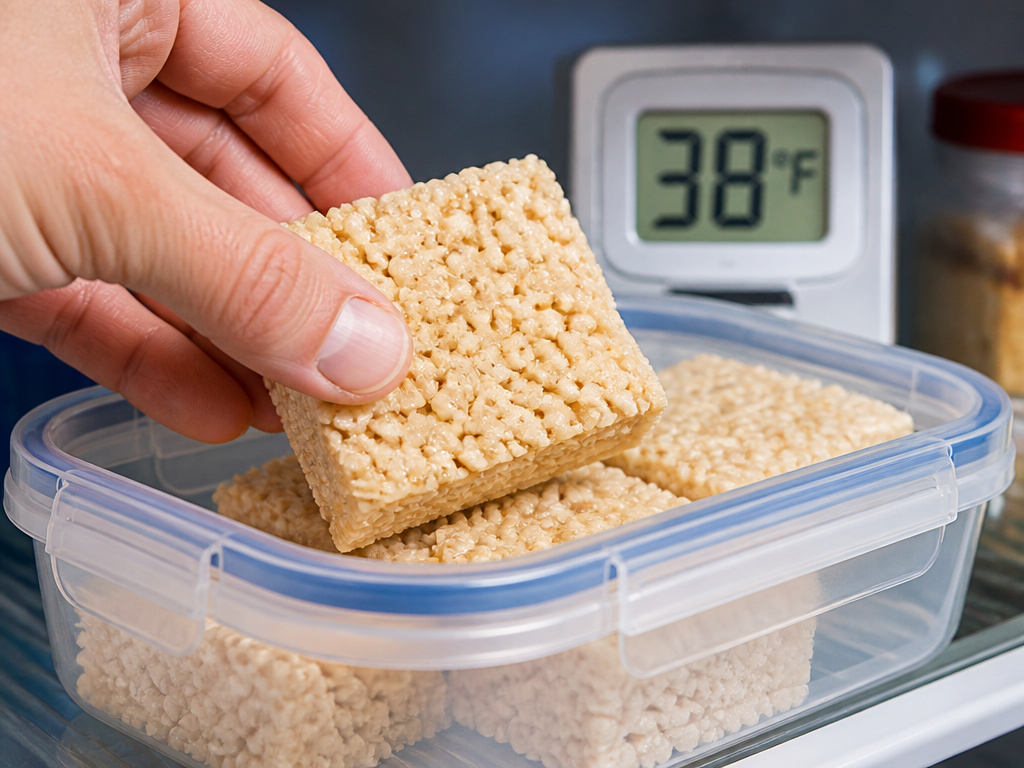
Refrigeration is where most guides give vague advice. The university extension publications are clear: your refrigerator should sit between 34°F and 40°F to safely slow bacterial growth. Putting Rice Krispie squares in that environment is safe, but it comes with a severe textural cost.
The cold, dry air of a fridge actively pulls moisture from the marshmallow and into the atmosphere. The treat doesn’t just get firm; it becomes hard and crumbly. This happens within a few hours, not days.
Where this goes sideways: Storing treats uncovered in the fridge. This maximizes moisture loss, turning them into rock-hard bricks that taste stale. If you must refrigerate, an airtight container is mandatory.
So when does this trade-off make sense? Only in two scenarios: during a heat wave where your kitchen stays above 80°F for days, or if your homemade version includes a perishable add-in like cream cheese. In those cases, prioritize safety and accept the texture change. Let the treat sit on the counter for an hour before eating; it won’t fully recover, but it will soften slightly.
The principle is similar to storing condensed milk after opening, the cold prevents spoilage of a sugar-rich ingredient, but it can alter consistency.
Freezing Rice Krispie Squares: The Long-Term Solution
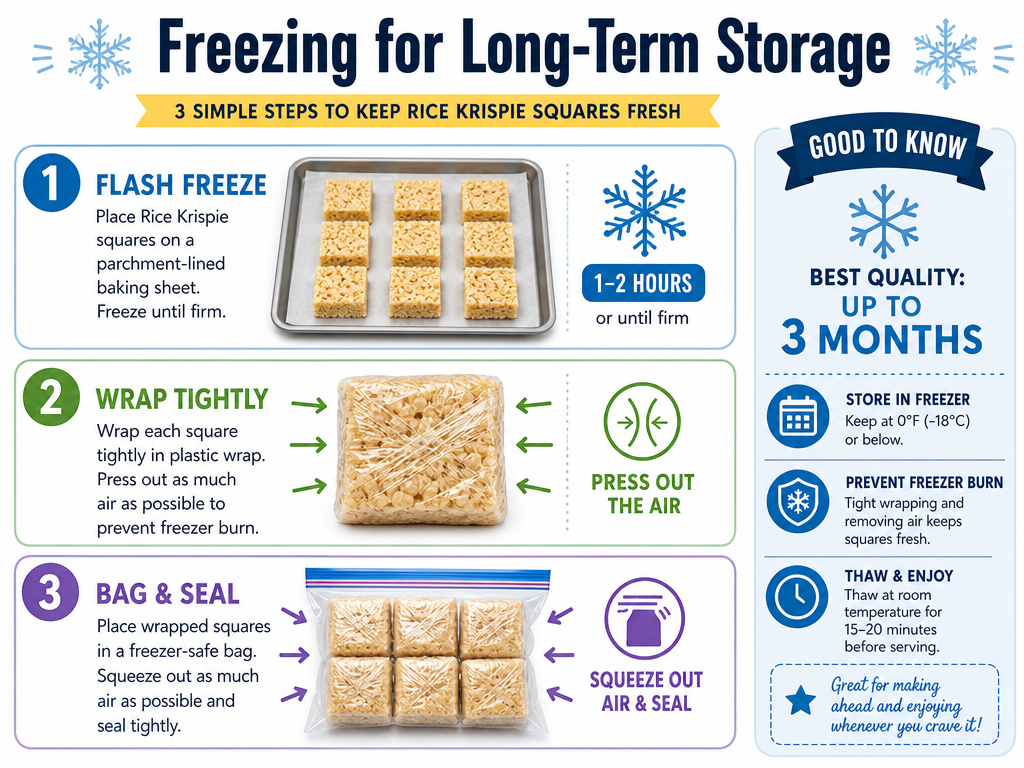
Freezing is the best method for storage beyond three days. At 0°F or lower, all molecular activity, including staling and moisture migration, virtually stops. The UC ANR refrigerator storage guide confirms that baked goods like bars and cookies can be frozen for 6-12 months, but for Rice Krispie treats, 3 months is the practical limit for best quality.
The process requires more than tossing the pan in the freezer. You need a double barrier against freezer burn.
- Flash-Freeze Individually: Place squares on a parchment-lined baking sheet and freeze for 1-2 hours until solid. This prevents them from sticking together into a block.
- Wrap Tightly: Wrap each square tightly in plastic wrap, pressing out all air.
- Seal in an Airtight Container: Place the wrapped squares in a freezer bag or rigid container. Squeeze out excess air and seal.
Skipping the individual wrap means ice crystals will form on the surface, giving the marshmallow a grainy, unpleasant texture upon thawing. Thaw them overnight in the refrigerator or for a few hours at room temperature while still wrapped to prevent condensation.
The 2-Hour Rule and Food Safety
This is the non-negotiable line. Perishable foods left in the “danger zone” between 40°F and 140°F allow bacteria to multiply rapidly. The Virginia Cooperative Extension food storage guide states the rule clearly: discard food left out for more than 2 hours, or 1 hour if the ambient temperature is above 90°F.
Discard all refrigerated and frozen foods that may have been at room temperature more than 2 hours (or 1 hour if the ambient temperature is above 90°F).
Rice Krispie squares, especially homemade ones, are a perishable food. The moisture in the marshmallow and the potential for cross-contamination during preparation create a risk. While the high sugar content is somewhat inhibitory, it is not a reliable preservative at room temperature for extended periods.
| Scenario | Max Time Out | Reason | Action After Limit |
|---|---|---|---|
| Cool kitchen (<70°F) | 2 hours | Bacterial growth risk becomes significant | Discard |
| Hot day (>90°F) | 1 hour | Pathogens multiply exponentially | Discard |
| With dairy add-ins | 2 hours | Higher risk, shorter practical window | Discard |
This rule reframes the room-temperature recommendation. It’s not just about texture; it’s a safety countdown. Your 3-day storage window assumes the treats are sealed and protected immediately after cooling.
Humidity: The Invisible Enemy
If temperature controls safety and texture, humidity controls crispness. Cereal is a dry, porous material that eagerly absorbs water vapor from the air. The Texas A&M AgriLife Extension guide notes that dry foods stored in humidity greater than 60% may become caked and stale.
For Rice Krispie squares, high humidity means the toasted rice cereal loses its snap, crackle, and pop and turns soft and soggy. This can happen even in a cool room if the air is damp.
You combat this with airtight containers and by being mindful of storage location. Don’t store them above the dishwasher or next to the kettle where steam is frequent. This same vigilance is required for keeping rice pest-free and other dry grains.
Easy to miss: The container’s seal degrades over time. A plastic container that warps after 50 uses no longer counts as airtight. Check the lid’s fit every few months.
Commercial vs. Homemade: A Storage Difference
A store-bought Kellogg’s Rice Krispies Square and a homemade treat are different products. The commercial version contains humectants like glycerol and specific emulsifiers (E472e, E472a) that are designed to retain moisture and maintain a soft texture in varied ambient storage conditions. It’s a stable, shelf-stable snack bar.
Your homemade version has none of those industrial stabilizers. It relies on the basic properties of marshmallow and butter. This makes it more delicious but also more fragile, more susceptible to drying out in the fridge, getting soggy from humidity, and staling at room temperature.
Therefore, treat homemade squares with more care. Assume a shorter room-temperature shelf life (2 days vs. 3). Be more fastidious about airtight sealing. View freezing not as an option, but as the standard method for making them ahead. The principles of proper rice storage apply here: the purer the ingredient, the more protection it needs from its environment.
Frequently Asked Questions
Can you freeze Rice Krispie squares?
Yes, freezing is the best method for long-term storage. Individually wrap squares in plastic wrap and place them in an airtight freezer bag or container. They will maintain good quality for 2-3 months at 0°F. Thaw in the refrigerator overnight.
How long do Rice Krispie treats last?
At cool room temperature (below 70°F) in an airtight container, they are best eaten within 2-3 days. In the refrigerator, they become hard and stale within 1-2 days. In the freezer, they last for 2-3 months.
Why did my Rice Krispie treats get hard?
They got hard because they lost moisture to dry air, likely from being stored uncovered or in the refrigerator. The cold, dry environment of a fridge pulls moisture from the marshmallow binder very quickly. Always store in an airtight container at room temperature for the softest texture.
Can I store them in the fridge to make them last longer?
You can, but you shouldn’t if texture is a priority. Refrigeration below 40°F will make them hard and stale much faster than room-temperature storage. Only refrigerate if your kitchen is very hot (above 80°F) or if the treats contain perishable ingredients like fresh fruit or cream cheese.
How do I keep Rice Krispie treats from getting soggy?
Sogginess is caused by humidity. Store them in an absolutely airtight container in a cool, dry place. Do not store them near sources of steam like a stovetop or dishwasher. If you live in a humid climate, the airtight seal is non-negotiable.
What’s the best container for storing them?
Rigid plastic or glass container with a locking, silicone-gasketed lid is best. It provides a true airtight seal that neither plastic wrap nor a loose-fitting lid can achieve. This is the same type of container recommended for optimal rice storage conditions.
The Bottom Line
For fresh Rice Krispie squares, an airtight container at cool room temperature is the only way to preserve their perfect chew. Commit to the 2-3 day window and eat them within it. For longer storage, the freezer is your reliable friend, just wrap them tightly. Never let the fridge be your default; it’s a tool for food safety emergencies, not quality. Your goal is to lock in the texture you worked to create, and that battle is won against temperature and humidity with a good lid.
