What Is a Freezer Bag? Understanding Vital Standards & Specs
This post contains affiliate links. As an Amazon Associate, we earn from qualifying purchases.
A freezer bag is a thick, food-safe plastic bag engineered to remain flexible and airtight at subzero temperatures, preventing freezer burn and contamination. Its design is governed by standards like EN 14867:2005, which mandate specific thickness, seal strength, and material durability for long-term frozen storage.
The standard published in 2005 is a checklist of physical tests a bag must pass to be sold as a freezer bag in Europe. The thickness, the seal’s grip at -20°C, and the plastic’s resistance to becoming brittle are verified requirements, not marketing claims.They’re verified requirements.
What follows: the two certifications that separate real freezer bags from thick storage bags, the exact loading math that keeps your food from spoiling in a working freezer, and the one packing mistake that causes freezer burn within weeks.
Key Takeaways
- A genuine freezer bag meets material standards like EN 14867:2005 for thickness and low-temperature performance, not just a marketing claim.
- Freezer burn is a quality issue, not a safety one, it’s caused by air exposure, which thick, well-sealed bags are designed to prevent.
- You must limit your freezer load to 2-3 pounds of unfrozen food per cubic foot of space; overloading slows freezing and ruins texture.
- Most foods need headspace for expansion, but items like broccoli, asparagus, and bony meats do not, packing them tight prevents ice crystals from forming inside the bag.
- Reuse bags for the same type of dry food, but never reuse a bag that held raw meat, fish, or allergens.
What Makes a Bag a ‘Freezer Bag’?
Look past the label on the box. The difference between a freezer bag and a regular storage bag is written in millimeters and material science.
A standard plastic storage bag might be 1.5 to 2 mils thick (a mil is one-thousandth of an inch). A true freezer bag starts at 3 mils and often runs to 5 mils. That extra thickness isn’t for feel; it’s a barrier. At 0°F, thin plastic becomes brittle. A bone tip, an ice crystal, a sharp berry stem, any of them can puncture a thin bag in a week. The 3-5 mil wall resists that.
The seal is the other half. It must lock and hold at low temperatures. A weak seal lets air in. Air carries moisture away from your food’s surface, creating the dry, grainy patches of freezer burn.
Freezer Bag Standard EN 14867:2005 specifies dimensional characteristics, mechanical requirements, and fitness-for-purpose tests for plastic bags used for freezing foodstuffs. This includes verification of seal integrity and material flexibility at freezer temperatures.
This is why a brand like Ziploc lists “double zipper strength” and “freezer toughness” as features on its freezer bags. They’re not just selling a thicker bag; they’re guaranteeing the seal won’t fail when you need it most. A regular bag might close, but its seal can become brittle and micro-crack under constant freeze-thaw cycles.
The Two Tests a Real Freezer Bag Passes
If you want to know if a bag is legit, look for two things: a thickness specification and a reference to a food-contact material standard.
First, the thickness. While not always printed on consumer boxes, manufacturers design to a known range. Ask yourself: is this bag flimsy, or does it have a substantive, resistant feel? A bag that you can easily stretch and see through is likely under 2 mils, it’s a storage bag, not a freezer bag.
Second, the material safety. In the United States, food-contact plastics fall under FDA oversight. A bag labeled for freezer use has been evaluated for what substances might migrate into food at freezing temperatures. Polyethylene, the most common material, does not contain BPA. The real risk isn’t the plastic at 0°F; it’s using a bag not rated for food contact, or one that’s too thin for the job.
You don’t need a lab. Your checkout test is simple: pick a brand that states “for freezer use” and feels robust. Skip the thin, generic “storage bags” sold in bulk for organizing. They fail the thickness test every time.
| Characteristic | Freezer Bag | Regular Storage Bag |
|---|---|---|
| Material Thickness | 3–5 mils | 1.5–2 mils |
| Primary Purpose | Prevent freezer burn, withstand prolonged subzero temps | Short-term fridge storage, organization |
| Seal Strength | Double-track or reinforced lock designed for cold | Single-track zip, can become brittle when frozen |
| Material Safety | Rated for food contact at freezing temperatures | May be rated for food contact, but not tested for freeze-thaw stress |
How to Pack a Freezer Bag Correctly
The bag is a tool. Using it wrong defeats its purpose. The goal is to remove the enemy: air.
Start with dry food. If you’re freezing blanched vegetables, pat them dry. Moisture inside the bag turns into ice crystals between the food pieces, creating a frosty block. For liquids like soup or stock, freeze them flat first in a tray, then transfer the frozen block to a bag. This gives you a stackable brick, not a liquid-filled balloon.
Now, remove the air. The water-displacement method is the most effective. Lower the filled, unsealed bag into a bowl of cold water. Let the water pressure push the air out toward the top. Keep the water from entering the zipper track. Once the air is gone, seal the bag while it’s still submerged.
Common mistake: Leaving a large air pocket at the top. That air pocket is where freezer burn begins. The same quality loss that happens in a year at 0°F occurs in three months at 10°F, and in just five days at 30°F. An air pocket raises the temperature around that section of food, speeding up the damage.
Headspace is your next decision. Most foods expand as they freeze. Leave about a half-inch of space between the food and the seal for things like soups, fruits in syrup, or casseroles. However, some items are exceptions. The NDSU food freezing basics guide notes that asparagus, broccoli, bony meat pieces, and breads should be packed tightly with no headspace. Their structure doesn’t expand uniformly; giving them space lets ice crystals form inside the bag, leading to frost.
The Math of Freezer Loading
Your freezer is a machine, not a black hole. Dumping in ten pounds of unfrozen food at once breaks it.
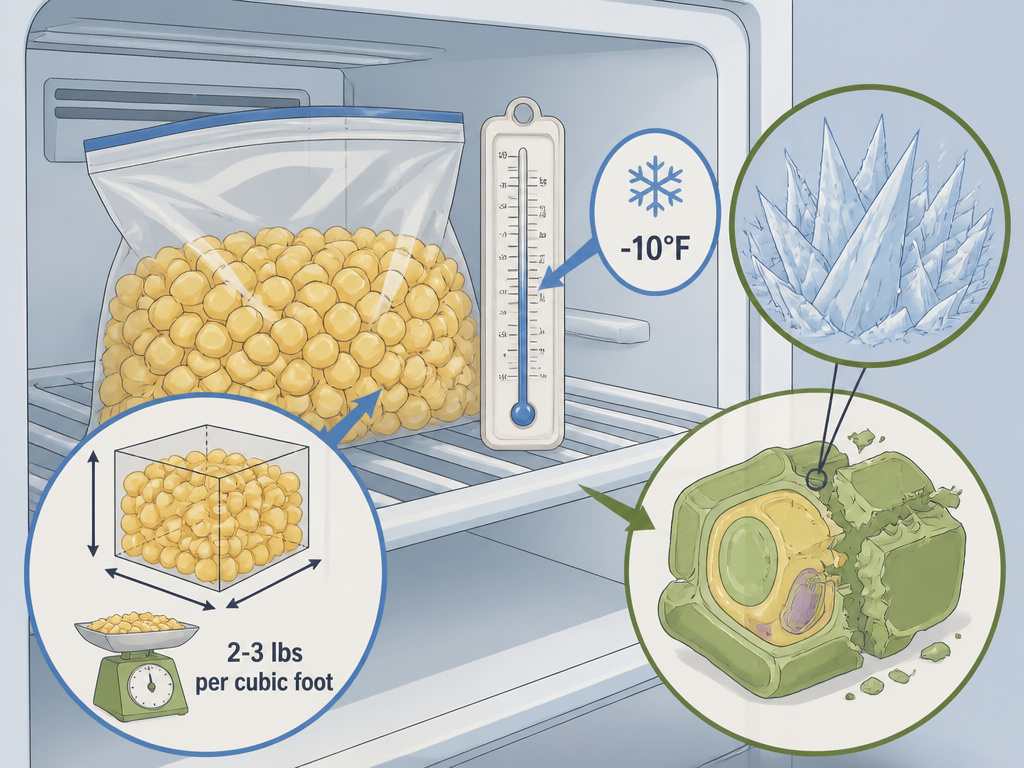
The cooling coils can only remove heat so fast. Overload them, and the temperature inside the freezer rises. Food freezes slowly. Slow freezing creates large, jagged ice crystals inside the food’s cells. Those crystals rupture cell walls. When you thaw it, the food leaks moisture and turns mushy.
The rule is 2 to 3 pounds of unfrozen food per cubic foot of freezer space. Find your freezer’s cubic footage (it’s on the label). If you have a 10-cubic-foot freezer, you can safely add 20-30 pounds of room-temperature food at one time. That’s it.
To make it work, set your freezer to -10°F about 24 hours before you plan to add a big batch. This gives you a cold buffer so the temperature stays at or below 0°F during the freezing process. This is especially critical when you’re doing a large batch of freezer corn or freezer breakfast burritos.
Freezer Burn vs. Food Safety
People confuse these two. They are not the same.
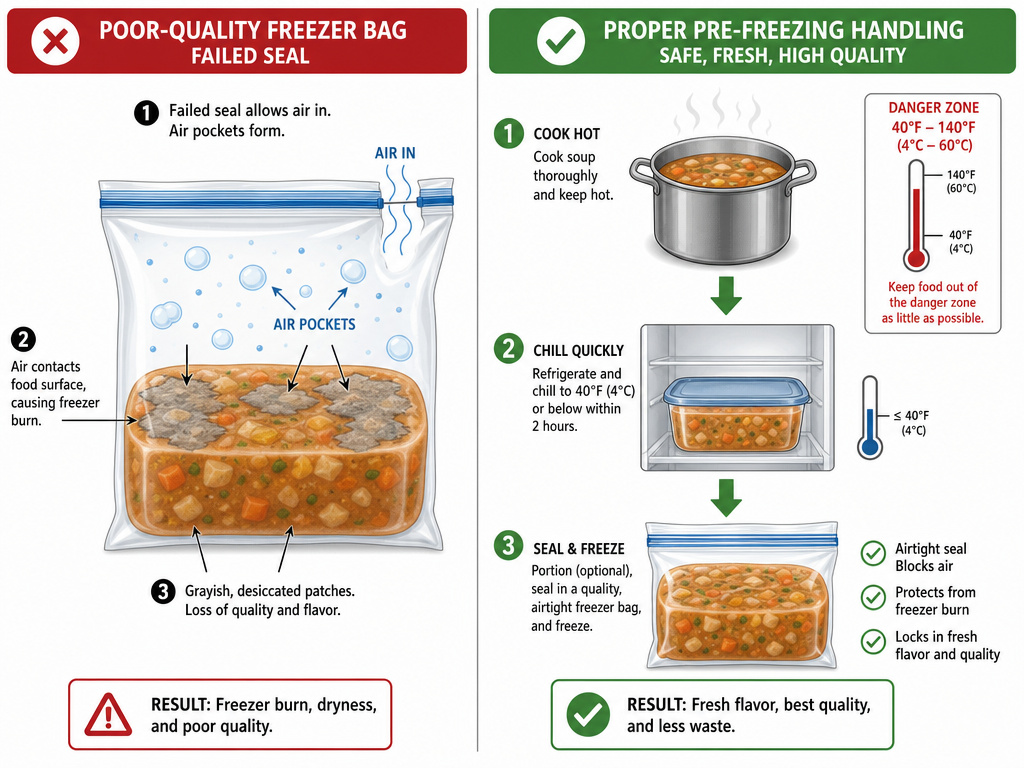
Freezer burn is a quality problem. It’s the dry, leathery, grayish-brown patches that form when air reaches the food’s surface. It happens because the bag was poor, the seal failed, or you left an air pocket. The food is still safe to eat. The texture is ruined. You can often trim off the affected area and use the rest.
Food safety in the freezer is about temperature and time before freezing. Bacteria and molds are dormant at 0°F, but they are not killed. If food spent too long in the “danger zone” (40°F to 140°F) before you froze it, the microbes are still there, waiting. Once thawed, they wake up and multiply as if no time had passed.
This is why you chill food rapidly before bagging and freezing. Don’t bag a hot pot of soup. Cool it in the fridge first, then pack it into quality freezer bags for long-term storage. The bag protects quality; your handling before the bag determines safety.
Can You Reuse Freezer Bags?
Yes, but with a strict rule.
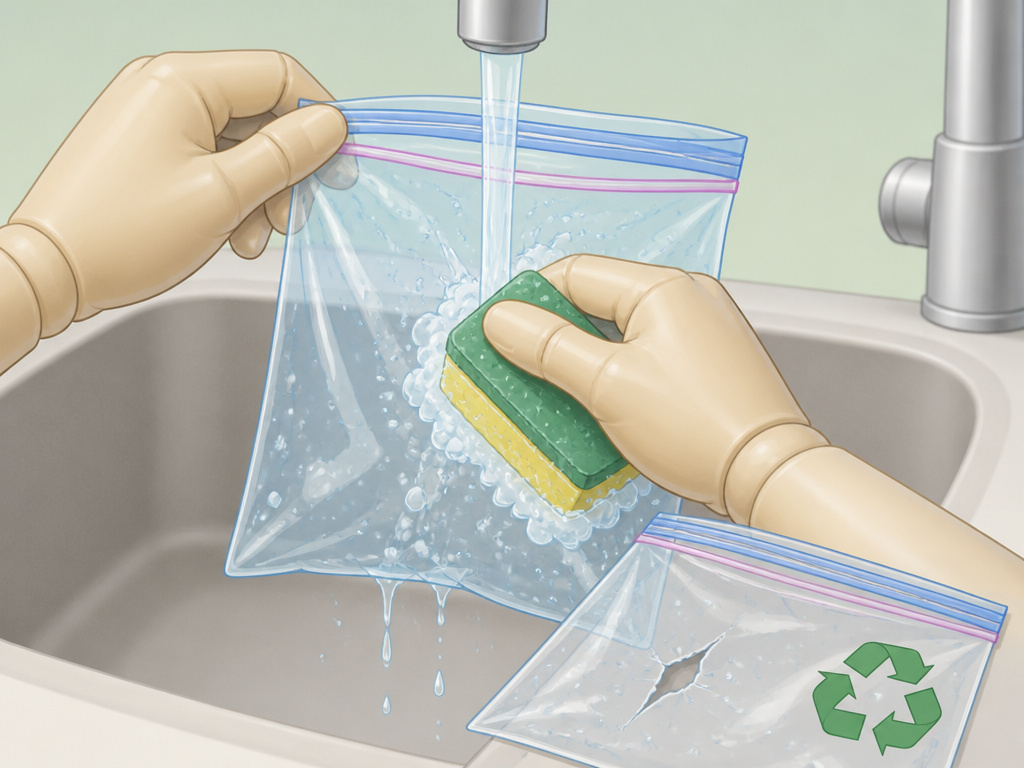
Wash the bag thoroughly with warm, soapy water. Rinse it completely. Turn it inside out to air-dry. Check for any nicks, tears, or a stretched-out seal. If it’s damaged, recycle it.
Now, the rule: Never reuse a bag that held raw meat, fish, eggs, or common allergens. The risk of cross-contamination is too high, even with washing. The plastic can retain microscopic residues and proteins.
Reuse bags for the same category of dry, benign foods. The bag you used for freezing tomatoes can be washed and used for bell peppers. The bag for bread can be used for rolls. This practice is economical and reduces waste, but safety always trumps convenience.
Freezer Bags vs. Other Frozen Storage
Freezer bags are one option in a toolkit. Knowing when to use them, and when to use something else, saves food.
For long-term storage of bulky, dry items (like a whole chicken, a roast, or a batch of muffins), a freezer paper wrap followed by a bag is the gold standard. The paper provides an extra layer of protection against punctures and air.
For liquids, especially those you might want to reheat directly, consider rigid containers. Freeze soups or stocks in silicone molds or glass containers first, then pop the frozen block into a bag. This avoids the risk of a leak from a faulty seal and is perfect for freezing soup.
For delicate berries or herbs that clump, the “tray freeze” method is essential. Spread the food in a single layer on a tray, freeze until solid, then pour the individual pieces into a bag. This prevents a giant, unusable ice block.
| Storage Method | Best For | Risk If Used Wrong |
|---|---|---|
| Freezer Bags | Dry vegetables, fruits, baked goods, portioned meats | Leaks if overfilled; freezer burn if not air-tight |
| Freezer Paper + Bag | Large, irregular cuts of meat, whole fish | More steps; paper alone is not airtight |
| Rigid Containers | Liquids (soups, stocks), semi-liquids (stews) | Takes more space; can crack if overfilled |
| Vacuum Sealer Bags | Very long-term storage, preventing all air exposure | Equipment cost; bags are single-use |
Frequently Asked Questions
Are freezer bags BPA-free?
Most consumer freezer bags are made from polyethylene, which does not use BPA in its production. For assurance, look for a “BPA-free” label on the box, but the primary safety designation to trust is “for freezer use” or “food contact.”
Can I use a regular Ziploc bag in the freezer?
You can, but you shouldn’t for anything beyond very short-term storage. Regular bags are thinner and have seals not engineered for the stress of freezing, making them far more likely to leak, tear, or allow freezer burn. The manufacturer states its freezer bags are “designed to protect in very low temperatures.”
What is the best way to thaw food in a freezer bag?
The safest method is in the refrigerator overnight. For quicker thawing, place the sealed bag in a bowl of cold water, changing the water every 30 minutes. Do not thaw at room temperature. Never microwave a freezer bag unless the packaging explicitly states it is microwave-safe; most are not.
How do I prevent leaks?
Three things: don’t overfill, ensure the sealing track is clean and dry before closing, and use the water-displacement method to remove air. For liquids, leave adequate headspace (about an inch) for expansion. Double-bagging is an option for very long storage or valuable food.
Is freezer burn dangerous?
No. Freezer burn is a texture and quality issue caused by dehydration and oxidation. It is not a sign of spoilage or bacterial growth. You can cut away the affected area and consume the rest of the food safely.
Before You Go
A freezer bag is defined by its thickness, its seal, and its certification. It’s a specific tool for a specific job. Thickness fights punctures. The seal locks out air. Certification means it’s been tested.
Use it right. Remove the air. Respect the loading limit. Know what doesn’t need headspace. Reuse it wisely.
That’s how you stop freezer burn before it starts. Your food keeps its texture, its color, and its taste. That’s the whole point.
