What Should Temperature Be in Your Fridge? Safe vs. Ideal
This post contains affiliate links. As an Amazon Associate, we earn from qualifying purchases.
Your refrigerator should be at 40°F (4.4°C) or below to meet the FDA’s food safety standard, but for actual food preservation, aim for 37°F (2.8°C). This 3-degree gap is where bacteria slow from a crawl to a near-stop, buying you extra days before spoilage starts. The freezer needs to hit 0°F (-17.8°C).
Those numbers are ceilings, not recommendations. Hitting 40°F exactly means any warm spot in the fridge is already in the danger zone. The FDA’s limit is a public health line; your fridge’s performance is a mechanical reality. They are not the same thing.
What follows: why 37°F beats 40°F, how to find your fridge’s actual temperature (not the display), the three things that trick your thermostat, and the one spec sheet clause that voids your warranty if you put the unit in a garage.
Key Takeaways
- 37°F (3°C) is the target, not 40°F (4°C). The colder end of the safe range dramatically slows bacterial growth.
- Your fridge’s display shows the setting, not the reality. You need a standalone thermometer placed on the middle shelf, left overnight.
- Ambient temperature breaks everything. Installing a standard kitchen fridge in a garage below 50°F can cause the fresh food compartment to freeze.
- Overcrowding is a temperature killer. Blocking the air vents with food creates warm pockets where spoilage starts unseen.
- “Auto” modes are energy hogs. Functions like Bosch’s Super Cooling or Miele’s Party Mode run the compressor flat-out for 12-15 hours, use them only before loading a week’s groceries.
The One Number That Matters Most (And Why It’s Not Enough)
The FDA’s 40°F rule is the law. It’s the line where bacterial growth, for pathogens like Listeria and Salmonella, shifts from dangerous to potentially catastrophic. But a fridge sitting at 40°F on the dot is a fridge already flirting with failure.
A refrigerator thermometer is the only way to verify the actual temperature. Built-in displays often show the target setting, not the air temperature at the food level. The FDA states cold air must circulate to keep food properly chilled, and an inexpensive freestanding appliance thermometer allows you to monitor and adjust.
The mechanism is simple: temperature distribution inside a fridge is uneven. The back wall is colder, the door shelves are warmer, and the center is a compromise. If your thermometer reads 40°F in the middle, the back could be 34°F and the door could be 45°F. Food on the door enters the “danger zone” above 40°F every time you open it. The solution is to aim lower, creating a safety buffer.
Where this goes sideways: Relying on the digital display. That number is what the thermostat is trying to achieve, not what’s happening around your milk. A Frigidaire manual states its fresh food compartment can range from 34°F to 44°F (1°C to 7°C) depending on load and ambient conditions. The display might say 37°F while the actual air temperature is 43°F.
You need a standalone thermometer. Leave it on the middle shelf overnight. Read it in the morning before opening the door. That’s your baseline.
How to Actually Measure Your Fridge’s Temperature
Forget the buttons on the front. Your fridge’s brain lies to you, politely. The only truth comes from a device it doesn’t control.
Here’s the real sequence, confirmed by multiple manufacturer manuals:
- Get a standalone appliance thermometer. Not a meat probe, not an outdoor gauge. One designed for fridge/freezer use.
- Place it on the middle shelf, toward the front. This spot best represents the “average” air temperature your food experiences. Don’t let it touch the walls or food.
- Leave it alone for at least 12 hours. A Bosch manual notes it can take up to 12 hours for a set temperature to stabilize after adjusting the setting or adding a large load of food. Overnight is perfect.
- Read it first thing in the morning. This gives you the temperature at its most stable, after the compressor’s had a long, quiet period to maintain the set point.
Check the freezer the same way. The target is 0°F (-17.8°C). If it reads +5°F, your ice cream gets soft and your frozen peas will develop freezer burn within weeks.
| Checking Method | What It Tells You | Risk If Skipped |
|---|---|---|
| Built-in Display | Thermostat setting goal | Actual food zone could be 5°F warmer, moving perishables into the danger zone. |
| Standalone Thermometer (Middle Shelf) | True air temperature at food level | You miss warm spots where bacteria multiply, thinking you’re safe when you’re not. |
| Glass of Water Trick | Approximate liquid temp (slower to change) | Less responsive than air; can lag behind actual air temperature shifts by hours. |
TL;DR: Buy a $10 fridge thermometer. Use it. Adjust your settings until the middle shelf holds 37°F. Your food will thank you with extra days of crispness.
37°F vs. 40°F: The Science of Slowing Decay

Bacteria don’t have an on/off switch at 40°F. They have a throttle. Lowering the temperature from 40°F to 37°F doesn’t stop growth; it reduces the rate exponentially.
Think of it like a car slowing from 60 mph to 30 mph. It’s still moving, but the time to reach a dangerous distance (spoilage) doubles. At 40°F, some pathogens like Listeria can still slowly multiply. At 37°F, their activity grinds nearly to a halt. This is why brands like Frigidaire recommend 37°F (2.8°C) as the ideal setting, it builds in a buffer against the fridge’s own imperfections.
I won’t recommend the “OK” sticker some Bosch models include. It only confirms the fridge is at or below +4°C (39.2°F). That’s the bare minimum. Your milk still sours on schedule.
The why-layer matters here. Refrigeration doesn’t kill bacteria; it puts them in suspended animation. Every degree closer to freezing extends the shelf life of everything from lettuce to chicken broth. The energy cost of maintaining 37°F versus 40°F is marginal, a few dollars a year, but the food savings are immediate. You throw out less.
The part nobody mentions: Your fridge works harder when full. Adding a dozen warm groceries forces the compressor to run longer to bring the mass back down to temperature. That’s what “Super Cooling” modes are for, they pre-chill the cavity. Use them. But know they’re a short-term energy spike to prevent a long-term food-waste loss.
Why Your Fridge Lies: Thermostats, Zones, and Load
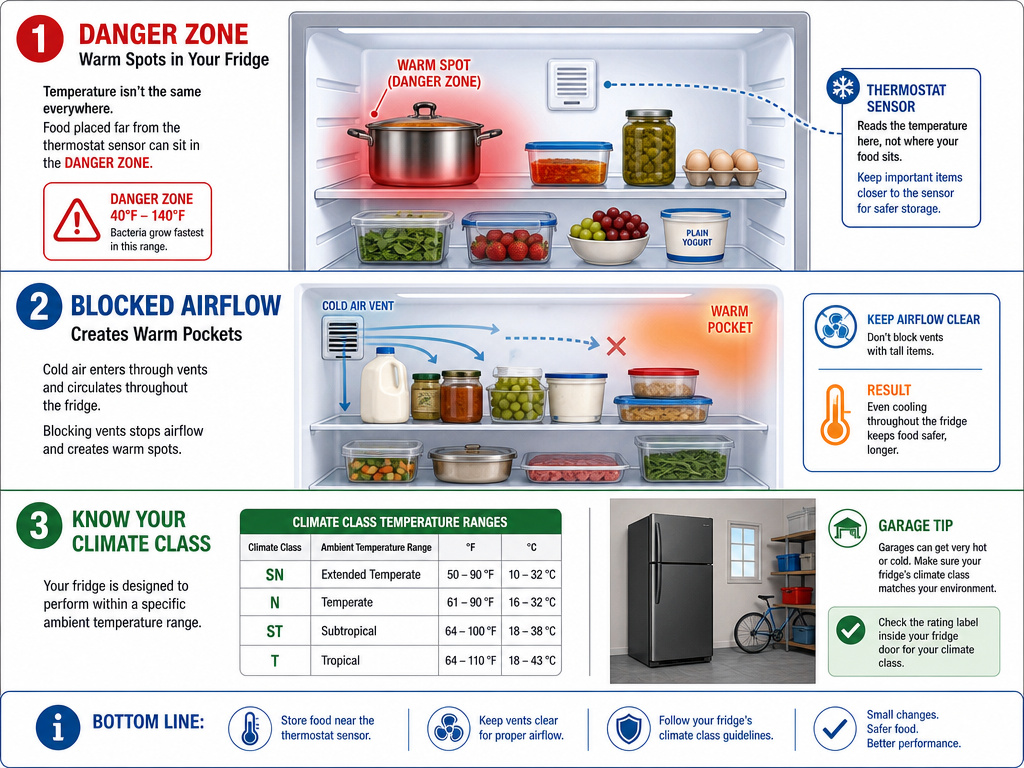
Your refrigerator is a bad liar. It wants to be cold, but physics gets in the way. Three things routinely fool its temperature sensor:
- Thermal Mass (The “Full Fridge” Effect). Dump a pot of warm soup on the top shelf. The surrounding air heats up, the thermostat detects it, and the compressor kicks on. But the sensor is usually on the back wall. It might cool down long before the air around your soup does. That soup stays in the danger zone for hours.
- Airflow Blockage (The “Overpacked” Effect). The Frigidaire manual explicitly warns against overcrowding shelves and placing food in front of air ports. Cold air needs to circulate. Block the vents with a gallon of milk, and the opposite corner becomes a warm, stagnant pocket. Spoilage starts there, unseen.
- Ambient Temperature (The “Garage” Problem). This is the big one. Your fridge is designed for a kitchen, not a utility room.
| Climate Class (Per Bosch) | Permitted Ambient Temp Range | What Happens Outside This Range |
|---|---|---|
| SN (Subnormal) | 50°F to 90°F (10°C to 32°C) | Standard for most European kitchens. |
| N (Normal) | 61°F to 90°F (16°C to 32°C) | Most common for US models. |
| ST (Subtropical) | 61°F to 100°F (16°C to 38°C) | For hotter climates. |
| T (Tropical) | 61°F to 109°F (16°C to 43°C) | For high-heat environments. |
If your garage dips below 50°F in winter, a standard kitchen fridge can fail. The compressor doesn’t run enough, letting the freezer warm up. Or, the fresh food compartment can actually freeze because the thermostat is tricked by the cold room air. Brands like Beko explicitly say their larder fridges need an ambient temperature of 41°F (5°C) or above, and to avoid using the fridge compartment altogether if the garage gets below 15°F (-10°C).
Easy to miss: The climate class is buried in the manual, not on the sales sticker. Putting a standard fridge in an unheated space often voids the warranty and guarantees performance issues. You need a garage refrigerator built for wider temperature swings.
Fridge Settings Decoded: What the Numbers Really Mean
That dial with numbers 1 through 7, or 1 through 9, isn’t a temperature gauge. It’s a resistance setting for the compressor. Higher number = more cooling power = colder interior if the ambient conditions are right.
A Bosch manual lists a range of +3°C to +8°C (37°F to 46°F) for the refrigerator compartment. Setting “5” might yield 37°F in a 70°F kitchen, but the same “5” could cause freezing in a 55°F garage. This is why guessing is useless. You must measure.
For units with digital controls, the same principle applies. The LG support page recommends a middle ground of 3°C (37°F), warning that going above 5°C (41°F) risks spoilage, while settings near 0°C (32°F) will freeze your lettuce and eggs.
Here’s the actionable rule: Start at the manufacturer’s recommended default (often 37°F or 4°C). Wait 24 hours. Check with your standalone thermometer. Adjust one degree at a time, waiting another 24 hours between changes. Fridge thermodynamics are slow. Patience is the only tool that works.
The Tools You Actually Need (And One to Skip)
You can manage your fridge’s temperature with two cheap tools and one piece of knowledge.
- A Standalone Appliance Thermometer. This is non-negotiable. It’s your ground truth.
- The User Manual. Find the PDF online if you lost the paper copy. It contains the exact temperature range, climate class, and recommended setting for your model.
- The Knowledge That “Auto” Modes Cost Money. Functions like Miele’s Automatic SuperCool run the compressor at full power for up to 12 hours. They’re for chilling a large grocery haul fast, not for daily use. After the party, turn it off.
Skip the “smart” fridge features that promise perfect temperatures via Wi-Fi. They’re still relying on the same internal sensors that can be fooled by a blocked vent. The analog thermometer doesn’t lie.
A well-organized fridge is a colder fridge. Strategic fridge storage keeps vents clear and allows air to move. Using airtight storage containers prevents moisture loss and odor transfer, which are separate problems from temperature but compound the waste. If you’re battling persistent refrigerator smells, the cause is often a combination of a warm spot and spilled food.
Frequently Asked Questions
What is the safest temperature for a refrigerator?
The safest temperature is 37°F (3°C). This meets and exceeds the FDA’s food safety requirement of 40°F (4°C) or below, creating a buffer against uneven cooling and door openings. It slows bacterial growth more effectively than the minimum standard.
Why is my refrigerator freezing food on the correct setting?
Two likely causes: a faulty thermostat or incorrect ambient temperature. If your fridge is in a space colder than 50°F (like a garage), the external chill can trick the internal sensor, causing the fresh food compartment to over-cool. First, check if your model is rated for your installation location. Also, ensure food isn’t blocking the cold air vent inside.
How often should I check my fridge temperature?
Check it with a standalone thermometer every season. Ambient changes in your kitchen, winter dryness, summer humidity, heating system drafts, can affect performance. Also check anytime you notice food spoiling faster than usual or after you’ve adjusted the temperature setting.
Does a full fridge stay colder?
Full fridge retains cold better once everything is chilled, but it’s harder to cool down initially. Adding a lot of room-temperature food will raise the internal temperature for hours. Use the “Super Cool” or “Power Cool” function before a big shopping trip to pre-chill the empty space, then load the groceries.
What’s the best way to cool hot leftovers before refrigerating?
Divide them into small, shallow containers for fridge. A large, deep pot of soup can take hours to cool in the center, staying in the danger zone. Spreading it out increases surface area, allowing it to reach a safe temperature within an hour. Then, refrigerate immediately.
Can the freezer temperature affect the fridge?
In a single-compressor fridge-freezer combo, yes. The freezer gets cooling priority. If the freezer is set too warm or is overloaded, the compressor may struggle to maintain the fridge temperature. Ensure your freezer temperature is at 0°F (-18°C) for the entire system to work efficiently.
Before You Go
Target 37°F, verify it with a five-dollar thermometer, and never trust the display. Your fridge’s job is to preserve food, not just to be cold. That three-degree gap between the legal minimum and the practical ideal is where most household food waste happens.
If your fridge lives anywhere but a climate-controlled kitchen, download its manual and find the climate class. The wrong ambient temperature breaks more units than faulty compressors. And if you’re shopping for a new unit, remember that a commercial refrigerator for home often has a broader operating range and heavier insulation, solving both the garage problem and the overcrowding issue in one shot. Keep it cold, keep it measured, and keep it full, but never blocked.
