Learn How to Preserve Onions at Home for Long-Term Storage
This post contains affiliate links. As an Amazon Associate, we earn from qualifying purchases.
To preserve onions at home, you need to match the method to the onion type and your storage timeline. Bulb onions last 1-8 months in a cool, dry, dark place at 35-55°F with 65-70% humidity. For longer-term preservation, freeze diced or sliced onions (blanched or raw) or dehydrate slices at 130-140°F for 3-9 hours. Sweet, high-moisture onions should be used first, as they spoil faster.
That temperature and humidity window isn’t a suggestion. It’s the mechanical guard against two things: sprouting, which is triggered by warmth, and mold, which is fueled by dampness. Get one variable wrong and the shelf life collapses.
What follows is a breakdown of cold storage, freezing, and dehydrating, with the exact numbers from university extension guides. You’ll learn why a basement can be perfect or a disaster, how to freeze onions without them turning to mush, and the one prep step that ruins more dehydrated onions than any other.
Key Takeaways
- Store cured bulb onions between 35-55°F (1.7-12.8°C) with 65-70% relative humidity. Warmer temps spark sprouting; higher humidity invites rot.
- Freeze onions within 3 to 6 months for best flavor. After that, they tend to lose potency and can pick up freezer odors.
- Dehydrate onions at 130-140°F (54.4-60°C). Slices should be 1/8 to 1/4 inch thick and dried until brittle, which takes 3 to 9 hours in a dehydrator.
- Sweet onions (Vidalia, Walla Walla) have higher water content and a shorter shelf life. Use them within weeks, not months.
- One soft onion can spoil the whole bag. Check your stored onions every few weeks and remove any that are going soft.
The Cold Storage Sweet Spot
The goal is to slow the onion’s respiration to a crawl. An onion breathes. At room temperature (75-79°F), its respiration rate is 27-29 ml/kg·hr. Drop the temp to near-freezing (32-41°F), and that rate plummets to 3-4 ml/kg·hr. Slower breathing means slower aging.
Onions require 65-70% relative humidity with adequate air circulation (1 cubic meter per minute per cubic meter of onion) for optimal storage. Pungent varieties can last 6 to 9 months at 32°F under these conditions, while mild onions last only 0.5 to 1 month.
Your pantry, basement, or unheated garage must hit two targets: cool and dry. A cabinet away from the stove or fridge exhaust often works. A basement is ideal if it stays above freezing and isn’t damp. An unheated garage works until deep winter.
The University of Maine onion storage guide notes that condensation is the enemy. Bringing cold onions into a warm house makes moisture condense under the skin, which leads directly to rot. If you move onions from a cold shed, let them acclimate in a cooler spot like a mudroom first.
Here’s what happens when you miss the mark:
| Condition | Result | Timeline |
|---|---|---|
| Above 55°F | Sprouting begins | Within 2-4 weeks |
| Above 70% Humidity | Mold and bacterial rot | 1-3 weeks |
| Below Freezing | Cells rupture, onion turns mushy upon thaw | Immediate upon thawing |
| No Air Circulation | Condensation builds, promoting rot | Varies, accelerates in closed bags |
For successful long-term onion storage, start with properly cured onions. The outer skins should be papery and rustle. Never store onions in sealed plastic bags. Use mesh bags, woven baskets, or even old pantyhose to allow air flow. Check the bag every few weeks. Remove any onion that feels soft. One bad one really can spoil the bunch.
Freezing Onions for Cooking
Freezing changes an onion’s cell structure. The water inside expands, breaking cell walls. That’s why a thawed whole onion turns to mush. But for cooking, where texture disappears into soups, stews, and sauces, freezing is a legitimate long-term preserving onions strategy.
You have two paths: blanch or don’t blanch.
Blanching (boiling briefly) deactivates enzymes that cause flavor loss and off-colors over time. It’s the method recommended for best quality. For diced onions, blanch for 1-2 minutes. For small whole pearl onions, the Clemson Extension preserving guide notes to blanch for 3 to 7 minutes until the center is heated. Cool them in ice water immediately, drain thoroughly, and spread on a parchment-lined sheet to freeze solid before bagging.
The no-blanch method is faster. Simply chop, spread on a tray, freeze, and bag. The flavor will be fine for 3 months. After that, it degrades. Frozen onions at 0°F should be used within months for best quality.
Common mistake: Freezing onions in a big clump. You’ll have to thaw the entire bag to use a cup. The tray-freeze method keeps pieces separate.
Here is the step-by-step for the tray-freeze method, which is the one I use most often: 1. Peel and chop. Dice or slice your onions uniformly. Wear glasses or goggles if the fumes bother you. 2. Spread. Lay the pieces in a single layer on a baking sheet lined with parchment paper. Crowding makes them stick together. 3. Flash-freeze. Place the tray flat in your freezer for 2-3 hours, until the pieces are rock-solid. 4. Bag and seal. Transfer the frozen pieces to a heavy-duty freezer bag. Squeeze out all the air, label with the date, and return to the freezer.
Skip this for storing green onions. Their delicate structure doesn’t freeze well. For those, refrigeration or regrowing in water is the better bet.
Drying Onions for Pantry Staples
Dehydrating removes the water that bacteria and molds need. What’s left is intense, shelf-stable flavor. A dehydrator is the right tool, ovens often run too hot, which cooks the onion instead of drying it.
The prep is non-negotiable. Slice uniformly, 1/8 to 1/4 inch thick. A mandoline slicer gives you consistent rings or half-moons. Thicker slices take forever to dry; thinner slices can vanish into nothing.
Consider when and where you dry onions because the odor will permeate the house. Run the dehydrator in a garage, on a porch, or under a stove vent.
No blanching is needed. Arrange the slices in a single layer on dehydrator trays, leaving space between pieces for air flow. Set the temperature to 130-140°F (54.4-60°C). This is the optimum temperature for drying food without cooking it. Drying takes 3 to 9 hours. They are done when they are brittle and snap, not bend.
| Onion Form | Slice Thickness | Dehydrator Temp | Estimated Time | Doneness Test |
|---|---|---|---|---|
| Rings | 1/8 inch | 140°F (60°C) | 3-5 hours | Snaps cleanly |
| Half-moons / Diced | 1/4 inch | 130°F (54.4°C) | 6-9 hours | Hard, no moist center |
Once dry, let the pieces cool completely. Any residual warmth will create condensation in the storage jar. Store dried onions in an airtight container in a dark, cool place. A mason jar in the pantry works. For the longest shelf life, vacuum seal the jar. Dried vegetables can be stored for 1 year at 60°F, or 6 months at 80°F.
To use, cover with cold water and soak for 30 minutes to 2 hours. They won’t regain a raw crunch, but they’ll soften perfectly for adding to casseroles, dips, or bread dough. You can also powder them in a spice grinder for instant onion flavor.
Canning Onions: The High-Stakes Method
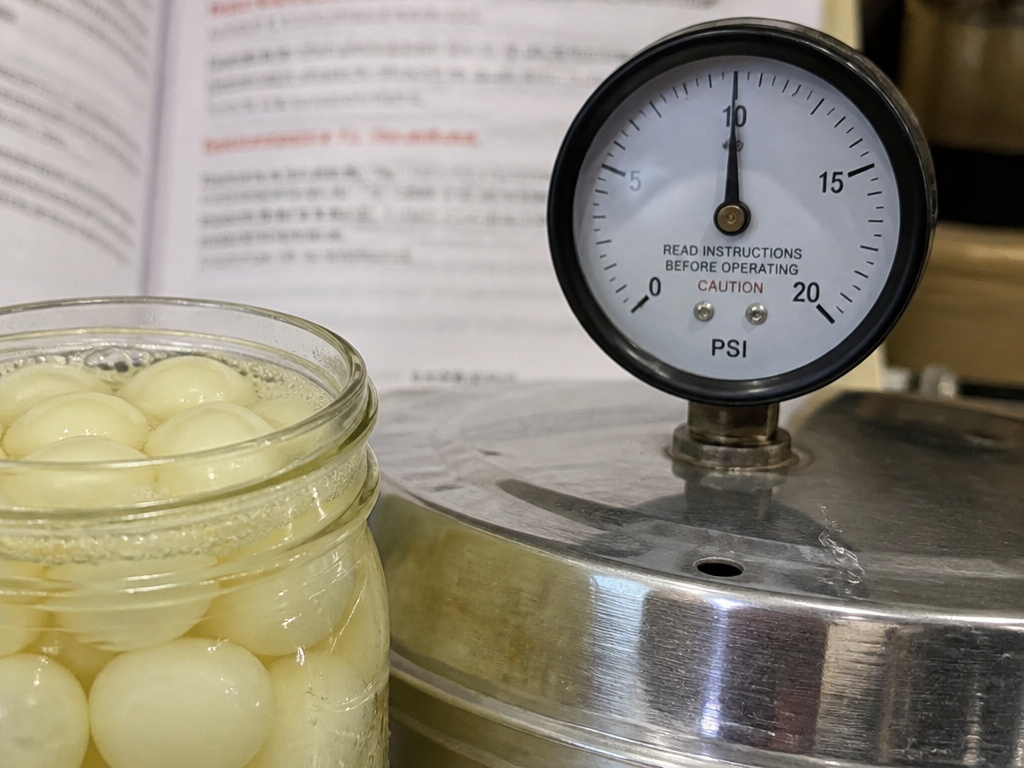
Canning low-acid vegetables like onions carries a real botulism risk. The only safe method is pressure canning. The Ohio State onion storage guide directs readers to research-tested recipes for this reason.
If you proceed, you must use a tested process from a source like the National Center for Home Food Preservation. Generally, you pack peeled onions 1-inch in diameter or less into jars, cover with boiling water, and process in a pressure canner at the correct PSI for your altitude for a specified time. This is not a beginner project.
Most home preservers find that the effort and risk outweigh the reward, especially when freezing onions and dehydrating are simpler and safer. Canning is best left for high-acid pickled onion recipes, where vinegar creates a safe environment for water-bath processing.
Which Onion for Which Job?
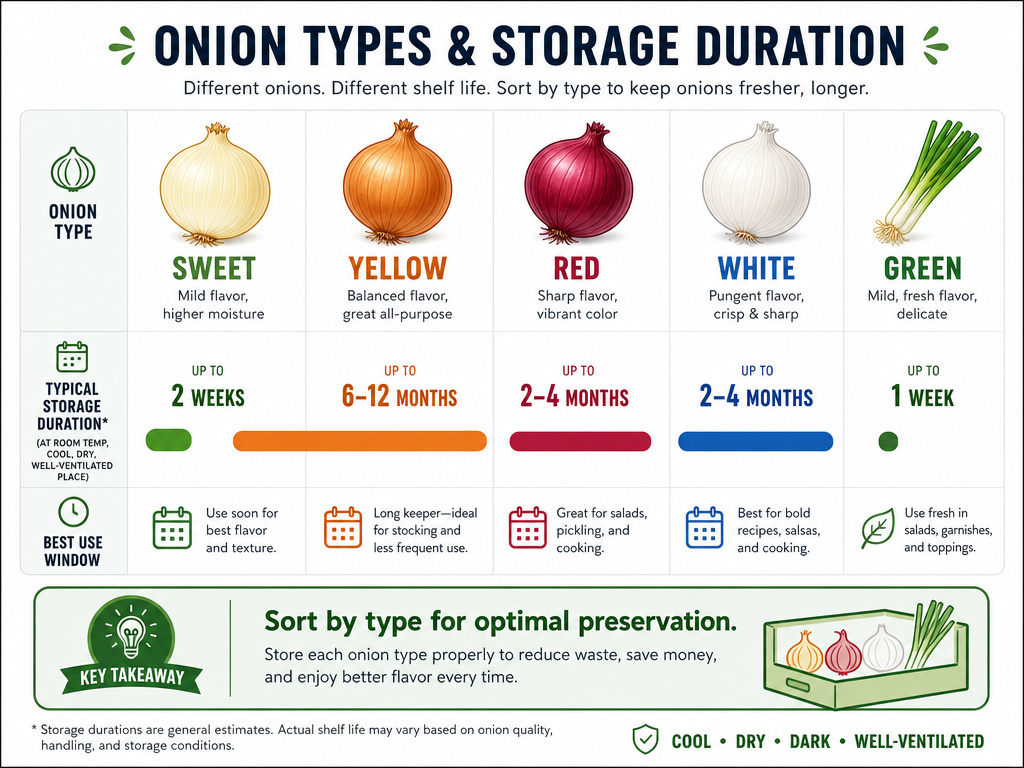
Not all onions store the same. Your storage plan must account for the onion’s natural chemistry. Pungent yellow and red storage onions have lower water content and more sulfur compounds, which act as natural preservatives. Sweet onions are the opposite.
- Sweet Onions (Vidalia, Walla Walla, Maui): High water content, low pungency. These are eating onions, not storing onions. Plan to use them within a couple of weeks. They are prime candidates for immediate use or freezing.
- Yellow Storage Onions: The workhorse. With proper curing and storing onions, these can last 6-8 months in ideal conditions.
- Red Onions: Slightly higher moisture than yellow storage types. They keep well for 3-4 months.
- White Onions: Often milder. Treat them like red onions, a medium-term storage option.
- Green Onions (Scallions): A completely different beast. Keep them cold and moist in the fridge, wrapped in a damp paper towel inside a plastic bag. They’ll last about a week.
When you bring a haul home, sort them. Set the sweet onions on the counter for first use. Send the firm, pungent yellow ones to your best onion storage spot.
The One Mistake That Ruins Stored Onions
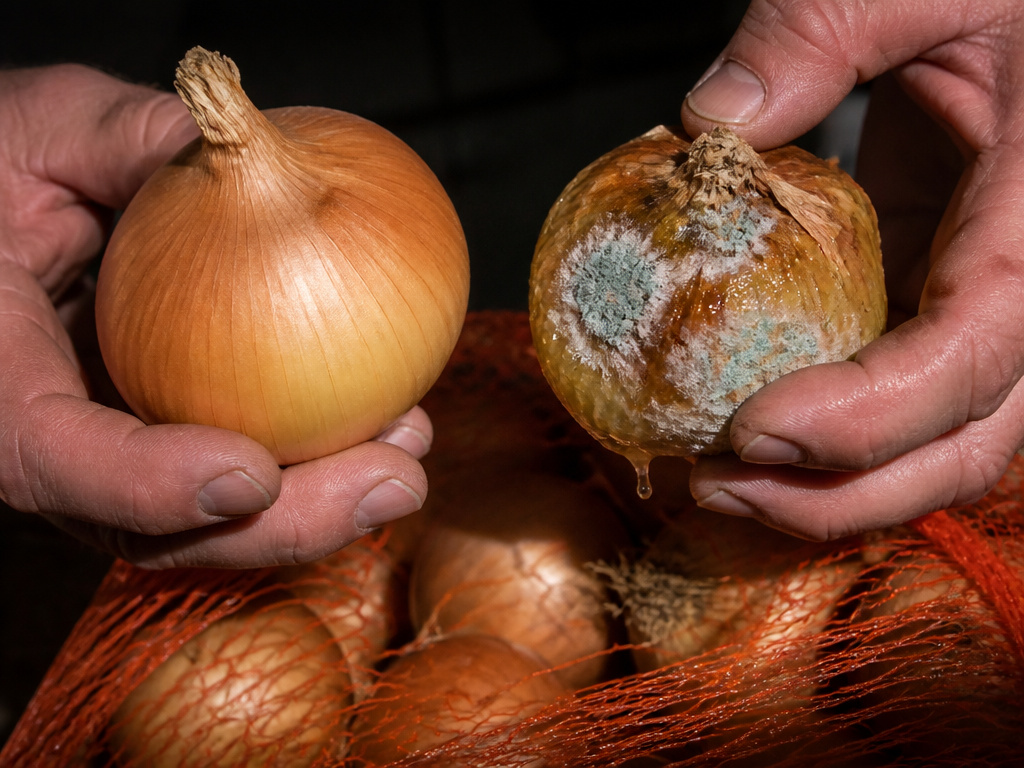
It’s not temperature. It’s not humidity. It’s inspection neglect.
You set up a perfect basement storage environment. You forget about the bag for two months. When you open it, a third of the onions are soft and leaking, and a fuzzy blue mold has spread to the ones touching them. The entire batch is trash.
The fix is a calendar reminder. Every two weeks, feel your stored onions. Any that have lost their rock-hard firmness get pulled immediately. Use them right away, or chop and freeze them. This simple habit doubles the effective life of your stash. It’s the difference between throwing away a few onions and losing the whole harvest.
Frequently Asked Questions
Can you store onions and potatoes together?
No. This is a classic storage error. Potatoes release moisture and ethylene gas, which causes onions to sprout and rot faster. Keep them in separate, well-ventilated containers in the same cool area. For more on storing root vegetables together, we have a dedicated guide.
How long do chopped onions last in the fridge?
Chopped or sliced onions last 7-10 days in a sealed container in the refrigerator. The cut surface will dry out, so use them within a week for best quality. For leftover onion storage, a glass container is better than plastic.
Why did my stored onions get translucent and mushy?
This is called translucent scale. It often happens when there’s a 3-4 week delay between curing and getting onions into cold storage. The outer scales break down, looking water-soaked. It resembles freezing injury. The onion is still safe to cook with but won’t store further.
Is it safe to preserve onions in oil?
No. Mixing low-acid vegetables like onions or garlic with oil and storing them at room temperature creates an ideal, oxygen-free environment for botulism bacteria to grow. If you want flavored oil, make it fresh, use it immediately, and store any leftovers in the fridge for no more than 4 days.
What’s the best container for storing whole onions?
Mesh bag, a wire basket, or a wooden crate. Anything that allows maximum air circulation. Never use sealed plastic bags or airtight bins, they trap moisture and ethylene gas, speeding up decay.
Before You Go
Preserving onions comes down to controlling water and temperature. Get the dry bulbs into a cool, dark, airy spot and check on them. For longer keeps, freeze what you’ll cook with or dehydrate slices into pantry staples.
The default pick for most households is a simple mesh bag in a cool pantry, combined with freezing any surplus chopped onions on a tray. That system handles a 10-pound bag without waste. If you grow your own, prioritize curing them thoroughly, it’s the step that makes everything else possible.
