Learn How to Preserve Tomatoes: Key Rules for Safe Canning
This post contains affiliate links. As an Amazon Associate, we earn from qualifying purchases.
To preserve tomatoes, you must acidify them before canning, add 2 tablespoons bottled lemon juice or 1/2 teaspoon citric acid per quart. This non-negotiable step ensures a safe pH to destroy botulinum toxin risk. Frozen tomatoes, however, need no added acid. Your choice between canning and freezing hinges on texture: canned holds shape, frozen turns limp for sauces.
That acid rule is the single biggest shift in home food safety in the last decade. Older guides sometimes treated tomatoes as acidic enough on their own. Modern hybrid varieties have lower natural acidity, so the blanket acidification mandate from every university extension service now overrides vintage cookbooks. Skip it, and you are canning a low-acid vegetable with the same botulinum risk as green beans.
What follows: the exact acid math, the two canning methods dissected, the freezer shortcut that bypasses the chemistry, and the three physical signs that a jar has spoiled.
Key Takeaways
- Acidify every jar. For canning, add 2 tablespoons bottled lemon juice or 1/2 teaspoon citric acid per quart of tomatoes. This is mandatory, not optional.
- Freezing needs no acid. The cold stops microbial growth without pH adjustment. Frozen whole tomatoes become limp, plan to use them only in cooked sauces.
- Reprocess within 24 hours. If a jar doesn’t seal after cooling, you can empty it, reheat the contents, and process with a new lid within one day. After that, destroy it.
- Headspace is a measurement, not a guess. Use 1/2 inch for a boiling water canner; use 1 inch for a pressure canner. Overfilling prevents the vacuum seal from forming.
- Never can tomatoes from dead vines. Frost-killed plants alter the fruit’s acidity. The pH can drift into the danger zone regardless of added lemon juice.
Canning vs. Freezing: Which Method Wins?
You are not just picking a storage method. You are choosing between shelf-stable convenience and peak flavor preservation. Canned tomatoes sit in your pantry for a year. Frozen tomatoes live in your freezer for up to 12 months. The difference is in the texture and the safety steps.
The part nobody mentions: Freezing may either strengthen or weaken seasonings like garlic and herbs. A sauce that tasted balanced on cooking day can taste sharp or bland after a month in the freezer. Season after thawing, not before.
Canned tomatoes keep their shape. The heat processing softens them, but a whole canned tomato still looks like a tomato. This is the hot-pack versus raw-pack decision. Hot-pack means simmering the tomatoes briefly before jarring, they shrink, so you fit more in a jar and get less floating fruit. Raw-pack means packing raw, peeled tomatoes into the jar and covering them with boiling water or juice. Raw-pack is faster but yields a looser pack with more floating. For most home cooks, the Texas A&M AgriLife Extension guide recommends hot-pack for better quality.
Frozen tomatoes lose all structural integrity. The ice crystals rupture cell walls. Thawed, they are a watery pulp. That is perfect for sauce, terrible for a salad. The Michigan Fresh: Using, Storing, and Preserving Tomatoes publication confirms you do not need to blanch before freezing if you are tray-freezing whole tomatoes. For freezing tomatoes, the bag method is simpler.
| Method | Best For | Safety Step | Final Texture |
|---|---|---|---|
| Canning | Salsas, whole tomatoes, juice | Acidification + heat processing | Holds shape, softer |
| Freezing | Sauces, soups, pastes | None required | Limp, watery pulp |
The Non-Negotiable Safety Step: Acidification
This is not a flavor tip. It is a public health requirement. Tomatoes border the pH 4.6 threshold that separates high-acid from low-acid foods. Newer varieties often fall on the wrong side of that line. The only way to guarantee safety is to force the pH down with added acid.
Tomatoes and tomato products must be heat processed to destroy microorganisms that cause spoilage. Because of the variation in tomato varieties, acid must be added to all jars of canned tomatoes and tomato juice before processing to ensure safety. – OSU Extension Service
The math is fixed: 2 tablespoons of bottled lemon juice or 1/2 teaspoon of citric acid per quart. For pints, cut it in half. You add it directly to the empty jar before filling, or stir it into the tomato product in the pot. Bottled lemon juice has a standardized acidity; fresh lemon juice does not. Do not substitute.
What happens if you skip it? The jar might still seal. The contents might look normal for months. But if the pH was above 4.6, Clostridium botulinum spores can survive the boiling water bath and produce toxin in the anaerobic jar environment. You cannot see, smell, or taste botulinum toxin. This is why the OSU Extension canning publication states that any spoiled product should be treated as potentially toxic and destroyed.
Green tomatoes are more acidic than ripe ones, so they are safe to can, but you still add the same amount of acid. Do not can tomatoes from dead or frost-killed vines. The plant’s death changes the fruit’s metabolic process, and the acidity can become unpredictable.
Equipment: Your Canner is a Precision Tool
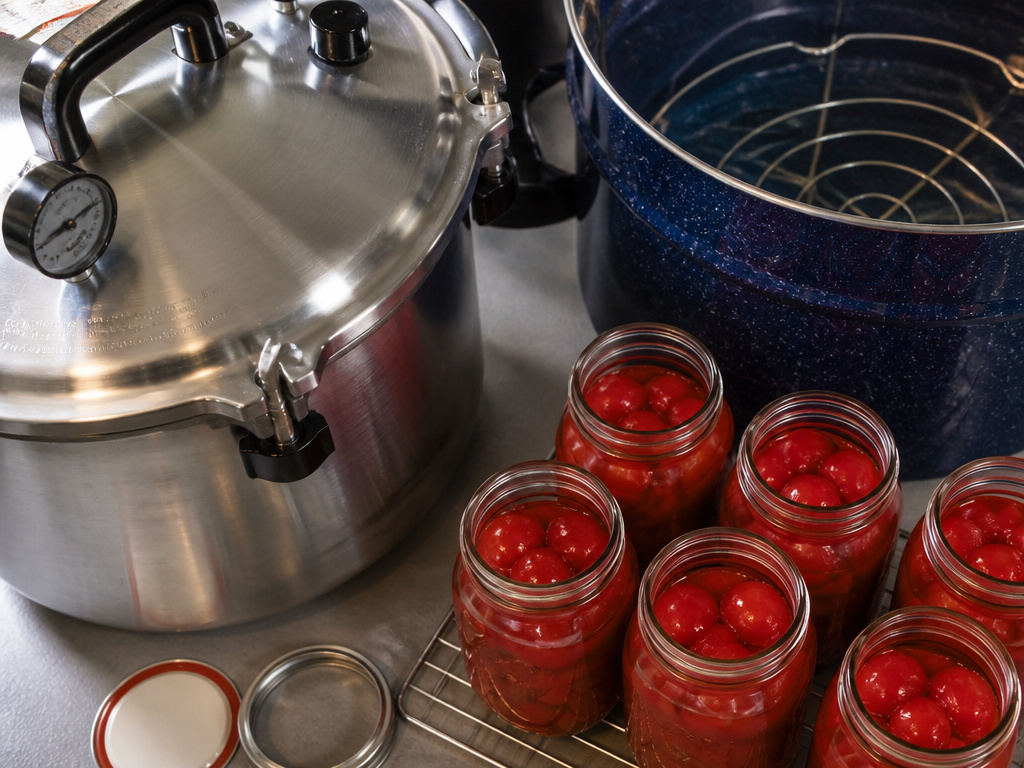
A boiling water canner is a large pot with a rack. A pressure canner is a sealed vessel that heats water under pressure to reach temperatures above boiling. You can process tomatoes in either, but the rules change.
Boiling Water Canner
- Must be deep enough to submerge jars by at least 1 inch of water.
- Processes at 212°F (100°C) at sea level.
- You must adjust processing time for altitude, add 5 minutes for every 1,000 feet above sea level.
Pressure Canner
- Required for low-acid vegetables, optional for tomatoes.
- Processes at 240°F (116°C) or higher, which better preserves nutrients and color.
- You must adjust pressure, not time, for altitude.
The NDSU canning and freezing guide provides tables for both. If your dial-gauge pressure canner hasn’t been tested for accuracy in the last year, do not use it for canning. A weighted gauge only needs cleaning.
Jars must be standard mason jars. Lids are single-use. Bands can be reused if they are not rusty or bent. This is the same basic equipment used for preserving vegetables like carrots or beans.
Step-by-Step Canning Walkthrough
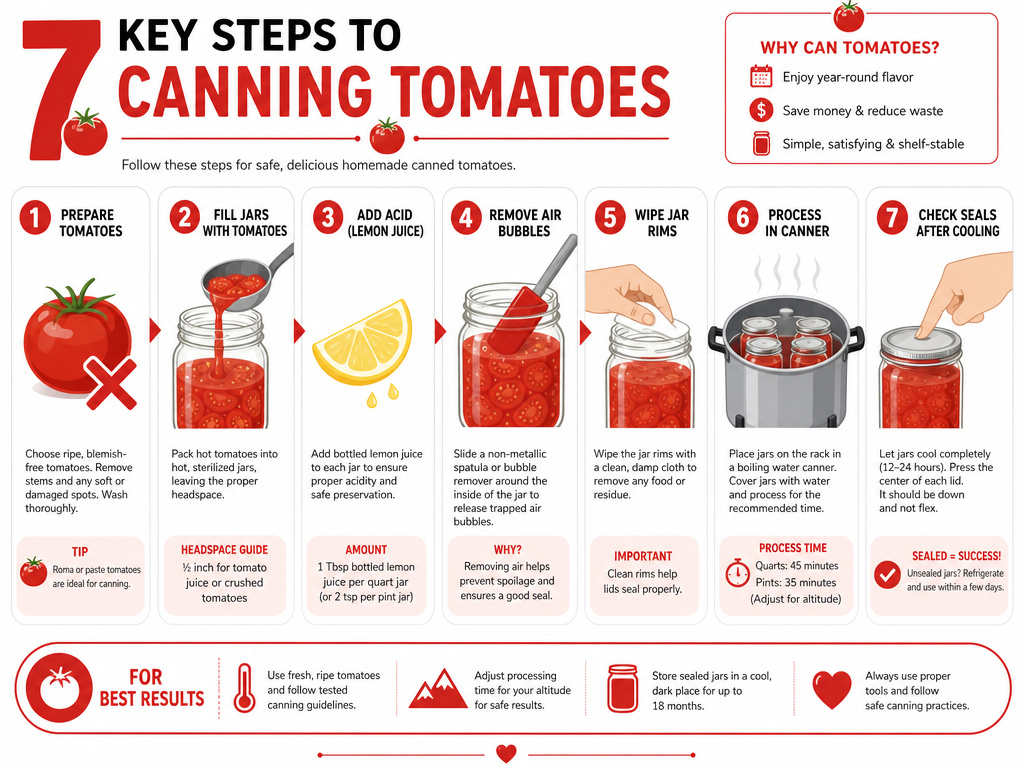
Follow this sequence. Deviating on timing or order risks an unsealed jar or spoilage.
1. Prepare the Tomatoes
Wash them. Core them. To peel, score an X on the bottom and dip in boiling water for 30-60 seconds until the skins split. An ice bath stops the cooking and lets the skins slip off. This step is identical for preserving cherry tomatoes.
2. Pack the Jars
Hot-pack: Simmer peeled tomatoes for 5 minutes, then pack them into hot jars. Raw-pack: Pack raw, peeled tomatoes into hot jars. Leave 1/2 inch of headspace for a boiling water canner. Leave 1 inch for a pressure canner. This gap allows for expansion during processing and creates the vacuum.
3. Add Acid and Salt
Pour the measured lemon juice or citric acid into each jar. Salt is for flavor only, add 1/2 teaspoon per pint if you want it.
4. Remove Air Bubbles
Run a plastic spatula around the inside of the jar. Trapped air lifts the headspace and can prevent sealing.
5. Wipe the Rim, Apply the Lid
Any food particle on the jar’s sealing surface breaks the seal. Wipe with a damp cloth. Apply the lid and screw the band on fingertip-tight, snug, not cranked.
6. Process
Lower jars into the canner. Process for the time listed in your recipe, adjusted for altitude.
7. Cool and Test
Let jars cool on a towel for 12-24 hours. Press the center of the lid; it should be concave and not move. Remove the bands for storage. If a lid pops up, you have 24 hours to reprocess.
Freezing Tomatoes: The No-Fuss Alternative
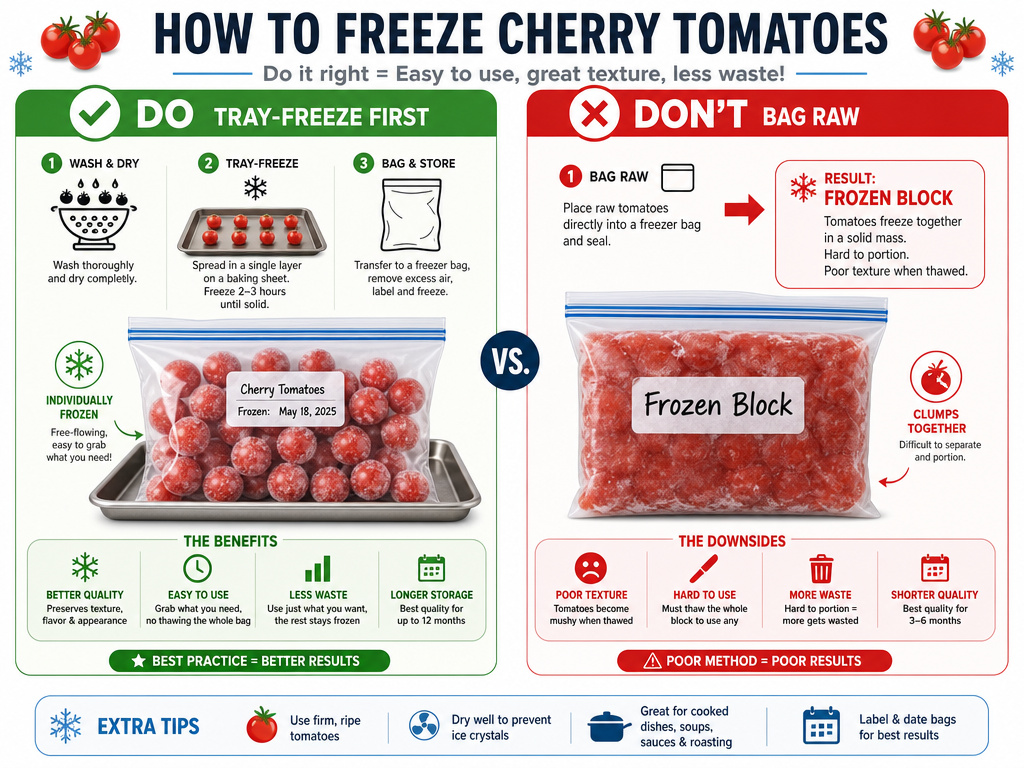
Canning is chemistry and heat. Freezing is physics and cold. The freezer stops all microbial activity in its tracks, so you skip the acid, the peeling, and the precise timing. You trade shelf space for simplicity.
Where this goes sideways: Freezing whole tomatoes without blanching on a tray first. If you bag them raw, they freeze into a solid brick. You cannot chip off a cup for sauce. You thaw the whole block.
Tray-Freezing (for whole tomatoes)
- Wash and core tomatoes. No need to peel.
- Spread them in a single layer on a baking sheet.
- Freeze until solid (about 4 hours).
- Transfer to a freezer bag, removing as much air as possible.
This method is perfect for cherry tomato preservation. Once frozen, they are like little marbles you can pour from the bag.
Freezing for Sauce
- Cook your sauce completely.
- Cool it to room temperature.
- Portion into freezer bags or containers, leaving 1 1/2 inches of headspace for expansion.
- Lay bags flat to freeze for efficient storage.
Frozen tomato products are best used within a year. This is a core food preservation technique that also works for preserving fruit like berries.
Diagnosing Spoilage: The Three Signs You Cannot Ignore
A sealed jar is not a forever guarantee. Storage temperature swings, initial underprocessing, or a microscopic jar flaw can lead to spoilage over months.
1. The Broken Seal
The lid is no longer concave. It moves when pressed. If this happens days or weeks after canning, do not open it. The contents are spoiled. Treat it as a biohazard and dispose of the entire jar.
2. Visual Corruption
Look for: * Cloudy liquid (should be clear). * Bubbles rising through the jar (fermentation). * Mold on the surface or underside of the lid (often white or fuzzy). * Unnatural color (grey, pink, or black discoloration).
3. Off Odors and Texture
Upon opening, if the smell is sour, cheesy, or simply “off,” do not taste it. Spoiled tomatoes can host Bacillus coagulans, which causes “flat-sour” spoilage, the product tastes sour but shows no gas bubbles. It is not botulinum, but it is still unsafe.
If you see any sign, destroy the contents so no person or animal can consume them. Clean the jar thoroughly with bleach solution if you wish to reuse it. This vigilance is the final, personal layer of safety beyond the recipe.
Frequently Asked Questions
Do I have to peel tomatoes before canning?
Yes, for whole, halved, or crushed canned tomatoes. The skin is tough and can harbor bacteria. For freezing, you do not need to peel if you are making sauce, the skins will soften during cooking.
Can I use my own tomato sauce recipe for canning?
Only if it is a tested, research-based recipe from a university extension or the USDA. Adding onions, peppers, celery, or mushrooms lowers the overall acidity. You must then process the sauce as a low-acid vegetable in a pressure canner for a longer time. When in doubt, freeze the sauce.
Why did my jars break in the canner?
Thermal shock. Jars must be hot when filled with hot product. Placing a hot jar on a cold counter or putting a room-temperature jar into boiling water causes stress cracks. Always preheat your jars in simmering water before filling.
How long do canned tomatoes last?
For best quality, eat them within one year. They are safe indefinitely as long as the seal holds, but color, flavor, and nutrient levels decline after 12-18 months. This is the same shelf-life principle for storing sun-dried tomatoes.
Can I preserve tomato seeds from my garden?
Yes, but that is a separate fermentation process to remove the gelatinous seed coat. See our guide on saving tomato seeds for the specifics. Do not try to can seeds inside the fruit.
What’s the best way to store fresh tomatoes short-term?
Keep them at room temperature, stem-side up, out of direct sunlight. Do not refrigerate until they are fully ripe, as cold damages texture and flavor. For more, read our article on keeping tomatoes fresh.
Before You Go
Preserving tomatoes is a choice between the pantry and the freezer, each with its own rulebook. The canning rulebook is written by food scientists, acidify, measure headspace, process for the exact time. The freezer rulebook is written by physics, chill fast, store airtight, use within a year. Both methods beat watching a summer harvest rot on the counter.
Your next step: pick your method. If you have a canner and want shelf-stable jars, follow the acid math to the letter. If you have freezer space and want simplicity, tray-freeze whole tomatoes or bag cooked sauce. Either way, you are turning a seasonal glut into a year-round staple. That is the whole point of fundamental preservation, making plenty today feed you tomorrow.
