
How Smoking Preserves Meat: The 3 Mechanisms You Must Know
This post contains affiliate links. As an Amazon Associate, we earn from qualifying purchases.
Smoking preserves meat through three simultaneous actions: heat kills bacteria on the surface, antimicrobial chemicals in the smoke inhibit microbial growth, and the drying action of the warm, moving air removes the moisture bacteria need to survive. The preservative effect is almost entirely a surface phenomenon, smoke does not penetrate deeply.
That surface-level action is where the real decisions live. The type of smoking you choose dictates the level of preservation you actually get, and a wrong turn on temperature or humidity turns a preservative method into a bacterial incubator.
What follows breaks down the three mechanisms with the specific temperatures and chemicals that drive them, the documented failure modes that ruin smoked meat, and the one storage rule that commercial processors follow and home smokers often miss.
Key Takeaways
- Smoking is a surface treatment. Its preservative power does not reach the center of a thick cut without help from curing salt.
- Low humidity during hot smoking can dry microbes instead of killing them. Rehydration later makes them viable again, a specific risk with jerky and thin fish.
- Cold-smoked fish carries a persistent Listeria risk because the process never reaches a kill temperature. No amount of smoking time eliminates it without a final cook.
- Biogenic amines, compounds like tyramine and putrescine, can spike during smoking, especially between 20°C and 50°C. They cause headaches in sensitive people even if the meat is technically safe from pathogens.
- Always store ready-to-eat smoked products at or below 4°C (40°F) unless you have performed shelf-stability testing. Cured and smoked meats are not inherently shelf-stable.
The Three Preservation Mechanisms of Smoke
Smoke is not a magic bullet. It works through three distinct physical and chemical processes that, together, create a hostile environment for spoilage microbes on the meat’s surface. Missing one mechanism compromises the entire effort.
The technical snapshot: Per the K-State Rapid Response Center, preservation occurs via 1) thermal lethality (time/temperature), 2) antimicrobial compounds (phenols, acids, formaldehyde), and 3) surface desiccation. The FAO Codex PAH reduction standard notes these components play a bacteriostatic and antioxidant role, extending shelf life.
First, heat. Even in traditional cold smoking, the air temperature is rarely ambient. That mild heat begins to denature proteins on the outermost layer of the meat. In hot smoking, where temperatures range from 60°C to over 90°C (140°F to 194°F), the heat is sufficient to kill a broad spectrum of bacteria and parasites. This is why a fully cooked smoked ham is safe to eat without further cooking. The thermal kill step is the most reliable of the three mechanisms, but it requires precise control. Undercook, and pathogens survive.
Second, chemistry. Wood smoke contains over a hundred identified compounds. Among them, phenols and formaldehyde act as natural antimicrobials. Acids, like acetic acid from hardwood smoke, coagulate surface proteins, creating a tighter barrier against new bacterial invasion. These chemicals are why historically, before the roles of heat and drying were fully understood, smoking was thought to “infuse” meat with preservatives. The effect is real, but shallow. The Culinary Institute of America’s technique guide identifies these compounds as key for preventing surface mold and bacterial growth, particularly botulism in cured products.
Third, drying. This is the oldest and most fundamental preservation method. Smokehouses, by design, move warm, dry air across the meat. This airflow carries away moisture. Bacteria need water to multiply; reducing the surface water activity (a_w) puts them in stasis or kills them. The pellicle, that glossy, tacky skin that forms on meat after drying, serves for smoke adhesion and is a dried, protein-rich layer that is far less hospitable to new microbial colonization than wet flesh. This principle is central to all traditional meat preservation, from wind-dried biltong to smoked jerky.
The catch is that these three mechanisms are interdependent. Rely on chemicals alone without drying, and the interior remains wet and vulnerable. Rely on drying without enough heat, and you merely dehydrate surface bacteria instead of killing them. Get the balance wrong, and you have not preserved meat. You have seasoned it for later spoilage.
Cold Smoking vs. Hot Smoking: Temperatures That Decide Safety
The single biggest choice in smoking is temperature. It splits the process into two distinct methods with different safety profiles and end products. The line is not vague.
| Smoking Type | Temperature Range | Primary Goal | Preservation Level | Key Risk |
|---|---|---|---|---|
| Cold Smoking | 18°C – 30°C (64°F – 86°F) | Flavor infusion, mild drying | Low (requires prior curing) | Pathogen survival, biogenic amine formation |
| Hot Smoking | 70°C – 90°C+ (158°F – 194°F+) | Cooking & flavor | High (pasteurizes meat) | Surface overdrying, toxin formation if smoked too long |
Cold smoking is a flavoring and drying step, not a cooking step. The FAO defines it as occurring at approximately 18–25°C (64–77°F). The Institute of Food Technologists states it typically does not exceed 80°F. At these temperatures, no pathogenic bacteria are killed. The meat remains raw. This is why all cold-smoked products must be cured first with salt and often nitrites. The cure penetrates the meat, providing the primary preservative effect by lowering the water activity throughout. The smoke then adds flavor and a secondary surface preservation. This method is how traditional salt curing is finished to produce products like European-style smoked salmon or speck.
Where this goes sideways: Cold smoking raw, uncured meat. Without the protective cure, the low-temperature, high-humidity environment of a smoker becomes an incubator for bacteria like Salmonella and E. Coli. The smoke’s antimicrobials are too superficial to prevent growth in the moist interior.
Hot smoking is cooking with smoke. The FAO classifies warm (hot) smoking at approximately 70–90°C (158–194°F). The IFT gives a wider range of 140°F to 300°F. At these temperatures, the meat is fully cooked and pasteurized. The heat kills pathogens, the smoke adds flavor, and the drying action still occurs. This produces ready-to-eat products like smoked ham, kielbasa, or barbecued brisket. The preservation here is more robust, but it is still not indefinite because the interior moisture, while cooked, is not removed. This is why a hot-smoked ham still requires refrigeration, unlike a fully dried jerky.
The preservation outcome is decided before you light the wood. Choose cold smoking for a cured, raw product that needs strict refrigeration. Choose hot smoking for a cooked product that is safer but still perishable. Confusing the two is how people get sick.
The Hidden Risks: What Smoking Does NOT Preserve Against
Smoking creates a stable surface environment. It does not create a sterile product. Several real hazards persist, and most home-smoking guides gloss over them in favor of simplistic “low and slow” mantras.
Biogenic amine formation. This is the most overlooked chemical risk. A 2023 peer-reviewed study in MDPI tracked traditional dry-cured chorizo smoked with oak for 14 days. Total biogenic amines, compounds like tyramine and putrescine, jumped from 126 mg/kg to 1,385 mg/kg. The smoking process, with its ideal temperatures between 20°C and 50°C, created a perfect environment for bacterial decarboxylase enzymes to convert amino acids into these amines. While still below the oral toxicity limit (2,000 mg/kg), such levels can trigger migraines, hypertension, and allergic reactions in sensitive individuals. The study concluded the amines are highly temperature-stable and will not break down in subsequent cooking. Your smoked sausage might be free of Salmonella but packed with headache-inducing tyramine.
Pathogen survival in cold-smoked fish. The Nova Scotia Department of Agriculture factsheet is blunt: there is no known control measure to eliminate Listeria monocytogenes on cold-smoked fish unless it is cooked by the consumer. The salt levels reached in typical cold-smoked salmon are not high enough to inhibit this hardy bacterium, and the smoking temperatures are too low to kill it. The product is essentially a raw, flavored fish that has been exposed to warm air for hours. This is a critical food safety consideration for preserving fish, often missed in rustic “survival” smoking techniques.
The low-humidity drying trap. Smoking at very high temperatures in a dry environment can be deceptive. The surface of the meat dries rapidly, forming a hard crust. Microbes on the surface are not necessarily killed; they can be desiccated and enter a dormant state. If that product is later stored in a humid environment or vacuum-sealed, moisture re-enters the surface layer. Those dormant microbes rehydrate and become viable again, leading to spoilage or illness. This is a particular risk with homemade jerky and thinly sliced smoked fish. The Nova Scotia guide explicitly warns against this and recommends controlling humidity during hot smoking.
Common mistake: Assuming a thoroughly dried, dark exterior means a safe product. It might just mean you’ve created a microbial time capsule.
These are predictable outcomes of the smoking environment. Treating smoke as a universal preservative ignores its specific limitations.Your best defense is knowing what it cannot do.
Step-by-Step: How to Smoke Meat for Actual Preservation
If your goal is extended shelf life, not just flavor, the process must be designed around the three mechanisms and the hidden risks. This sequence prioritizes safety.
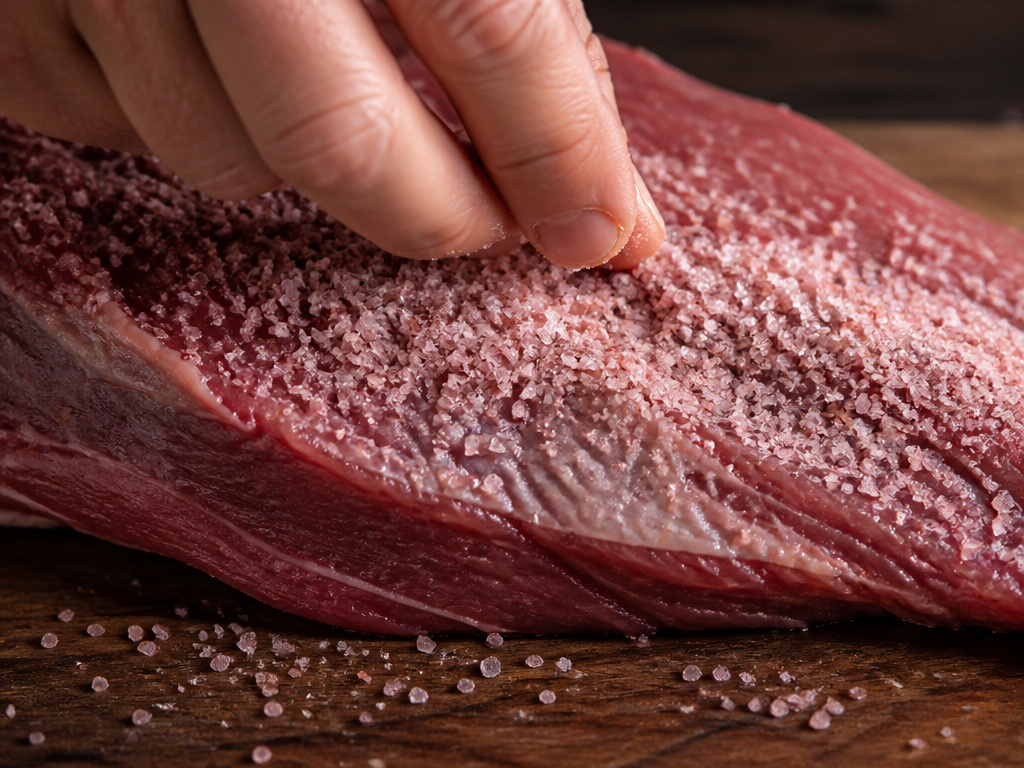
Step 1: Cure the Meat (Non-Negotiable for Cold Smoking, Recommended for Hot)
Curing with salt, either as a dry rub or a brine, is the foundation. Salt penetrates, drawing out moisture and creating an interior environment hostile to bacteria. For cold smoking, this is your primary preservative. Use a tested recipe with precise salt percentages. Skipping this because you plan to “smoke it long enough” is how historical meat preservation failed before the science was understood. The Oklahoma State University meat curing fact sheet confirms that even cured products have a limited refrigerated shelf life of about 30 days, underscoring that curing alone is not forever preservation.
Step 2: Form the Pellicle
After curing and rinsing, air-dry the meat uncovered in a refrigerator for 4–12 hours. A fan helps. The goal is a dry, tacky surface. This pellicle allows smoke compounds to adhere and begins the drying preservation mechanism. A wet surface repels smoke and remains a bacterial playground.
Step 3: Choose and Control Your Smoke
Select hardwood chips or chunks (hickory, oak, apple). Avoid softwoods like pine or spruce; their resins impart a bitter taste and can introduce undesirable compounds. Generate smoke at a high temperature (between 600°F and 650°F, per IFT) to ensure clean combustion, then route it to your smoking chamber. This minimizes the production of soot and harmful polycyclic aromatic hydrocarbons (PAHs), which the EPA AP-42 smokehouse emission document identifies as a pollutant of concern.
Step 4: Manage Temperature AND Humidity
This is the professional’s secret. For hot smoking, monitor the smoker’s humidity. If the air is too dry, spritz the meat with water or place a pan of water inside the chamber. This prevents the “microbial time capsule” effect. For cold smoking, keep the temperature firmly below 30°C (86°F) and ensure good airflow to carry moisture away. Use a calibrated thermometer. Guesswork here invalidates everything else.
Step 5: Cool and Store with Discipline
Post-smoking, cool the meat rapidly to below 4°C (40°F). The Nova Scotia factsheet mandates this for any ready-to-eat smoked product without shelf-stability testing. Do not let it sit at room temperature to “bloom.” Once chilled, wrap it tightly to prevent rehydration from ambient air. For long-term storage, vacuum sealing and freezing is the only reliable method. The idea that smoking alone creates room-temperature-stable meat is a dangerous myth, akin to misunderstanding the proper storage of dehydrated fruit.
Follow these steps in order. Each one supports the preservation mechanisms and mitigates a known risk. Reverse them, skip one, or guess at a variable, and you are merely cooking with extra steps.
Smoking vs. Other Preservation Methods
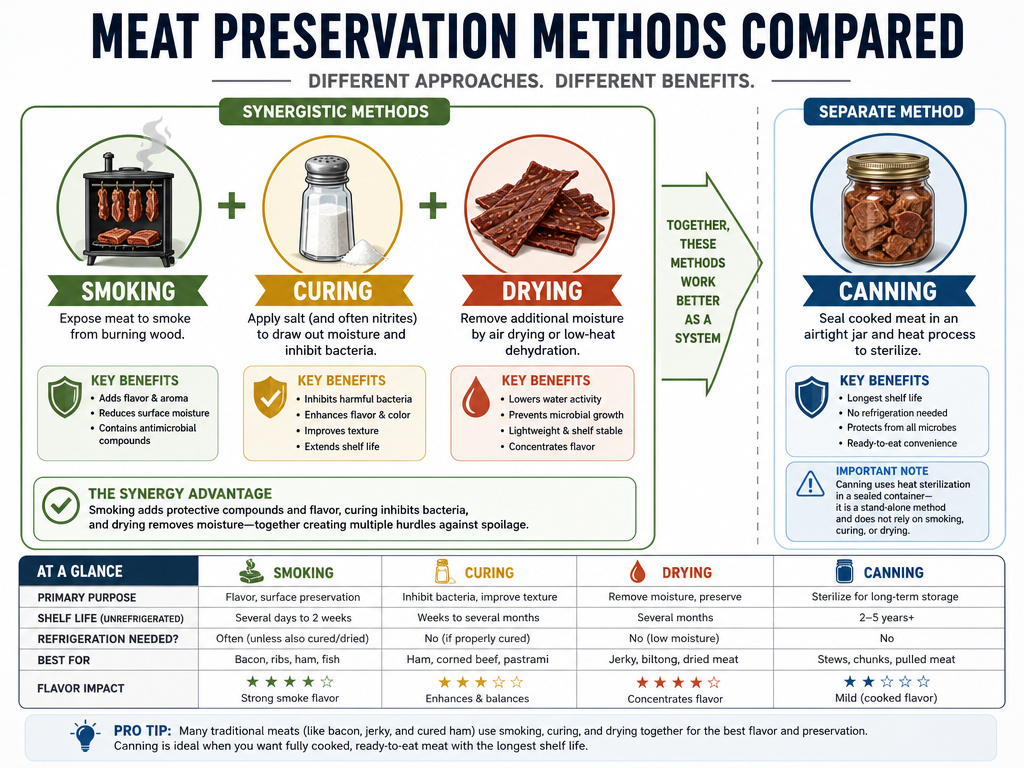
Smoking rarely works alone. It is most effective when combined with other methods. Understanding how it compares clarifies its role in your preservation toolkit.
| Method | Primary Mechanism | Depth of Action | Shelf Life (Refrigerated) | Best Paired With |
|---|---|---|---|---|
| Smoking | Heat, Chemicals, Drying | Surface | Weeks to Months | Curing, Refrigeration |
| Curing (Salting) | Osmosis, Chemical Inhibition | Full penetration | 1-3 Months | Smoking, Drying |
| Drying/Dehydrating | Moisture Removal | Full (if sliced thin) | Months to Years | Salting, Smoking |
| Canning | Thermal Sterilization, Vacuum Seal | Full | 1-5 Years | High-Acid Environments |
Smoking and curing are a classic pair. The cure works from the inside out, the smoke from the outside in. This is the foundation for most traditional charcuterie. Smoking without curing is for flavor only. Curing without smoking is how you make corned beef or salt pork.
Smoking and drying have a natural synergy. The warm, dry airflow of a smoker is an efficient dehydrator. This is how jerky and biltong are made. However, as the earlier risk noted, if the drying is too aggressive at high heat, it can be counterproductive. For true shelf-stable dried meat, a dedicated dehydrator or low-temperature oven following a tested drying method is often safer and more consistent than a smoker.
Smoking is not canning. It does not create a sterile, vacuum-sealed environment. A smoked fish is nothing like a properly sealed canning jar of tuna. Never treat a smoked product as shelf-stable unless you have performed laboratory testing to prove it. The storage rule is simple: when in doubt, refrigerate or freeze.
The bottom line: smoking is a versatile secondary preservation method. It adds a layer of defense and incredible flavor, but it is not a standalone solution for long-term food security. Use it to enhance other methods, not replace them.
Frequently Asked Questions
Does smoking meat kill bacteria?
Hot smoking (above 70°C/158°F) kills bacteria through heat, similar to roasting or baking. Cold smoking (below 30°C/86°F) does not kill bacteria; it relies on prior curing with salt to inhibit microbial growth. The smoke itself has only superficial antimicrobial effects.
How long does smoked meat last?
Refrigerated, a properly cured and hot-smoked meat (like a ham) lasts 3-4 weeks. Cold-smoked products (like salmon) last 2-3 weeks. Vacuum-sealing and freezing can extend shelf life to 2-3 months for optimal quality. These timelines assume constant refrigeration at or below 4°C (40°F).
Can you smoke meat without curing it?
You can hot smoke uncured meat for flavor and cooking, as with a smoked pork butt. However, for any preservation goal, especially with cold smoking, curing is non-negotiable. Uncured, cold-smoked meat is a significant food safety hazard.
What is the “danger zone” for smoking meat?
The temperature danger zone where bacteria multiply rapidly is 4°C to 60°C (40°F to 140°F). Cold smoking operates within this zone, which is why curing is mandatory. Hot smoking must bring the internal meat temperature above 60°C (140°F) as quickly as possible to minimize time in the danger zone.
Is liquid smoke as effective for preservation?
No. Liquid smoke adds flavor but provides none of the drying action and only a fraction of the surface antimicrobial effect. It is a flavoring agent, not a preservation method. Do not rely on it to extend shelf life.
Before You Go
Smoking meat preserves it through a fragile alliance of heat, chemistry, and drying. Its power is real but strictly limited to the surface. The choice between cold and hot smoking is really a choice between a risky, flavor-focused technique and a safer, cooking-focused one. The hidden risks, biogenic amines, surviving Listeria, and improperly dried microbes, are documented in food science literature and government advisories.
For true preservation, always pair smoking with a penetrating cure and disciplined refrigeration. Treat it as the enhancing step it is, not as a magic wand. That mindset is the difference between a delicious, safe product and a risky experiment.
